Product Quality Incident & Recall Template
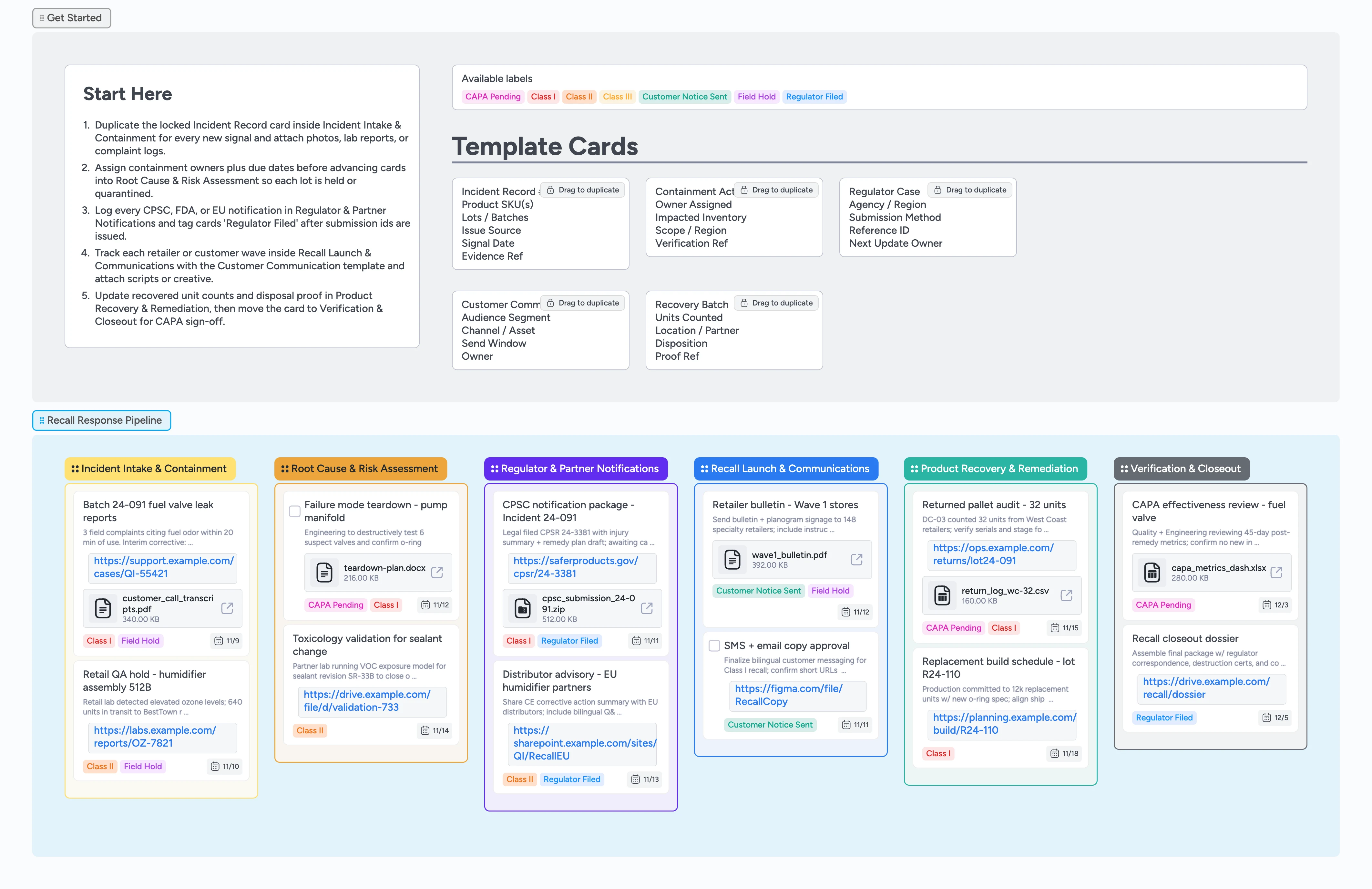
Keep every recall action on one canvas
Instaboard is an online whiteboard app where you organize your work on cards, lists, files and handwriting, alone or live with your team by link. Product issues escalate fast, and scattered spreadsheets slow incident intake, regulator filings, and customer notices when you most need clarity. This template pulls signals, containment checklists, communications, and recovery evidence onto one board: drag a source card to make a fresh copy, assign owners with due dates, move work forward, and keep each proof on the card it belongs to. Legal, quality, and CX teams all see the same live status. Free plan: 5 boards, 150 items, 1 file per board (up to 10 MB); Pro $5/mo billed yearly.
- Drag incident cards through intake, regulator filing, comms, and CAPA lanes without status meetings
- Tag severity labels such as Regulator Filed or Customer Notice Sent, then filter a list by label to surface priorities
- Attach regulator packets, scripts, and destruction proof directly on the cards responsible
- Drag source cards for incidents, containment logs, and recovery batches to make fresh copies so data stays structured
Start with the Incident Intake & Containment lane
Read the Start Here card in the Get Started section, then drag the Incident Record source card in the Incident Intake & Containment list to make a fresh copy for every new signal. Fill in SKU, lot codes, and signal date, then assign the containment owner and due date. Drag the card alongside other open incidents and apply the Class I/II/III plus Field Hold labels so the team sees severity instantly. Attach complaint photos, lab reports, or call logs before handing it to quality.
Drive the root-cause huddle
Move cards into Root Cause & Risk Assessment as soon as containment is live. Use the Containment Action template to log teardowns, lab work, or supplier checks, assigning engineers with clear deadlines. When a teardown requires sequential approvals, add a checklist to the card and assign each gatekeeper by typing @ (Instaboard sends no notification, so tell them). Attach failure analysis decks or VOC models directly to the card so leadership can review evidence without digging through shared drives.
Log regulator filings and partner notices
Drag the Regulator Case source card inside Regulator & Partner Notifications whenever you submit to CPSC, FDA, or EU authorities. Record the agency, submission method, and reference IDs, then apply the Regulator Filed label so you can filter the list by compliance status. Attach the PDF packet or portal receipt directly to the card, and create sibling cards or attachments for distributor advisories so updates stay in one lane. Keep external partners aligned by assigning their owners with @ and logging promised update dates in the description.
Coordinate every customer communication wave
Track each retailer bulletin, call center script, and SMS/email blast in Recall Launch & Communications using the Customer Communication template. Assign CX or marketing owners, set send windows, and drag cards left-to-right as approvals land. Attach creative files, signage, and call scripts so store teams can download them directly from Instaboard. Once a wave ships, add the Customer Notice Sent label and link performance dashboards or press coverage for context. Need a timeline view? Add a Calendar from More and drop those cards on their send days to visualize send dates.
Close the loop with recovery and CAPA
Log every returned pallet or destruction batch in Product Recovery & Remediation with the Recovery Batch card, noting units, locations, and proof files. Attach destruction certificates, warehouse audits, or replacement build schedules so finance and compliance can reconcile volumes. When remedy shipments or reimbursements finish, push the card into Verification & Closeout and tag it CAPA Pending until QA signs off. Summarize regulator correspondence in the card description, attach the final closeout dossier, and flip the CAPA Pending label to complete once leadership approves.
What’s inside
Get Started section
A Start Here card tells you which source cards to drag out first and how to apply severity plus regulator labels for filtering.
Incident Intake & Containment lists
Capture every signal with complaint evidence, assign containment owners, and quarantine lots before moving anything downstream.
Regulator & partner lane
Duplicate the Regulator Case card, fill agency + reference IDs, and attach proof PDFs or portal receipts.
Communications workstation
Store retailer bulletins, SMS/email copy, signage assets, and calendar-ready send windows right on the cards you'll duplicate.
Recovery & CAPA trackers
Log returned units, destruction certificates, replacement builds, and QA verification steps through closeout.
Why this works
- Aligns quality, legal, and CX around the same live recall board
- Links severity labels, owners, and attachments so evidence is never orphaned
- Tracks regulator filings, customer notices, and recovery batches in chronological context
- Closes CAPA loops with repeatable source cards instead of ad-hoc spreadsheets
- Surfaces recall progress fast by filtering lists on Class and Regulator Filed labels
FAQ
Will this work for food, consumer, or medical devices?
Yes. Drag the Incident Record source card once per SKU or lot, adjust the severity labels if needed, and tag each regulator so you can filter a list by product class.
Where does regulator evidence go, and who can see it?
Attach the PDF packet or portal receipt to its Regulator Case card so the file sits next to the status and owner. On the free plan a board is shared by link (anyone with the link can view; editing takes a free sign-in) and holds 1 file up to 10 MB. Pro adds invite-only boards, per-person permissions and files up to 100 MB.
Can we rehearse recalls without confusing live work?
Make a copy of the board for tabletop drills, clear the filled cards, and drag the source cards to simulate actions without touching the production board. On the free plan the copy counts as 1 of your 5 boards.
What if we need a calendar for notice waves?
Add due dates to Customer Communication cards, then add a Calendar from More and drop the cards on their send days.