Travel Guide
Sokcho in 3 Days: Seoraksan Peaks, Waterfalls & Coastal Korea
Want the editable version of this route?
Open the Instaboard template and adapt stops, timing, and notes to fit your trip.
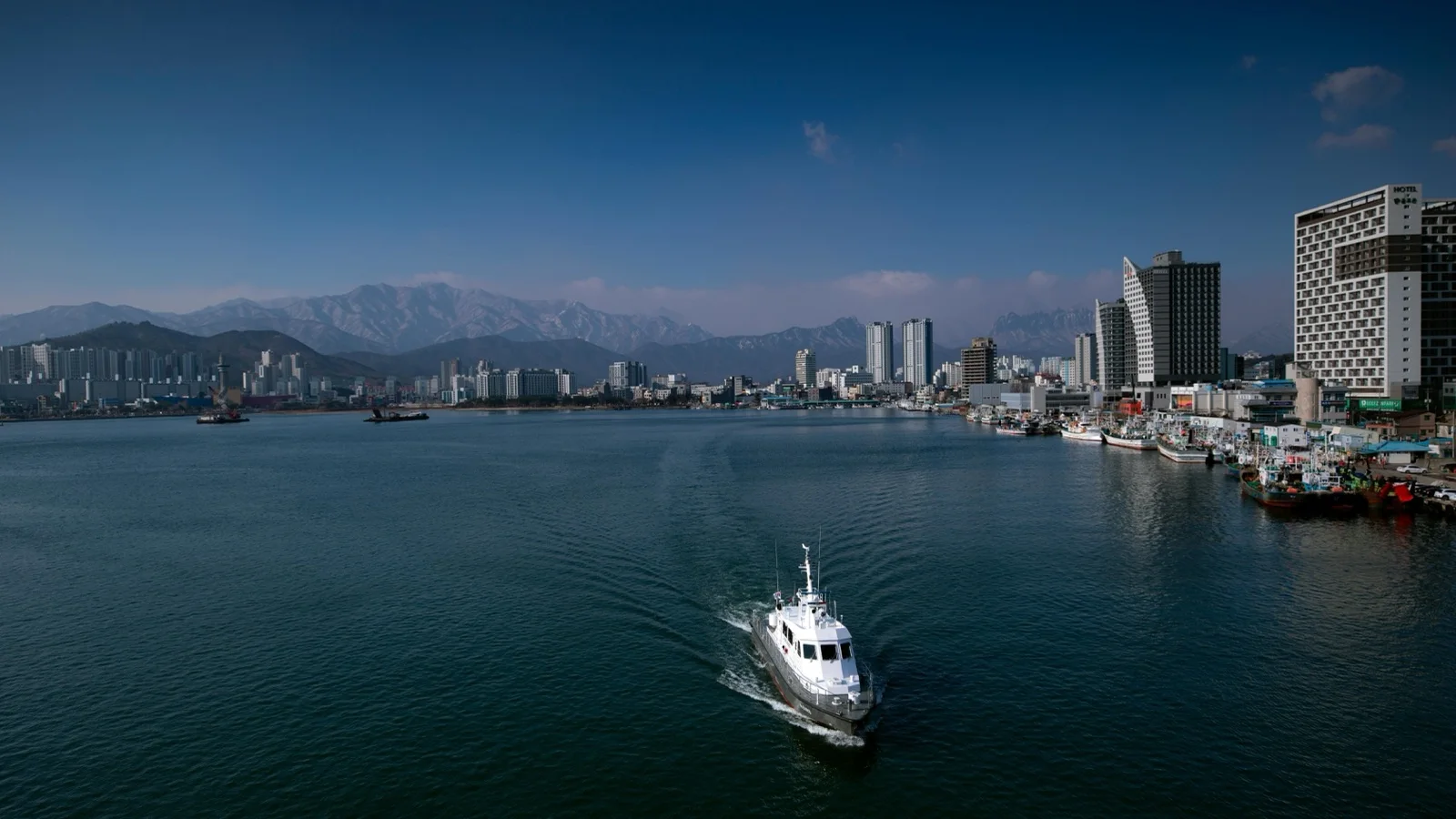
Sokcho is a small coastal city in northeast South Korea where granite mountain peaks rise directly behind white-sand beaches, and the whole thing feels like a place that shouldn't fit together but absolutely does. Three days here is enough to hike one of Korea's best national parks, eat food you can't get anywhere else, and still end up on a beach at sunset, if you get the sequence right.
Shoulder season is the move here. April through June or September through November gives you comfortable temps and thinner crowds on the trails.
Day 1
Day one is the mountain day. Seoraksan National Park, a thousand-year-old temple on the way in, and a granite formation that allegedly fell asleep and never showed up to its own destination.
Seoraksan National Park
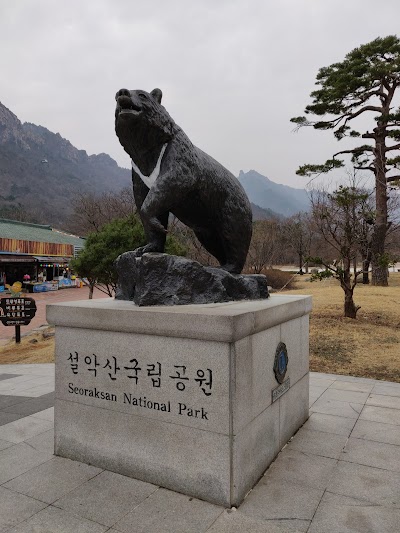
Seoraksan is Korea's first national park, designated in 1970, with dramatic granite spires, dense forest valleys, and trails ranging from flat boardwalks to leg-breaking summits, all about fifteen minutes from downtown Sokcho. This is probably why you came here. If you skip Seoraksan, you skipped the main event. It is consistently ranked among Korea's top three national parks by Korean travelers themselves.
The catch: seasonal fire-prevention closures block peak trails roughly early March to mid-May and mid-November to mid-December. Check the Korea National Park Service site before you commit to a specific hike. Get here right at opening. Morning light in the valley is softer and more photogenic, and you will beat the tour bus groups because the cable car tickets sell out fast on busy days.
Tip: Arrive right at opening to beat the crowd and secure parking. Wear a warm layer. Valley mornings run 10 °C cooler than the city.
Seoraksan Sinheungsa Temple
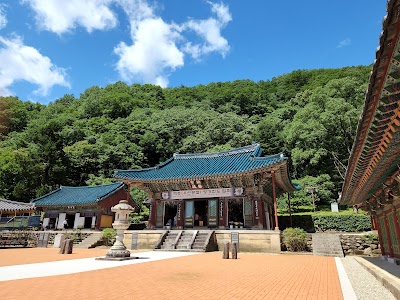
On the way into the park you pass Sinheungsa, a Buddhist temple complex that has been active here for over a thousand years, and it is free, because you would walk through it anyway. The centerpiece is a seated bronze Buddha that is fifteen meters tall and sixty tons, sitting in a clearing with granite peaks behind it. The kind of thing you photograph thinking it won't look impressive, and then it really does.
Incense drifts through forest air, temple bells ring at intervals, and the shaded path from the gate stays cool even on warm days, a genuinely gentle transition into the park before any real hiking starts. Walk the ten minutes from the gate to the Buddha before nine a.m., because by ten-thirty this path turns into a bottleneck from every tour group entering the park.
Tip: Walk ten minutes from the gate to see the bronze Buddha before tour groups arrive. Entry is free and the shaded path is a gentle warm-up.
Ulsanbawi Rock
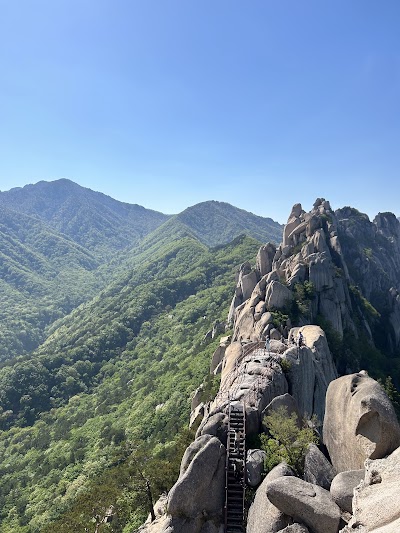
Ulsanbawi is a six-peaked granite formation at the top of an eight-hundred-plus-stair hike, roughly three hours round-trip, and the summit view spans the East Sea on one side and Seoraksan's highest peak on the other. Local folklore says this rock formation was supposed to travel south to the city of Ulsan, near Busan, but stopped to rest at Seoraksan and just never left. A mountain that literally ghosted its destination.
The final ascent is a metal staircase bolted to granite, and at the top the wind hits hard while the view opens up in every direction. Your legs will absolutely remind you they exist. Bring at least a liter of water per person and start early enough to descend before the trail gets dim, because there is no lighting and those stairs are harder going down than up.
Tip: This 3-hour round-trip climb has over 800 stairs. Bring one liter of water per person and start early so you descend before sunset.
Day 2
Day two stays in Seoraksan but shifts gears. A gentle riverside walk to one waterfall, then nine hundred stairs up a cliff face to stare at another waterfall you can't actually reach.
Biryong Falls
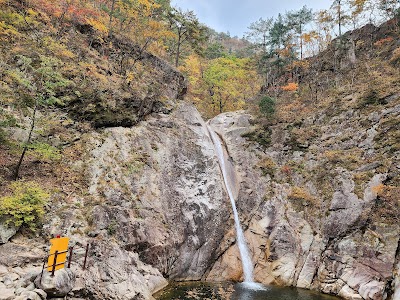
Biryong Falls is a thirty-minute flat walk from the park entrance along a mountain stream. The easy Seoraksan experience, no suffering required. The trail follows a clear stream over a shaded, flat path, and honestly the walk might be better than the destination. It is named 'flying dragon' after local mountain folklore, which is a nice thought while you stroll.
Running water the whole way, mist on the observation deck at the end, and in winter the falls freeze partially into something quietly beautiful. If you are continuing to Towangseong, treat Biryong as your water break, not your destination, because the real climb starts right after this.
Tip: A gentle 30-minute riverside walk from the park entrance. The observation deck gets slippery, so wear good shoes and bring a warm layer in autumn.
Towangseong Falls
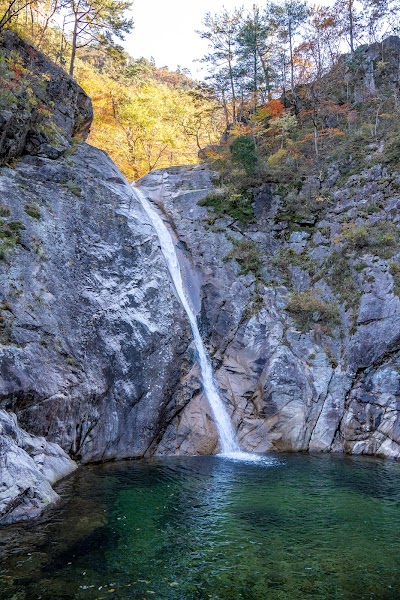
Past Biryong, the trail turns into roughly nine hundred metal stairs going straight up a cliff face. At the top, an observation platform gives you a panoramic view of a three-tier, three-hundred-twenty-meter waterfall across the valley. You never actually reach the waterfall. You watch it from a metal balcony bolted to the opposite cliff, which makes it feel enormous and slightly unreal, like nature's IMAX behind glass.
You hear the waterfall before you see it, and the observation platform sways just enough in the wind to notice. The observatory was specifically built for this view. Nine hundred stairs down is harder on your knees than nine hundred stairs up, so take the descent seriously, and try to avoid weekends when the single-file staircase becomes a traffic jam.
Tip: Climb over 900 stairs past Biryong Falls to reach the 320 m cascade. Go slowly on the descent and avoid the weekend crowd heading up.
Cheongchoho Lake Park
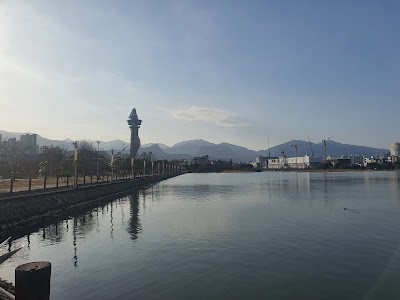
Cheongchoho Lake is a calm lake right in central Sokcho with paved walking paths, boat harbors, and a twisted observation tower from a 1999 expo that looks slightly alien lit up at night. After two days of granite and stairs, flat ground with mountain views and nearby cafes feels like civilization's greatest achievement. This is your decompression.
Evening is the move here because the Expo Tower lights up in changing colors and the Taebaek mountain silhouettes reflect in the lake at dusk. The lakefront cafes stay open late, so walk the paths past the boat harbors toward the tower and grab something warm. You have earned it.
Tip: Wind down with an evening walk on paved lakeside paths past boat harbors and the lit-up Expo Tower. Cafes here stay open late.
Day 3
Day three trades mountains for coast. A dawn sunrise over the East Sea, North Korean refugee food in narrow alleys, and a beach sunset where the mountains you just climbed fill the horizon behind you.
Yeonggeumjeong Sunrise Pavilion
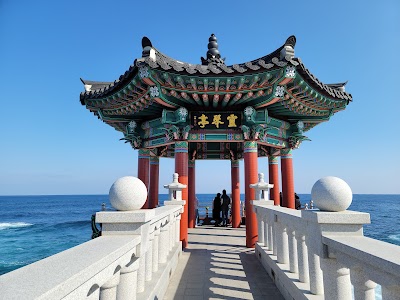
Yeonggeumjeong is a pavilion on a rocky outcrop at the end of a fifty-meter bridge over the East Sea, Sokcho's signature sunrise spot, where waves crash against the rocks and the whole bridge vibrates slightly underfoot. The name references a geomungo, a traditional Korean stringed instrument. Locals say the waves sound like one. Whether you hear the resemblance is debatable, but the wave crash in a quiet dawn is genuinely atmospheric.
As the sun comes up, the silhouette of Seoraksan appears behind the city, the mountains you hiked for two days, now framed by open ocean and salt air. Check Sokcho's sunrise time the night before and arrive about twenty minutes early, because the bridge is narrow and early arrival means a better spot.
Tip: Arrive before dawn to claim a spot on the bridge for sunrise over the East Sea. Bring a warm layer. The ocean breeze is relentless.
Abai Village
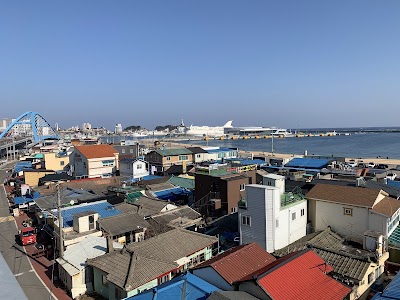
Abai Village is a neighborhood of narrow alleys and small restaurants settled by North Korean refugees who fled south during the Korean War. Their descendants still run many of the food stalls today. The gaetbae is a hand-pulled flatbed ferry: you grab a rope and drag yourself across a narrow canal, which takes about thirty seconds and might be the most memorable thirty seconds of your afternoon.
Steam rising from food stalls, the smell of boiled pork and broth, and the ferry creaking as you pull yourself across. It is tactile in a way most tourist experiences aren't. Withdraw won before you get here because most vendors are cash-only, and try the Abai sundae, a North Korean-style blood sausage that is the reason Korean domestic tourists make the trip.
Tip: Try North Korean-style sundae in the narrow alleys. Most vendors are cash-only so withdraw won in advance. Ride the hand-pulled ferry across the canal.
Sokcho Beach
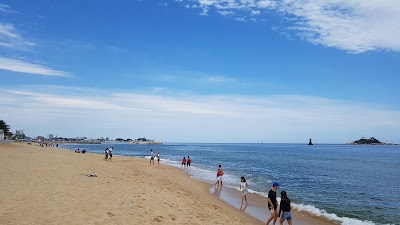
Sokcho Beach is where this trip comes full circle, a white-sand beach along the East Sea with a pine-lined promenade, and Seoraksan's peaks rising behind the city in the same frame. The sunset here is the real event: Seoraksan's silhouette backlit by golden-hour light over the water, the kind of scene that makes you stop walking.
This city was part of the DMZ buffer zone until the nineteen seventies, so its transformation into a beach destination is surprisingly recent. The old fishing harbor is still right nearby. Grab a spot along the pine promenade as the light drops. You spent two days climbing those mountains, and now you are standing on sand looking at them for free.
Tip: Walk the pine-lined promenade or rent a jet ski near the lifeguard tower. The golden-hour light on Seoraksan's silhouette is stunning as sunset approaches.
What to book ahead
- Book Sokcho accommodation (4–6 weeks ahead) - Beachfront hotels and Seoraksan-adjacent minbaks sell out during autumn foliage and summer weekends
- Reserve Seoraksan Cable Car tickets (2 weeks ahead) - Only needed if substituting a hike with the Gwon Geum Seong cable car ride
- Check bus schedules to Sokcho (1 week ahead) - Express buses from Seoul Dong Seoul Terminal run every 30 min; last departure around 9 PM
- Download offline maps (Before departure) - Cell signal is unreliable deep in Seoraksan valleys
What to pack
Essentials
- Sturdy hiking shoes - Rocky, uneven trails with 800+ stone stairs on Ulsanbawi and Towangseong routes
- Layered clothing - Mountain temperatures swing 10–15 °C between valley floor and peaks
- Reusable water bottle - Essential for multi-hour Seoraksan hikes with limited water sources
- Korean won cash - Many market vendors, the Abai Village ferry, and smaller shops are cash-only
Nice to have
- Trekking poles - Reduce knee strain on the 900-stair descent from Towangseong Falls
- Portable charger - Full-day hikes drain phone batteries quickly
- Swimsuit - Sokcho Beach is swimmable from July to early September
Final take
Sokcho packs granite peaks, war-history food alleys, and a sunrise-over-the-sea moment into a city small enough to feel knowable in three days. That is a rare combination.
Plan this trip
Turn this guide into an editable trip plan
Open the route in Instaboard, adjust the stops, and share the itinerary with your travel group.