Biology · Immune system
Clonal selection, explained in four steps
A new germ doesn't teach your body to make a matching antibody. The B cell that fits it already exists. Clonal selection is how your immune system finds that one cell and turns it into an army. Watch the 3-minute lesson, read the notes, then copy the board into your own notes.
By Boardling, from the Instaboard teamLesson 004 · 3:13 videoUpdated
- 0:00True or false: does the antigen teach your body?
- 0:20A real B cell and its receptors
- 0:49Step 1: millions of receptor shapes
- 0:57Step 2: selection
- 1:12Step 3: clonal expansion
- 1:29Step 4: plasma cells and memory cells
- 1:41Why a second infection goes better
- 1:49T cells follow the same rule
- 1:59Your turn
- 2:23Back to true or false
Clonal selection in 30 seconds
- Before any infection you already have millions of B cells, each with one receptor shape, made at random.
- An antigen binds only the B cells whose receptors fit. That's the selection: the antigen picks a cell, it doesn't shape a new one.
- The selected cell divides about 10 times into ~1,000 identical copies, a clone. That's clonal expansion.
- The clone splits into plasma cells (antibodies, up to ~2,000 a second each) and memory cells (last for years).
- A second infection goes faster and stronger because the matching clone is already big.
The notes board from the lesson
This is the board built during the video. Copy it and it's yours: add your own cards, rearrange it, draw on it.
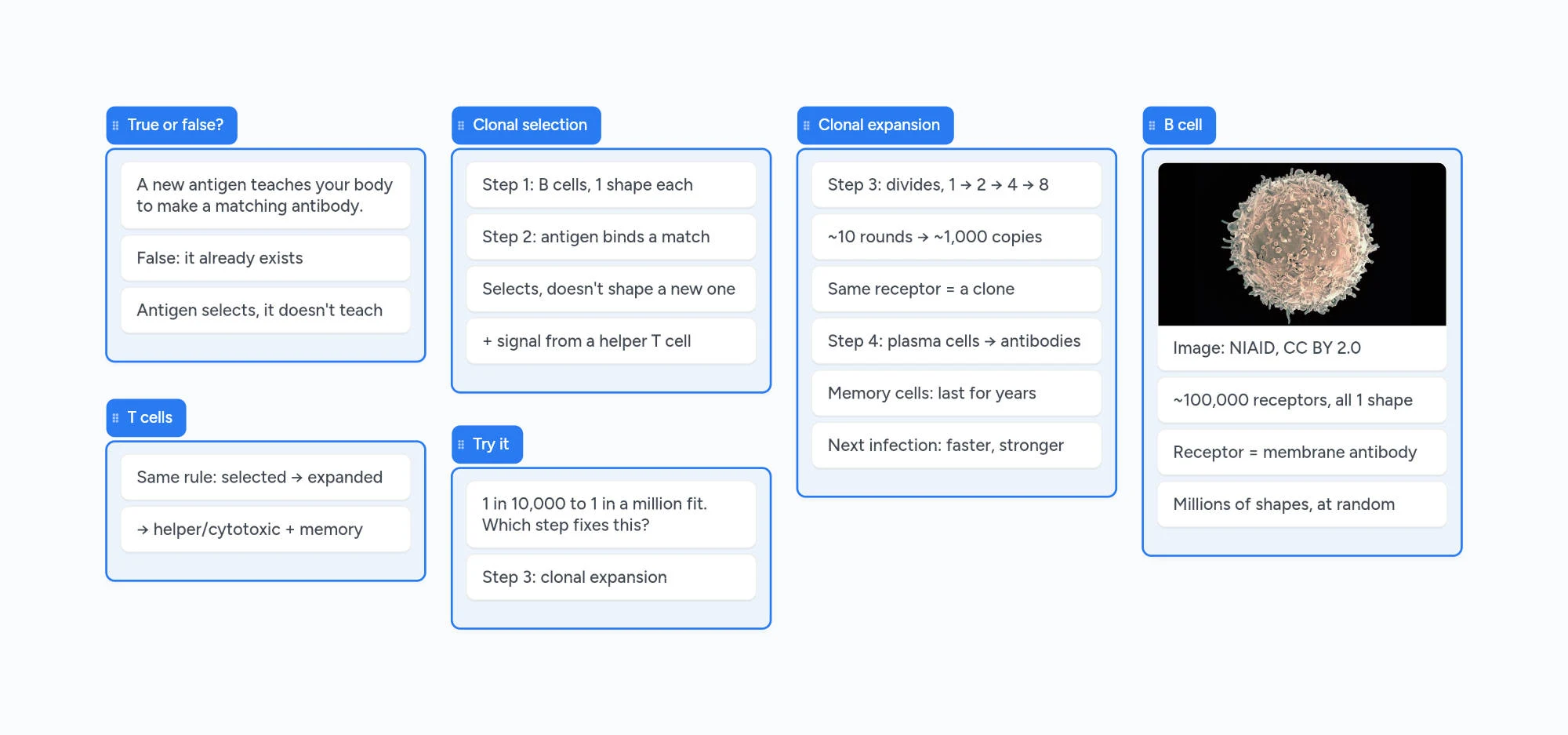
True or false: the antigen teaches your body
In the video at 0:00
"When a new germ gets into your body, it teaches your immune system to make an antibody that fits it." Lots of students say true. It's false. The matching antibody already existed, as a receptor on a B cell, before you ever met that germ.
This idea is called clonal selection. It answers two questions at once: how your body finds an antibody for a germ it has never seen, and why a second infection goes so much better than the first.
A B cell and its receptors
In the video at 0:20
A naive B cell carries around 100,000 receptors on its membrane, and every one of them has the same shape. That receptor is really an antibody, stuck in the membrane (the B cell receptor, or BCR).
Another B cell has receptors of a different shape. Across your body there are millions of different shapes, made at random while the cells develop, long before any infection.
The four steps
In the video at 0:49
Step 1: one shape per cell. Before any infection, you already have B cells with millions of different receptor shapes, one shape per cell.
Step 2: selection. An antigen arrives and binds only the B cells whose receptors fit it. The antigen picks a cell; it doesn't shape a new one. To switch on fully, the chosen B cell usually also needs a signal from a helper T cell.
Step 3: clonal expansion. The selected cell divides again and again: one cell becomes two, then four, then eight. About ten rounds of division turn one cell into roughly 1,000 copies, all with the same receptor. The copies are called a clone.
Step 4: plasma cells and memory cells. The clone splits into two jobs. Plasma cells pump out antibodies, up to about 2,000 every second, and every one fits the same antigen. Memory cells stay behind and can last for years.
Why a second infection goes better
In the video at 1:41
The first time, only a handful of B cells fit the antigen, so the response is slow. The next time, the matching clone is already big (the memory cells), so the response is faster and stronger. This is the idea behind immunological memory and vaccines.
T cells follow the same rule
In the video at 1:49
A T cell whose receptor matches is selected and expanded in the same way. Its copies become effector T cells (helper or cytotoxic, depending on the type) plus memory T cells.
Practice question
Only about 1 in 10,000 to 1 in a million of your B cells fits any new antigen. Which step fixes that problem?
Show the answer
Step 3, clonal expansion. A handful of matching cells is far too few to fight an infection, so the selected cell copies itself until there are enough.
Common mix-ups
The antigen instructs the B cell to make a new antibody shape.
The shape already exists. The antigen only selects the cell that fits.
Each B cell makes several kinds of antibody.
One B cell (and its whole clone) makes antibodies of one shape.
Clonal selection and clonal expansion are the same thing.
Selection is the antigen binding the matching cell; expansion is that cell dividing into a clone.
How this lesson was made
Boardling lessons are made by the Instaboard team. The narration is a synthetic (text-to-speech) voice, and the script and these notes were written with AI help, then checked against the sources listed below (last checked October 29, 2026). The notes board is built live in Instaboard during the video. Spotted a mistake? Tell us and we'll fix it.
Put this lesson in your notes
The board opens in your browser in a few seconds. Add your lecture notes, photos of your handwritten pages and your own questions next to it. Sign in for free to keep it.
Questions
What is clonal selection in simple terms?
Your body already has millions of B cells, each with one receptor shape. When an antigen arrives, it binds only the cells whose receptors fit. Those cells are selected, divide into a large clone, and become plasma cells that make antibodies and memory cells that remember the antigen.
What is the difference between clonal selection and clonal expansion?
Clonal selection is the antigen binding and activating the B cell (or T cell) whose receptor matches it. Clonal expansion is what happens next: that selected cell divides many times, about ten rounds, into roughly 1,000 identical copies.
Does the antigen tell the B cell what antibody to make?
No. The receptor shapes are made at random while B cells develop, before any infection. The antigen only selects the cell that already fits. This is why the theory is called selection, not instruction.
Why is the secondary immune response faster?
After the first infection, memory cells from the expanded clone stay in the body for years. Next time, many matching cells are ready at once, so the response is faster and stronger.
Do T cells undergo clonal selection too?
Yes. A T cell with a matching receptor is selected and expanded the same way. Its copies become effector T cells (helper or cytotoxic) and memory T cells.
Exam fit
- MCAT 3B: immune system
- AQA A-level 3.2.4
- Anatomy & physiology
- Intro biology