For nursing students
Build a nursing concept map for your patient
A nursing concept map shows one patient: what's going wrong, the data that proves it, what you'll do about it and how you'll know it worked, all joined by arrows that say why. Here is how to build one from your clinical worksheet without losing a whole evening, with a finished heart failure example you can open and change.
Opens in your browser. Anyone can view; a free sign-in lets you edit.
Updated
The short answer
- Put the patient in the middle: age, admitting diagnosis and the one or two facts that matter most.
- Around it, add the pathophysiology, then the assessment data, labs and meds, each joined to what it explains.
- Pick your priority problems and number them. Oxygen and airway usually come first.
- Under each problem: the interventions, then a measurable outcome. Label every arrow.
What a nursing concept map is (and how it differs from a care plan)
A care plan is a table: diagnosis, goal, interventions, rationale, evaluation, one row after another. A concept map holds the same information but shows how it connects. The weak heart explains the crackles, the crackles explain the low oxygen, and the low oxygen explains why you raise the head of the bed. Your instructor reads the arrows to see whether you understand why each thing is on the page.
- One patient, not a disease. Use the numbers from your clinical day, not a textbook list of every possible symptom.
- Every arrow has words on it. "Shown by", "treats", "causes", "evaluated by". An arrow you can't label is a link you haven't worked out yet.
- Priorities are numbered. Most programmes expect the airway, breathing and circulation problems first.
Follow your school's template first
Programmes grade the format, and the boxes differ: some want nursing diagnoses in a set wording, some want a rationale on every intervention, some want a spider map with the patient in the centre. Use the layout below as a starting point and change it to match your rubric.
Care plan, concept map or both? Start with what your school asks for
Searches for a "nursing care plan concept map" usually mean one question: does my assignment want a care plan, a concept map, or a concept map that is my care plan? The Nursing Fundamentals open textbook (chapter 4.6, Planning) says nursing care plans written in school can come in various formats such as concept maps or tables, and that some facilities use standardized plans with lists of interventions while others have the nurse write each plan independently. Whatever the format, it says the plan should be individualized to the patient. So the format is your programme's choice, not a rule of nursing.
- Your rubric says "care plan" with columns. Use your school's form. A map is a way to work out the content before you fill it in.
- Your rubric says "concept map care plan" or "concept map". Build the map, and check that every part your rubric names has a card on it.
- It asks for both. Build the map first, then copy each card into the matching column of the form.
The two hold the same content. This is where each care plan column usually lands on a map:
| Care plan column | On the concept map |
|---|---|
| Assessment data | Data cards beside the problem they point to |
| Nursing diagnosis / priority problem | A numbered problem card. Use the diagnosis wording and reference your school requires. |
| Goal or expected outcome | An outcome card under the problem, with a number, a time or something the patient can do |
| Interventions | Intervention cards under the problem |
| Rationale | The label on the arrow from the data or the problem to the intervention ("because", "treats") |
| Evaluation | A tickable outcome you check after the shift |
Column names vary by school. Layout is ours; the point that formats differ and plans must be individualized is from Nursing Fundamentals, ch. 4.6, read November 2, 2026.
We don't supply diagnoses
This page doesn't give you a list of nursing diagnoses or care plan wording, and Instaboard has no generator. Choose the diagnoses from the reference your instructor assigns, and use the patient's own data from your clinical day.
Build it from your clinical worksheet
- Patient card in the middle. Initials or a made-up name, age, admitting diagnosis, relevant history. Nothing that identifies the real person.
- Pathophysiology, in three or four cards. What is actually going wrong in the body, in your own words. These are the cards everything else hangs from.
- Assessment data next to what it proves. Group your vital signs and findings by problem (breathing data, fluid data) and join each group to the pathophysiology card it comes from.
- Labs and diagnostics. Write the value and the normal range on the card, then join it to the problem it confirms.
- Medications. One card per drug: the class and what you check before giving it. Join each one to the problem it treats. A med with no arrow is the first thing an instructor circles.
- Priority problems, numbered. Two to four is usually enough for one clinical day.
- Interventions and outcomes under each problem. Interventions you would actually do on your shift, then an outcome you can measure: a number, a time or something the patient can say or do.
- Check it before you hand it in. Read every arrow aloud as a sentence. If it doesn't make sense, fix the link or the card.
Doing it on cards instead of paper means you can drag a whole problem branch somewhere else when the map gets crowded, and the arrows follow the cards instead of being redrawn.
Worked example: a patient with heart failure
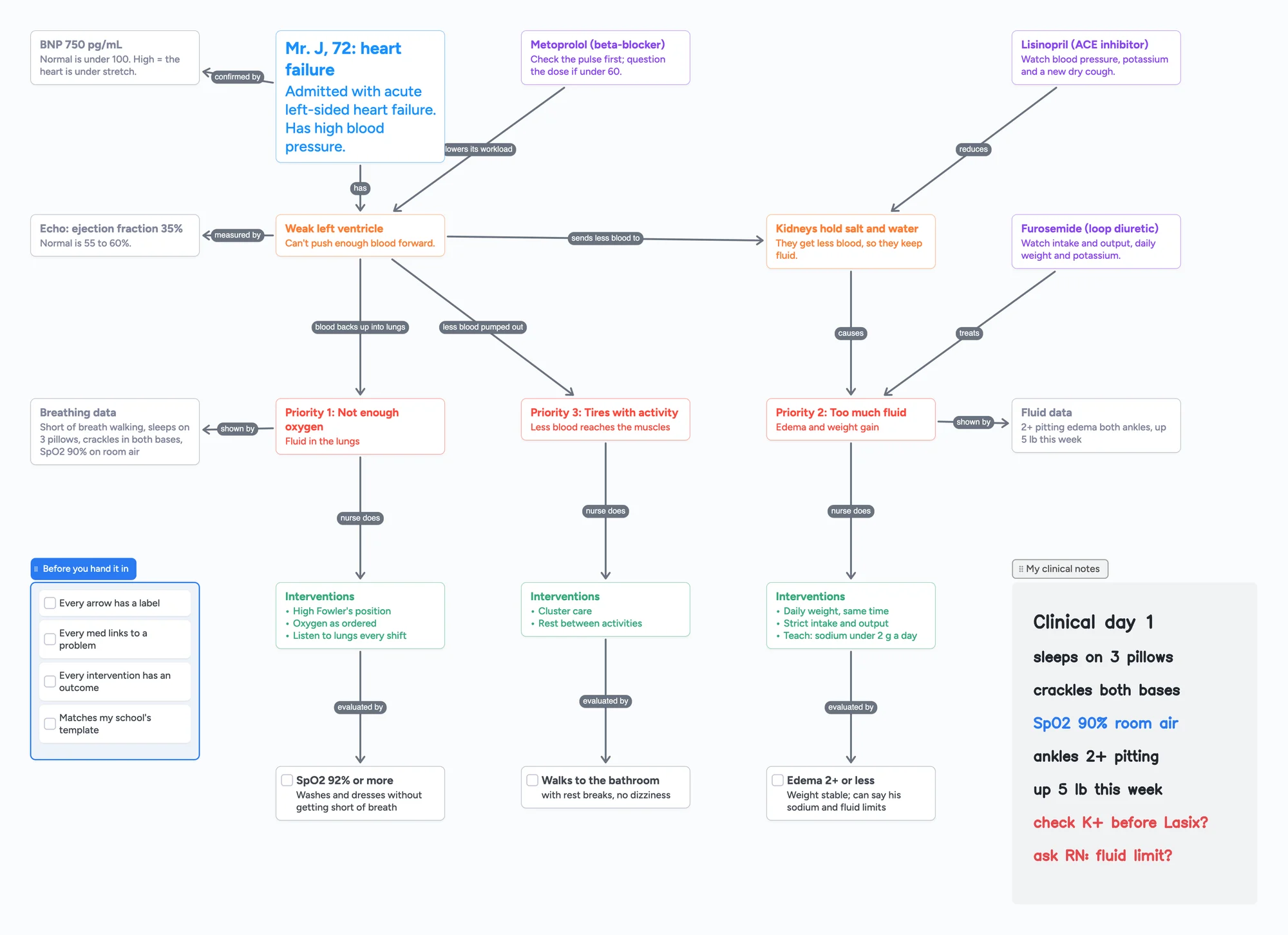
The ready board above is a teaching case, not a real patient. Mr. J is 72, has high blood pressure, and was admitted with acute left-sided heart failure. The facts come from OpenStax Medical-Surgical Nursing (12.3 Heart Failure) and Pharmacology for Nurses (19.5 Diuretics):
- Pathophysiology. The weak left ventricle can't push enough blood forward. Blood backs up into the lungs, and the kidneys get less blood, so they hold on to salt and water.
- Data. BNP 750 pg/mL (normal is under 100). Echo ejection fraction 35% (normal is 55 to 60%). Short of breath walking, sleeps on three pillows, crackles in both lung bases, SpO2 90% on room air. 2+ pitting edema in both ankles, up 5 lb this week.
- Medications. Metoprolol, a beta-blocker that lowers the heart's workload: check the pulse first. Lisinopril, an ACE inhibitor: watch blood pressure, potassium and a new dry cough. Furosemide, a loop diuretic that treats the fluid: watch intake and output, daily weight and potassium.
- Priority 1: not enough oxygen. High Fowler's position, oxygen as ordered, listen to the lungs every shift. Outcome: SpO2 92% or more, and he can wash and dress without getting short of breath.
- Priority 2: too much fluid. Daily weight at the same time, strict intake and output, teach sodium under 2 g a day. Outcome: edema 2+ or less, stable weight, and he can say his sodium and fluid limits.
- Priority 3: tires with activity. Cluster care and rest between activities. Outcome: walks to the bathroom with rest breaks and no dizziness.
The handwritten notes in the corner are the kind of questions that come up on a clinical day ("check K+ before Lasix?"). Keep them next to the map so they turn into cards or questions for your instructor instead of getting lost.
This is a study example, not medical advice
The case is simplified for learning how a concept map is built. Real orders, drug doses and hold parameters come from the provider and your facility's policies.
Nursing care plan on the same board: the five steps on Mr. J's map
OpenStax Medical-Surgical Nursing (4.1, Critical Thinking and the Nursing Process) describes the nursing process as five steps: assessment, diagnosis, planning, implementation and evaluation, usually abbreviated ADPIE. It calls the process cyclic: the nurse usually follows the order but may move forward or back depending on how the patient responds. A care plan writes those steps down for one patient. The ready board already holds all five without a separate form, so here is where each one sits on Mr. J's map (the steps are paraphrased from the book).
- Assessment. The book says this means gathering data from the patient, the record, family or caregivers and the physical assessment, then looking for patterns. On the board these are the grey data cards (BNP, echo, breathing data, fluid data), each joined to what it confirms by "confirmed by", "measured by" or "shown by", plus your own notes in the handwriting corner.
- Diagnosis. OpenStax says a nursing diagnosis is not the medical condition: it names the problems that go with it, is broader, and gets prioritized. On the board the medical diagnosis (heart failure) sits on the patient card, and the three red cards are the numbered problems. We wrote them in plain words ("Not enough oxygen", "Too much fluid"); if your school requires a set nursing diagnosis wording or reference, replace the card text with it. This page doesn't supply a list.
- Planning. For each diagnosis the book says to set outcomes or goals. These are the tick cards at the bottom of each branch (an oxygen number, a stable weight, walking to the bathroom with rest breaks), each with something you can measure or see.
- Implementation. The planned actions, prioritized. These are the green intervention cards, joined to their problem by "nurse does".
- Evaluation. The book says the nurse checks whether the actions worked and the outcomes were met, and that this can change the diagnosis, the plan or the actions. On the board, tick the outcome card when it is met. When it isn't, edit the intervention card or add a new one; the arrows stay attached to the cards you edit, so nothing has to be redrawn. Put the date or shift in the card text or in the notes corner so the change shows.
What a board map has that a row-by-row care plan usually doesn't: the pathophysiology and medication cards. They aren't a care plan column; they are the reasons behind it, which an instructor can read off the arrows (see how the same idea works for one disease in the pathophysiology concept map).
- Care plan form in a table. Use your school's form. The map shows where each cell comes from; copy the cards across. The "Care plan, concept map or both?" section above has the column-by-column table.
- No form, no template. There is no care plan form on the board: no rationale column, no diagnosis picker, no printable layout, and nothing that checks your wording against your program.
- Free items. This section adds no cards, so the example stays at its 23 cards. Each card is one of your 150 free items; arrows don't count.
Study aid, not clinical guidance
This describes how a student can organize the nursing process on a board. It is not clinical guidance and gives no doses. Real care plans follow the provider's orders, your facility's policies and what your program requires.
Study the physiology behind it
Instructors often ask why each finding is on the map. These short lessons from Boardling, our biology channel, cover the physiology under this case, each with a video, notes and a board you can copy:
- Why the kidneys hold on to salt and water: when less blood reaches them, the juxtaglomerular apparatus releases renin, which leads to angiotensin II and higher blood pressure. Lisinopril blocks the enzyme that makes angiotensin II. Lesson and notes.
- Steroid vs peptide hormones: aldosterone is a steroid and ADH is a peptide, and the lesson shows where each kind of receptor sits. Lesson and notes.
- How a hormone axis is controlled: the HPA axis, gland by gland, with its feedback loop. Lesson and notes.
All lessons are on the biology lessons page. The endocrine system concept map lays out four hormone pathways on one board, and Cornell notes, digital shows how to turn lecture notes into cue questions.
Watch the kidney sensor lesson
When less blood reaches the kidneys, the juxtaglomerular apparatus releases renin. This Boardling lesson shows the three cells involved and where renin comes from.
Juxtaglomerular Apparatus Explained: 3 Cells, 2 Jobs (Renin)
3:03 min · Notes and board
Watch the Frank-Starling lesson
Mr. J's left ventricle is the weak link on this map. This Boardling lesson shows how, in a healthy heart, more filling makes the next beat stronger: preload, sarcomere stretch and stroke volume. It is physiology background for the case, not care advice.
Frank-Starling Law Explained: More Filling, Stronger Beat
2:19 min · Notes and board
Handing it in
- As a link (easiest): share the board and your instructor can open it in a browser without an account, with every card, arrow and label as you left it.
- As an image: zoom out until the whole map fits on your screen and take a screenshot. For one part of the map, select those cards, choose Copy as image and paste it into your document.
- Not as Word or PDF: Instaboard doesn't export this kind of board to Word or PDF. If your programme only accepts its own Word template, a printable template is the simpler route.
When another tool fits better
- Your school gives you a fill-in template. Use theirs. Printable templates from Canva, Etsy or nursing sites suit programmes that grade on a fixed form.
- You want the layout done for you. Lucidchart, Creately and EdrawMind have nursing concept map templates and arrange shapes automatically. In Instaboard you place each card yourself.
- You want a generator. Instaboard has no AI and won't write diagnoses or a care plan for you. You choose every card and arrow, which is also what your instructor is grading.
Instaboard fits when you build a new map every clinical week: open the example again for a fresh board, swap in the new patient, keep your handwritten notes and photos of your worksheet beside the map, and open any problem into its own board when one card isn't enough room. For the biology behind a map, see how to make a biology concept map. If your assignment is one disease rather than one patient, see how to build a pathophysiology concept map.
What to know before you start
- Free covers 5 boards and 150 cards and items across your account. Arrows, sections and pen strokes don't count toward the 150; the example map uses 23 cards.
- 3 images per board on Free. Enough for photos of your worksheet or notes; Pro has no image limit.
- Editing needs a free sign-in (Google, Apple or email). Viewing a shared link doesn't.
- No AI, no automatic layout, no Word or PDF export for concept maps. Never put real patient names or identifying details on any board.
Start from the ready board
It opens in your browser in a few seconds, with nothing to install. Sign in for free when you want to save it and share it.
Questions
What goes on a nursing concept map?
The patient and diagnosis in the centre, the pathophysiology, the assessment data and labs that show it, medications linked to the problems they treat, numbered priority problems, interventions for each problem, and measurable outcomes. Your school's template decides the exact boxes.
What is the difference between a nursing concept map and a care plan?
A care plan lists the same information in rows. A concept map shows how it connects, with labelled arrows from the disease to the data, the problems, the interventions and the outcomes, so the reasoning is visible.
How many nursing problems should a concept map have?
For one clinical day, two to four priority problems is usual. Number them, with airway, breathing and circulation first, unless your instructor asks for a set number.
What are the steps of a nursing care plan?
OpenStax Medical-Surgical Nursing describes five steps in the nursing process: assessment, diagnosis, planning, implementation and evaluation (ADPIE). On the example map they are the data cards, the numbered problem cards, the outcome cards, the intervention cards and the tick-off after the shift.
Can one board be both the concept map and the care plan?
It can hold the content of both. If your assignment accepts a concept map as the care plan, check that every part your rubric names has a card. If it needs a fixed form, build the map first and copy each card into the form, because the board has no care plan template or export.
Can I hand in an Instaboard concept map?
Yes, as a link or an image. Share the board link so your instructor can open it in a browser, or zoom out until the whole map fits and take a screenshot. There is no Word or PDF export for this kind of board, so if your school requires its own Word form, use that instead.
Is there a nursing concept map generator?
Instaboard isn't one: it has no AI and doesn't write diagnoses or interventions. It gives you cards and labelled arrows so building the map, which is the part you're graded on, goes faster.
Is Instaboard free?
Yes. The free plan includes 5 boards, 150 cards and items across your account (pen strokes, arrows and sections don't count), 3 images and 1 file per board, unlimited collaborators and video calls up to an hour. Pro is $5 a month billed yearly ($59.99 a year), or $7.99 monthly, and the people you invite join free.
Sources
- OpenStax Medical-Surgical Nursing: 12.3 Heart Failure
- Nursing Fundamentals (Wisconsin Technical College System), ch. 4.6 Planning: nursing care plans can be concept maps or tables (read November 2, 2026)
- OpenStax Medical-Surgical Nursing: 4.1 Critical Thinking and the Nursing Process (published Oct 16, 2024 per its citation block; read in full, Nov 11, 2026)
- OpenStax Pharmacology for Nurses: 19.5 Diuretics
- Nevada State University: How to Create a Nursing Concept Map
- Novak & Cañas: The Theory Underlying Concept Maps and How to Construct and Use Them (IHMC)
Related
Make a biology concept map from your own notes
Turn your lecture notes into a biology concept map: concepts on cards, labelled arrows, feedback loops and a recall check. Worked example on the HPA axis, a ready board to copy, and a nursing version.
Build an endocrine system concept map from your own notes
Build an endocrine system concept map from your notes: glands, hormones, target tissues and feedback loops. A sourced example board to edit. No answer key, no AI.
Cornell notes, digital: cue cards that stay linked to your notes
How to take Cornell notes on a screen: a filled example (glycolysis) with cue cards joined to note cards by arrows, a self-quiz checklist and a summary. What a board does that a printable can't, and where a printable is better.
How to export an Apple Freeform board (PDF, image or another app)
Freeform has no Save as Image button. For a PNG: on a Mac export a PDF and use Preview > File > Export; on iPhone or iPad take a screenshot. PDF steps too.
A pharmacology concept map you can edit: one list per drug class
A filled pharmacology concept map you can open and edit: five blood pressure drug classes with the prototype drug, how it works, side effects, what to watch for and what to teach. How to build your own, and where a printable template is better.
How to take anatomy & physiology notes (with a filled example board)
How to take anatomy and physiology notes on a board you can edit: draw the feedback loop first, then terms, examples and a self-quiz. A filled homeostasis example built from OpenStax A&P 2e, for college and nursing students.
Build a pathophysiology concept map: one disease in six squares
An editable pathophysiology concept map for nursing students: one disease (COPD) worked in six squares with labelled arrows, a gaps list and room for your notes.