For a novelist planning how the cast changes
A character arc template board: how each character changes, tied to the plot
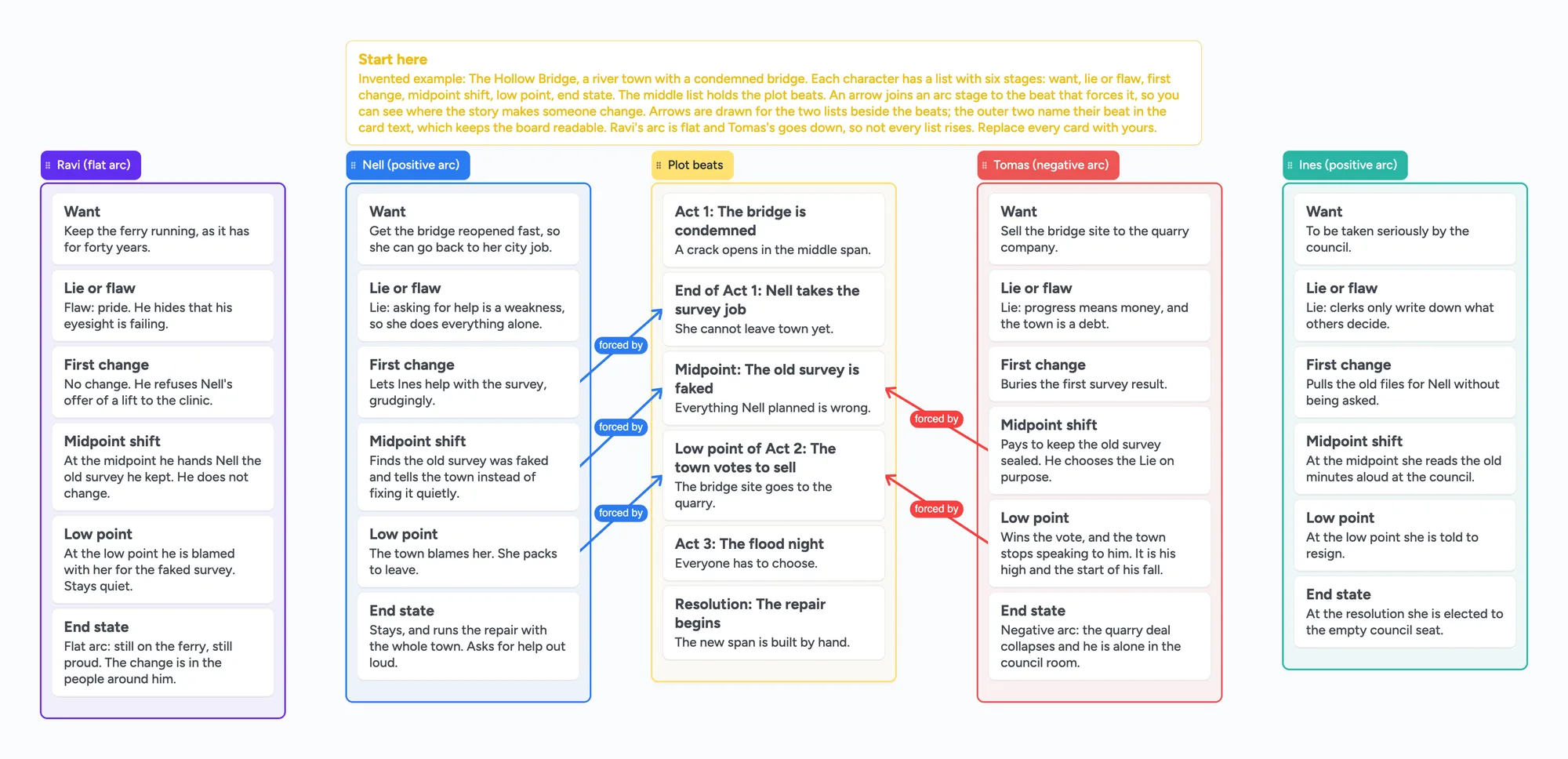
This is for a novelist who knows the plot beats and wants to see, in one place, how each character changes across them. The ready board gives every character a list with six stage cards (want, lie or flaw, first change, midpoint shift, low point, end state), a list of plot beats in the middle, and captioned arrows from an arc stage to the beat that forces it. The example cast has a flat arc, a negative arc and two positive ones, so not every list rises. It is a planning board, not a manuscript: there is no draft, no scene-by-scene tracker that counts anything, no word count and no reminders. Dabble, Storyflow, Reedsy, Now Novel and Helping Writers Become Authors cover parts of this better, and the sections below say which.
Opens in your browser. Anyone can view; a free sign-in lets you edit.
Updated
The short answer
- What it is: one list per character with six stage cards: Want, Lie or flaw, First change, Midpoint shift, Low point and End state. A Plot beats list sits in the middle, and an arrow joins a stage to the beat that forces it. The example shows a flat arc (Ravi), a negative arc (Tomas) and two positive ones (Nell, Ines).
- Different job from a relationship map: a character relationship map shows who is tied to whom. This board shows how each person changes over the story.
- What it isn't: no manuscript, no scene counts, no word count, no reminders and no sorting, and no file import or export (Copy as image only). Dabble's fillable PDF and Storyflow's arc tracks are better at parts of this.
- Arrows: an arrow joins a card in one list to a card in another, takes a caption and its own colour, and stays attached when a card moves. Arrows are drawn here for the two lists beside the beats; the outer two lists name their beat in the card text, which keeps the board readable.
- Sharing: anyone with the link can read the board with no account. Writing takes a free sign-in, and new boards start view-only, so set Share to "Anyone with the link can edit" for a co-author or writing partner.
- Free plan: the example is 36 of your 150 free items (31 cards and 5 lists, our count). Arrows, sections and pen strokes don't count.
What goes on an arc board, and what the posts we read say
Most pages that rank for a character arc template are a blog post with a PDF. Dabble's article (read November 15, 2026) offers a free, downloadable, fillable PDF and a 9-point template: everything is normal, interrupt their normal, pivot toward the future while still clinging to the past, throw new things at them, flip something on its head, the boldest thing they have done, one last failure, full commitment to change, and the new normal. It describes three kinds of arc: positive, negative and flat, and says protagonists with flat arcs appear most often in mysteries, thrillers and adventures.
The six stages on the board are our shorthand for the same idea: where the character starts (want, lie or flaw), where the story first moves them, where it turns, where it hurts most, and where they end up. Dabble's template has more beats and its own wording; the board is a smaller frame you can rename. Dabble's article calls the flawed belief a Lie and the thing the character learns the Truth; the board's "lie or flaw" card follows that wording, and you can rename it.
How to fill it in
- Start with the beats. Put your major plot beats in the middle list, one card each. The example has six, from the condemned bridge to the repair. If you already have a novel outline on index cards, copy the beats from there.
- Give each character who changes a list. Dabble's article says to consider which secondary characters should have an arc, not only the protagonist. Name the arc type in the list title (flat, positive, negative), as the example does.
- Fill the six stages in plain words. The want is what they chase, the lie or flaw is what stands in the way, and the end state says where they land. A flat arc such as Ravi's keeps the same end state; the change is in the people around him, which the card says.
- Draw arrows from stages to beats. An arrow captioned "forced by" shows which plot beat makes the stage happen. If a stage has no beat behind it, either the character changes for no reason or the plot is missing a beat. That is a judgement for you; the board doesn't flag it.
- Read across the lists. Two lists whose midpoint shifts hang on the same beat are two characters having one realisation. Storyflow's page makes the same point for its own tracks (it says two tracks with cards at the same points are usually two characters having one realisation).
The shape follows one r/writing reply (a deleted account, 42 votes, February 2022) to a question about keeping track of several arcs: for each major plot point, list each character's status in their arc and note whether the point affects their development. That is one person's method; the board lays it out as lists and arrows instead of pages.
The example novel, The Hollow Bridge, is invented. It is not a set book and does not use anyone's characters.
How this differs from the character relationship map
Both are character boards and both use cards and arrows. On the character relationship map, a card is a person and an arrow is a relationship ("rivals", "married to"). Here a list is a person and a card is a moment in their change, and the arrows run from those moments to plot beats. Use the map when your problem is a large cast and who knows whom. Use this board when your problem is whether anyone actually changes.
For plot structure itself, the index-card outline board holds the beats of a novel or screenplay by act, and the mystery outline board and the romance outline board do the same for those genres. This board does not repeat them; it takes your beats as given.
Where Dabble, Storyflow, Reedsy, Now Novel and Helping Writers Become Authors are better
Read on November 15, 2026, each from its own page. Dabble's template is a fillable PDF you keep, and its article says Dabble's Plot Grid lets you keep track of character arcs alongside the scenes of your novel, with a 14-day free trial and no credit card required. If you want the arc beside the draft's scenes in a writing app, that is the better fit.
Storyflow has a character arc tracker page. It describes the plot as a spine of scenes with a track per character underneath, and a card only where a belief shifts, so that a long empty stretch shows an arc that has stalled. It also offers AI that points out arcs which go quiet. The page says Storyflow is paid-only during early access, with plans from $9.99 a month, and that a Free plan launches before the end of 2026. Its tracks sit under the scenes themselves; on our board the arcs sit beside a short list of beats.
Now Novel's article is a method with a template: it names first goals, the helps and hindrances that aid or block a character. Reedsy's blog post on character arcs explains the common types with examples from fiction. Helping Writers Become Authors has a long method post on writing character arcs and sells a Character Arc Workbook. Jericho Writers has an article with a template and examples. These explain how to build an arc; the board only gives you a place to lay the result next to the plot.
Where these win
For a fillable template to print or keep, use Dabble's PDF. For arcs tracked under every scene, look at Dabble's Plot Grid or Storyflow. For learning how arcs work, use the Now Novel, Reedsy, Jericho and Helping Writers Become Authors posts. Use this board for the picture: who changes, in which stages, and which plot beat forces each one.
This board vs Dabble vs Storyflow vs a plain template
| Tool | What we read (Nov 15, 2026) | Good at | Not what you get |
|---|---|---|---|
| Instaboard board | Free: 5 boards, 150 items, 3 images per board. Pro $5 a month billed yearly ($59.99 a year), or $7.99 monthly | Arcs next to plot beats, shared by a link, arrows from stage to beat | A manuscript, scene tracking, counts, export |
| Dabble | Free fillable 9-point PDF; Plot Grid tracks character arcs alongside scenes; 14-day free trial, no card | A template to keep, and arcs beside the draft | A free shared board |
| Storyflow | Arc tracker page; paid-only early access from $9.99/mo; a Free plan is promised before the end of 2026 | A track per character under every scene; AI that flags stalled arcs | A free plan today |
| Now Novel, Reedsy, Jericho, Helping Writers Become Authors | Method posts with a template or workbook | Learning how arcs work | A shared board |
Swipe the table sideways to see every column.
From each tool's own pages, read November 15, 2026. We name no tool as the best; they do different jobs.
Limits of the free plan for an arc board
- Items. Each card and each list is 1 of your 150 free items, across all your boards. The example is 31 cards and 5 lists, 36 in all (our count). Each extra character is a list plus six cards, 7 items, so a cast of 10 with six beats is about 78 (our arithmetic). A card per scene per character is much bigger: 4 characters across 40 scenes is 164, so keep the board to turning points.
- Boards. The free plan includes 5 boards. Making your own copy of the example uses 1 of them; a card that opens its own board uses another, so the example keeps everything on one board.
- No manuscript, no scene tracking. Nothing links a card to a scene in your draft, and nothing tells you that a character has gone quiet for a third of the book. You see that by looking.
- No sorting, counts or reminders, and no timeline axis. A deadline is text in a card.
- Arrows beside the beats only in the example. The board draws arrows for two of the four lists to stay readable; you can draw them for all four, and the picture gets busier.
- Writing needs a free sign-in. Viewing doesn't.
- Copy as image only. To send the plan to someone without the link, use Copy as image on the board.
Start from the ready board
It opens in your browser in a few seconds, with nothing to install. Sign in for free when you want to save it and share it.
Questions
Is there a free character arc template I can edit online?
Yes. Open the board, replace the example novel, characters and beats with yours, and set Share to "Anyone with the link can edit" if a co-author needs to write on it. It is a board of cards, lists and arrows, not a document. Dabble offers a free fillable PDF if you want a file to keep.
What stages does the template use?
Six per character: want, lie or flaw, first change, midpoint shift, low point and end state. Dabble's template has nine beats and other templates use their own; rename the cards to fit whichever method you follow.
Can I show a flat or negative arc?
Yes. The example has one of each: Ravi's arc is flat, so his end state matches his start and the card says the change is in the people around him, and Tomas's goes down. Dabble's article describes positive, negative and flat arcs.
Does it track arcs scene by scene?
No. It holds turning points beside a short list of beats. Dabble's Plot Grid and Storyflow track arcs alongside scenes and are better for that.
How many characters fit on the free plan?
Each character is a list plus six cards, 7 items of the 150 across all your boards. A cast of 10 with six beats is about 78. That is our arithmetic. Arrows are free.
Is Instaboard free?
Yes. The free plan includes 5 boards, 150 cards and items across your account (pen strokes, arrows and sections don't count), 3 images and 1 file per board, unlimited collaborators and video calls up to an hour. Pro is $5 a month billed yearly ($59.99 a year), or $7.99 monthly, and the people you invite join free.
Sources
- Dabble: A Character Arc Template for Crafting Riveting Transformations (read November 15, 2026)
- Storyflow: Character arc tracker (read November 15, 2026)
- Now Novel: Character arc template (read November 15, 2026; the page shows no date)
- Reedsy: What is a Character Arc? (read November 15, 2026; the page shows no date)
- Helping Writers Become Authors: How to Write Character Arcs (read November 15, 2026)
- Jericho Writers: Character Arcs and a template (read November 15, 2026)
- r/writing: Any template for character arcs? (December 12, 2019; the top reply points to the Helping Writers Become Authors post)
- r/writing: How to keep track of character arc progression and plot details (February 2, 2022; one deleted account's reply, 42 votes, lists each character's arc status at each plot point)
Related
Character relationship map: a filled template two people can edit
A character relationship chart you fill in by hand: a card per character, captioned arrows, shared with a co-writer. No auto-layout or line styles.
Outline a novel or screenplay with index cards, on a board you can share
Outline a novel or screenplay on digital index cards: one list per act, 40 short cards, subplot arrows, a co-writer on the same board. Free to start; TV pilot too.
A mystery novel outline board for suspects, clues and red herrings
Outline a mystery novel on one board: a list per suspect, clues, red herrings and reveal order. A free ready board, and where Plottr and Sheets do more.
A romance novel outline board: one list for each lead, one for the beats they share
Outline a dual-POV romance on one shared board: a chapter list for each lead and a middle list of shared beats, with arrows between them. Free ready board, and where PlotProse and Plottr do more.