For organic chemistry students whose notes are pages of loose reactions
How to organize organic chemistry notes: a reaction map on cards you can move
A semester of organic chemistry leaves you with pages of reactions that all look alike. This page shows one way to organize them on a board: the functional groups as stops on a map, one card per reaction (start, reagent, product) joined by arrows, and a short synthesis worked backwards. It is a filled example for alcohols, aldehydes and ketones. Open it, swap in your own reactions, and keep it as your study map. It does not draw structures and it is not a lab manual.
Updated
The short answer
- Organize by functional group, not by lecture date. Draw each group once and join the groups with the reactions that turn one into another. Master Organic Chemistry's author describes it as groups being the cities on a map and reactions the roads between them.
- One card per reaction, in the same three parts: the starting group, the reagent, the product. Put the one thing you always forget under the reagent. Arrows join the cards, and if you move a card the arrow follows.
- Practice the map backwards. To make a tertiary alcohol, find it on the map, then ask where it can come from. The board ends with a three-step synthesis built that way.
- A map is not the same as knowing the mechanism. Students on r/OrganicChemistry say so loudly: use the map to see what connects, and the mechanisms and practice problems to make it stick.
Why notes in lecture order stop working
A student on r/OrganicChemistry (March 2025, 72 votes, 40 comments, read November 2, 2026) posted a dense hand-drawn chart of reactions and interconversions the night before an Organic Chemistry 2 exam and asked how to organize it. The replies split in a useful way. Some said to spend less time making a chart and more time on practice problems. Some said to keep a notebook with one reaction per page, drawn as a scheme, because exam questions arrive as schemes. Others said to group reactions by what they have in common, such as every reaction that makes an ester in one corner, and to learn the mechanism, because many reactions turn out to be variations of a few.
All of those fit on a board. A reaction card is the one-reaction page. A section or a list is the corner. The hub drawing is the chart. Nothing replaces the practice problems, but you can keep the organized version in one place and rearrange it as the course adds groups.
The idea: functional groups are the stops, reagents are the roads
James Ashenhurst of Master Organic Chemistry (study-tips page last updated September 13, 2022, read November 2, 2026) puts it this way: at one level of synthesis, functional groups are like cities on a map and the reactions that link them are the roads. Some groups are busy hubs with many roads in and out, such as ketones, while others, such as ethers, are dusty one-horse towns. If a problem takes you from an aldehyde to a tertiary alcohol, you find both on the map and work backwards from the destination. His advice for a first pass is just to get there: a longer route is fine, and efficiency is for later.
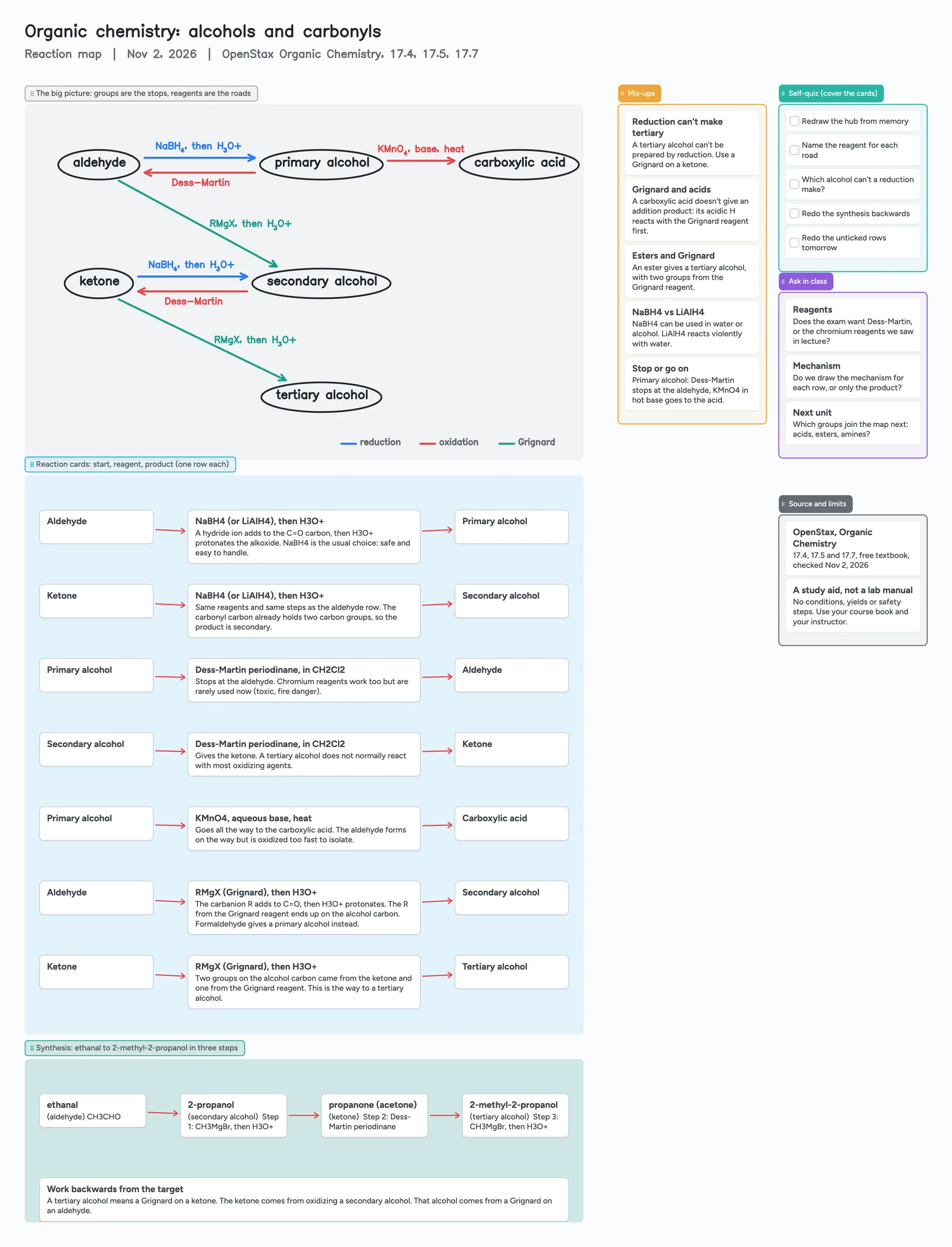
The hub drawing at the top of the board is that idea in miniature. It has six stops (aldehyde, ketone, primary, secondary and tertiary alcohol, carboxylic acid) and three kinds of road: reduction in blue, oxidation in red and Grignard addition in green. Each road carries its reagent.
The example: alcohols, aldehydes and ketones
The seven reaction rows paraphrase three sections of OpenStax's free *Organic Chemistry* (McMurry): 17.4 (alcohols from carbonyl compounds by reduction), 17.5 (by Grignard reaction) and 17.7 (oxidation of alcohols). Read November 2, 2026; the text is Creative Commons BY-NC-SA 4.0 and no tables or figures are copied.
| Start | Reagent | Product | The thing to remember |
|---|---|---|---|
| Aldehyde | NaBH4 (or LiAlH4), then H3O+ | Primary alcohol | NaBH4 is the usual choice: safe, easy to handle, works in water or alcohol |
| Ketone | NaBH4 (or LiAlH4), then H3O+ | Secondary alcohol | A tertiary alcohol can't be made by reduction |
| Primary alcohol | Dess-Martin periodinane | Aldehyde | Chromium reagents work but are rarely used now (toxic, fire danger) |
| Secondary alcohol | Dess-Martin periodinane | Ketone | Tertiary alcohols don't normally react with most oxidizing agents |
| Primary alcohol | KMnO4, aqueous base, heat | Carboxylic acid | The aldehyde forms on the way but is oxidized too fast to isolate |
| Aldehyde | RMgX (Grignard), then H3O+ | Secondary alcohol | Formaldehyde is the exception: it gives a primary alcohol |
| Ketone | RMgX (Grignard), then H3O+ | Tertiary alcohol | Two groups on the alcohol carbon from the ketone, one from the Grignard reagent |
Swipe the table sideways to see every column.
Paraphrased from OpenStax Organic Chemistry sections 17.4, 17.5 and 17.7 (CC BY-NC-SA 4.0), read November 2, 2026. Conditions, solvents and safety steps are left out on purpose; take those from your course book and lab manual.
The synthesis section on the board chains three of those rows: ethanal to 2-propanol with a methyl Grignard reagent, 2-propanol to propanone by oxidation, and propanone to 2-methyl-2-propanol with the same Grignard reagent again. Below it a card says how to find that route: a tertiary alcohol means a Grignard on a ketone, the ketone comes from oxidizing a secondary alcohol, and that alcohol comes from a Grignard on an aldehyde.
Two lists carry what the map can't. Mix-ups collects the look-alikes: a Grignard reagent doesn't give an addition product with a carboxylic acid because the acidic hydrogen reacts first, an ester gives a tertiary alcohol with two groups from the Grignard reagent, and NaBH4 can be used in water while LiAlH4 reacts violently with it. Ask in class holds what the textbook can't decide for you, such as whether your exam wants Dess-Martin or the chromium reagents from lecture.
Build your own, step by step
- Pick the groups from one unit, such as alcohols and carbonyls. A map of the whole course stops being readable. Add the next unit as a second section.
- Draw each group once as a circled word and put the stops where you can see which are hubs. Draw a road for each reaction with the reagent written on it, in a colour per reaction type.
- Make one row per reaction: a card for the starting group, a card for the reagent with a line about what to remember, a card for the product. Join them with arrows.
- Add a synthesis you worked yourself, then write under it how you found the route backwards.
- Add a Mix-ups list the first time you get a question wrong, and an Ask in class list for what you couldn't settle.
- To study, cover the cards and redraw the hub from memory, name the reagent for each road, and redo the synthesis backwards. Tick the self-quiz items you get and redo the rest tomorrow.
Cards and sections can be dragged, so when the course adds carboxylic acid derivatives you can add them beside the map and join them with new arrows, or regroup the same cards by reaction type instead of by starting group. A card can also open into its own board, which suits a mechanism you want to draw out over a full page.
Where something else is better
- A printed or PDF reaction map is better when you want a finished, complete map to learn from. Master Organic Chemistry sells a set of reaction maps as a PDF in its store. A board is for the map you build yourself, and building it is part of the studying.
- A paper notebook is better if you think in mechanisms and arrows on a full page, or your course expects handwritten work. One commenter on the r/OrganicChemistry thread suggests one A5 page per reaction with notes underneath, which is a fine way to do the same job.
- A structure editor is better for clean drawn structures. The board has no structure tool: every formula, ring and arrow in a mechanism is a pen drawing or typed text that the board does not understand. Our chemistry teaching page names tools that do draw structures.
- Practice problems are better than any chart for the exam itself. The map organizes what you have learned; it doesn't test you.
A study aid, not a lab manual
The example is a short, paraphrased student summary. It has no conditions, yields or safety steps and is not a substitute for your course book, your instructor or a lab manual. Check every reaction you will be tested on or run against your own course materials.
What Instaboard doesn't do
- No structure drawing, no reaction database, no mechanism arrows that know what they connect. Reagents and products are typed text, and structures are hand-drawn ink.
- No AI and no auto-layout. There is no map that fills itself in; the ready board is a layout to copy, and you move the cards yourself.
- No handwriting search and no conversion of handwriting to text. The eraser removes a whole stroke at a time.
- Editing needs a free sign-in. Viewing a board by link doesn't.
- The free plan is 5 boards and 150 items (cards, lists, images, text boxes; pen strokes, sections and arrows don't count), with 3 images and 1 file per board. This example uses about 45 items, so one board per unit works better than one per reaction. Photos of a mechanism you drew on paper count against the 3 images per board.
- No import from other note apps. Full-board PDF export works only on drawing boards and trip planners; for a card board, selected cards and lists can be saved as an image.
- Changes made offline are kept and sync when you're back online, but it isn't an offline-first app.
Start from the ready board
It opens in your browser in a few seconds, with nothing to install. Sign in for free when you want to save it and share it.
Questions
How do I organize organic chemistry notes?
Group by functional group instead of lecture date, with one card per reaction showing the start, the reagent and the product, and arrows between the groups. Keep a list of mix-ups for the reactions you confuse and use practice problems to test yourself. The board above is a filled example for alcohols, aldehydes and ketones.
What is an organic chemistry reaction map?
A diagram that treats functional groups as stops and reactions as the roads between them, so you can see how to get from one group to another. Master Organic Chemistry uses the same city-and-road comparison. You can print one or build your own; the board is for building your own.
Should I take organic chemistry notes by hand or on a device?
Students on r/OrganicChemistry disagree and it depends on the course. A board lets you type cards and draw by hand on the same page, but it has no structure tool, so drawn structures are pen sketches. Use whatever lets you draw mechanisms quickly, then keep the map on the board.
Will a reaction map get me through the exam?
Not on its own. Commenters on the r/OrganicChemistry thread say to learn the mechanisms and do practice problems, and that many reactions are variations of a few. The map is for seeing what connects and for working a synthesis backwards.
Does the board draw chemical structures?
No. Reagent and product cards are text and the hub drawing is pen ink. For clean drawn structures use a structure editor and, if you want, paste a picture onto a card. Each board takes 3 images on the free plan.
Can I share the map with a study group?
Yes. Copy the board link and send it. Anyone can look at it without an account, and anyone who wants to write on it signs in for free.
Is Instaboard free?
Yes. The free plan includes 5 boards, 150 cards and items across your account (pen strokes, arrows and sections don't count), 3 images and 1 file per board, unlimited collaborators and video calls up to an hour. Pro is $5 a month billed yearly ($59.99 a year), or $7.99 monthly, and the people you invite join free.
Sources
- OpenStax Organic Chemistry: 17.4 Alcohols from Carbonyl Compounds: Reduction
- OpenStax Organic Chemistry: 17.5 Alcohols from Carbonyl Compounds: Grignard Reaction
- OpenStax Organic Chemistry: 17.7 Oxidation of Alcohols
- Master Organic Chemistry: Organic Chemistry Study Tips: Reaction Maps (James Ashenhurst)
- r/OrganicChemistry: Study chart help. How do I neatly organize these reactions and interconversions? (March 2025)
Related
A pharmacology concept map you can edit: one list per drug class
A filled pharmacology concept map you can open and edit: five blood pressure drug classes with the prototype drug, how it works, side effects, what to watch for and what to teach. How to build your own, and where a printable template is better.
Cornell notes, digital: cue cards that stay linked to your notes
How to take Cornell notes on a screen: a filled example (glycolysis) with cue cards joined to note cards by arrows, a self-quiz checklist and a summary. What a board does that a printable can't, and where a printable is better.
Make a biology concept map from your own notes
Turn your lecture notes into a biology concept map: concepts on cards, labelled arrows, feedback loops and a recall check. Worked example on the HPA axis, a ready board to copy, and a nursing version.
Build a nursing concept map for your patient
How to build a nursing concept map from your clinical notes, step by step: patient, pathophysiology, assessment data, labs, meds, priority problems, interventions and outcomes. A worked heart failure example you can open and edit.
How to teach chemistry online on a whiteboard: a mole-ratio lesson, step by step
How a chemistry tutor can teach on an online whiteboard: a mole-ratio lesson step by step, what to write by hand, and when a structure editor like Molbrett is the better tool. Ready lesson board included.