For a writer laying a story out on the twelve-stage model
A hero's journey template board: twelve stages, the figures, and where your story bends the model
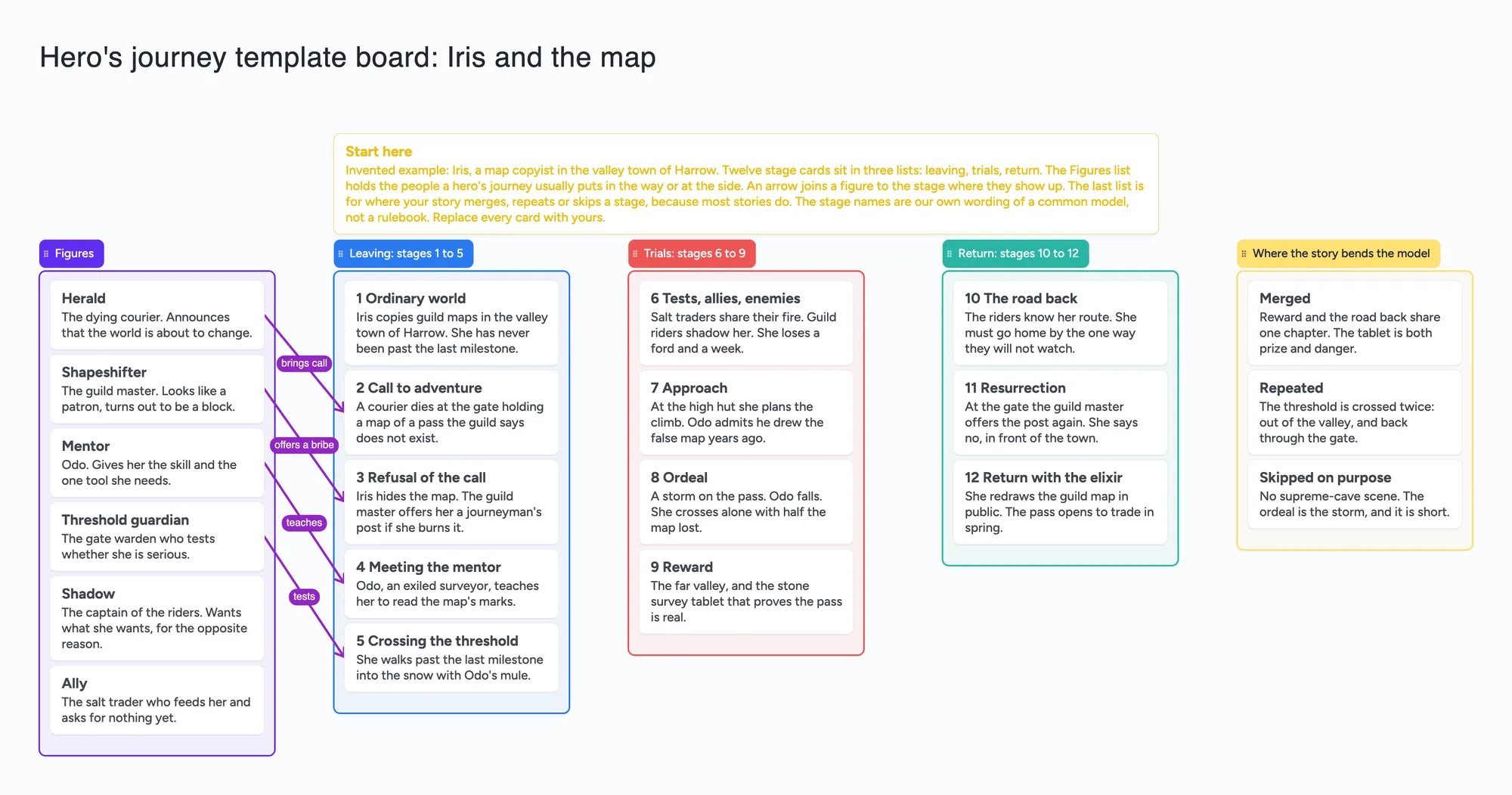
This is for a writer who has heard of the twelve-stage hero's journey and wants to see their own story laid out on it, in one place, with a collaborator or a critique partner. The ready board has the twelve stages as cards in three lists (leaving, trials, return), a list of the figures who usually appear (herald, mentor, threshold guardian, shapeshifter, shadow, ally), captioned arrows from a figure to the stage where they show up, and a fifth list for the places your story merges, repeats or skips a stage, because most stories do. It is a planning board, not a manuscript: no drafting, no word count, no page counts, no reminders. Reedsy, Milanote, Scrivener templates and Savannah Gilbo's guide do parts of this better, and the sections below say which.
Opens in your browser. Anyone can view; a free sign-in lets you edit.
Updated
The short answer
- What it is: twelve stage cards in three lists (Leaving, stages 1 to 5; Trials, 6 to 9; Return, 10 to 12), a Figures list and a list called Where the story bends the model. An arrow joins a figure to the stage where they appear.
- It is a lens, not a rulebook. The Joseph Campbell Foundation's own page says Campbell stressed three essential stages, and Christopher Vogler's short form keeps five. The board has a list for the stages your story merges, repeats or skips.
- Different job from our other story boards: the novel beat sheet board puts scene cards under 15 beats, and the character arc board tracks how several characters change. This one lays one hero's trip out on twelve stages and shows who shows up where.
- What it isn't: no manuscript, no word or page counts, no reminders and no sorting, and no file import or export (Copy as image only).
- Sharing: anyone with the link can read the board with no account. Writing takes a free sign-in, and new boards start view-only, so set Share to "Anyone with the link can edit" for a co-author or critique partner.
- Free plan: the example is 28 of your 150 free items (22 cards, 5 lists and the title text box, our count). Arrows, sections and pen strokes don't count.
Where the twelve stages come from, and what the sources say about using them
Reedsy's guide (read November 18, 2026) describes the hero's journey as a story structure in which a hero starts in an ordinary world, is forced out of it, faces challenges and returns changed, and gives twelve steps. It credits Christopher Vogler's The Writer's Journey (2007) for the twelve-step version and says Joseph Campbell's original, the monomyth, has seventeen stages.
The Joseph Campbell Foundation's page (read November 18, 2026) quotes Campbell's one-line summary of the pattern, a hero who ventures from the world of common day into a region of wonder, wins a decisive victory and returns with the power to bestow boons, and says Campbell stressed three essential stages: separation, initiation and return. The board's three lists follow that grouping, with Vogler's twelve stages inside it; the stage names on the board are our own wording.
Vogler's own short form (his blog, February 24, 2011; read November 18, 2026) says the bare minimum is five stages: the ordinary world, the call, the threshold, the ordeal or resurrection, and the reward or return. So even the twelve-stage author treats the twelve as a menu.
How to fill it in
- Open the board above and make it yours. The example, Iris and the map that should not exist, is invented: replace every card.
- Write one line per stage. Say what happens, not what the stage means. If you cannot say what happens at a stage, that is the useful finding.
- Put the figures on cards. The six on the board are the ones the guides usually name. Rename or delete any; a story with no mentor is fine.
- Draw an arrow from a figure to the stage where they matter, and caption it in a word or two. Arrows stay attached when a card moves.
- Fill the last list honestly. Where does your story merge two stages, cross a threshold twice, or skip a stage on purpose? Reedsy's own template page says to skip, merge or repeat stages as your story demands. Naming it keeps the template from bending the story.
- Share the link with a co-author or critique partner. Set Share to "Anyone with the link can edit" so they can write; they sign in free.
If you are under 18, check with a parent or your school before you sign up for a new tool. The example story is invented and uses no set book or film.
A note on the name
A November 2020 Medium post by dkudler carries a notice that "The Hero's Journey is a registered trademark of Joseph Campbell Foundation." We could not find a terms page on the Foundation's own site that says the same, so we cannot confirm the notice ourselves. This page names the model only as the source of the twelve-stage idea, the stage names on the board are our own wording, and this page and board are not affiliated with or endorsed by the Joseph Campbell Foundation, Christopher Vogler or Reedsy.
How this differs from the beat sheet and arc boards
The novel beat sheet board sets 15 beats under three act sections and puts a few scene cards under each, so it is a plan for the whole manuscript. The character arc board gives each character a list of six stages and ties them to plot beats, so it tracks change across a cast. This board has one card per stage of one hero's trip and a list of figures, so it is the smallest of the three: twelve cards you can read at once. For a novel you will likely use the beat sheet or chapter outline board for the manuscript and this board only if the journey is how you think about the story.
Where Reedsy, Milanote, Scrivener and Savannah Gilbo are better
Read November 18, 2026, from each page. Reedsy's Studio template (a hero's journey template with a worked example from Rocky) comes with guided questions per stage and links to character and place boards, and says it is built as three boards (Outline, Characters, Places). Reedsy's pricing page lists core Studio as free, with boards limited to card view, and a 30-day trial of its add-ons; we did not check which plan includes this template. If you want questions to answer at every stage, that is the better start.
Milanote's template is a circular diagram and its page lists PDF export, collaboration and a free plan with no time limit. If you want the journey as a wheel, or a PDF to print, use it. In an r/scrivener thread (August 20, 2021) the poster asked for a hero's journey template after a link went dead, and u/tacogratis2 replied that one linked from a YouTube video works but you must join its creator's email list, then listed the three groups and twelve steps. Scrivener's template keeps the stages as binder folders beside your draft, which this board cannot; we did not read the template itself. A Notion template from writerpal was listed at 5 USD on the page we saw.
Savannah Gilbo's guide sets the twelve stages over a 25 percent, 50 percent, 25 percent act split and puts stages at points of the word count, which we don't do. It also calls the model "a lens, not a blueprint" and quotes Vogler calling it a skeletal framework.
Where these win
For guided questions per stage, use Reedsy's Studio template. For a circular picture or a PDF, use Milanote. For stages beside your draft, use Scrivener or Plottr. For word-count placement, read Gilbo. Use this board for a shared, editable, one-screen picture of your story's twelve stages and who shows up where.
What writers on Reddit say about the model
One thread, r/writing (March 24, 2020, 67 votes), has u/ElizzyViolet pointing out that Campbell was an anthropologist, not a writing teacher; u/Max_XXIX says steps are omitted, fused and reordered in the stories that follow it; u/Shortstoriesaredumb (25 votes) calls structures lenses and analysis tools. Those are three people's views. They are why the board has a list for the places you bend the model, and why the example merges, repeats and skips on purpose.
Another, r/writers (October 23, 2020), is a question about Vogler's twelve stages against Campbell's seventeen. We take no side; the board uses twelve because that is the version the writing guides use.
This board vs Reedsy vs Milanote vs a Scrivener template
| Tool | What we read (Nov 18, 2026) | Good at | Not what you get |
|---|---|---|---|
| Instaboard board | Free: 5 boards, 150 items, 3 images per board. Pro $5 a month billed yearly ($59.99 a year), or $7.99 monthly | A shared one-screen picture; stages, figures, arrows, bends | A draft, guided questions, PDF |
| Reedsy Studio | Hero's journey template with a Rocky example, built as Outline, Characters and Places boards; core Studio free (boards limited to card view), add-ons 30-day trial; which plan holds this template not checked | Guided questions, linked character and place boards | Free-form arrows between any two cards |
| Milanote | Circular template; PDF export and collaboration listed; free plan with no time limit | A wheel picture, export | More than its free limits |
| Scrivener template | Template named in an r/scrivener thread (2021); one reply says it needs the creator's email list; template itself unread | Stages beside the draft | A shared board, a free web tool |
Swipe the table sideways to see every column.
From each tool's own pages and the threads named, read November 18, 2026. We name no tool as the best; they do different jobs.
What each one costs over three years
| Tool | Listed price | Three years (our arithmetic) |
|---|---|---|
| Instaboard | Free: 5 boards, 150 items; Pro $59.99 a year or $7.99 a month | $0 within the free limits; $179.97 on Pro billed yearly, or $287.64 at $7.99 a month |
| Reedsy | The hero's journey guide is free to read; Studio's core writing and formatting features are free with a free Reedsy account; Studio Essential $4.99 a month, Outlining $7.99 a month (both from the Studio home page FAQ; the pricing page text shows no figures) | $0 for the guide and core Studio; $179.64 on Essential; $287.64 on Outlining |
| Plottr | $60 a year or $150 once, Windows and Mac; Pro $99 a year adds the browser app | $180 at $60 a year; $150 once; $297 on Pro at $99 a year |
| Campfire | Free plan with module limits (25,000-word manuscript); Standard $12 a month, shown beside $19.00 | $0 within the free limits; $432 at $12 a month |
| Scyn | Free: one novel with acts, chapters, up to 100 scenes and 200 links; Pro from $6.99 a month or $70 a year | $0 within the free limits; $210 at $70 a year |
| Kindling, novelWriter | Free; Kindling is open source and needs no account; novelWriter is open source | $0 |
| Obsidian | Its pricing page says free without limits, no sign-up; Sync $4 a month billed annually | $0 for the app; $144 for Sync |
Swipe the table sideways to see every column.
Listed prices from each maker's own page, read on November 19, 2026, in US dollars. The three-year column is our arithmetic and assumes the price doesn't change. The prices of Campbell's and Vogler's own books are not counted.
Where each one runs
| Tool | Runs on, as listed |
|---|---|
| Instaboard | Any modern browser, plus iPhone, iPad and Android apps; changes are kept and sync when you're back online, but it isn't offline-first. |
| Reedsy Studio | In a browser with a free Reedsy account; no dedicated mobile app, but it works in a mobile browser on a phone or tablet, per its page |
| Plottr | Windows and Mac, works offline; the browser app on Pro, which its page says works on tablets |
| Campfire | Browser and desktop apps, plus a mobile writing app that does not carry every module, per its pricing page |
| Kindling | macOS 12 or later, Windows 10 or later, and Linux (x86_64 AppImage) |
| novelWriter | Linux and Windows; its home page says it runs on macOS too, but that as of release 2026.1 macOS DMGs have been discontinued and the only current way to run it there is to install its Python package |
Each cell is from the maker's own pages, read on November 19, 2026. Obsidian and Scyn are left out of this table because the pages we read do not list their platforms.
Which tool for which job
- You want to read about the twelve stages first: Reedsy's free guide walks through each one, with examples. It is reading, not a board.
- You want a template inside a plotting app: Plottr has a Hero's Journey plot structure template, per its template page, and works offline on Windows and Mac.
- You want to write on your own computer for free: Kindling and novelWriter are both free and open source.
- You already keep your notes in one place: Obsidian is free without limits per its pricing page, or a document with twelve headings does the same job.
- Several people move the same cards, such as a writing group or a class project: a shared Instaboard board does that, and each person signs in free to edit. Our novel beat sheet board and character arc board cover the manuscript and the cast. This page is written for people 13 and older; for coursework, check with a parent or your school before using a web tool.
- The structure doesn't fit your story: there are two critiques, each one writer's view. A Mythcreants post says that while structures like this "won't ruin a good story, they aren't providing what storytellers need", though it allows that the hero's journey "can be a fun addition to the plans you already have" if you already know how to build arcs. An r/writing post by u/ElizzyViolet (March 24, 2020, 67 votes) is titled "Why you should not use the Hero's Journey to structure your book". The board's last list, for stages your story merges, repeats or skips, is there for that.
Limits of the free plan for a journey board
- Items. Each card and each list is 1 of your 150 free items, across all your boards. The example is 22 cards, 5 lists and a title text box, 28 in all (our count). If every stage held five scene cards it would be 12 x 5 = 60 cards plus the lists, Start here and the title, about 67 (our arithmetic), so keep it to one line per stage.
- A list for every stage. If you make one list per stage with three scene cards each, that is 12 lists + 36 cards = 48 items; with five cards each, 12 + 60 = 72. Twelve lists can hold at most 138 cards before the 150 runs out, and the three group sections are free (our arithmetic).
- Boards. The free plan includes 5 boards. Making your own copy of the example uses 1; a card that opens its own board uses another, so the example keeps everything on one board.
- No manuscript, no counts. Nothing links a card to a scene in your draft, and nothing places a stage at a page or word count.
- No guided questions. The board holds your answers; Reedsy's template prompts them.
- No sorting, reminders or timeline axis, and no template store: you copy the example and rename.
- Writing needs a free sign-in. Viewing doesn't.
- Copy as image only. To send the plan to someone without the link, use Copy as image on the board.
Start from the ready board
It opens in your browser in a few seconds, with nothing to install. Sign in for free when you want to save it and share it.
Questions
Is there a free hero's journey template I can edit online?
Yes. Open the board, replace the example story with yours, and set Share to "Anyone with the link can edit" if a co-author needs to write on it. It is a board of cards, lists and arrows, not a document. Reedsy's Studio template adds guided questions per stage.
What are the twelve stages?
The board uses ordinary world, call to adventure, refusal of the call, meeting the mentor, crossing the threshold, tests allies and enemies, approach, ordeal, reward, the road back, resurrection and return with the elixir, in our own wording of the version Reedsy describes from Vogler's book.
Do I have to use all twelve?
No. Vogler's own short form lists five as the bare minimum, and the Joseph Campbell Foundation says Campbell stressed three essential stages. The board has a list for the stages your story merges, repeats or skips.
How is this different from a beat sheet?
A beat sheet is a plan for the whole manuscript with scenes under each beat. This board is one hero's trip on twelve cards plus the figures who appear. Our novel beat sheet board is the one with scene cards.
How many stages or scenes fit on the free plan?
The example is 28 items of your 150. With five scene cards under each stage it would be about 67. That is our arithmetic. Arrows are free.
What is a hero's journey template for outlining a story?
It is the twelve stages laid out in a fixed order so you can fill in what happens in your own story. In our wording they fall into three groups: leaving home (the ordinary world, the call, the refusal, the mentor, crossing the threshold), the trials (tests and allies, the approach, the ordeal, the reward) and coming back (the road back, the last test, returning with something gained). The ready board has one list per group and a card per stage, with an example story you replace. The model comes from Joseph Campbell's monomyth and Christopher Vogler's twelve-stage version; this page and board are not affiliated with either, and the stage names are our own.
Is there a free hero's journey outline board online?
Yes. The ready board is free to open and edit within the free plan: 5 boards and 150 items across your account, with arrows, sections and pen strokes not counted. Anyone with the link can view it with no account; writing takes a free sign-in. Reedsy also has a free guide and a template that needs a free Reedsy account. If this is for coursework, check with a parent or your school before using a web tool; the page is written for people 13 and older.
Hero's journey vs Save the Cat for plotting a novel?
Reedsy describes the hero's journey as a hero going from an ordinary world through a challenge and trials to a transformation and a return, and Save the Cat as 15 beats that track emotional and plot turns. A board can hold either: twelve lists for the journey, fifteen for the beats. Writers disagree about whether a fixed structure helps: one Mythcreants post argues that structures like these do not give storytellers what they need, and Savannah Gilbo's guide calls the hero's journey a lens, not a blueprint. Each is one view. Our novel beat sheet board is the one with fifteen beats and scene cards.
Is Instaboard free?
Yes. The free plan includes 5 boards, 150 cards and items across your account (pen strokes, arrows and sections don't count), 3 images and 1 file per board, unlimited collaborators and video calls up to an hour. Pro is $5 a month billed yearly ($59.99 a year), or $7.99 monthly, and the people you invite join free.
Sources
- Plottr: Hero's Journey plot structure template (read November 19, 2026)
- Plottr: pricing (read November 19, 2026)
- Reedsy Studio (read November 19, 2026)
- Campfire: pricing (read November 19, 2026)
- Scyn: pricing (read November 19, 2026)
- Kindling (read November 19, 2026)
- novelWriter (read November 19, 2026)
- Obsidian: pricing (read November 19, 2026)
- Mythcreants: Why Structures Like The Hero's Journey Don't Work (read November 19, 2026)
- Reedsy: Save the Cat beat sheet guide (read November 19, 2026)
- Reedsy: Hero's Journey, 12 steps (read November 18, 2026)
- Reedsy Studio: Hero's Journey template (read November 18, 2026)
- Joseph Campbell Foundation: Joseph Campbell and the Hero's Journey (read November 18, 2026)
- Chris Vogler's Writer's Journey blog: Hero's Journey Short Form (February 24, 2011)
- Savannah Gilbo: How to Outline Your Novel with the Hero's Journey (read November 18, 2026)
- Milanote: Hero's Journey template (read November 18, 2026)
- r/writing: What are your thoughts on the Hero's Journey? (March 24, 2020)
- r/scrivener: Hero's Journey Template for Scrivener? (August 20, 2021)
- r/writers: Vogler's 12 vs Campbell's 17 (October 23, 2020)
Related
A novel beat sheet on one shared board: 15 beats, three acts, scenes under each beat
A 15-beat novel outline to open and edit: 3 act sections, a list per beat, scene cards under each. Free-plan item counts and where other tools are better.
A character arc template board: how each character changes, tied to the plot
A shared character arc template: a list per character with want, lie, first change, midpoint shift, low point and end state, tied to your plot beats by arrows. Free to open.
24-chapter novel outline board: acts, chapters and beats on one shared board
A filled 24-chapter novel outline to open and edit: four act sections, a list per chapter, three beat cards each. Item counts for the free plan stated, and where other tools are better.
Outline a novel or screenplay with index cards, on a board you can share
Outline a novel or screenplay on digital index cards: one list per act, 40 short cards, subplot arrows, a co-writer on the same board. Free to start; TV pilot too.