For nursing and pharmacology students making their own drug-class notes
A pharmacology concept map you can edit: one list per drug class
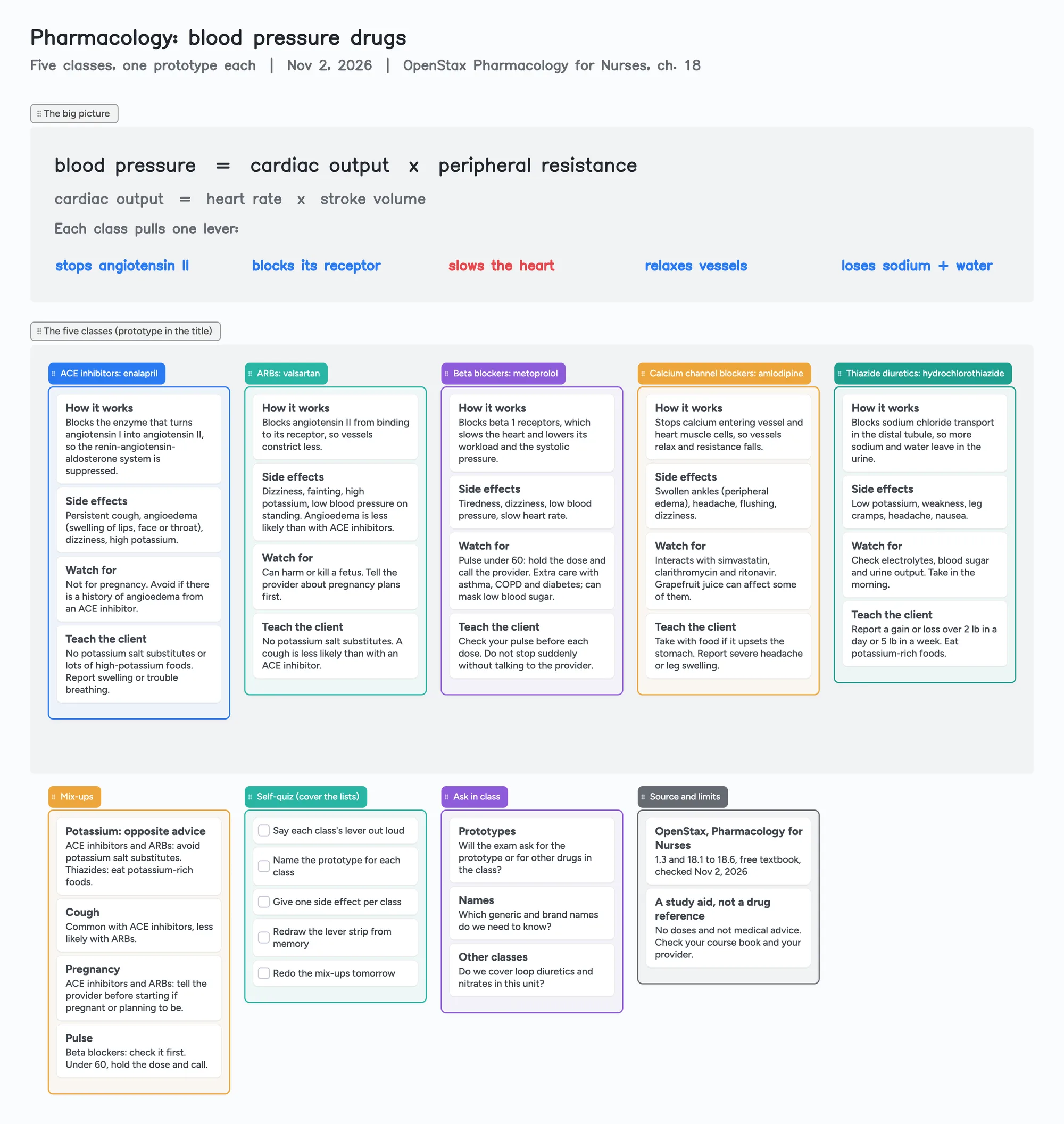
Most pharmacology concept map templates are blank forms to print and fill in. Here is a filled one on a board instead: five blood pressure drug classes, each a list of cards (how it works, side effects, what to watch for, what to teach the client), with the prototype drug named in the title and a short strip that shows which lever each class pulls. Open it, swap in your own course's classes, and keep it as your study map. It is a study aid, not a drug reference.
Updated
The short answer
- One list per drug class, one card per question. The list title names the class and its prototype drug. The cards under it answer the same four questions every time: how it works, side effects, what to watch for, what to teach the client.
- Start from the prototype. OpenStax's *Pharmacology for Nurses* says to learn one drug per class as the class representative, then compare the others to it. That is why each list names one.
- Add what a printable can't: a hand-drawn strip of the lever each class pulls, a mix-ups list for look-alike advice, and a self-quiz you tick. Cards and lists move, so you can regroup them by disease or by exam topic.
- It is a study aid. The board has no doses and isn't medical advice. Use your course book and your instructor for anything you will be tested or work from.
How drugs are grouped, and why one prototype per class
OpenStax's *Pharmacology for Nurses* (section 1.3, read November 2, 2026) says most drugs are classified in two ways. A therapeutic classification is what the drug is used for, such as antihypertensive or antianginal. A pharmacologic classification is how it works, its mechanism of action, such as beta-adrenergic blocker. The book's example is metoprolol, which is both an antianginal and an antihypertensive but has the same mechanism, side effects and safety points either way.
The same section describes the prototype approach: once drugs are sorted into classes, one drug is used as the class representative and the rest are compared to it. If you know metoprolol well, you know roughly what to expect from atenolol. The ready board follows this: each list is a class, and the prototype is in the title.
The example: five blood pressure classes
The board covers the five classes in chapter 18 of the same textbook that work on blood pressure. The strip at the top shows why there are five: blood pressure is cardiac output times peripheral resistance, and cardiac output is heart rate times stroke volume. Each class pulls a different lever.
| Class (prototype) | Lever | One thing to remember |
|---|---|---|
| ACE inhibitors (enalapril) | Stops angiotensin II being made | A persistent cough can develop; avoid potassium salt substitutes; not for pregnancy |
| ARBs (valsartan) | Blocks angiotensin II from its receptor | Cough and angioedema are less likely than with ACE inhibitors; not for pregnancy |
| Beta blockers (metoprolol) | Slows the heart | Check the pulse first; under 60, hold the dose and call the provider |
| Calcium channel blockers (amlodipine) | Relaxes vessels | Swollen ankles and headache are common; some interact with grapefruit juice |
| Thiazide diuretics (hydrochlorothiazide) | Loses sodium and water | Low potassium; report a gain or loss over 2 lb in a day or 5 lb in a week |
Swipe the table sideways to see every column.
Paraphrased from OpenStax Pharmacology for Nurses, sections 18.2 to 18.6 (Creative Commons BY-NC-SA 4.0), read November 2, 2026. No doses are given. Always follow your course book and your provider.
Two lists on the board exist because the classes look alike. Mix-ups collects the points that trip people up: ACE inhibitors and ARBs say avoid potassium salt substitutes, while thiazides say eat potassium-rich foods; the cough belongs mostly to ACE inhibitors; both ACE inhibitors and ARBs need a pregnancy conversation first; the pulse check belongs to beta blockers. Ask in class holds what the textbook can't answer for you, such as whether your exam wants prototypes only.
Build your own, step by step
- Pick one family from your course unit, such as blood pressure, anticoagulants or antibiotics. A map that tries to hold the whole course stops being readable.
- Add one list per class. Put the class and its prototype drug in the list title.
- Add the same four cards to every list: How it works, Side effects, Watch for, Teach the client. Same questions in every list is what lets you compare classes at a glance.
- Draw or type a short strip at the top that shows what ties the classes together, as the board does with the blood pressure equation.
- Add a Mix-ups list for look-alike facts, and an Ask in class list for open questions.
- To study, cover the lists and say each class's lever and prototype out loud. Tick the self-quiz items you get, and redo the rest tomorrow.
Cards and lists can be dragged, so you can later regroup the same cards by disease (hypertension, heart failure) instead of by class. A card can also open into its own board if one drug needs a longer page.
What a board adds to a printable template, and where a printable is better
- Moves and regroups. Drag a class next to the one you confuse it with, or pull the mix-ups beside the lists they came from.
- One link to share. Send the board to a study partner. Anyone can look at it without an account; to write on it, they sign in for free with Google, Apple or email.
- Draw and type on the same page. A hand-drawn mechanism sketch can sit beside the cards.
- A printable is better if your instructor hands out a required form, wants a fixed layout, or grades a printed page. Fill that one in and use the board for your own study version.
- A flashcard app is better if you want spaced repetition. A board has a tickable checklist, not a scheduler.
A study aid, not a drug reference
The example board is a short, paraphrased student summary with no doses. It is not medical advice and not a substitute for your course book, your instructor, a drug reference or a provider's orders. Check every fact you will be tested or work from against your own course materials.
What Instaboard doesn't do
- No drug database, no dose or interaction checker, no AI. Every card is something you type or paste yourself.
- The layout is manual. There is no pharmacology template that fills itself in; the ready board is a layout to copy.
- No handwriting search and no conversion of handwriting to text. The eraser removes a whole stroke at a time.
- Editing needs a free sign-in. Viewing a board by link doesn't.
- The free plan is 5 boards and 150 items (cards, lists, images, text boxes; pen strokes, sections and arrows don't count), with 3 images and 1 file per board. This example uses 34 cards, so one board per unit works better than one per drug.
- No import from other note apps. Full-board PDF export works only on drawing boards and trip planners; for a card board, selected cards and lists can be saved as an image.
- Changes made offline are kept and sync when you're back online, but it isn't an offline-first app.
Start from the ready board
It opens in your browser in a few seconds, with nothing to install. Sign in for free when you want to save it and share it.
Questions
What is a pharmacology concept map?
A one-page map of a group of drugs: the classes, a prototype drug for each, how each works, side effects, what to watch for and what to teach. Nursing courses often assign them for a drug class or a disease. The board above is a filled example for blood pressure drugs.
What is a drug prototype?
OpenStax's Pharmacology for Nurses describes it as the class representative: one drug used to explain the class, with the others compared to it. Learning one well tells you what to expect from the rest, though you still check the differences.
What is the difference between a therapeutic and a pharmacologic class?
Therapeutic means what the drug is used for, such as antihypertensive. Pharmacologic means how it works, such as beta-adrenergic blocker. The same drug can have two therapeutic classes and one pharmacologic class.
Does the board give doses?
No. The example leaves doses out on purpose. It is a study aid, so use your course book or a drug reference for doses, and never rely on a student map for patient care.
Can I use this for my assignment?
You can copy the layout and fill in your own classes, but follow your instructor's required format and cite your own sources. If you have to hand in a specific printable form, fill that one in and use the board as your study version.
Can I share it with a study group?
Yes. Copy the board link and send it. Anyone can look at it without an account, and anyone who wants to write on it signs in for free.
Is Instaboard free?
Yes. The free plan includes 5 boards, 150 cards and items across your account (pen strokes, arrows and sections don't count), 3 images and 1 file per board, unlimited collaborators and video calls up to an hour. Pro is $5 a month billed yearly ($59.99 a year), or $7.99 monthly, and the people you invite join free.
Sources
- OpenStax Pharmacology for Nurses: 1.3 Drug Classifications and Prototypes
- OpenStax Pharmacology for Nurses: 18.1 Hypertension and Angina
- OpenStax Pharmacology for Nurses: 18.2 ACE Inhibitors
- OpenStax Pharmacology for Nurses: 18.3 Angiotensin II Receptor Blockers (ARBs)
- OpenStax Pharmacology for Nurses: 18.4 Beta-Adrenergic Blockers
- OpenStax Pharmacology for Nurses: 18.5 Calcium Channel Blockers
- OpenStax Pharmacology for Nurses: 18.6 Diuretics
Related
Build a nursing concept map for your patient
How to build a nursing concept map from your clinical notes, step by step: patient, pathophysiology, assessment data, labs, meds, priority problems, interventions and outcomes. A worked heart failure example you can open and edit.
Cornell notes, digital: cue cards that stay linked to your notes
How to take Cornell notes on a screen: a filled example (glycolysis) with cue cards joined to note cards by arrows, a self-quiz checklist and a summary. What a board does that a printable can't, and where a printable is better.
Make a biology concept map from your own notes
Turn your lecture notes into a biology concept map: concepts on cards, labelled arrows, feedback loops and a recall check. Worked example on the HPA axis, a ready board to copy, and a nursing version.
Build an endocrine system concept map from your own notes
Build an endocrine system concept map from your notes: glands, hormones, target tissues and feedback loops. A sourced example board to edit. No answer key, no AI.