For one person or a small crew sorting a pile of tasks, not for tracking them afterwards
An Eisenhower matrix template on one shared board
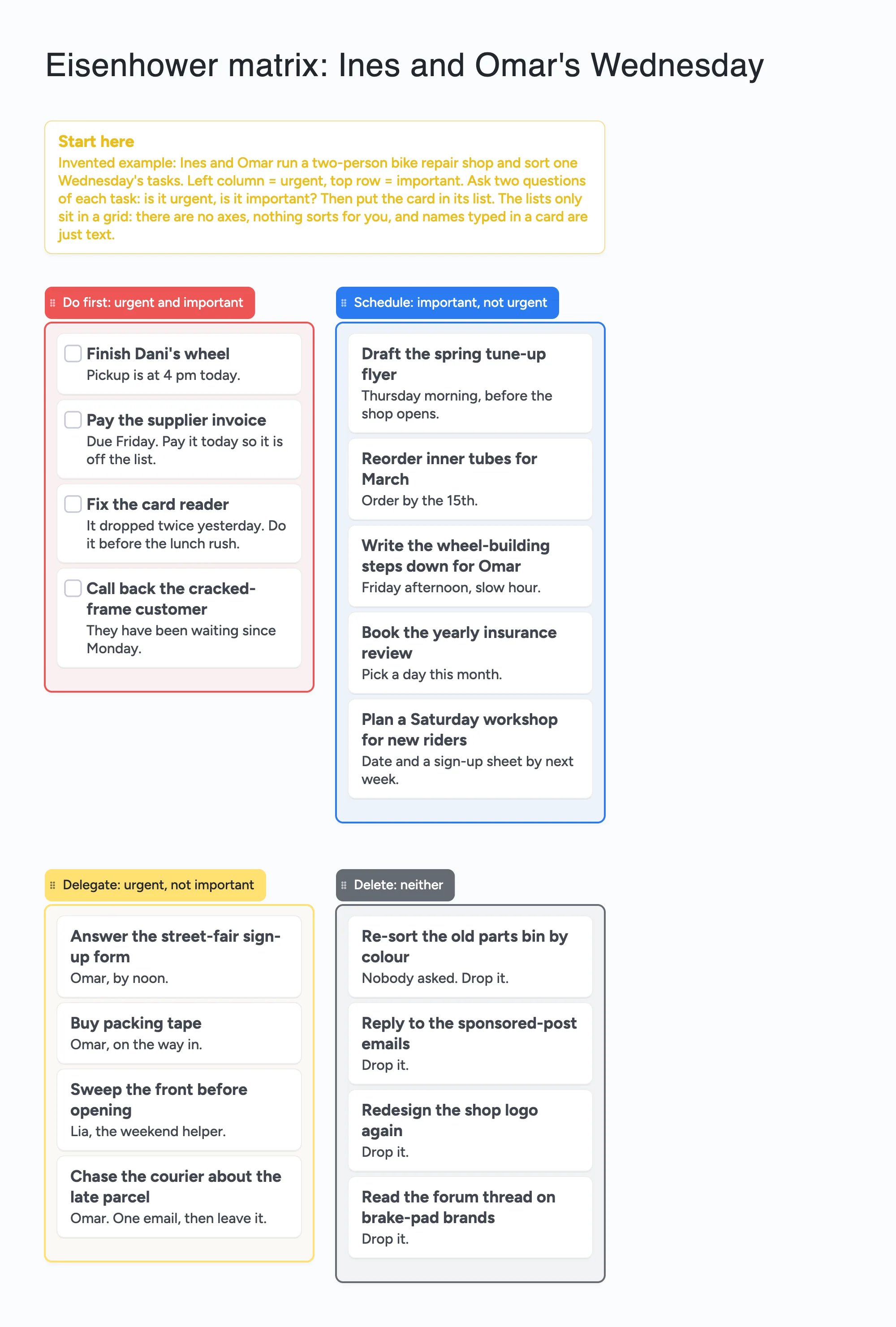
We make Instaboard, a free online board. This page gives you an Eisenhower matrix already laid out on it as four lists in a grid, filled in for one invented pair, Ines and Omar, who run a small bike repair shop and sort one Wednesday morning. Copy it, replace their tasks with yours, and send the link to whoever sorts with you. It is a sorting surface, not a 2x2 chart: the four lists sit in a grid, but there are no axes, nothing places a card for you, and nothing reminds anyone. If you want any of that, or you work alone and want it free with no sign-in, the tools named below do it better. Eisenhower is the name of a time-management method; we are not affiliated with or endorsed by anyone named on this page.
Opens in your browser. Anyone can view; a free sign-in lets you edit.
Updated
Read this first: what the board does and doesn't do
- What it is: four lists named Do first, Schedule, Delegate and Delete, laid out two by two, with 17 example cards from one invented Wednesday. You move a card by dragging it to the list you decide it belongs in. The example uses 23 of your 150 free items.
- What it isn't: not a chart. There are no urgent and important axes, nothing sorts or scores a card, nothing reminds anyone, and nothing repeats a task. The example sets no due dates. Names typed in a card (Omar, Lia) are plain text, not assignments. The Do first list has tick boxes you tick yourselves; nothing records who ticked or when.
- Who it's for: two or three people who want to sort one pile together on a screen, with one link. A person working alone with nobody to hand things to gets less from the method (see the Reddit threads below), and a free tool with no sign-in, or your usual to-do app, may suit you better.
- Where it comes from: the matrix is a later tool named after Dwight D. Eisenhower, who in a 1954 speech quoted an unnamed former college president on the urgent and the important. The summary below is ours and rests on pages we read; no one named here reviewed the board.
- Free plan: 5 boards, 150 items, 3 pictures per board. Copying the board takes 1 of your 5 boards. Writing on it needs a free sign-in. New boards start with "Anyone who joins can view". Pro adds invite-only boards: $5 a month billed yearly ($59.99 a year), or $7.99 monthly.
What four lists can't do
- No axes and no placement. A matrix is meant to show urgent against important at a glance. Here the grid is four lists you arrange yourselves; Miro's template page, for instance, lists a 2x2 grid with Importance and Urgency axes as a key part.
- No auto-sort. You decide where a card goes and drag it. Moving a card to another list changes nothing else on the card.
- No reminders or recurring tasks. A Schedule card says "Thursday morning" in its text; the example sets no due date and nothing reminds anyone. Asana's own steps for this method rely on owners, due dates and rules that move tasks; this board has no rules and sends no reminders.
- No who or when on a tick. Anyone with edit access can tick or untick a card, everyone sees it live, and nothing records who or when. A copy of the board keeps its ticks, so untick them before reuse.
- No private lists. New boards start with "Anyone who joins can view". Anyone you give the link to can read it. Set Share to "Anyone who joins can edit" only if the people sorting should write on it, and each person who writes signs in free.
- 3 pictures per board. The example has none.
Ines and Omar's Wednesday, list by list
The shop, the names and the tasks are invented. Read the board with the left column as urgent and the top row as important.
- Do first (urgent and important), 4 tick-box cards. Finish a customer's wheel before a 4 pm pickup, pay a supplier invoice due Friday, fix a card reader that dropped twice yesterday, call back a customer waiting since Monday. Each is on a clock and has a cost if it slips.
- Schedule (important, not urgent), 5 cards. A spring tune-up flyer, a reorder of inner tubes for March, writing the wheel-building steps down for Omar, a yearly insurance review, a Saturday workshop for new riders. Each card says when in its own words; nothing enforces it.
- Delegate (urgent, not important), 4 cards. A street-fair sign-up form, packing tape, sweeping the front, chasing a late parcel. Each names Omar or Lia in the text. The parcel card says one email, then leave it.
- Delete (neither), 4 cards. Re-sorting a parts bin by colour, replying to sponsored-post emails, redesigning the logo again, reading a forum thread about brake pads. Each says to drop it.
Seventeen cards in four lists is a Wednesday morning for two people. Ines and Omar clear the Delete cards and tick the Do first ones as they go, then start the next sort from a copy or by editing the same cards.
Where the name comes from, in three sources' words
Each page below was read in full on November 22, 2026. The summaries are ours.
| Source | What it says (our summary) | What the board takes |
|---|---|---|
| Quote Investigator, "What Is Important Is Seldom Urgent and What Is Urgent Is Seldom Important" (URL dated 2014/05/09; the page shows an update note of January 23, 2025) | It reports an August 19, 1954 address by Eisenhower in Evanston, Illinois, to the Second Assembly of the World Council of Churches. He quoted an unnamed former college president: "I have two kinds of problems, the urgent and the important. The urgent are not important, and the important are never urgent." The "seldom" versions appear later. It says it does not know whether Eisenhower used the matrix technique. | Nothing but the name. The board does not claim the method is his. |
| Todoist, "Avoid the Urgency Trap with the Eisenhower Matrix" (page shows no date) | Says Stephen Covey repackaged the idea in The 7 Habits of Highly Effective People into the matrix, and that Eisenhower quoted an unnamed university president in 1954. Four quadrants: urgent and important (do now), not urgent and important (schedule), urgent and unimportant (delegate), not urgent and unimportant (delete). Describes a "mere-urgency effect" from a Journal of Consumer Research study. Shows two Todoist setups: two labels plus four filters, or priority levels 1 to 4. | The four quadrant names and the do, schedule, delegate, delete actions. We do not use its labels or filters; we have neither. |
| Asana, "The Eisenhower Matrix: How to Prioritize Your To-Do List" (page title says 2026) | The same four quadrants; its sections are named Do, Schedule, Delegate and Delete. Its setup is a project with four sections, urgency and importance fields, an owner and a due date on each task, a weekly review, and optional rules that move a task when its due date nears. It says assigning owners and due dates turns the matrix "into an actionable plan, rather than a sorting exercise". | The four section names. The board is the sorting exercise only; owners and due dates are where Asana does more. |
Swipe the table sideways to see every column.
Pages read November 22, 2026: quoteinvestigator.com/2014/05/09/urgent, todoist.com/productivity-methods/eisenhower-matrix, asana.com/resources/eisenhower-matrix. The quotation is from Quote Investigator's transcript of the speech.
The Delegate list is where people get stuck
Each reply below is one person's view; counts are of the comments the page showed us.
From r/productivity, "The Eisenhower Matrix sounds interesting but what do I do with urgent-and-not-important tasks when I work alone and have no one to delegate?" (OP u/SirToxe, February 2, 2024; 24 of 31 comments shown). u/nuxxi's answer was that if the task would cause you problems when you don't do it, treat it as urgent and important. u/hugo2309 uses the urgent-but-unimportant list to ask how to stop those tasks coming back, and puts that fix in the not-urgent-but-important list. u/OneTalos, on TickTick, wrote that the default setup didn't help and remapped the four boxes by date: tasks due today, tasks due later, undated important tasks, and undated lower-priority tasks. A commenter whose account is deleted called the matrix "an illusion" that only helps you see what you must complete.
From r/productivity, "The Eisenhower Matrix: If a task isn't important, why delegate it at all?" (OP u/Effective-Start3859, April 23, 2026; 25 of 43 comments shown). u/conglies's top reply: an invoice needs paying, but not by the CEO. u/TotalRuler1 said the rubric fails when you can't delegate any task. u/CurrentRisk tried it in TickTick, found they were thinking about where to put a task more than doing it, and moved to plain lists in Things 3. u/everythingbagel1 suggested renaming "not important" to "relevant to me".
From r/projectmanagement, "I don't understand the Eisenhower Matrix" (OP u/Otherwise-Peanut7854, October 7, 2025; 10 of 16 comments shown). u/Cranifraz described it as an exercise to separate urgency from importance. u/Pomponcik gave the one-line version: urgent and important, do it; only important, plan it; only urgent, delegate it; neither, discard it.
Two lessons for this board: the Delegate list only works when someone else exists, so the example names Omar and Lia and the page says it is for a pair or small crew; and the sorting can cost more time than the tasks, so the cards stay short and the board is meant to be cleared and re-sorted, not kept.
Where other tools do this better
Read on November 22, 2026; plans and pages change, so check the page. A source date is printed only where the page shows one.
| Tool | What the page says | Better for |
|---|---|---|
| Eisenhower Matrix app (eisenhowermatrix.com, no date) | Says it is free forever for personal use, with a free tier of 5 projects, 100 active tasks and 250 total items; workspaces to share priorities with teammates and clients; voice capture, natural-language dates, smart reminders (the page does not say which plan includes them), iOS, mobile web, Microsoft Teams and Google Play; Pro at $8 a month | A real matrix app with voice capture and date parsing, free for one person; check what its free tier includes before counting on reminders |
| Priority Matrix (prioritymatrix.com, no date) | Describes shared team matrices in Outlook, Teams and the web, with templates and reminders; no price read | A team that works in Microsoft 365 and wants reminders and follow-up |
| eisenhowermatrixtool.com (no date) | A free online tool with the four quadrants (Do First, Schedule, Delegate, Eliminate) and no account; the page says items are saved in your browser's local storage and not sent anywhere. It describes no sharing | One person, one browser, no sign-in |
| Miro template page (no date) | Says a good board has five parts: a 2x2 grid with Importance and Urgency axes, a brainstorming bucket, action icons, a weekly focus goal and a delegate log; account and price terms not read | A real 2x2 on a canvas with sticky notes |
| Todoist (page shows no date) | Setup with labels and filters or priority levels; says you can share projects and assign tasks | People who already keep their to-dos in Todoist |
| Asana (page title says 2026) | A project with four sections, owner and due date fields, rules; plan and price terms not read | A team that needs owners, due dates and a weekly review |
| Vertex42 (page shows Updated 2/16/2023) | A free Eisenhower matrix template for Excel and Google Sheets and an editable PDF; licence "Private Use" | A file you print or fill in alone |
| Instaboard board | Free: 5 boards, 150 items, 3 pictures per board. Pro $5 a month billed yearly ($59.99 a year), or $7.99 monthly | Two or three people sorting one pile on one screen, with one link |
Swipe the table sideways to see every column.
From each page, read November 22, 2026: eisenhowermatrix.com, prioritymatrix.com, eisenhowermatrixtool.com, miro.com/templates/eisenhower-matrix, todoist.com/productivity-methods/eisenhower-matrix, asana.com/resources/eisenhower-matrix, vertex42.com/ExcelTemplates/eisenhower-matrix.html. Our wording, not theirs.
Where these win
If you work alone, the browser tool needs no sign-in and the free matrix app adds voice capture and dates. If you need owners, due dates or a weekly review, use Asana, Todoist or Priority Matrix. If you want a true 2x2 with axes, use Miro. Use this board when two or three people want to sort one pile together on a screen, in short cards, with one link.
How to use it, in about ten minutes
- Open the board and sign in free when it asks you to write. Delete the bike shop cards.
- Dump the pile first. Add each task as a card in whichever list is closest, before sorting. Keep titles short.
- Ask two questions of each card: is it urgent, is it important? Urgent means it has a clock and a cost if it slips. Important means it serves a goal you named. Drag the card to the list that matches.
- Name who in the card text for anything in Delegate. It is only text; check in with that person yourself.
- Tick Do first as you go. Delete the Delete cards. Don't keep them.
- To share it, set Share to "Anyone who joins can edit" if the other person should write on it. Each person who writes signs in free.
- Next sort, edit the same cards or copy the board and start from the top row. A copy takes 1 of your 5 boards and keeps its ticks.
How many tasks fit in 150 items?
Each card and each list is 1 of your 150 free items, across all your boards. The title text box counts too. Arrows, sections and pen strokes don't. Our arithmetic from the example:
- As built: 4 lists + 17 sorted cards + the Start here card + 1 title = 23.
- Four people each sorting 17 cards on one board: 4 lists + 68 cards + 2 = 74.
- Never clearing it: 17 new cards a week on the same four lists reach 4 + 17 x 8 + 2 = 142 after 8 weeks and 159 after 9, over 150. Clearing the Delete and finished cards each time keeps it small.
This is a small board by design. Those items count against the same 150 as your other boards.
Start from the ready board
It opens in your browser in a few seconds, with nothing to install. Sign in for free when you want to save it and share it.
Questions
What is the Eisenhower matrix?
It is a way of sorting tasks into four groups by whether they are urgent and whether they are important: do the urgent and important ones first, schedule the important but not urgent ones, delegate the urgent but not important ones, and delete the rest. It is named after Dwight D. Eisenhower, who in 1954 quoted an unnamed former college president on the urgent and the important; Quote Investigator says it does not know whether he used the matrix himself.
Is there a free Eisenhower matrix template I can use online?
Yes. Open the board, replace the example tasks with yours and write on it after a free sign-in. It is four lists, not a chart with axes. Free apps and browser tools such as eisenhowermatrix.com and eisenhowermatrixtool.com give you a real quadrant view if you want one.
Can my partner or team sort on the same board?
Yes. New boards start with "Anyone who joins can view", so anyone with the link can read it. Set it to "Anyone who joins can edit" if the other person should write too; each person who writes signs in free.
Does the board put tasks in the right quadrant for me?
No. You decide and drag. There are no axes, no scoring, no reminders and no rules, so nothing moves a card as a deadline nears.
What do I do with urgent tasks I can't delegate?
People on r/productivity disagree. One commenter said to treat them as urgent and important if you'd have problems otherwise, another uses them to work out how to stop them coming back, and a third said the matrix fails when you can't delegate anything. The board doesn't settle it; it holds whichever answer you pick.
Is Instaboard free?
Yes. The free plan includes 5 boards, 150 cards and items across your account (pen strokes, arrows and sections don't count), 3 images and 1 file per board, unlimited collaborators and video calls up to an hour. Pro is $5 a month billed yearly ($59.99 a year), or $7.99 monthly, and the people you invite join free.
Sources
- Quote Investigator: What Is Important Is Seldom Urgent and What Is Urgent Is Seldom Important (URL dated 2014/05/09; page shows an update note of January 23, 2025; read November 22, 2026)
- Todoist: Avoid the Urgency Trap with the Eisenhower Matrix (page shows no date; read November 22, 2026)
- Asana: The Eisenhower Matrix: How to Prioritize Your To-Do List (title says 2026; read November 22, 2026)
- Eisenhower Matrix app (page shows no date; read November 22, 2026)
- Priority Matrix (page shows no date; read November 22, 2026)
- The Eisenhower Matrix Tool (page shows no date; read November 22, 2026)
- Miro: Eisenhower matrix templates (page shows no date; read November 22, 2026)
- Vertex42: Eisenhower Matrix Template (page shows Updated 2/16/2023; read November 22, 2026)
- r/productivity: The Eisenhower Matrix sounds interesting but what do I do with urgent-and-not-important tasks when I work alone (OP u/SirToxe, February 2, 2024; replies are single accounts, 24 of 31 comments loaded, read November 22, 2026)
- r/productivity: The Eisenhower Matrix: If a task isn't important, why delegate it at all? (OP u/Effective-Start3859, April 23, 2026; replies are single accounts, 25 of 43 comments loaded, read November 22, 2026)
- r/projectmanagement: I don't understand the Eisenhower Matrix (OP u/Otherwise-Peanut7854, October 7, 2025; replies are single accounts, 10 of 16 comments loaded, read November 22, 2026)
Related
A GTD template on one shared board: inbox, next actions, projects and a Friday review
A Getting Things Done style template on one shared board: inbox, next actions by context, projects, waiting for, someday and a Friday review. What a board can't do, and the apps that can.
A now next later roadmap template on one shared board
A now next later roadmap template on one shared board: problems not dates, a Not doing list, evidence beside it. Filled in for a three-person team. No timeline, votes or reminders.