For writers outlining an episode or a short story that has to come back changed
A story circle template on one shared board: eight steps in a ring that loops back
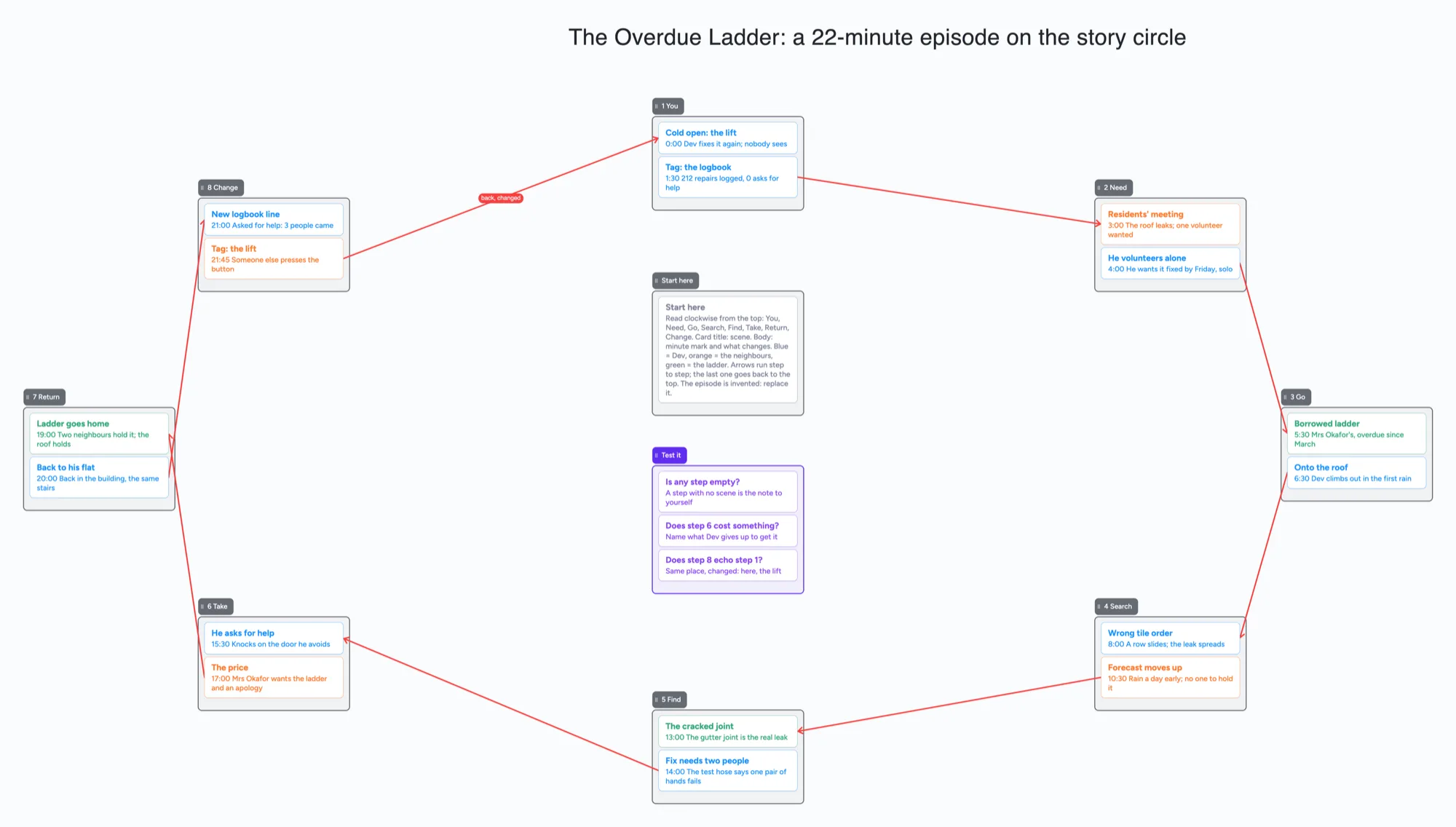
We make Instaboard, a free online board. This page gives you Dan Harmon's story circle already laid out on it: eight step lists in a ring, two scene cards under each with a minute mark, a short test list, and a last arrow from step 8 back to step 1. It is the right shape when your story is one 22-minute episode or a short story and the question is whether the character comes back changed. It is the wrong tool for a script, a timeline or a spreadsheet. The episode is invented. Open it, replace it with yours, and send one link to a co-writer or a script reader. The idea is Dan Harmon's; this page and board are not affiliated with or endorsed by him.
Opens in your browser. Anyone can view; a free sign-in lets you edit.
Updated
The short answer
- Use this board when the story is an episode or a short story and the point is the return. Eight lists sit in a ring, step 1 at the top and step 8 at the end of the loop; an arrow runs from each step to the next and the last one goes back to the top. If you want a line of 12, 15 or 7 beats, use our Hero's Journey board, novel beat sheet or seven-point board instead.
- The eight steps, as StudioBinder, Reedsy and Arc print them: a character is in a zone of comfort (you); they want something (need); they enter an unfamiliar situation (go); they adapt to it (search); they get what they wanted (find); they pay a heavy price for it (take); they return to their familiar situation (return); having changed (change). Step labels differ a little between sources. We use You, Need, Go, Search, Find, Take, Return, Change.
- Each scene is a card: the scene title on top, the minute mark and what changes underneath. Two cards per step make a 22-minute episode: 16 scenes.
- What it doesn't have: no script formatting, no timeline axis, no running time that adds up, no import or export of a story-circle file, no AI that fills it in, no pictures beyond 3 per board.
- Count the items before you copy it. The example is 10 lists (8 steps, Start here, Test it), 20 cards (16 scenes, 1 Start here, 3 Test it) and the title text box: 31 of your 150 free items (our arithmetic). Arrows, sections and pen strokes don't count.
- Pro lifts the limit: $5 a month billed yearly ($59.99 a year), or $7.99 monthly. The free plan keeps 5 boards, 150 items and 3 pictures per board.
- Anyone with the link can read it; writing takes a free sign-in. New boards start view-only. Set "Anyone with the link can edit" if a co-writer should add cards.
How this differs from our other structure boards
We have several structure boards. They hold different shapes, so pick the one that matches your story.
| Board | Shape | The question it answers |
|---|---|---|
| Story circle (this page) | 8 steps in a ring; the last loops to the first | Does the character come back changed, and what did it cost? |
| Hero's Journey | 12 stages in a line | What are the stages of a longer departure, trials and return? |
| Seven-point structure | 7 points planned back from the ending | Where do the hook, turns, pressure and resolution sit? |
| Novel beat sheet and screenplay beat sheet | 15 beats in a line | Where does each beat land across a whole book or feature? |
| Short film outline | 3 acts with minute marks | What happens in what order in a short film? |
Swipe the table sideways to see every column.
The shapes are those of the boards' own pages (our reading).
Those boards: Hero's Journey, seven-point structure, novel beat sheet, screenplay beat sheet and short film outline.
The circle is the smallest of these. StudioBinder says Harmon consolidated Joseph Campbell's Hero's Journey from 17+ steps into a more contemporary set of 8; Plottr says it is adapted from the Hero's Journey; Storyflow, a vendor, calls it a compressed reading of the monomyth built for television, where a complete arc has to land in twenty-two minutes. Wikipedia says Harmon cites Christopher Vogler's The Writer's Journey and Syd Field as influences. All of these describe the circle in their own words; the board uses ours.
How to fill in a story circle
- Write steps 1 and 8 first, side by side. The circle only works if the end echoes the start in a changed form. The example opens on a handyman fixing a lift where nobody sees, and ends with someone else pressing the button for him.
- Write what the character wants in step 2 as one thing. Not a theme, an object or an outcome you could see on screen. In the example it is a leak fixed by Friday, solo.
- Put the unfamiliar situation at step 3 and the price at step 6. The example's price is a ladder returned with an apology. A step 6 that costs nothing is the note to yourself on the Test it list.
- Give each step two scene cards, then move cards until the minute marks run in order. Scene title in the card title, minute mark and what changes in the body. Colour cards by thread: blue for the lead, orange for the people around them, green for the object that carries the plot.
- Draw the arrows. An arrow joins a card in one list to a card in another and stays attached when you reorder cards or move a list. The example has eight, one per step, and the last is labelled back, changed.
- Run the Test it list. Is any step empty? Does step 6 cost something? Does step 8 echo step 1?
- Share it. In the share menu set "Anyone with the link can edit" (new boards start view-only). A co-writer signs in free and writes live. If you each own a thread you never type in the same card; two people typing in one card merge letter by letter.
Writers disagree about how much a structure like this helps. In an r/writing thread on the story circle (June 2015, 608 votes, 129 comments), u/BlaineTog wrote that the circle should be held at arm's length because rigid structure can limit creativity, and u/Bartweiss wrote that tight structure is valuable for half-hour comedy and plodding for a novel. Those are two accounts, not a measurement. Arc Studio's own page lists as cons that the structure may be too open for some and purposely skimps on detail. The board suits any of these views: steps are lists you can rename, reorder or delete.
Story circle templates and tools, side by side
Each row is from the tool's own pages, read on November 19, 2026. Features and prices change, so check the page before you choose.
| Tool | What its page says | Where it beats a shared board | Where a shared board fits |
|---|---|---|---|
| Instaboard board | Free: 5 boards, 150 items. Pro $5 a month billed yearly ($59.99 a year), or $7.99 monthly | Nothing in this table on script formatting, AI or worksheets | A ring you can see at once, arrows between scenes, a co-writer on the same link after a free sign-in |
| Storyflow | A story circle template page: eight steps as movable cards on an infinite canvas, or ask its AI to lay them out. It says it does not format screenplays, paginate, or export to Final Draft | AI that lays out the cards; characters and research on the same canvas | No AI and no paid plan: a free board you open in a browser |
| StudioBinder | A free story circle bundle: printable worksheet, online workbook and an infographic example (The Dark Knight). The page asks for an email address to send it | A printable worksheet for an in-person meeting; a worked film example | A live board two people edit, with no download |
| Plottr | A story circle template and a guide using Inception as its example | A timeline and many other structures in one app | No install and no price for a one-episode outline |
| Arc Studio | A story circle template inside the screenwriting app, and a blog post listing the beats and the pros and cons | Outline and script in one place | A shared outline before there is a script |
| Notion template (Make Fiction) | A free story circle template | Notion's own notes and pages beside your outline | A visual ring instead of a page |
| Reedsy | A free guide that walks the eight steps through an episode of Rick and Morty | A full written example to read | A board to fill in, not an article |
Swipe the table sideways to see every column.
From each tool's own pages, read November 19, 2026. The Notion template is listed as free. Prewrite also lists a story circle template; its price and plan limits were not checked.
What a story circle template costs over three years
Prices are each tool's own page, read on November 19, 2026, multiplied by three years (our arithmetic). Sale prices change.
| Tool | Price on its page | Three years |
|---|---|---|
| Instaboard board | Free: 5 boards, 150 items. Pro $59.99 a year, or $7.99 a month | $0 on Free; $179.97 on Pro yearly (3 x $59.99); $287.64 on Pro monthly (36 x $7.99) |
| Storyflow | Plus $7.99 a month billed yearly, or $9.99 monthly; its page says a free plan launches before the end of 2026 | $287.64 (36 x $7.99) or $359.64 (36 x $9.99); free plan not yet listed |
| StudioBinder story circle bundle | Free, sent by email | $0 for the bundle |
| Plottr | $60 a year; Pro $99 a year; $150 lifetime; Pro $9.99 monthly | $180 (3 x $60); $297 (3 x $99); $150 once |
| Arc Studio | Free $0 (2 scripts, PDF export with a watermark); Essentials $69 a year; Pro $99 a year | $0; $207 (3 x $69); $297 (3 x $99) |
| Notion template (Make Fiction) | Free template; Notion's own plans not read | $0 for the template |
Swipe the table sideways to see every column.
Each figure is from the tool's own page, read November 19, 2026; the three-year column is our arithmetic. Reedsy's guide is free to read. Storyflow, Plottr and Arc Studio do more than a board: AI, timelines, script writing.
Where each one runs
From each tool's own pages, read November 19, 2026. Where a page does not state a platform, none is claimed.
| Tool | What its page says it runs on |
|---|---|
| Instaboard board | In a browser, and in the iPhone, iPad and Android apps. Changes made offline are kept and sync when you reconnect; it is not an offline-first app |
| Storyflow | Not checked |
| StudioBinder bundle | A printable worksheet and an online workbook sent by email; platforms not checked |
| Plottr | Windows and Mac; a browser app and real-time collaboration are on Pro only |
| Arc Studio | Its pricing page marks the desktop app and the iPhone and iPad app "Not included" on Free and "Included" on Essentials and Pro |
From each tool's own pages, read November 19, 2026.
Which story circle tool for which job
No ranking: these are different jobs.
- Reading about the steps first: Reedsy's guide or StudioBinder's guide, both free to read.
- A printable worksheet for a room: StudioBinder's bundle.
- AI that lays the cards out for you: Storyflow, which is paid today.
- The outline and the script in one app: Arc Studio, which has a story circle template.
- A timeline beside the steps: Plottr.
- Notes and a database around it: the free Notion template.
- One ring you and a co-writer move cards around, free to open: this board. A co-writer signs in free to edit. It has no script pages, no AI and no link by name.
How many scenes fit
On this board the 10 lists (8 steps, Start here and Test it), the 4 cards in Start here and Test it, and the title text box are 15 items before any scene:
- 16 scene cards (two per step): 15 + 16 = 31 of your 150 free items.
- 24 scene cards (three per step): 15 + 24 = 39.
- The most the free plan holds: 150 - 15 = 135 scene cards, with nothing else on the account.
- The example as it is is 31 items, so four boards like it use 124 of the 150 across your boards and a fifth passes the limit (5 x 31 = 155).
Arrows, sections and pen strokes are free. This is our arithmetic; Pro removes the item limit.
When another tool is the better choice
- You want the AI to fill the cards in. Storyflow offers that; the board has no AI.
- You want to write the script now. Use a screenwriting app. The board holds the plan, not the pages.
- You want a printed worksheet. StudioBinder's bundle is built for that.
- You want a timeline. Plottr has one; the board has no time axis.
- Your story is a long line, not a loop. Use the Hero's Journey, seven-point or beat sheet boards linked above.
- You want to learn why the steps work. Read Reedsy's or Arc Studio's guide first; a board does not teach.
Limits of the free plan for a story circle board
- Items. Each card and each list is 1 of your 150 free items, across all your boards. The example is 16 scene cards, 4 other cards, 10 lists and the title text box, 31 in all. Arrows, sections and pen strokes don't count.
- Boards. The free plan includes 5 boards. Keep the whole circle on one board.
- Photos. 3 images per board. The example has none.
- No script or AI features. No script formatting, running-time sum, import, export, tagging or reminders.
- The ring is placed by hand. Lists don't snap to a circle; the layout is just where you put the lists.
- Writing needs a free sign-in. A co-writer who joins by link or code can add cards and arrows, and the board counts as one of their 5 boards.
- If you are under 18, check with a parent or your school before you sign up. This page is written for people 13 and older.
Start from the ready board
It opens in your browser in a few seconds, with nothing to install. Sign in for free when you want to save it and share it.
Questions
Is there a free Dan Harmon story circle template?
Yes, several. The ready board here has eight step lists in a ring, two scene cards under each, a Test it list and an arrow that loops back from step 8 to step 1. It is free within 5 boards and 150 items, and you open it and replace the example episode with yours. StudioBinder sends a free worksheet bundle by email and a free Notion template exists. The board is something you move cards on, not a printable worksheet or a script editor.
What are the eight steps of the story circle?
As StudioBinder, Reedsy and Arc Studio print them: a character is in a zone of comfort, they want something, they enter an unfamiliar situation, they adapt to it, they get what they wanted, they pay a heavy price for it, they return to their familiar situation, and they have changed. Sources label the steps slightly differently: You, Need, Go, Search, Find, Take, Return, Change is the common set.
How do I use the story circle to outline a TV episode?
Write step 1 and step 8 first and make the last echo the first in a changed form. Put what the character wants in step 2 and what it costs in step 6. Then give each step one to three scenes with a minute mark and what changes, and move cards until the order holds. In a 22-minute episode that is about two scenes a step in the example here. Storyflow's page says the circle suits television, where a complete arc has to land in twenty-two minutes.
Story circle vs hero's journey: which should I use?
StudioBinder says Harmon consolidated Campbell's Hero's Journey from 17+ steps into 8, and Plottr says the circle is adapted from it. The Hero's Journey has more stages and suits a longer departure and return; the circle has eight and suits an episode or a short story. A board can hold either: 8 lists in a ring here, or 12 stages in a line on our Hero's Journey board.
Is the story circle only for TV?
No. Plottr's guide uses a film, Inception, as its example, and StudioBinder's page shows it on The Dark Knight. Storyflow says the same eight steps can describe an episode, a scene, a season and a series, which is that vendor's claim. On this board you can use the ring at any size; a short story or a single scene works with fewer cards.
How many scenes fit on the free plan?
Each card and each list is one item of the 150 across all your boards. With 10 lists, 4 other cards and the title text box, 16 scene cards is 31 items and 24 is 39. The most a board holds is 135 scene cards. That is our arithmetic. Arrows and sections are free.
Is this affiliated with Dan Harmon?
No. The story circle is Dan Harmon's idea. This page and board are our own wording of the eight steps, from StudioBinder, Reedsy and Arc Studio, and are not affiliated with or endorsed by him.
Sources
- StudioBinder: free story circle template and workbook (eight steps, free bundle by email; read November 19, 2026; page shows no date)
- StudioBinder: Dan Harmon's story circle guide (read November 19, 2026; page shows no date)
- Reedsy: Dan Harmon's story circle (eight steps, Rick and Morty walkthrough; read November 19, 2026; page shows no date)
- Arc Studio: the story circle, Dan Harmon (beats, pros and cons; read November 19, 2026; page shows no date)
- Arc Studio: pricing (read November 19, 2026)
- Storyflow: story circle template (paid plan, no screenplay formatting; read November 19, 2026; page shows no date)
- Plottr: story circle plot template (read November 19, 2026; page shows no date)
- Plottr: pricing (read November 19, 2026)
- Notion: Dan Harmon's Story Circle template by Make Fiction (free; read November 19, 2026)
- Wikipedia: Dan Harmon (story circle, influences; read November 19, 2026)
- r/writing: thread on Dan Harmon's story circle (June 2015; replies are single accounts; read November 19, 2026)
Related
A hero's journey template board: twelve stages, the figures, and where your story bends the model
A shared hero's journey template: 12 stage cards in three lists, the figures who appear, and a list for where your story merges, repeats or skips a stage. Free to open.
A 7-point story structure board: seven points, planned from the end, scenes under each
A 7-point story structure outline to open and edit: seven lists from Hook to Resolution with scene cards under each, plus a try/fail list. Free-plan item counts and where other tools are better.
A novel beat sheet on one shared board: 15 beats, three acts, scenes under each beat
A 15-beat novel outline to open and edit: 3 act sections, a list per beat, scene cards under each. Free-plan item counts and where other tools are better.
A screenplay beat sheet on one shared board: 15 beats, scenes under each, with pages
A 15-beat feature screenplay outline to open and edit: three act sections, a list per beat with its page, scene cards under each. Free-plan item counts and better tools.
A short film outline on one shared board: three acts, minute marks, the payoff in one line
A short film outline to open and edit: logline, payoff, three act sections with minute marks, scene cards under eight story steps. Free-plan item counts and better tools.
A character arc template board: how each character changes, tied to the plot
A shared character arc template: a list per character with want, lie, first change, midpoint shift, low point and end state, tied to your plot beats by arrows. Free to open.