For biology, A&P and nursing students
Build an endocrine system concept map from your own notes
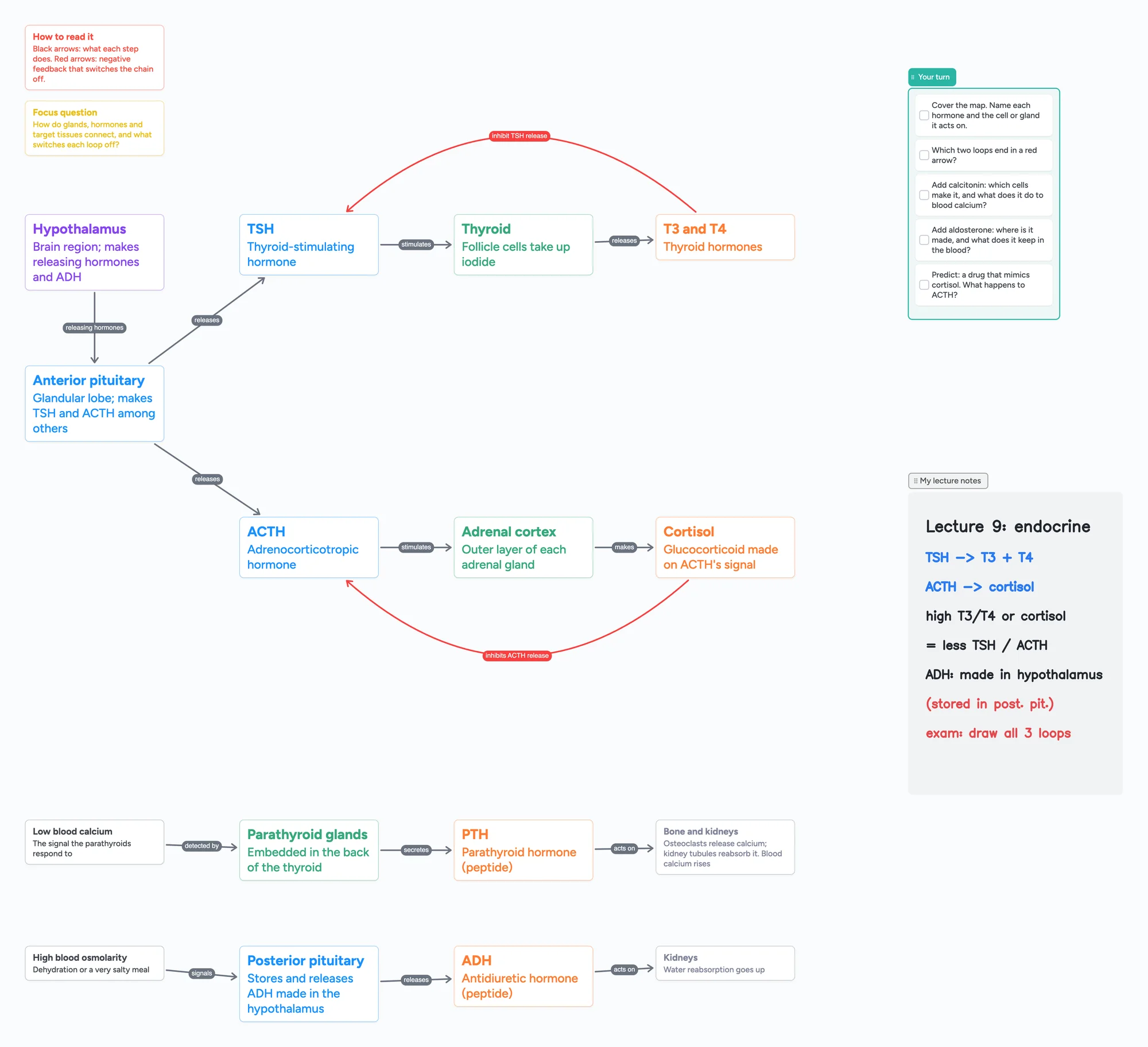
The endocrine system is too big for one tidy diagram, so a good map starts with one question and follows each hormone from the gland that makes it to the tissue it acts on and the signal that switches it off. Below: how to build one from your lecture notes, and a finished example with four pathways you can open and change. There is no answer key here. The map is yours, and building it is how you find what you don't know yet.
Updated
The short answer
- Pick a focus question, such as "how does each hormone connect a gland to its target, and what switches it off?"
- One card per gland, hormone and target tissue. Join them with arrows and write the verb on every arrow: "releases", "stimulates", "inhibits".
- Draw feedback in a second colour. The loops are what exams ask about.
- Lay it out yourself. Instaboard has no automatic layout, no AI and no answer key; you place every card.
Decide what the map is for before you draw
A map of "the endocrine system" ends up as a poster of every gland. A map of one question ends up as something you can revise from. Three focus questions that work:
- Gland to target: which hormone does each gland release, and what does it act on?
- Control: what tells each gland to release, and what tells it to stop?
- One exam topic: for example calcium balance, or how the body holds on to water.
The example board follows the first two questions across four pathways. For a single pathway in more depth, such as the stress response, see the biology concept map guide, which walks through the HPA axis in full.
The four pathways on the example board
The facts come from OpenStax Anatomy and Physiology 2e, chapter 17, read on November 2, 2026. Your lecture may use different wording or add more hormones, so check anything that matters for your exam against your own course material.
Thyroid: hypothalamus, anterior pituitary, thyroid
- The anterior pituitary releases TSH (thyroid-stimulating hormone), which stimulates thyroid hormone release from the thyroid.
- TSH binds to receptors on the thyroid's follicle cells and makes them take up iodide ions from the blood.
- T3 and T4 are the thyroid hormones. OpenStax describes a negative feedback system in which increasing levels of T3 and T4 decrease the production and secretion of TSH (and, in the pituitary chapter, a drop in TRH from the hypothalamus too). That is the red arrow at the top of the board.
Adrenal cortex: ACTH and cortisol
- The anterior pituitary releases ACTH, which stimulates hormone release by the adrenal cortex.
- In the stress response, ACTH stimulates the adrenal cortex to make cortisol.
- Cortisol then feeds back on both the hypothalamus and the anterior pituitary, inhibiting CRH and ACTH release (StatPearls, Physiology, Cortisol). That is the red arrow back to ACTH, the same negative-feedback pattern as the thyroid loop; add a CRH arrow if your course wants it. The HPA axis lesson walks through it.
- The adrenal medulla and its hormones epinephrine and norepinephrine belong to the short-term fight-or-flight pathway, a different arrow from the hypothalamus. Keep the two apart.
Parathyroid: calcium
- The parathyroid glands are embedded in the back of the thyroid gland.
- They secrete PTH, a peptide hormone, in response to low blood calcium.
- PTH stimulates osteoclasts, which degrade bone and release calcium, and increases calcium reabsorption in the kidney tubules. Both raise blood calcium.
Posterior pituitary: ADH
- The posterior pituitary doesn't make hormones. It stores and releases hormones made in the hypothalamus, and ADH (antidiuretic hormone) is one of them.
- High blood osmolarity, for example from dehydration or a very salty meal, leads the posterior pituitary to release ADH.
- ADH is a peptide hormone that stimulates water reabsorption by the kidneys.
Gaps left on purpose
The board's "Your turn" list asks you to add calcitonin (made by the thyroid's parafollicular cells; OpenStax says its role in calcium balance is not entirely understood) and aldosterone (the major mineralocorticoid, which raises sodium retention and blood volume). Adding them yourself is the point: a map you didn't build is a picture, not a study tool.
Build it from your lecture notes
- Put the focus question on a card in the corner.
- Pull out the nouns. Go through your slides or handwritten pages and make one card for each gland, hormone and target tissue. Nouns, not sentences.
- Order them. Put the controlling structures (hypothalamus, pituitary) at the top and the targets at the bottom or the right. Don't connect anything yet.
- Draw the arrows and write the verb on every one. If you can't name the link, that's the part of the lecture to reread.
- Add the feedback arrows in a different colour, from the hormone back to whatever released it.
- Keep your source beside the map. Drop a photo of your handwritten notes or import the lecture PDF next to it, as the example board does with its lecture-notes section.
A card can open into its own board, so a gland with a lot of detail can have a board of its own without cluttering the overview.
When one pathway needs more than a card
Boardling is a YouTube channel that builds one biology board per lesson. Each lesson page has the video, written notes, a practice question and the finished board to copy.
- HPA axis, gland by gland: lesson and notes, the stress pathway on the adrenal row of this map.
- Tropic vs non-tropic hormones: lesson and notes, why TSH and ACTH are called tropic hormones.
- Steroid vs peptide hormones, and where each receptor sits: lesson and notes, the difference between cortisol and PTH or ADH.
- The juxtaglomerular apparatus: lesson and notes, the kidney's side of the aldosterone and blood-volume loop.
For how concept maps work in general, and a recall check to test yourself with, see make a biology concept map from your own notes. Nursing students can start from the patient concept map.
When another tool fits better
- You want the layout done for you. Lucidchart, Creately and EdrawMind arrange shapes automatically. Instaboard doesn't; you place each card.
- You want an answer key. Your textbook, instructor and worksheet have those. This page and its board are an example to learn from, not a marked answer.
- You want AI to draw it. Instaboard has no AI and won't generate a map from your notes.
- You need a printout. Instaboard exports whole boards as PDF only for drawing boards. For a map like this, share a link or take a screenshot.
What to know before you start
- Free covers 5 boards and 150 cards and items across your account. Arrows, sections and pen strokes don't count toward the 150.
- 3 images per board on Free. Enough for a few photos of notes; Pro has no image limit.
- No automatic layout, no AI, no flashcard mode.
- Sharing with a study group: anyone with the link can view; to edit, they sign in for free.
Start from the ready board
It opens in your browser in a few seconds, with nothing to install. Sign in for free when you want to save it and share it.
Questions
How do you make a concept map of the endocrine system?
Start with one focus question, put each gland, hormone and target tissue on its own card, join them with arrows and write the verb on every arrow, then add feedback loops in a second colour. Keep the map to the pathways your course covers instead of every gland.
Is there an answer key for the endocrine system concept map?
Not here. The board is a worked example of four pathways, checked against OpenStax Anatomy and Physiology 2e, and it leaves gaps for you to fill. Your instructor's version is the one that counts for your course.
What is the difference between a concept map and a mind map for endocrine topics?
A mind map branches out from one central word and usually leaves the lines unlabelled. A concept map labels every link and can loop back, which suits hormone pathways because so many of them end in a feedback loop.
Can I make one on an iPad?
Yes. Instaboard has an iPad app, and the same board opens in any browser and on Android. You can add cards and arrows with your finger and write with Apple Pencil.
Does Instaboard draw the map or check my answers for me?
No. There is no AI and no automatic layout: you place and connect every card yourself.
Is Instaboard free?
Yes. The free plan includes 5 boards, 150 cards and items across your account (pen strokes, arrows and sections don't count), 3 images and 1 file per board, unlimited collaborators and video calls up to an hour. Pro is $5 a month billed yearly ($59.99 a year), or $7.99 monthly, and the people you invite join free.
Sources
- OpenStax Anatomy and Physiology 2e: 17.3 The Pituitary Gland and Hypothalamus (read Nov 2, 2026)
- OpenStax Anatomy and Physiology 2e: 17.4 The Thyroid Gland (read Nov 2, 2026)
- OpenStax Anatomy and Physiology 2e: 17.5 The Parathyroid Glands (read Nov 2, 2026)
- OpenStax Anatomy and Physiology 2e: 17.6 The Adrenal Glands (read Nov 2, 2026)
- StatPearls: Physiology, Cortisol (NCBI Bookshelf NBK538239, read Nov 2, 2026)
- Novak & Cañas: The Theory Underlying Concept Maps and How to Construct and Use Them (IHMC)
Related
Make a biology concept map from your own notes
Turn your lecture notes into a biology concept map: concepts on cards, labelled arrows, feedback loops and a recall check. Worked example on the HPA axis, a ready board to copy, and a nursing version.
Build a nursing concept map for your patient
How to build a nursing concept map from your clinical notes, step by step: patient, pathophysiology, assessment data, labs, meds, priority problems, interventions and outcomes. A worked heart failure example you can open and edit.
A free infinite canvas app for your notes, on Windows, Android, Chromebook and iPad
Free infinite canvas apps for class notes on Windows, Chromebook, Android and iPad: where each one runs, what its free plan really gives, and a ready notes board to open.