For two adults dividing up a home
A household responsibilities board for two: who owns what, on one page
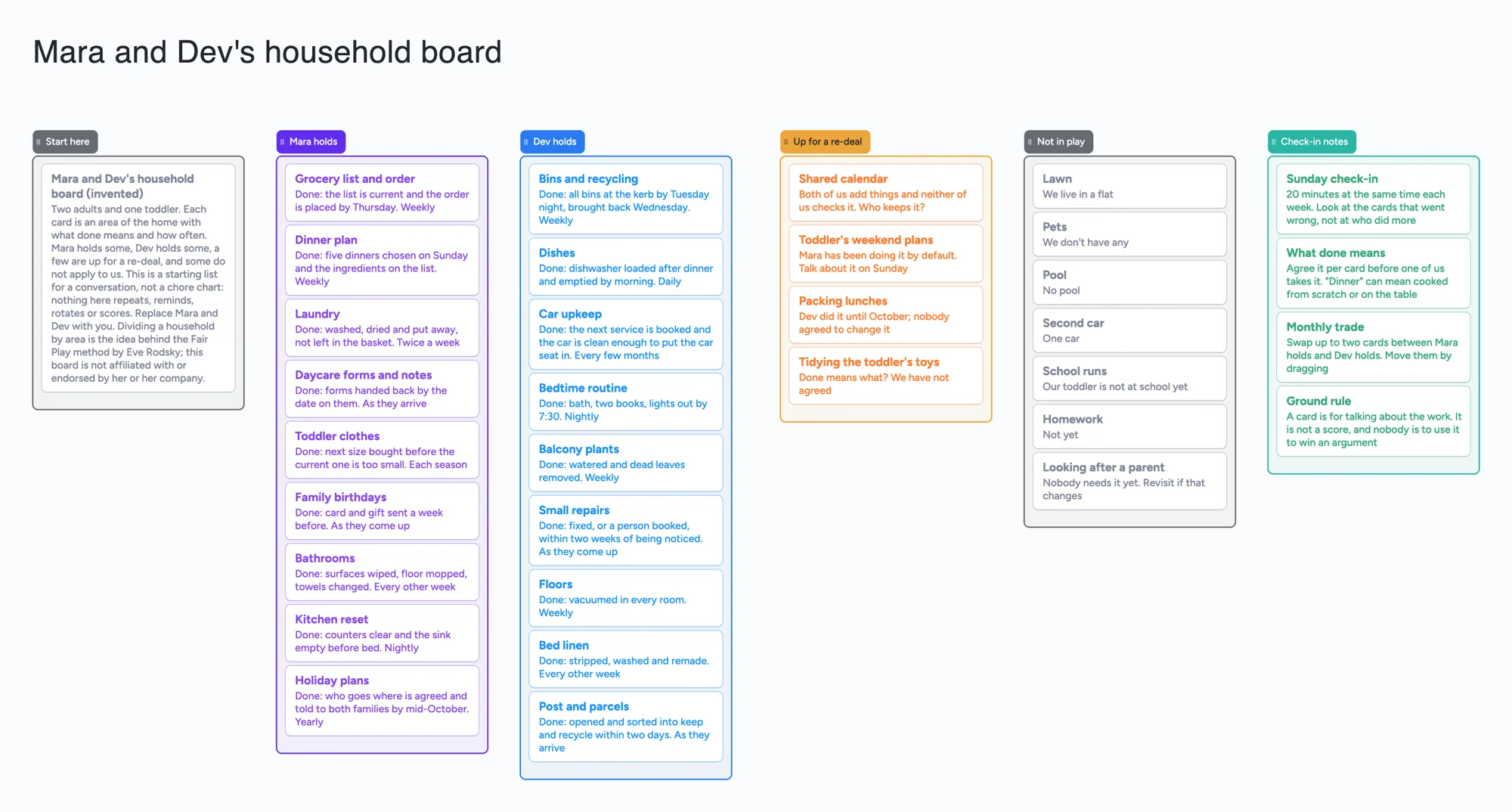
We make Instaboard, a free online board. Read this before the board: it is not a chore chart. Nothing on it repeats, rotates, reminds, scores or records who did a job, and it does not know whether a job got done. It is a starting list for a conversation between two adults: each area of the home is a card, and the cards sit under whoever holds that area, or under "Up for a re-deal", or under "Not in play". It is filled in for an invented couple, Mara and Dev, and their toddler. If you want reminders or a rotation, apps built for that do it better, and we name them below. The idea of dividing a home by whole areas, with one person owning each end to end, is the one Eve Rodsky describes in her Fair Play method, as the sites we read describe it: we are not affiliated with or endorsed by her or her company, and we use the name only as a source.
Opens in your browser. Anyone can view; a free sign-in lets you edit.
Updated
Read this first: what this board does and doesn't do
- It is not a chore chart. No repeating jobs, no rotation, no reminders, no points, no "who did it" tick. A card says what done means and how often, as text you wrote.
- It is a list to talk from. The cards give two people something to point at. Whether the split is fair is for the two of you to decide; this page gives no relationship advice.
- Share it with your partner only. Anyone who joins with the link can edit if you allow it, and the board names areas of your home. Keep names of children, health, money and insurance off it.
- Writing needs a free sign-in. Anyone with the link can read the board; the people who edit sign in free, and the board then counts as 1 of their 5.
- Free and Pro: Free keeps 5 boards, 150 items and 3 pictures per board. Pro is $5 a month billed yearly ($59.99 a year), or $7.99 monthly, and adds no image limit, invite-only boards and per-person permissions.
When an app or a printed list is the better pick
If what you want is a job that comes back every week, a reminder when it's due or a rotation, a board is the wrong tool. Instaboard has no recurring cards, reminders or due-date alerts. FairShare, an app built around this idea, lists a weekly check-in and a heat map of who carries what on its pages (read November 22, 2026; details in the table below). We found no reminders line on its home page. A printed list on the fridge also works if you both read it.
Where a shared board fits instead: two people each with their own phone, one list both can open from a link, and cards you can drag between "Mara holds" and "Dev holds" while you talk. If that isn't you, use the app.
The idea behind it, and whose it is
The method is Eve Rodsky's. fairplaypolicy.org (undated) describes a system of 100 household tasks played like a card game by a couple, and links a "CPE checklist" PDF that we did not open. FairShare's page describes owning a card end to end: the noticing, the planning and the doing. We use these only to say where the idea comes from. We haven't read the book. The cards on our board are our own areas in our own words; we didn't copy the deck's card names or definitions.
On trademark: the terms on fairplaylife.com (last modified January 20, 2022, operated by Unicorn Space, LLC) say all trademarks and logos belong to their owners, that no licence is granted, and that you may not use their names or trademarks in hidden text or metatags without written consent. The terms on fairplaypolicy.org (last modified October 2024) carry a general intellectual-property clause. We found no separate trademark notice for the method's name on either site, and we haven't searched any trademark register. So our title, headings and meta description don't use the method's name, and this board is not affiliated with or endorsed by Eve Rodsky, Unicorn Space, LLC or fairplaypolicy.org.
If your work at home is closer to a weekly review of your own list, see the GTD board. If several siblings share care of a parent, see the caregiver sibling board.
Mara and Dev's board, list by list
The example is invented: two adults and one toddler, no child's name, and nothing about health, money or insurance. Each card reads "Done: what done means. How often".
| List | What goes in it | In Mara and Dev's board |
|---|---|---|
| Start here (grey) | What the board is, and that it isn't a chore chart | One card with the same warning as the top of this page |
| Mara holds (purple) | Areas Mara decides, plans and does | 9 cards: "Grocery list and order", "Dinner plan", "Laundry", "Daycare forms and notes", "Kitchen reset" |
| Dev holds (blue) | Areas Dev decides, plans and does | 9 cards: "Bins and recycling", "Dishes", "Car upkeep", "Bedtime routine", "Small repairs" |
| Up for a re-deal (orange) | Areas where the split isn't agreed, or was by default | 4 cards: "Shared calendar", "Toddler's weekend plans", "Packing lunches", "Tidying the toddler's toys" |
| Not in play (grey) | Areas that don't apply to this household | 7 cards: "Lawn", "Pets", "Pool", "Second car", "School runs", "Homework", "Looking after a parent" |
| Check-in notes (green) | How the two of you will use the board | 4 cards: a Sunday check-in, what done means, a monthly trade, a ground rule |
Swipe the table sideways to see every column.
The board's own wording. Frequencies such as "Weekly" are typed text; the board has no repeat or date field and sends no reminder.
A family meeting or a weekly check-in
A list does nothing until you talk about it. Connected Families, a parenting organisation, has a page on family meetings (dated March 10, 2026, by Chad Hayenga) that describes three goals for them, some basic rules, and a printable agenda template; we haven't tested it. What follows is our own suggestion, not that article's.
- Pick a fixed 20 minutes. Mara and Dev's "Sunday check-in" card says the time and what to look at.
- Look at cards, not at people. Open "Up for a re-deal" first. Ask what is going wrong with a card, not who did more.
- Agree what done means before a card moves. "Dinner" can mean cooked from scratch or on the table; write it on the card.
- Trade by dragging. Their "Monthly trade" card says up to two cards swap between Mara and Dev each month. That is their agreement, not a setting.
- If your children are old enough to join, bring them into the part that is about them. We haven't tested that and give no advice on it.
What people who use the cards say
These are two Reddit threads about the method's cards, read November 22, 2026. Each reply is one person's view; most comments in these threads are about relationships, and we aren't repeating those or judging them. On r/workingmoms, a thread by u/krissyface posted February 9, 2024 has 289 comments and 25 loaded when we read it. A second thread there, posted September 30, 2024 by u/giraffe9109, has 44 comments and 25 loaded. In the second:
- u/Dandylion71888 wrote that comments in the thread show "how easy it can be to weaponize it and become toxic", about Fair Play. That is the risk this page's first line is about: a card is for talking about the work, not for winning an argument.
- u/flyingpinkjellyfish described making their own colour-coded cards and then holding a monthly meeting to trade them. That is close to what Mara and Dev's "Monthly trade" card does.
That is two commenters, not a count of how couples use the method. We haven't read the rest of the comments in full, and we take no side on whether the method works.
Where other tools do this better
Read November 22, 2026. Prices and limits change, so check the page before you choose. No ranking: they suit different people. Every row is what the tool's own page says; nothing is from using it.
| Tool | What its page says | Better than a board at | Where a board fits |
|---|---|---|---|
| FairShare (app) | Calls itself "not a chore chart". Free: 20 active cards, one weekly rhythm, basic visualizer snapshots, 5 Brain Dump sessions a month. FairShare+ $59.99 a year or $8.99 a month: unlimited cards with a library of what "done" means, the full visualizer, one subscription for both of you, 7-day trial on yearly. The site says iPhone (iOS 17 or later) and Android (8.0 or later). The page shows no date | A built-in 15-minute weekly check-in, a heat map of who carries what, a library of what "done" means | A plain list both people open from a link, with nothing to install, and cards you rearrange by hand |
| A public Trello board (u/CuriousConnect) | A community-made board, linked from r/FairPlayLife, with 100 cards sitting in a list called "Not in Play" and five other lists (Cards of Concern, Player 1, Player 2, Kid Split and Trimmed) showing 0 cards when we read it. Some cards we opened held only a title. Someone else's work: read before you copy | A ready 100-card deck laid out for you; Trello Free lists up to 10 boards per Workspace and unlimited cards | A short starting list of your own that you write in your own words (this board is 34 cards, not 100) |
| A Notion template ("Fair Play the Notion version" by 5teph) | $0; 4 ratings on its page, the reviews dated December 2024; says it's inspired by the book and deck | Steps for how to play and a registry of the cards (two reviewers, December 2024); we did not open the template | One page where you drag cards between two people, with no database to set up |
| A Coda doc (@sj-crawford) | The author says to copy the doc and clear the data, and that it uses the exact cards she and her husband used; no date shown | A written walk-through by one couple, in a document | Dragging cards between people instead of editing a table |
Swipe the table sideways to see every column.
From each page as read November 22, 2026: tryfairshare.app, the Trello board linked from r/FairPlayLife (post 1bokdb6), Notion's template page, coda.io/@sj-crawford/fair-play, trello.com/pricing. Instaboard isn't affiliated with any of these.
Does it fit in 150 items?
Each card and each list is 1 of your 150 free items, across all your boards. The title text box counts too. Arrows, sections and pen strokes don't. Moving a card between lists adds nothing; only a new card does. Our arithmetic from Mara and Dev's board:
- As built: 6 lists + 34 cards + the title = 41.
- A full 100-area deck laid out the same way: 6 lists + 100 area cards + the Start here card + 4 check-in notes + the title = 112, with 38 items to spare. Our areas are our own, so this assumes you write one card per area.
- Other boards share the 150. A second board on the same account draws from the same pool, so a full-deck board leaves little for anything else.
A household board fits on Free. We have no source that says Pro lifts the 150; what Pro adds is listed above.
What a board can't do for this
- Repeat or reset. No recurring cards, no "every Sunday". A weekly job is a card whose wording says weekly.
- Remind or rotate. No reminders, due-date alerts or rotation.
- Record who did what, or when. Nobody is credited on a card, and we haven't checked whether the board logs who moved one.
- Score effort. No points and no totals.
- Stop either of you editing. If you let anyone who joins edit, either person can move or delete any card. Agree what's yours to move.
- Be private on a link. Anyone with the link can view a board; invite-only boards are a Pro feature.
- Settle whether the split is fair. That's your call, not the board's.
Set up your own, in order
- Open the board and delete Mara and Dev's cards as you go. Keep the Start here card, with the warning.
- Write one card per area, together. A card is an area of the home, with what done means and how often.
- Sort them in the open. Drag each card to "Mara holds", "Dev holds" or "Not in play"; put what you can't agree on under "Up for a re-deal".
- Share it with your partner only. Set the share setting so anyone who joins can edit; new boards start view-only, and each person signs in free to write.
- Fix a time to look at it, and use the Check-in notes list for the rules you both agree.
Limits of the free plan for this board
- Items. Each card and each list is 1 of 150 free items across your account; the example is 41. Arrows, sections and pen strokes don't count.
- Boards. 5 on the free plan. "Make a copy" takes 1 of them.
- Pictures. 3 per board. The example has none.
- Writing needs a free sign-in. Anyone with the link can read the board; to change it they sign in free, and the board then counts as 1 of their 5.
- Private work. A link board isn't the place for names of children, health, money or insurance.
Start from the ready board
It opens in your browser in a few seconds, with nothing to install. Sign in for free when you want to save it and share it.
Questions
Is this a chore chart?
No. Nothing on the board repeats, rotates, reminds or records who did a job. It's a list of household areas under the person who holds each, for the two of you to talk from.
Do I need the book or the cards to use it?
No. The cards on this board are our own areas in our own words. The idea of dividing a home by whole areas comes from Eve Rodsky's method; we haven't read the book, and we're not affiliated with or endorsed by her.
Can the board remind us or repeat a job each week?
No. Instaboard has no reminders, due dates or recurring cards. An app such as FairShare lists a weekly check-in and a heat map on its pages, and a printed list works if you both read it.
Should my partner and I both edit it?
Yes, if you set the share setting so anyone who joins can edit; each of you signs in free to write, and a signed-in free joiner sees changes live. Either person can then move any card, so agree what's yours to move.
What should I keep off a shared board?
Children's names, health, money and insurance details. Anyone with the link can read a board, and invite-only boards are a Pro feature.
How many cards fit on the free plan?
150 items across your account, where each card and each list is one item. This board is 41; a board with 100 area cards laid out the same way is 112. That is our arithmetic, and your other boards share the same 150.
Sources
- fairplaylife.com terms and conditions (operated by Unicorn Space, LLC; last modified January 20, 2022; trademarks clause; read in full November 22, 2026)
- fairplaylife.com home page and The Book page (read November 22, 2026; pages show no date)
- fairplaypolicy.org The Cards (100 household tasks; read November 22, 2026; page shows no date) and terms of use (last modified October 2024)
- FairShare home and pricing (Free 20 active cards; FairShare+ $59.99 a year or $8.99 a month; read November 22, 2026; page shows no date)
- Public Trello board linked from r/FairPlayLife (100 cards in one list, five other lists at 0; read November 22, 2026; board shows no date)
- Coda doc (@sj-crawford; read November 22, 2026; page shows no date)
- Connected Families: Family meetings (March 10, 2026; Chad Hayenga; read November 22, 2026; we haven't tested its template)
- r/workingmoms: thread by u/krissyface (posted 2024-02-09; 25 of 289 comments loaded; read November 22, 2026)
- r/workingmoms: thread by u/giraffe9109 (posted 2024-09-30; 25 of 44 comments loaded; read November 22, 2026)
- r/FairPlayLife: Trello template post by u/CuriousConnect (posted 2024-03-26; 25 of 64 comments loaded; read November 22, 2026)
- Trello pricing (Free: unlimited cards, up to 10 boards per Workspace; read November 22, 2026; page shows no date)
Related
A caregiving board for siblings: who owns what for a parent, on one shared page
A shared board for siblings caring for a parent: who owns what, next visit, doctor questions, bills follow-up, updates. Nothing medical on it.
A decision log template on one shared board: open, decided, revisit, reversed
A decision log template on one shared board for two to five people: open questions, decided with the why, revisit on a date, reversed. When a spreadsheet or Notion is the better home.
A GTD template on one shared board: inbox, next actions, projects and a Friday review
A Getting Things Done style template on one shared board: inbox, next actions by context, projects, waiting for, someday and a Friday review. What a board can't do, and the apps that can.