For the few classmates who plan the reunion
A class reunion planning template: one shared board for the committee
We make Instaboard, a free online board. This page gives a class reunion committee a plan already laid out on it, for the five or so people who organize: who owns what, classmates still to find, date and venue options, the program, tasks by phase and what to ask the class. The class is invented. A reunion tool such as Reunly or RSVPify does what a board can't: RSVPs, ticket payments and reminders. This board is only the committee's working plan.
Opens in your browser. Anyone can view; a free sign-in lets you edit.
Updated
The short answer
- For the committee, not the whole class. One list per job: committee roles, classmates still to find, date and venue options, the program, tasks by phase, what to ask the class, and what happens after. Each person, option or task is a card with an owner's first name.
- What it is not: no RSVP form, no ticket sales or payments, no email to classmates, no reminders and no classmate directory. For 200 people who each need to answer and pay, use a reunion or ticketing tool; a board can't do that.
- Count the items before you copy it. The example is 8 lists, 45 cards and the title text box: 54 of your 150 free items. Arrows, sections and pen strokes don't count (our arithmetic).
- Pro price form: $5 a month billed yearly ($59.99 a year), or $7.99 monthly. The free plan keeps 5 boards, 150 items and 3 pictures per board.
- Anyone with the link can read it; writing takes a free sign-in. New boards start view-only. Set "Anyone who joins can edit" so each committee member can add a card.
How this differs from our family reunion board
Both are reunion boards for a small group of organizers, but the job is different.
| Board | The question it answers | A card is |
|---|---|---|
| Class reunion (this page) | Who on the committee owns what, which classmates can't be reached yet, and which date and venue? | A committee role, a classmate still to find, a venue or date option, a task |
| [Family reunion](/family-reunion-planning-board) | Which weekend works for which branch of the family, and where do they stay? | A person, a branch, a venue, a date or a meal |
Swipe the table sideways to see every column.
The shapes are those of each page's own text (our reading).
A class has no branches and no family tree. It has a roster of people nobody has heard from in twenty years, and a committee that tends to be a handful of volunteers. That is why this board has a Find classmates list and a Committee list instead of headcount by branch.
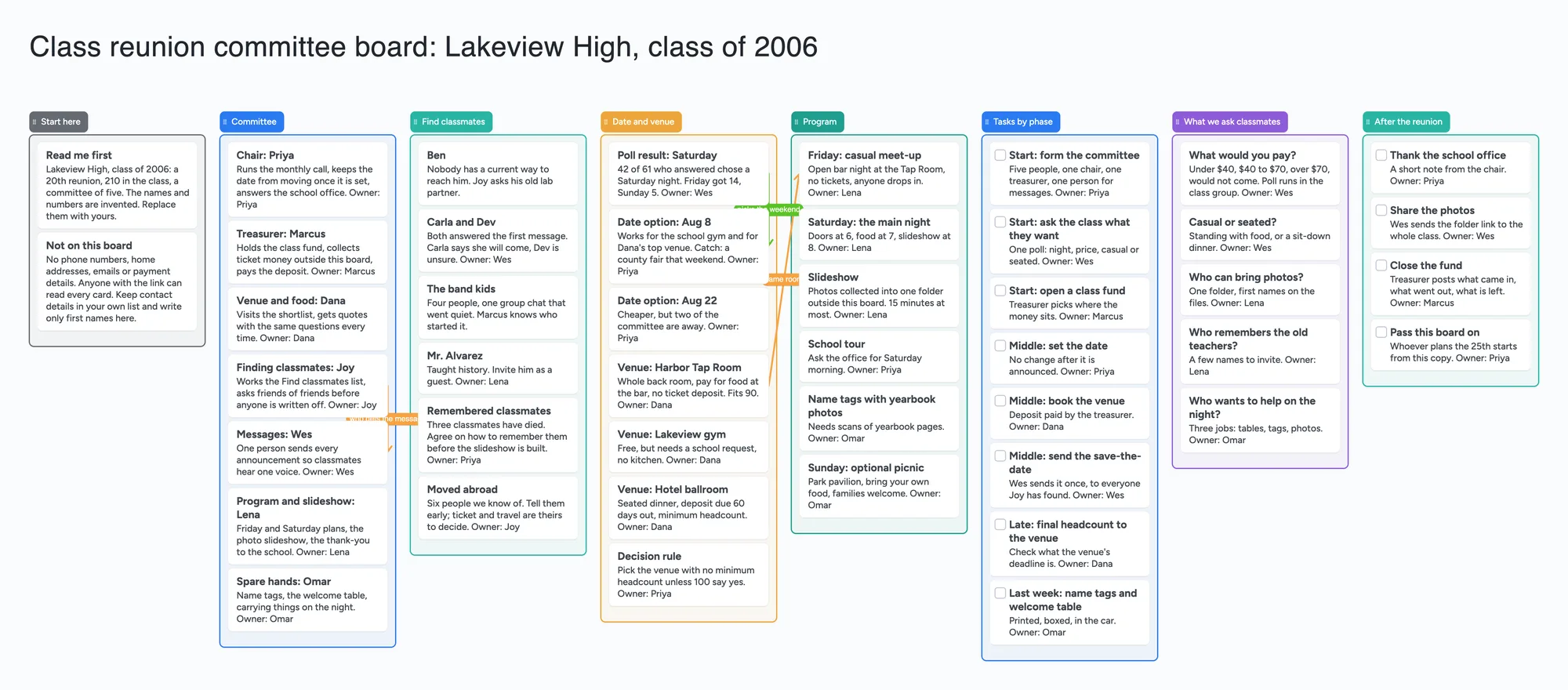
The example, list by list
The class is invented: Lakeview High, class of 2006, 210 in the class, a twentieth reunion and a committee of five. Every name, number and price is the example's own. Each task ends "Owner:" and a first name.
- Start here (2 cards). "Read me first" says what the board is. "Not on this board" keeps phone numbers, addresses, emails and payment details off it, because anyone with the link can read every card. First names only.
- Committee (7 cards). Chair, treasurer, venue and food, finding classmates, messages, program and slideshow, spare hands. One person sends every announcement, so classmates hear one voice.
- Find classmates (6 cards). People nobody can reach yet, with a line on who might know: a lost contact, a group chat that went quiet, a teacher to invite, classmates who have died (agree how to remember them before the slideshow), people who moved abroad.
- Date and venue (7 cards). A poll result (42 of 61 who answered chose a Saturday night: 42 + 14 + 5 = 61), two date options with their catches, three venue options with their catches, and a decision rule. The rule is the example's own.
- Program (6 cards). A casual Friday meet-up, the Saturday main night, the slideshow, a school tour, name tags with yearbook photos, an optional Sunday picnic.
- Tasks by phase (8 cards, tick boxes). Start, middle, late and the last week, written as phases rather than calendar dates, because the board has no date axis.
- What we ask classmates (5 cards). What would you pay, casual or seated, who can bring photos, who remembers the old teachers, who wants to help on the night.
- After the reunion (4 cards, tick boxes). Thank the school office, share the photos, close the fund, pass the board on to whoever plans the next one.
Three arrows tie the board together: the Harbor Tap Room venue points to the casual Friday meet-up held in the same room, the poll result points to the date it picks, and the person finding classmates points to the person sending messages.
What people who planned one say
These are people's accounts, credited per account, not rules. In r/partyplanning "Planning my own high school reunion" (u/fuzzydaymoon, November 29, 2025; read November 22, 2026, every comment the page loaded, 25 of 45), the poster, planning for the class of 2017, said the class of 2015 did it themselves, and asked how to get people to pay for tickets in advance. u/taintlangdon wrote that at their reunion the most popular price in a poll was $100 a person, but far more people had chosen the lower tiers together, so few bought tickets and the organizers moved to a smaller venue; the same account said about 20 showed up from a class of 550. u/Responsible_Side8131 said the casual reunions their class held drew the biggest turnout, and u/upsidedownpotatodog advised making it a meet-up instead of renting a venue. u/Sondari1 asked organizers not to change the date once it is set, after missing a 40th when it moved a week with a month to go.
In r/Adulting ("What was your 10 year high school reunion like?", April 2022), u/no_one_important123 said their class used a Facebook event and Eventbrite tickets and listed $75 for the meal, about $110 with bottomless drinks ("I think") and $40 for "just the vibes" at a reunion they did not attend. In r/introvert (u/misselpis, September 2024) the poster described a reunion planned late enough that the old school could not be booked, held in a busy beer garden. Each is one person's account of one reunion.
The example board follows the pattern in those accounts without turning it into a rule: a cheap, casual Friday beside the main night, a poll that asks what people would pay, a date that does not move once announced, and a venue shortlist with the catch written on each card.
Committee roles in the guides
Guides for institutions put the same shape on paper. GiveCampus's "How to Plan a Class Reunion" (read November 22, 2026; the page shows no usable publication date) is written for alumni relations teams. It suggests a reunion committee with regular meetings, monthly early on and biweekly as the event gets close, and clear responsibilities such as communications, vendor coordination, fundraising outreach and day-of logistics. Checklist.com's "Plan a Class Reunion Checklist" (read November 22, 2026; no date on the page) lists 29 tasks that start with forming a committee, electing a chairperson and treasurer, and creating subcommittees. Our Committee list uses roles in that spirit with one named owner per card; it is our own layout, not either source's.
Reunion tools, side by side
Each row is from the tool's own page, read on November 22, 2026. Features and prices change, so check the page before you choose.
| Tool | What its page says | Where it beats a shared board | Where a shared board fits |
|---|---|---|---|
| Instaboard board | Free: 5 boards, 150 items, 3 pictures per board. Pro $5 a month billed yearly ($59.99 a year), or $7.99 monthly | Nothing in this table on RSVPs, payments or classmate search | The committee's working plan on one link after a free sign-in |
| Reunly (Class Reunly) | Its pricing page: free to set up; Pro is $149 per reunion, "$149 until Dec 31, then $199 from Jan 1". Pro lists an AI classmate finder, committee co-organizers, email to the whole class, RSVPs and ticket sales, payment collection through Stripe, QR name badges and check-in. Card payments add 3% + $0.99 per ticket unless the committee covers it | Finding classmates, mailing the class, ticket sales, check-in at the door | A plan before you pay for any of that, or alongside a ticketing tool |
| RSVPify | Its reunion page: Free $0 a month up to 100 guests with basic email invitations and RSVPs; Gold $10 a month up to 300 guests with secondary events, seating charts, save-the-dates and automated reminders; Platinum $15 a month up to 500 guests. Ticket sales run through Stripe, with funds "typically" transferred within 48 hours | RSVP forms, tickets, reminders, seating | The planning that happens before a form exists |
| Checklist.com | Its class reunion page lists 29 tasks, offers PDF, Word and Excel downloads, and says you can save the list to a free Checklist account, invite others to collaborate and set reminders | A ready task list with reminders | Owners, options and open questions side by side, not only tasks |
| Facebook group and a spreadsheet | Named by several accounts in the r/partyplanning thread, for example u/noxxmod (a class group with join questions and polls) and u/banditotis | Reach: classmates are already there. A spreadsheet holds the full roster and sums | A plan that isn't a feed of posts |
Swipe the table sideways to see every column.
From each tool's own pages and the thread, read November 22, 2026. None of the vendor pages shows a date. Reunly's own comparison guide lists RSVPify's plans differently from RSVPify's page; the RSVPify row here is RSVPify's own text.
Which tool for which job
No ranking: these are different jobs.
- Selling tickets and taking RSVPs from 150 classmates: RSVPify or Reunly, which both list tickets and Stripe payments on their own pages.
- Finding classmates after twenty years: Reunly lists an AI classmate finder in Pro; a class Facebook group is what several accounts in the thread used.
- A checklist with reminders: Checklist.com's free account lists reminders; a board sends none.
- The full roster, sums and sorting: a spreadsheet.
- A shared working plan for the five people organizing: this board. A committee member signs in free to edit. It has no RSVPs, payments, email or reminders.
How many cards fit
On this board the 8 lists and the title text box are 9 items before any card:
- 45 cards (the example): 9 + 45 = 54 of your 150 free items.
- A class of 210, one card per classmate: 210 cards alone would pass 150. Keep the roster in a spreadsheet and put only the people still to find on the board, which is what the example's Find classmates list does.
- The most the free plan holds: 150 - 9 = 141 cards, with nothing else on the account.
- The example as it is is 54 items, so two reunion boards like it use 108 of the 150 across all your boards and a third passes the limit (3 x 54 = 162).
Arrows, sections and pen strokes are free. This is our arithmetic, and a copy of the board takes 1 of your 5 free boards. The free plan has no way to go past 150 items; Pro's listed changes are invite-only boards, per-person permissions and no image limit.
When another tool is the better choice
- You need RSVPs. The board has no form. Use a reunion or invitation tool.
- You need to sell tickets or collect money. The board tracks no payments and holds no balances.
- You need to reach 200 classmates. The board can't email or text anyone.
- You need to find people. The board has no search for classmates; it only holds the notes you type.
- You want reminders. The board sends none; a date on a card is text.
How to use it with your committee
- Open the board and replace the class. Change the school, the year and the names. Delete what you don't need; every card and list is 1 of your 150 items.
- Give each committee role one owner. Write the first name on the card so people who own a line get asked about it.
- Fill Find classmates last. Start with who you can already reach, then add the missing people with who might know.
- Put date and venue options as cards with the catch written on each. The example's catches are a county fair, a minimum headcount, a school request.
- Share it. In the share menu set "Anyone who joins can edit" (new boards start view-only). Each committee member signs in free to write live. If two people type in one card at once, the edits merge, so give each person their own card.
- Tick the phase tasks together. Everyone with edit access sees a tick live. The board records no one's name or time, and anyone with edit access can un-tick; there is no clear-all button.
Limits of the free plan for a class reunion board
- Items. Each card and each list is 1 of your 150 free items, across all your boards. The example is 45 cards, 8 lists and the title text box, 54 in all. Arrows, sections and pen strokes don't count.
- Boards. The free plan includes 5 boards. Keep the whole reunion on one board.
- Photos. 3 images per board. The example has none; keep the slideshow photos in a folder outside the board.
- Writing needs a free sign-in. A classmate who joins by link or code can add cards and arrows, and the board counts as one of their 5 boards. Someone who isn't signed in can open the link and read everything, but can't change anything.
- Everyone with the link can read every card. Keep contact details, payment details and sensitive notes off it.
- Offline. Changes made offline are kept and sync when you are back online.
Start from the ready board
It opens in your browser in a few seconds, with nothing to install. Sign in for free when you want to save it and share it.
Questions
Is there a free class reunion planning template?
Yes, several. The ready board here has lists for the committee, classmates still to find, date and venue options, the program, tasks by phase, what to ask the class and the after list. It is free within 5 boards and 150 items, and you open it and replace the example class with yours. Checklist.com lists a free 29-task checklist, and RSVPify lists a free plan up to 100 guests; the board does neither RSVPs nor reminders.
Who should be on a class reunion committee?
Guides name roles such as a chair, a treasurer and people for communications, vendors, fundraising outreach and day-of logistics. The example board has seven: chair, treasurer, venue and food, finding classmates, messages, program and slideshow, and spare hands. Five people can cover all of them; the roles are ours, not a rule.
How do you plan a class reunion?
Form a committee, ask the class what it wants and what it would pay, set the date once and keep it, shortlist venues with the catch written on each, and decide how classmates will RSVP and pay. Several accounts in an r/partyplanning thread said a casual night drew more people than a formal one. The board holds the committee's side of that; ticketing and RSVPs belong in a ticketing tool.
What is the best software for class reunion planning?
It depends on the job. Reunly and RSVPify list RSVPs, tickets and Stripe payments on their own pages. A Facebook group and a spreadsheet are what accounts in a Reddit thread used for reach and the roster. For the committee's own working plan, a shared board like this one holds it, but it sells nothing and sends nothing.
How do I share a reunion plan so the whole committee can edit?
In the share menu set "Anyone who joins can edit", then send the link. Each committee member signs in free (Google, Apple or email) to write; someone who isn't signed in can open the link and read, but can't change anything. Give each member their own card so you never type in the same one.
How many items does a class reunion board use on the free plan?
Each card and each list is one item of the 150 across all your boards. With 8 lists and the title text box, 45 cards is 54 items, and the most a board holds is 141 cards. That is our arithmetic. Arrows and sections are free. A full class roster of 210 would not fit as one card each, so keep it in a spreadsheet.
Sources
- r/partyplanning: Planning my own high school reunion (u/fuzzydaymoon, November 29, 2025; replies are single accounts; read November 22, 2026, 25 of 45 comments loaded)
- r/Adulting: What was your 10 year high school reunion like? (April 2022; replies are single accounts; read November 22, 2026)
- r/introvert: Regretted going to my 10 year high school reunion (u/misselpis, September 2, 2024; the post only; read November 22, 2026)
- Reunly: pricing (Class Reunly Pro $149 per reunion; read November 22, 2026; page shows no date)
- Reunly: class reunion RSVP software comparison (June 2026; Reunly's own guide; read November 22, 2026)
- RSVPify: reunion ticketing and RSVP tools (Free, Gold, Platinum; read November 22, 2026; page shows no date)
- Checklist.com: Plan a Class Reunion Checklist (29 tasks; read November 22, 2026; page shows no date)
- GiveCampus: How to Plan a Class Reunion (read November 22, 2026; page shows no usable publication date)
Related
Family reunion planning template: one shared board for the committee
A free family reunion planning template to open and edit with your committee: venues, dates by who can attend, headcount by branch, food and lodging.
An office holiday party planning board: who owns what, in one place
Plan the office holiday party with a small committee on one shared board: budget, venue, food, gift swap rules and the evening. Free ready board, and where SignUpGenius does more.
A group trip planning template on one shared board: who's going, which dates, which stay, who books what
A group trip planner template to open and edit with friends: who is going, dates by who can make them, stays side by side and who books what.
A craft fair planning template: one shared board for the organising committee
Plan a craft fair or makers market with a small committee on one shared board: venue, vendor call, confirmed vendors, waitlist, setup, market day and volunteers. Free ready board; Zeffy and Eventbrite do the payments.