For biology, A&P and nursing students
Build an immune system concept map: innate vs adaptive, step by step
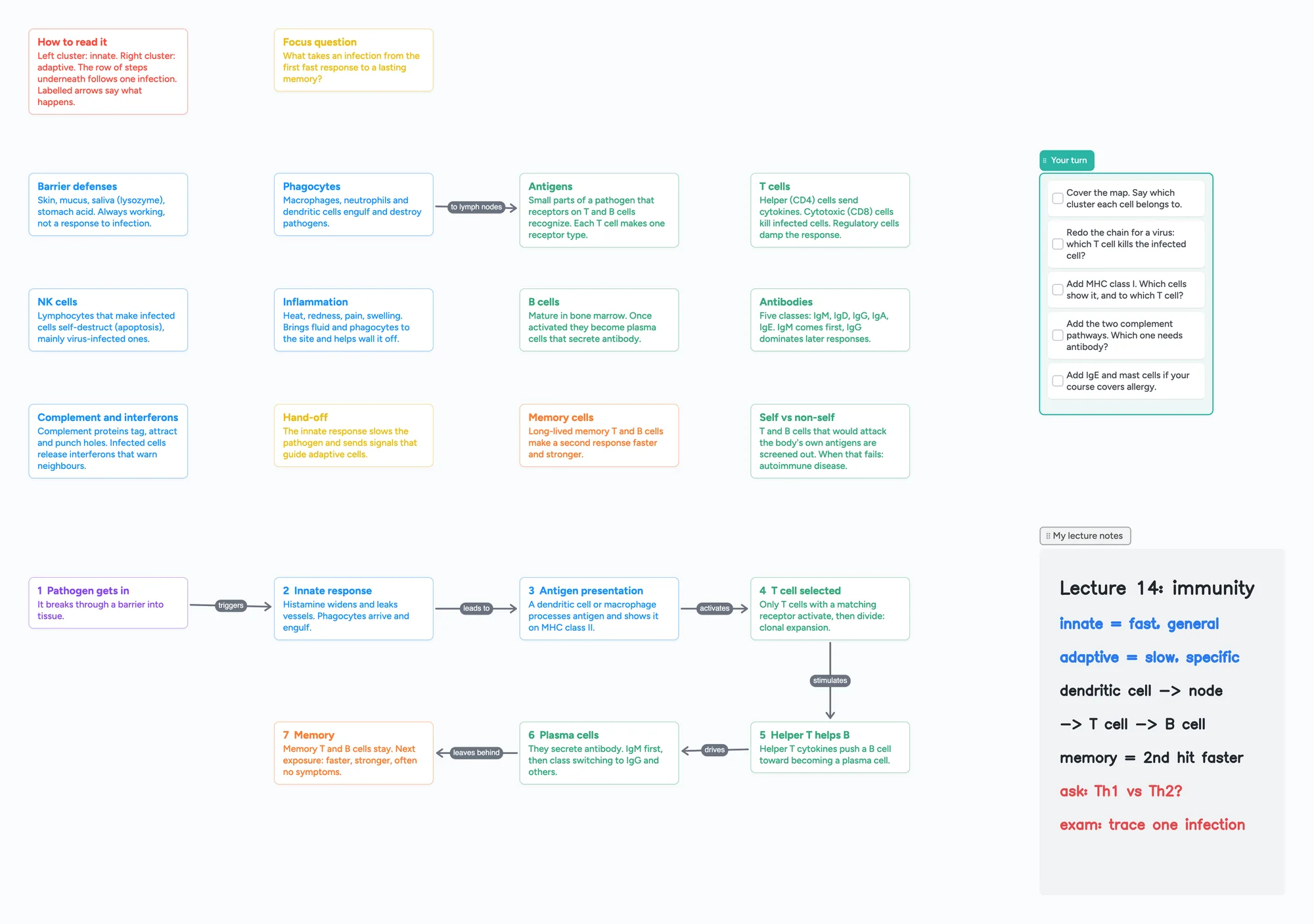
The immune system is hard to map because everything connects to everything. One way that works: split the page into two clusters, innate on the left and adaptive on the right, then trace a single infection across them from the first barrier to memory. The board below does that with sourced facts, and you replace them with your own lecture notes. It is a worked example to build from, not a set of marked solutions, and it is a study aid, not medical advice.
Updated
The short answer
- Two clusters first. Put innate cards on the left and adaptive cards on the right before you draw any arrow. Innate is the fast, general response; adaptive is slower and specific.
- Then trace one infection. A row of numbered cards, from the pathogen getting in to memory, shows how the clusters hand over to each other.
- Label every arrow with a verb: "triggers", "activates", "stimulates". If you can't name the link, that is the part of the lecture to reread.
- Leave gaps for yourself. The board's "Your turn" list asks you to add MHC class I, the two complement pathways and more. Adding them is the point.
- You lay it out by hand. Instaboard has no automatic layout and no AI map; you place and connect every card.
Step 1: the innate and adaptive clusters
The facts below follow OpenStax Anatomy and Physiology 2e, chapter 21 (sections 21.2, 21.3 and 21.4), each read in full on November 5, 2026. The wording is shortened and paraphrased. Your course may use different names or add detail, so check anything that matters for your exam against your own materials.
| Cluster | What goes on its cards | On the board |
|---|---|---|
| Innate: first, fast, not specific | OpenStax calls it "relatively rapid but nonspecific". It starts with barrier defenses (skin, saliva with lysozyme, stomach acid, mucus), then phagocytes (macrophages, neutrophils, dendritic cells), natural killer cells that make infected cells self-destruct, complement proteins, interferons and inflammation. | Barrier defenses, Phagocytes, NK cells, Inflammation, Complement and interferons |
| Hand-off | The innate response slows the pathogen and sends signals that guide the adaptive cells. Inflammation also helps dendritic cells carry antigen to lymph nodes. | The yellow Hand-off card and the arrow into the adaptive cluster |
| Adaptive: slower, specific, remembers | T and B lymphocytes recognize antigens with receptors. Helper T cells send cytokines, cytotoxic T cells kill infected cells, B cells become antibody-secreting plasma cells, and memory cells make a second response stronger and faster. | Antigens, T cells, B cells, Antibodies, Memory cells, Self vs non-self |
Swipe the table sideways to see every column.
From OpenStax Anatomy and Physiology 2e, sections 21.2, 21.3 and 21.4, read November 5, 2026. Paraphrased and shortened for the board.
Step 2: trace one infection across both clusters
A map of cells stays a list until something moves through it. The seven numbered cards on the board follow one infection:
- Pathogen gets in. It breaks through a barrier into tissue.
- Innate response. Damaged cells release mediators such as histamine, which widens and leaks local vessels, and phagocytes arrive and engulf.
- Antigen presentation. A dendritic cell or macrophage processes the antigen and shows it on an MHC class II molecule. T cells only recognize antigen shown this way.
- T cell selected. Only T cells whose receptor matches are activated, and they divide: clonal expansion.
- Helper T helps B. Helper T cell cytokines push a B cell toward becoming a plasma cell.
- Plasma cells. They secrete antibody, IgM first, then class switching to IgG and others.
- Memory. Memory T and B cells stay behind. On the next exposure the response is faster and stronger, often with no symptoms.
Your lecture may order or name these steps differently, or start with a virus, where cytotoxic T cells and MHC class I matter more. The board's "Your turn" list asks you to redo the chain for a virus. Nursing students can also add the active versus passive immunity table from section 21.4 (vaccines, antibodies from the mother, immune globulin injections) next to the memory card.
Build it from your lecture notes
- Put a focus question on a card. For example "what takes an infection from the first fast response to a lasting memory?"
- Pull the nouns out of your slides. One card per cell, tissue or molecule, not whole sentences.
- Sort them into two clusters before you connect anything.
- Pick one infection and number the steps in a row underneath. Draw arrows and write the verb on each.
- Add a second colour for anything you are unsure about and take it to class.
- Keep your source beside the map. Paste a photo of your handwritten notes or lecture slide into the notes area (the free plan allows 3 images per board).
A card can open into its own board, so a topic with a lot of detail, such as antibody classes, can have a board of its own without crowding the overview.
Mix-ups worth putting on the map
- Cells in both clusters. Macrophages belong to the innate response but also work with lymphocytes in the adaptive one, and complement has an alternate pathway that needs no antibody and a classical pathway that does. Draw the link rather than forcing them into one column.
- Two kinds of killers. NK cells (innate) and cytotoxic T cells (adaptive) both trigger apoptosis in infected cells, using the same kinds of tools. What differs is how they recognize the target.
- Receptors are not the same. Innate cells use pattern recognition receptors, a limited set shared across many pathogens. T and B cells each make a receptor specific to one antigen.
- T cells and B cells see antigen differently. T cells recognize antigen only when an antigen-presenting cell shows it on MHC. B cells can recognize native, unprocessed antigen.
- Selection is not teaching. The antigen does not create a new receptor. It selects the cells that already have a matching one, which then expand. The clonal selection lesson goes through it in four steps.
Go deeper on two links in the chain
Boardling is a YouTube channel that builds one biology board per lesson. Each lesson page has the video, written notes, a practice question and the finished board to copy.
- Clonal selection and expansion: lesson and notes, for step 4 and the plasma and memory cells at the end of the chain.
- Opsonization: lesson and notes, for how antibodies and complement tag a microbe so a phagocyte can eat it, which ties the two clusters together.
For a pathway map in another system see the endocrine system concept map, and for taking notes chapter by chapter see anatomy and physiology notes on a board. For how concept maps work in general, see make a biology concept map from your own notes.
When another tool fits better
- You want the layout done for you. Lucidchart, Creately and EdrawMind arrange shapes automatically. Instaboard doesn't; you place each card.
- You want the textbook's own diagrams and exact wording. Your course textbook and lecture notes decide what is tested. This board paraphrases one open textbook chapter.
- You want a research-grade overview. Review articles and a full immunology text such as Janeway's go far beyond one board.
- You want AI to draw it. Instaboard has no AI and won't generate a map from your notes.
- Your instructor requires a specific format. Use the one your course requires.
Study aid, not medical advice
The board summarizes one textbook chapter for study. It is not clinical guidance and not advice about anyone's health or treatment. Check your own course materials for what is tested.
What Instaboard doesn't do
- The layout is manual. No template builds the map, no AI writes your notes and no auto-drawn diagram appears. You place every card and arrow.
- The board is a worked example, not a set of marked solutions. It leaves gaps and a "Your turn" list for you to fill from your own course.
- No labelled anatomy or cell images. The board has no atlas. Paste a photo of your own diagram if you want one.
- No handwriting search and no conversion of handwriting to text. The eraser removes a whole stroke at a time.
- Editing needs a free sign-in. Viewing a board by link doesn't. Instaboard's terms say users are not minors, so this page is written for college and nursing students.
- The free plan is 5 boards and 150 items (cards, lists, images, text boxes; pen strokes, sections and arrows don't count), with 3 images and 1 file per board. The ready board uses about 26 items.
- No import from other note apps. Paste text or photos instead. Full-board PDF export works only on drawing boards and trip planners; for a card board, selected cards and lists can be saved as an image.
- Changes made offline sync when you're back online, but Instaboard isn't built to work offline first.
Start from the ready board
It opens in your browser in a few seconds, with nothing to install. Sign in for free when you want to save it and share it.
Questions
How do you make a concept map of the immune system?
Split the page into an innate cluster and an adaptive cluster, put one card per cell or process in each, then trace one infection across them with numbered cards and a verb on every arrow. Keep the map to what your course covers.
What is the difference between innate and adaptive immunity?
Per OpenStax A&P 2e section 21.2, the innate immune response is relatively rapid but nonspecific, while the adaptive immune response is slower to develop during a first infection but highly specific and effective against a wide variety of pathogens.
How is a concept map different from a mind map for the immune system?
A mind map branches out from one central word and usually leaves the lines unlabelled. A concept map labels every link and can loop back, which suits the immune system because cells hand work to each other in both directions.
Where do dendritic cells and macrophages go on the map?
Both are innate phagocytes, and both are also professional antigen-presenting cells that show antigen to T cells, so draw an arrow from the innate cluster to the adaptive one. OpenStax names macrophages, dendritic cells and B cells as the three professional antigen-presenting cells.
Can I make one on an iPad?
Yes. Instaboard has an iPad app, and the same board opens in any browser and on Android. You can add cards and arrows with your finger and write with Apple Pencil.
Does Instaboard draw the map or check my work for me?
No. There is no AI and no automatic layout: you place and connect every card yourself.
Is Instaboard free?
Yes. The free plan includes 5 boards, 150 cards and items across your account (pen strokes, arrows and sections don't count), 3 images and 1 file per board, unlimited collaborators and video calls up to an hour. Pro is $5 a month billed yearly ($59.99 a year), or $7.99 monthly, and the people you invite join free.
Sources
- OpenStax Anatomy and Physiology 2e: 21.2 Barrier Defenses and the Innate Immune Response (read in full, Nov 5, 2026)
- OpenStax Anatomy and Physiology 2e: 21.3 The Adaptive Immune Response: T lymphocytes and Their Functional Types (read in full, Nov 5, 2026)
- OpenStax Anatomy and Physiology 2e: 21.4 The Adaptive Immune Response: B-lymphocytes and Antibodies (read in full, Nov 5, 2026)
- Boardling lesson: Clonal selection vs clonal expansion
- Boardling lesson: Opsonization
Related
Build an endocrine system concept map from your own notes
Build an endocrine system concept map from your notes: glands, hormones, target tissues and feedback loops. A sourced example board to edit. No answer key, no AI.
How to take anatomy & physiology notes (with a filled example board)
How to take anatomy and physiology notes on a board you can edit: draw the feedback loop first, then terms, examples and a self-quiz. A filled homeostasis example built from OpenStax A&P 2e, for college and nursing students.
Make a biology concept map from your own notes
Turn your lecture notes into a biology concept map: concepts on cards, labelled arrows, feedback loops and a recall check. Worked example on the HPA axis, a ready board to copy, and a nursing version.
Build a nursing concept map for your patient
How to build a nursing concept map from your clinical notes, step by step: patient, pathophysiology, assessment data, labs, meds, priority problems, interventions and outcomes. A worked heart failure example you can open and edit.