For a small team tracing one problem that already happened, not for a safety investigation or a formal quality record
A five whys board: one problem, one chain of causes
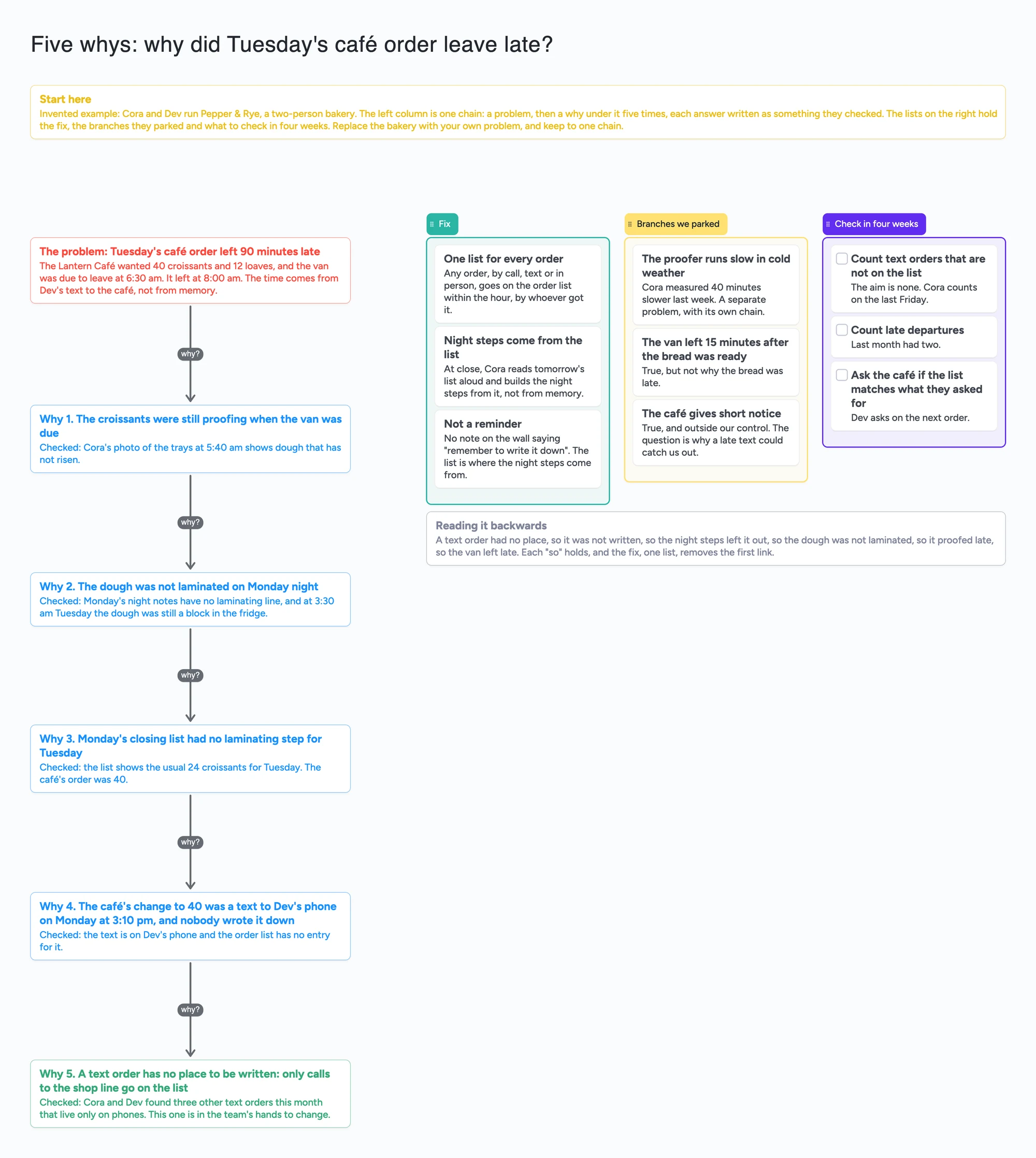
We make Instaboard, an online board. This page gives you a five whys already laid out on it and filled in for one invented problem: Pepper & Rye, a two-person bakery run by Cora and Dev, whose Tuesday café order left 90 minutes late. A problem card sits at the top of one column, five why cards follow it joined by arrows, and three lists beside it hold the fix, the branches they parked and a check for four weeks later. Copy it, swap the bakery for your own problem, and send the link to whoever was there. It is a shared board, not a worksheet file: it does not find the root cause for you, and it does not give you a PDF. The sources below do some of these jobs better, and our summaries of them are ours. Nobody named here reviewed the board.
Opens in your browser. Anyone can view; a free sign-in lets you edit.
Updated
Before you open it: what it holds and what it leaves to you
- Our edge is small, and we say so first. Atlassian, Miro and TeamAssurance each publish a five whys template, and the Lean Enterprise Institute shows a worked factory example. What this page adds is one filled small-team example you can edit together, a list for the branches you decided not to follow, and the limits written before you open anything.
- What it is: one chain of six cards (the problem and five whys) joined by five arrows, plus three lists of three cards each: Fix, Branches we parked, and Check in four weeks. You move a card by dragging it. The example uses 21 of your 150 free items.
- What it isn't: not an analysis. Nothing checks that an answer is true or that the chain stops at the right place; your team does that, and the board only holds the result. There is no voting, no file to download, and no reminders or due-date alerts. The Check list has tick boxes you tick yourselves, and nothing records who ticked or when.
- Who it's for: two to four people who were there when something went wrong and can look at one screen together. If the problem has many causes, use a fishbone first. If it is a safety incident or a customer complaint that needs a formal record, TeamAssurance's own page sends that to a corrective action (CAPA) process, with five whys as one step inside it, and this board is not that record.
- Free plan: 5 boards, 150 items, 3 pictures per board. Copying the board takes 1 of your 5 boards. Writing on it needs a free sign-in. New boards start with "Anyone who joins can view".
One chain or many causes? Pick the tool first
TeamAssurance's template page (published 3 November 2026, by its CEO and founder Matt Mafrici) says the five whys suits a straightforward problem with one main chain of cause and effect, and that when causes are many you use a fishbone first, then run five whys on the likely ones. A fishbone, also called an Ishikawa diagram, spreads possible causes across several branches before you pick one. Miro's page says its fishbone template lays out all possible causes.
Our view: a fishbone suits a problem where you do not yet know which cause to chase, and five whys suits one where you already have a likely cause. The Reddit threads below include commenters who suggest a fishbone for a problem with many causes. This board covers only the second case, and it has a place to park the other branches rather than a diagram for them.
- Use this board when the problem happened once or twice, you can name it with a number ("90 minutes late"), and you can check each answer by looking at something real.
- Use a fishbone first when nobody agrees where to look, or the problem has several unrelated causes at once.
- Use something formal when someone was hurt or a customer needs a written record. A shared list of cards is not that, and nothing here is a quality or safety document.
Cora and Dev's chain, card by card
The bakery, the names, the café and every number are invented. Cora bakes through the night; Dev drives the van and answers the phone.
- The problem card. The Lantern Café wanted 40 croissants and 12 loaves, and the van was due to leave at 6:30 am. It left at 8:00 am, 90 minutes late. It says where the time came from: Dev's text to the café, not memory.
- Why 1. The croissants were still proofing when the van was due. Checked: Cora's photo of the trays at 5:40 am shows dough that has not risen.
- Why 2. The dough was not laminated on Monday night. Checked: Monday's night notes have no laminating line, and at 3:30 am Tuesday the dough was still a block in the fridge.
- Why 3. Monday's closing list had no laminating step for Tuesday. Checked: the list shows the usual 24 croissants for Tuesday, and the café's order was 40.
- Why 4. The café's change to 40 was a text to Dev's phone on Monday at 3:10 pm, and nobody wrote it down. Checked: the text is on Dev's phone and the order list has no entry for it.
- Why 5. A text order has no place to be written, because only calls to the shop line go on the list. Checked: Cora and Dev found three other text orders this month that live only on phones. This one is in the team's hands to change.
Five arrows, each captioned "why?", join the six cards in order. That is the whole chain. The fifth answer is the one they stop at, and the next section explains why.
The Checked line: how you know a why is true
TeamAssurance's template has a column beside each why for the evidence that confirms it, and says that if nobody can say how an answer was confirmed, you go and check before asking the next why. Its list of common mistakes includes guessing in a meeting room instead of confirming each answer where the work happens. Atlassian's play asks the team to brainstorm answers for five minutes, choose one and record it, and at the end to verify whether addressing the root cause would prevent the initial problem from recurring.
The example borrows the idea in plain words. Each why card ends with a line starting Checked, naming something someone saw: a photo, a note, a list, a text on a phone. A card without one is a guess; a team using the board would move it to Branches we parked until somebody looks.
What one chain of cards can't do
- No analysis. The cards hold what you write. Nothing tests whether a why is the cause or just a symptom. The example's Checked lines are typed by hand, and a Checked line you did not check is worse than none.
- One chain only. Six cards in a column cannot show two causes at once. A second branch goes in the Branches we parked list, or on its own board, which is what the example does.
- No voting. Atlassian's play suggests a vote on problem statements. Here you decide in the room, and the cards show only the result.
- No file. Nothing on this page gives you a PDF, Word or PowerPoint version of the chain. TeamAssurance offers a worksheet you can print.
- No reminders or due-date alerts. The check list says "last Friday" in plain text. Cards can carry a due date, but nothing alerts anyone when it passes.
- No who or when on a tick. Anyone with edit access can tick or untick a card, everyone sees it live, and nothing records who or when. If the fix needs an owner, write the name in the card.
- No private lists. New boards start with "Anyone who joins can view", so anyone with the link can read the whole chain. A chain that names a colleague's mistake is best kept to what happened, not who.
- 3 pictures per board. The example has none.
Reading it backwards, the fix, and the check
TeamAssurance's template says to read the chain from the root cause upward with the word therefore, and that if any step does not follow, the chain is broken. The example does this on its last card, Reading it backwards: a text order had no place, so it was not written, so the night steps left it out, so the dough was not laminated, so it proofed late, so the van left late. Each so holds.
- Fix, 3 cards. One list for every order, by call, text or in person, written within the hour by whoever got it. Night steps built from that list at close. And a card saying it is not a reminder: a note on the wall saying to remember to write it down changes nothing. TeamAssurance's mistakes list makes the same point: a fix that is a reminder or a retraining session leaves the cause in place.
- Branches we parked, 3 cards. The proofer runs slow in cold weather, the van left 15 minutes after the bread was ready, and the café gives short notice. Each is true or may be, each has its own chain, and none is the cause this chain followed.
- Check in four weeks, 3 tick-box cards. Count text orders not on the list (the aim is none), count late departures, and ask the café whether the list matches what they asked for. Nothing alerts anyone when the four weeks are up, and the cards name a Friday and the next order, not a calendar date, so write the date in yours.
Run it on your own problem, about 30 minutes
- Open the board and sign in free when it asks you to write. Read the Start here card, then delete Pepper & Rye's cards one by one.
- Write the problem card. What happened, where, when and how much, with a number in it. If you cannot put a number in it, you may not have one problem.
- Ask why, and look. Write the first why, then the line starting Checked: what someone saw or found. If nobody can fill it in, park the card and go and look.
- Repeat until the answer is yours to change. Stop at a cause in your own process, not at a person and not at something outside your control.
- Draw the arrows, or move the cards so the order is clear. Read the chain backwards with the word so.
- Fill the three lists. The fix, the branches you set aside, and what to count in four weeks. Write names and dates in the card text.
- To share it, set Share to "Anyone who joins can edit" if the others should write on it. Each person who writes signs in free.
- To start a new problem, copy the board. A copy takes 1 of your 5 boards and keeps its ticks, so untick them first.
Where the chain stops, and what people say about five
Lean Enterprise Institute's page on the method says the specific number five is not the point: you keep asking until the root cause is reached and eliminated. Atlassian's play says it may take fewer or more than five. TeamAssurance says to stop when the answer is a cause in the process that the team can change, and warns against stopping at a person ("operator error" or "forgot" is where the next why starts, it says). The example stops at Why 5 for that reason: a missing place to write a text order is something Cora and Dev can change, and a forgetful Dev is not.
Every voice below is one person, read November 25, 2026. Forum dates are month and year only, because they shift with the reader's time zone.
From an r/agile thread (July 2021; we read 12 comments in an archived copy, 1 more deleted), where the original poster asked how to do five whys on a big problem with many possible root causes. u/naphox suggested a fishbone instead. u/TomOwens said there is nothing wrong with a multi-legged five whys, that he would not let the answers to one why grow past two or three, and that five is not a cap. u/Jestar342 wrote that the five is a guide and that tangential problems you find should be stashed for a separate dive, which is what the Branches we parked list is for.
From an r/projectmanagement thread (June 2020; we read 19 comments in an archived copy, 2 more removed), where the original poster showed a hypothetical five whys and asked for feedback. u/citizenc wrote "There is rarely a single root cause for something going wrong." u/catjuggler said they like to take the reasoning of five whys into a fishbone, and that looking for a single why introduces bias. u/Decker1138 said five is a target and that going past ten means you have identified the wrong problem and should start over. u/velvet8smiles said you have drilled down far enough when the whys land outside the organisation's control, or begin to repeat.
Two things follow for this board. The chain is one chain by design, and a parked list takes the rest. Nobody in either thread asked for a shared board; this is a place to hold the result, not a claim that people want one.
Nine problems on one board, and the 150
Each card and each list is 1 of your 150 free items, across all your boards, and the title text box counts too. Arrows and pen strokes don't. Our arithmetic from the example:
- As built: 3 lists + 17 cards (the six chain cards, nine list cards, Start here and Reading it backwards) + 1 title = 21.
- Another problem on the same board: a new chain of six cards plus three fix, three parked and three check cards is 15 more cards, if you reuse the lists. Nine problems in all come to 141 (21 plus 8 times 15); a tenth would reach 156.
- One copy per problem: each copy of the example is 21 items and takes 1 of your 5 boards, so five copies use 105 items and all five boards.
A five whys is a small board by design, and it counts against the same 150 as your other boards.
Where other tools do this better
Read on November 25, 2026. Pages change, so check them. A cell says only what its page says.
| Source | What the page says | Better for |
|---|---|---|
| Atlassian Team Playbook, 5 Whys play (page shows no date) | A 30-minute play for 3 to 8 people: pick one problem, ask why five times, propose a solution; links a Confluence template and a Trello template; says it may take fewer or more than five whys. Prices are not on the page | A guided session with set steps, in tools your team may already use |
| Miro, 5 Whys templates (page shows no date) | A collection of 5 Whys templates, including a fishbone one; one description mentions asking team members questions in chat or comments and colour-coded sticky notes. Plan limits and price are not on the page | A workshop on a big canvas, with a template for your exact variation |
| TeamAssurance, a software vendor (its page has Platform, Pricing and Request a demo links), 5 whys template (published 3 November 2026) | A one-page worksheet: a problem statement, five why rows each with an evidence column, then root cause, countermeasure, owner and due date, and a verification. Says to use a fishbone first when causes are many | A printed worksheet with an evidence column, from a vendor that also sells the formal process |
| Lean Enterprise Institute, 5 Whys lexicon page (page shows no date of its own) | Explains the method with Taiichi Ohno's machine example, cited to Ohno 1988 p. 17, and says the specific number five is not the point. No template | One worked factory example in the method's own words |
| Instaboard board | One chain and three lists you edit together by link: 5 boards, 150 items and 3 pictures on the free plan | A small team keeping the chain, the fix and the parked branches on one screen |
Swipe the table sideways to see every column.
From each page, read November 25, 2026 in a browser: atlassian.com/team-playbook/plays/5-whys, miro.com/templates/5-whys, teamassurance.com/templates/5-whys-template, lean.org/lexicon-terms/5-whys. Our wording, not theirs. Prices and limits not stated on a page as read are not given.
Where these win
If you want a facilitated session, use Atlassian's play. If you want a big canvas for a workshop, use Miro. If you want to print a worksheet with an evidence column, use TeamAssurance's. If the problem is a safety incident or a complaint that needs a formal record, its page says to use a corrective action (CAPA) process with five whys as one step, which this board is not. If you want a worked example from a factory, read the Lean Enterprise Institute's page. Use this board when a small team wants to keep one chain, its fix and its parked branches in one place, in short cards.
Start from the ready board
It opens in your browser in a few seconds, with nothing to install. Sign in for free when you want to save it and share it.
Questions
What are the five whys?
It is a way of finding the cause of a problem by asking why it happened, then why that happened, and so on. Atlassian's play describes it as asking why five times to uncover the underlying causes, and the Lean Enterprise Institute describes asking why repeatedly to get past the obvious symptoms.
Does it have to be exactly five whys?
No. Atlassian's play says it may take fewer or more than five, and the Lean Enterprise Institute's page says the specific number five is not the point. Stop when the answer is a cause you can change.
What if my problem has several causes?
Then a fishbone first is what TeamAssurance's page says, and two Reddit commenters we read suggest a fishbone too. On this board, keep one chain and put the other branches in the Branches we parked list, each to get its own chain later.
Can my team edit the same board?
Yes. New boards start with "Anyone who joins can view", so anyone with the link can read it. Set it to "Anyone who joins can edit" if the others should write too; each person who writes signs in free.
Does the board work out the root cause for us?
No. It holds the cards and arrows you write. Nothing checks that an answer is true; the example uses a Checked line on every why for that, and your team does the checking.
Is Instaboard free?
There is a free plan: 5 boards, 150 cards and items across your account (pen strokes, arrows and sections don't count), and 3 pictures and 1 file per board. Anyone with the link can read a board; writing on it takes a free sign-in. Pro removes the item limit and adds invite-only boards: $5 a month billed yearly ($59.99 a year), or $7.99 monthly.
Sources
- Atlassian Team Playbook: 5 Whys Analysis play (page shows no date; read in a browser November 25, 2026)
- Lean Enterprise Institute: 5 Whys (page shows no date of its own; read in a browser November 25, 2026)
- Miro: 5 Whys templates (page shows no date; read in a browser November 25, 2026)
- TeamAssurance: 5 Whys Template (published 3 November 2026, by Matt Mafrici, CEO and founder; read in a browser November 25, 2026)
- r/agile thread (July 2021; replies are single accounts, we read 12 comments in an archived copy, 1 more deleted; read November 25, 2026)
- r/projectmanagement thread (June 2020; replies are single accounts, we read 19 comments in an archived copy, 2 more removed; read November 25, 2026)