For college students and recent graduates going to a career fair, and a friend who helps them prepare
A career fair board for your employer list, your pitch and your follow-ups
We make Instaboard, an online board. This page gives you a career fair plan laid out on it and filled in for an invented college junior, Jada, who goes to her school's fair with five made-up employers on her list and has already visited two. Four lists cover before the fair, her pitch and questions, the fair itself and what comes after; one list per employer holds why she picked it, what she asked and what they said. The board does not replace your school's employer list or its own tracker, and it has no reminders or due-date alerts. Jada and the employers are made up.
Opens in your browser. Anyone can view; a free sign-in lets you edit.
Updated
Read this first: what the board does and doesn't do
- Your school's pages win for the facts. The employer list, the fair's rules and any tracker your career center offers come from the school. Three of the four career center pages we read below (UVA, Illinois and UMD) name Handshake as the place to find the employers attending; ETSU points to employer profiles on Handshake.
- It has no reminders or due-date alerts. A follow-up note has no alarm here. Put the date in a calendar or on a card's due date yourself.
- What it is: a prep and notes board. Lists for before, pitch, the fair and after, and one list per employer with what you asked and what they said. The example uses 42 of your 150 free items.
- Nothing private goes on it. Anyone with the link can read the board, so keep other people's phone numbers and your own personal details off it. New boards start with "Anyone who joins can view".
- A printed list is enough if you visit three employers. The board earns its place when you have ten or more, or a friend who is going too and wants to swap notes.
- Free plan: 5 boards, 150 items, 3 pictures per board. Copying the board takes 1 of your 5 boards. Writing on it needs a free sign-in. This page is for college students and recent graduates; if you are under 18, check with a parent or your school.
What four career centers tell students to do
These pages come from four universities and differ in detail, which is why Jada's lists hold shapes, not rules. We read each page on November 24, 2026. Dates, where we found them: UVA's page data says published July 1, 2026 and modified July 8, 2026; ETSU's page data says updated September 16, 2026; Utah's page prints "Published: March 14, 2025"; UMD's page refers to its Fall 2026 fairs; we found no date on Illinois's page.
- University of Virginia Career Center ("Career Fair Success"). Before: resume, a 30-second to one-minute pitch, research employers from the list in Handshake, prepare questions that are not answered by the company's website. After: record employer information as soon as possible, including business card details and what you talked about, and send a follow-up email, ideally within 24 hours, that reintroduces you, thanks them and mentions something you discussed. The page also says that for many fairs your public Handshake resume is used to check in at the employer's booth.
- University of Illinois Career Center ("Preparing for an In-Person Career Fair"). Bring a portfolio with a notepad and pen, more copies of your resume than the number of companies you plan to visit, and research notes. It says most conversations are brief, often three to four minutes, to take notes during them, and to ask for a business card. After the fair: apply for the positions that interested you, send a thank-you email within 24 hours and keep a file of all contacts with each employer, with dates and the materials you sent.
- University of Maryland University Career Center ("Prepare for the Fair"). Create a list of the employers of most interest to you so you can prioritize, prepare targeted questions for each, and see what roles they list. The page also offers a Career Fair & Networking Tracker built by the center to track organization names, deadlines, job descriptions and correspondence.
- East Tennessee State University Career Services ("Prepare for the Career Fair"). Research employers, review your resume, and during the fair record the names of the employers you meet, the opportunities discussed and the follow-up details. It also says to speak with organizations beyond your first choices.
The pattern across all four is a list before, notes during and a record after. That is the shape of the board. Where the career center has its own tracker, as Maryland does, use it or this board, whichever you will actually open.
Jada's board, list by list
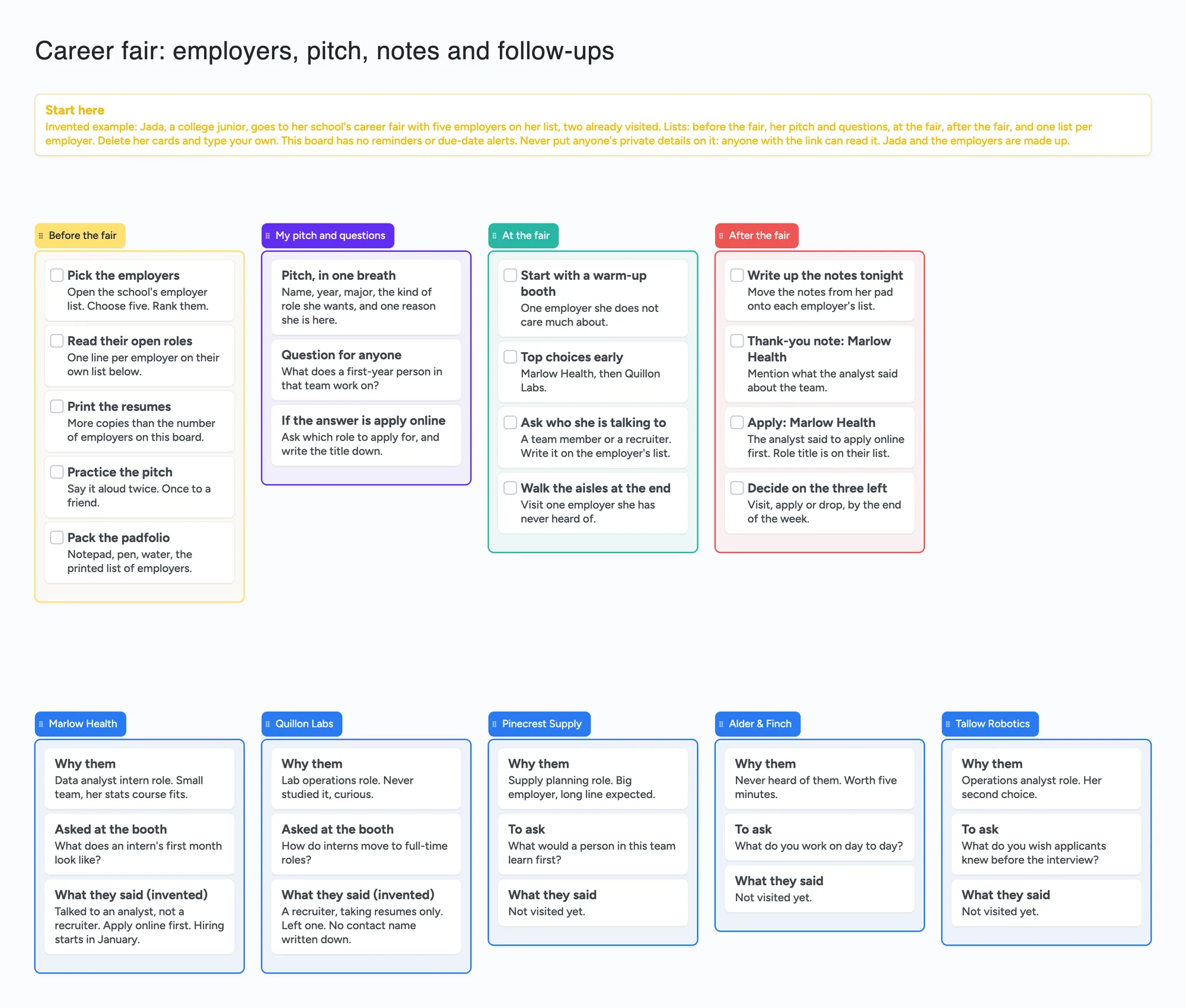
Jada, her school and the five employers are invented, and so is what they said. Read it top row left to right, then the employer lists.
- Before the fair. Five tick-box cards: pick the employers from the school's list, read their open roles, print the resumes, practice the pitch, pack the padfolio.
- My pitch and questions. Her pitch in one breath, a question for anyone, and what to ask when the answer is apply online.
- At the fair. Four tick-box cards: a warm-up booth first, top choices early, ask who she is talking to, walk the aisles at the end.
- After the fair. Four tick-box cards: write up the notes tonight, a thank-you note and an application for Marlow Health, and a decision on the three employers she did not reach.
- One list per employer. Marlow Health, Quillon Labs, Pinecrest Supply, Alder & Finch and Tallow Robotics, each with three cards: why them, what she asked, what they said.
One list per employer: what to write at the booth
The employer lists are the part of this board that a printed checklist does not give you. Each has the same three cards, so five employers fit side by side and a friend can read them at a glance.
- Why them. The role, and the one reason it fits. Write it before the fair, from the employer's own role page.
- Asked at the booth. The question you actually asked. It keeps you from asking the same thing twice at the next booth and from repeating it in your thank-you note.
- What they said. Who you spoke to (an employee, a recruiter) and what they told you. Jada's Marlow Health card says she talked to an analyst, who said to apply online first; her Quillon Labs card says it was a recruiter taking resumes only and she wrote down no name. That gap is the point: the card shows her who she cannot thank by name.
Three of Jada's employers read "Not visited yet". That is how the board tells you on the morning of the fair which booths are left.
What recruiters and students say in the threads
Replies are single accounts, not research, and these are the comments we read. All were read on November 24, 2026, and the people disagree in places.
- In r/cscareerquestions ("How to stand out at career fairs/ what to talk to recruiters about?", OP u/yungspartan0082, October 7, 2019), u/EmergencySundae says they recruited at Grace Hopper and that candidates stood out when they had already researched the company and its open roles, had a real pitch (graduation date, degree, the roles they wanted) and sounded interested. u/dan1son says they brought five people to their last fair, three of them developers, one a dev manager and one a recruiter, and that they have about a minute to decide whether to reach out to a student afterward.
- In r/rit ("Last minute career fair tips?", OP u/Chrisc235, September 28, 2021), u/Jimga150 says to go to the companies you want most first, and that asking "what can you tell me about <company>?" shows whether you are talking to an employee or a recruiter; a recruiter, they say, almost always means they are only taking resumes. u/Ap3X_GunT3R says to have a list of target companies, start with a middle company to warm up and then do the top choices, and says that an hour before the fair ends recruiters let their guard down. u/SlashStar also suggests starting with a couple of companies you are not very interested in. These two views on order are why Jada's "At the fair" list has a warm-up card and a top-choices card, and you may reorder them.
- In the same thread, u/pushhuppy says to apply online before the fair, because some employers cannot schedule an interview unless you are in their online system, and to confirm with the recruiter that you applied for the right positions. u/IMTonks says they got one interview from the fairs at RIT and got most of their positions through the co-op and careers portal, and that the fair gave them feedback on their resume and practice at small talk.
- In r/EngineeringStudents ("How to talk to recruiters at the career fair.", OP u/AmpFibian, December 28, 2022), u/PvtWangFire_ says they applied to a role ahead of time, told the employer at the booth they had applied, and were invited to an interview the following day. That is one person's account.
- In r/cscareerquestions ("What exactly should I ask to recruiters at career fair?", OP u/Niklaus_MK, September 30, 2020), u/puddinghimechan says that unless the company is big, recruiters do not expect you to know the open roles, and that they are often not on the website yet; they suggest asking about culture, the application process and the team's projects, and connecting on LinkedIn without being pushy.
The commenters also disagree on whether to research open roles first: u/EmergencySundae, a recruiter, says candidates who had researched the open roles stood out, while u/puddinghimechan says that unless it is a big company, recruiters do not expect you to know the roles, since they are often not on the website yet.
The threads are mostly from computing and engineering students, and several are from fairs several years ago. Treat them as how some people prepared, not as how your fair will run.
Follow-ups: when, and where the board stops
UVA and Illinois both say to send the thank-you email within 24 hours. The University of Utah Career Success page ("Career Fair Follow-Up Emails that Impress", which credits its text to Jenna Rein Zipf of the Intern Hustle) says timing depends on the situation: the same day or the next day when there is a specific job, and up to a week later if the main goal is to network. It also says to confirm the recruiter's preferred way to be contacted and to keep the salutation professional.
On the board, a follow-up is a tick card under "After the fair" and the employer's own list holds what to mention. The board will not remind you the day after. Put the date in a calendar or on the card's due date, and tick the card yourself. Ticks don't say who or when, so on a shared board anyone with edit access can untick a box.
How much of the 150 it uses
Our arithmetic: the example is 9 lists, 32 cards and a title, 42 items. Each employer is one list and three cards, 4 items, and the other 22 items are the title, the Start here card, four lists and 16 cards. Fifteen employers at that size make 82. With five cards on each of the fifteen employers (6 items each) it is 112. Someone who writes on your board adds the cards they type to their own 150. A copy takes 1 of your 5 free boards. Pro removes the item limit.
What a board can't do
- No employer list. It does not know which employers are coming. Take that from your school's page and type the ones you will visit.
- No reminders or due-date alerts. It will not tell you to send the thank-you note. Use a calendar or a card's due date.
- No email. It does not draft or send your follow-up. Your mail app does that; the board holds what to mention.
- No resume or application tracking. It does not read your resume or keep application status. Applications you send go in your school's portal or a tracker made for them.
- Ticks don't say who or when. Anyone with edit access can untick a box, and a copy keeps its ticks, so untick the lists before you reuse the board.
- A copy takes 1 of your 5 free boards, and the example uses none of the 3 pictures allowed per board.
Where other tools do this better
Read on November 24, 2026; pages change, so check them. A date is printed only where a page shows one.
| Tool | What we read | Better for |
|---|---|---|
| Your school's career center pages and employer list | UVA, Illinois and UMD name Handshake for the attending list; ETSU points to employer profiles on Handshake (read November 24, 2026) | The real list of employers, the fair's rules and its check-in steps |
| UMD Career Fair & Networking Tracker | UMD's page says its center built a tracker for organization names, deadlines, job descriptions and correspondence. We did not open the tracker itself | Students at UMD, and a model of what your own school may offer |
| Spreadsheet | Not read for this page | Sorting 30 employers by role, or keeping notes you want to search |
| Handshake | Not read for this page beyond what the career centers say about it | The employer list, booth check-in and applying through your school |
| Instaboard board | Free plan: 5 boards, 150 items, 3 pictures per board. Lists and cards you type, shared by link. No employer list, reminders, due-date alerts or email | One screen for your pitch, your questions and a list per employer that a friend can read and write on |
Swipe the table sideways to see every column.
From each page or comment named, read November 24, 2026: career.virginia.edu career fair success, careercenter.illinois.edu preparing for an in-person fair, careers.umd.edu prepare for the fair, etsu.edu prepare for the career fair, careers.utah.edu follow-up emails, and the four Reddit threads in the sources. Our wording, not theirs.
Where these win
Use your school's employer list and any tracker it offers, a calendar for the follow-up dates and your mail app for the follow-up email. Use this board when you want your pitch, your questions and what each employer said in one place that a friend can read and write on.
How to use it, in about fifteen minutes
- Open the board and sign in free when it asks you to write. Delete Jada's cards and keep the lists.
- Copy the employers you plan to visit from your school's list. Rename one employer list per name and delete the spare ones.
- Fill "Why them" from each employer's own role page, before the fair.
- Write your pitch in one card and your questions in the next, then edit the "Asked at the booth" card per employer.
- At the fair, write on each employer's list while you walk to the next booth: who you spoke to, what they said, what to mention.
- Tick off "After the fair" and put the follow-up dates in your calendar. Your school's career center can tell you what it expects.
- To share it, set Share to "Anyone who joins can edit" if a friend going to the same fair should write. Each person who writes signs in for free. Keep personal contact details off it.
Start from the ready board
It opens in your browser in a few seconds, with nothing to install. Sign in for free when you want to save it and share it.
Questions
What should I bring to a career fair?
University of Illinois's page lists a portfolio with a notepad and pen, copies of your resume (more than the number of companies you plan to visit) and your research notes. The board holds the packing list as a tick card; your school's page is the one that counts.
How do I keep track of what each employer said?
Several career centers say to take notes during the conversation and record employer information soon afterward. On the board, each employer has its own list with three cards: why them, what you asked and what they said.
When should I send a follow-up after a career fair?
Illinois and UVA say within 24 hours. The University of Utah's page says the same day or next day when there is a specific job, and up to a week later if your goal is networking. The board has no reminders, so put the date in a calendar or on a card's due date.
Does the board have the list of employers attending?
No. Your school's page or Handshake has the list; UVA, Illinois and UMD name Handshake for it, and ETSU points to employer profiles there. Copy the employers you plan to visit onto the board.
Can a friend who is going to the same fair write on it?
Yes. New boards start with "Anyone who joins can view", so anyone with the link can read it. Set it to "Anyone who joins can edit" if they should write; each person who writes signs in for free.
Is Instaboard free?
Yes. The free plan includes 5 boards, 150 cards and items across your account (pen strokes, arrows and sections don't count), 3 images and 1 file per board, unlimited collaborators and video calls up to an hour. Pro is $5 a month billed yearly ($59.99 a year), or $7.99 monthly, and the people you invite join free.
Sources
- University of Virginia Career Center: Career Fair Success (page data: published July 1, 2026, modified July 8, 2026; read November 24, 2026)
- University of Illinois Career Center: Preparing for an In-Person Career Fair (no date found; read November 24, 2026)
- University of Maryland University Career Center: Prepare for the Fair (refers to its Fall 2026 fairs; read November 24, 2026)
- East Tennessee State University Career Services: Prepare for the Career Fair (page data: updated September 16, 2026; read November 24, 2026)
- University of Utah Career Success: Career Fair Follow-Up Emails that Impress (Published: March 14, 2025, as printed; read November 24, 2026)
- r/cscareerquestions: How to stand out at career fairs/ what to talk to recruiters about? (OP u/yungspartan0082, October 7, 2019; replies are single accounts; read November 24, 2026)
- r/cscareerquestions: What exactly should I ask to recruiters at career fair? (OP u/Niklaus_MK, September 30, 2020; replies are single accounts; read November 24, 2026)
- r/rit: Last minute career fair tips? (OP u/Chrisc235, September 28, 2021; replies are single accounts; read November 24, 2026)
- r/EngineeringStudents: How to talk to recruiters at the career fair. (OP u/AmpFibian, December 28, 2022; replies are single accounts; read November 24, 2026)