For an adult committee sealing a building or community capsule
Time capsule committee board: who collects, who seals, and who holds the record
If one person is filling a family capsule from a printed checklist, use the checklist. If a small committee of adults has to agree on what goes in, collect it, seal it and hand the record to whoever is around when it opens, one board can keep those jobs and decisions in one place. We make Instaboard. It plans the capsule; it does not store it or remind anyone when to open it. The building and the committee are invented. Open it, replace them with yours, and send one link to the committee. The page gives no advice for children's classroom capsules.
Opens in your browser. Anyone can view; a free sign-in lets you edit.
Updated
The short answer
- What it is: a list for each part of a capsule project (decisions, what goes in, rules for items, collecting, sealing, where it is and the record, opening day), with a card for each task and a colour for who has it. It answers "who has what, and what is still undecided".
- What it isn't: a place to keep the capsule or its record. The Library of Congress copy of an Iowa State University Library guide says to keep a contents checklist in duplicate and a record of the capsule "in several places"; keep those on paper, not only here.
- Who it is for: three or four adults sharing the job for a building, club or neighbourhood capsule. It isn't for a solo family capsule, where a printed checklist is simpler.
- Adults only: the example committee is adult residents. The page gives no advice for school classes or children.
- Free plan: 5 boards, 150 items across your account, 3 pictures per board. Anyone who joins can view; editing needs a free sign-in.
- Not on it: a date lock, reminders, a print layout, names, addresses or phone numbers. A board shared by link can be opened by anyone who has the link.
What this board doesn't do, before you build
- No date lock and no reminders. Nothing stops anyone opening the capsule early and nothing tells anyone it is due. Instaboard has a countdown timer you can put on a board, but it does not read your opening year.
- Not an archive. The Iowa State guide opens by saying the urge to bury a capsule "overlooks the deterioration effects of time", and that a bank box or sealed archival housing would improve the odds of materials surviving. Don't rely on any app, including this one, to hold the record for decades. Print the contents list and the location note and keep copies in more than one place.
- No print layout. The contents list and the label for the outside are printed from a document you write, not from the board.
- No pictures to speak of. The free plan holds 3 pictures per board, so photos go in the capsule as paper prints, not on the board.
- Not private by default. Anyone who has the link can see every card, so keep names, addresses and phone numbers off it. This page is for adult residents and committee members.
When something else is the better choice
- You are one person filling a family capsule. timecapsule.com, a seller whose page says you can order more stationery by phone, publishes an ideas checklist of items to gather (newspapers, ticket stubs, a list of slang, letters from family, photos to take, a receipt, a bill) and says "Print this list and use it to help you gather items". A printed list is simpler than a board for one person.
- You want the physical advice. The Library of Congress copy of an Iowa State University Library guide by Ivan Hanthorn gives eight tips on paper, photographs, enclosures, containers and documentation. Vanderbilt's 2023 article, written after its 1874 copper-box capsule was found with "water and mold", gives the same kind of advice. A board holds none of this; it holds who does each step.
- You want a ready template in a notes app. Notion's marketplace lists a template called "Temporal Vault - A Time Capsule" by Idea Palette at 5 USD (listing page only; we did not read the template).
- You are an institution with an archivist. Placer County's news release of September 17, 2026 says it will seal a capsule in a safe dating to 1878 at its museum until 2101, with county staff gathering the items. A county with museum staff and a safe needs no board from us.
The board is for the other case: a few neighbours or club members who each own part of the project, don't live in each other's pockets, and need to see the whole of it, including the part that happens in 25 years.
What the preservation guides say to decide first
These are the sources the board's lists come from. Each is one publisher's advice, not a rule.
- Choose where it will be found. Vanderbilt's article (June 7, 2023) says to "choose a location where the time capsule is likely to be found", and that a building the community treasures is likelier to be renovated than demolished. The board's "Where is it kept?" card holds this.
- Pick the container for the job. Vanderbilt says the capsule "should be made of chemically inert materials such as stainless steel, aluminum or uncoated polyethylene" and should seal tightly. The Iowa State guide lists polypropylene, aluminum and stainless steel and says seals are critical. The board's Packing and sealing list has a card for it.
- Choose paper over machines. The Iowa State guide says to include items that need nothing "other than the eye and hand to use and interpret", and to avoid plastics. Vanderbilt says people of the future "might not have the equipment to read a zip drive". The board's Rules for items list has a card for each.
- Write the record down twice. The Iowa State guide says to make a contents checklist in duplicate, one copy for the capsule and one to file, and to keep a record of the capsule in several places. The board's record list has two copy cards and a hand-over card.
- Choose items that last. Vanderbilt says "choose items that will last for 100 years or more" and that black-and-white photographs survive better than colour ones.
What people say goes wrong
These are Reddit commenters talking about school, class and workplace capsules, so take them as one setting. Each comment is one person's view, read November 24, 2026.
- The location gets forgotten. In r/Xennials (April 3, 2025) u/Sad_Increase216 wrote that the teacher "moved away, forgot about the capsule and none of us seemed to remember where she buried it." The board's record cards exist so one person's memory is not the only copy.
- Nobody checks what went in. In r/AskAnAmerican (September 25, 2025) u/DivaJanelle wrote that nobody checked what the class of 1990 had deposited and "one of the deposits was a full beer can", and that after they were dug up for a 30th reunion that was cancelled, they were "still sitting at someone's house". The board's Collecting list has a card for a second person checking every item, and none for who keeps the items between drop-off and sealing, so add one.
- It is opened in poor condition. In r/Xennials u/probablyatargaryen wrote that a school dug up its 50-year capsule in front of alumni and it was "just soggy, indistinguishable clumps of matter and mud." Vanderbilt's "water and mold" story says the same thing.
- The contents are dull. In r/history (November 1, 2016), on a thread about a capsule opened after 50 years, u/Downvotes-All-Memes wrote "Make the contents of the new one better." The board's "What goes in" list has a page of predictions and letters from residents.
Maple Court's capsule, list by list
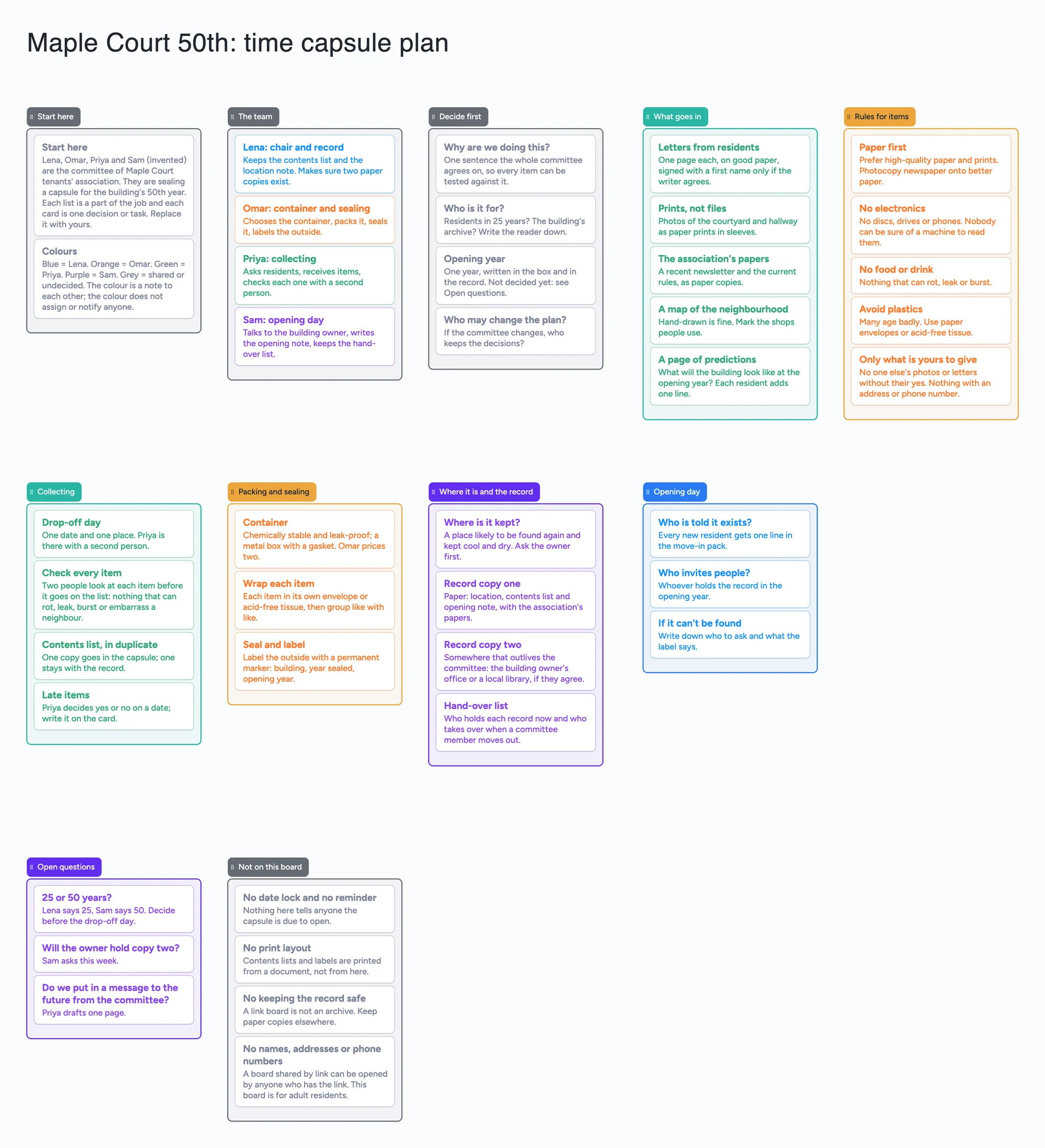
The example is invented. Lena, Omar, Priya and Sam are the committee of a tenants' association sealing a capsule for the building's 50th year. Each list is a part of the job.
| List | What goes in it | In the example board |
|---|---|---|
| Start here (grey) | The committee and the colour rule | Blue is Lena, orange Omar, green Priya, purple Sam, grey shared or undecided |
| The team (grey) | One card per member and what they own | Chair and record, container and sealing, collecting, opening day |
| Decide first (grey) | Decisions before anything is collected | Why, who it is for, the opening year, who may change the plan |
| What goes in (green) | The kinds of item, not every item | Letters from residents, paper prints, association papers, a map, a page of predictions |
| Rules for items (orange) | What is allowed | Paper first, no electronics, no food or drink, avoid plastics, only what is yours to give |
| Collecting (green) | How items arrive and are checked | Drop-off day, a second person checks every item, contents list in duplicate, late items |
| Packing and sealing (orange) | Container, wrapping, label | Container, wrap each item, seal and label |
| Where it is and the record (purple) | Where it is kept and who holds the paper | Location, two record copies, hand-over list |
| Opening day (blue) | How people find out it exists | A line in the move-in pack, who invites people, if it can't be found |
| Open questions (purple) | What the committee hasn't decided | 25 or 50 years, will the owner hold copy two, a message from the committee |
| Not on this board (grey) | What stays off a link board | No date lock or reminder, no print layout, no archive, no names, addresses or phone numbers |
Swipe the table sideways to see every column.
The board's own wording. Names, the building and the dates are made up. Rules for the container and the record come from the guides above; read the source before you copy a number.
The useful move is the record list. The two record-copy cards and the hand-over card make someone name where the paper lives and who takes over when a committee member leaves. That is the step the "forgot where it was buried" stories skip.
Does your capsule fit in 150 items?
The free plan allows 150 items across all your boards. Each card, list and text box is one item; sections, arrows and pen strokes aren't. The ready board has 53 items (11 lists, 41 cards and the title). Our arithmetic:
| Capsule | Cards added | Items | Of the free 150 |
|---|---|---|---|
| As built | 0 | 53 | 97 left |
| 20 more item cards | 20 | 73 | 77 left |
| One card for each of 60 residents' letters | 60 | 113 | 37 left |
| 97 more cards | 97 | 150 | 0 left |
| 98 more cards | 98 | 151 | Over 150 |
Swipe the table sideways to see every column.
Our arithmetic: 53 items on the ready board, plus one card for each item you add. Items are counted across all your boards, so a second board uses the same 150.
If you reach the limit, log item types on cards instead of every item, or upgrade. Pro removes the item limit; it is $5 a month billed yearly ($59.99 a year), or $7.99 monthly.
Set it up for your own capsule, in order
- Open the board and sign in free to edit it. Delete the Maple Court cards as you go.
- Name the committee on the team cards, one job each, and give each person a colour.
- Fill Decide first before you ask anyone for anything, and write the opening year in one place.
- Set the board's Share setting to "Anyone who joins can edit" so each member can move their own cards, and give each person their own cards rather than typing in the same one.
- Print the record (contents list, location note, opening note) and put copies where the hand-over card says.
- Move what nobody has decided to Open questions and re-read the board together before drop-off day.
Start from the ready board
It opens in your browser in a few seconds, with nothing to install. Sign in for free when you want to save it and share it.
Questions
Can a committee plan a time capsule on one board?
Yes. Send the link; anyone can view it, and editing needs a free sign-in. Once you set Share to "Anyone who joins can edit", each member can add and move cards. Colour is a note to each other; it doesn't assign anyone or send a message.
Can the board remind us when to open it?
No. There is no date lock and no reminder. Put the opening year on the label, in the paper record and in the hand-over list, and give someone the job of passing it on.
Should the contents list live on the board?
Plan it there, but keep it on paper. The Iowa State guide says to keep one copy in the capsule, one on file, and a record in several places. Don't rely on any app to hold it for decades.
Does it work for a school class?
This page is for adult committees. It gives no advice for classes or children, and the example has no children's names.
How long should a capsule stay sealed?
The sources differ. Placer County is sealing its capsule for 75 years, until 2101. Vanderbilt's advice on item lifespan is to choose items that will last for 100 years or more. The board's Open questions list is where your committee writes its choice.
How many items fit on the free plan?
With one card per item you add, the ready board plus 97 more cards is 150 items (our arithmetic). The limit is 150 items across all your boards. Pro removes the item limit.
Sources
- Iowa State University Library (Ivan Hanthorn), "So you want to do a time capsule?", copy on loc.gov (eight tips: paper, photographs, enclosures, container, no electronics, duplicate checklist, avoid plastics; read November 24, 2026)
- Vanderbilt University, How to Make a Time Capsule (Kim Green, June 7, 2023; location, container, materials; read November 24, 2026)
- timecapsule.com, Ideas Checklist: What to Put in a Time Capsule (a seller's printable list; read November 24, 2026)
- Placer County, Placer County invites community to time capsule sealing ceremony Oct. 10 in Auburn (published Sept. 17, 2026; read November 24, 2026)
- Notion Marketplace: Temporal Vault - A Time Capsule (listing page only, 5 USD; read November 24, 2026)
- Reddit r/Xennials: Did you guys ever do a time capsule in school? (April 3, 2025; u/Sad_Increase216, u/probablyatargaryen)
- Reddit r/AskAnAmerican: Are time capsules actually a thing in schools? (September 25, 2025; u/DivaJanelle)
- Reddit r/history: We opened a 50-year-old time capsule at work the other day (November 1, 2016; u/Downvotes-All-Memes)
Related
A moving board: pack by room, number every box, share one list
Plan a move on one shared board: a list per room with a card for every numbered box, plus moving-day tasks. Free ready board; a moving app or a spreadsheet searches better.
A decision log template on one shared board: open, decided, revisit, reversed
A decision log template on one shared board for two to five people: open questions, decided with the why, revisit on a date, reversed. When a spreadsheet or Notion is the better home.