For a small team about to start a project that can't easily be undone
A pre-mortem template on one shared board: imagine it failed, list why, assign the fixes
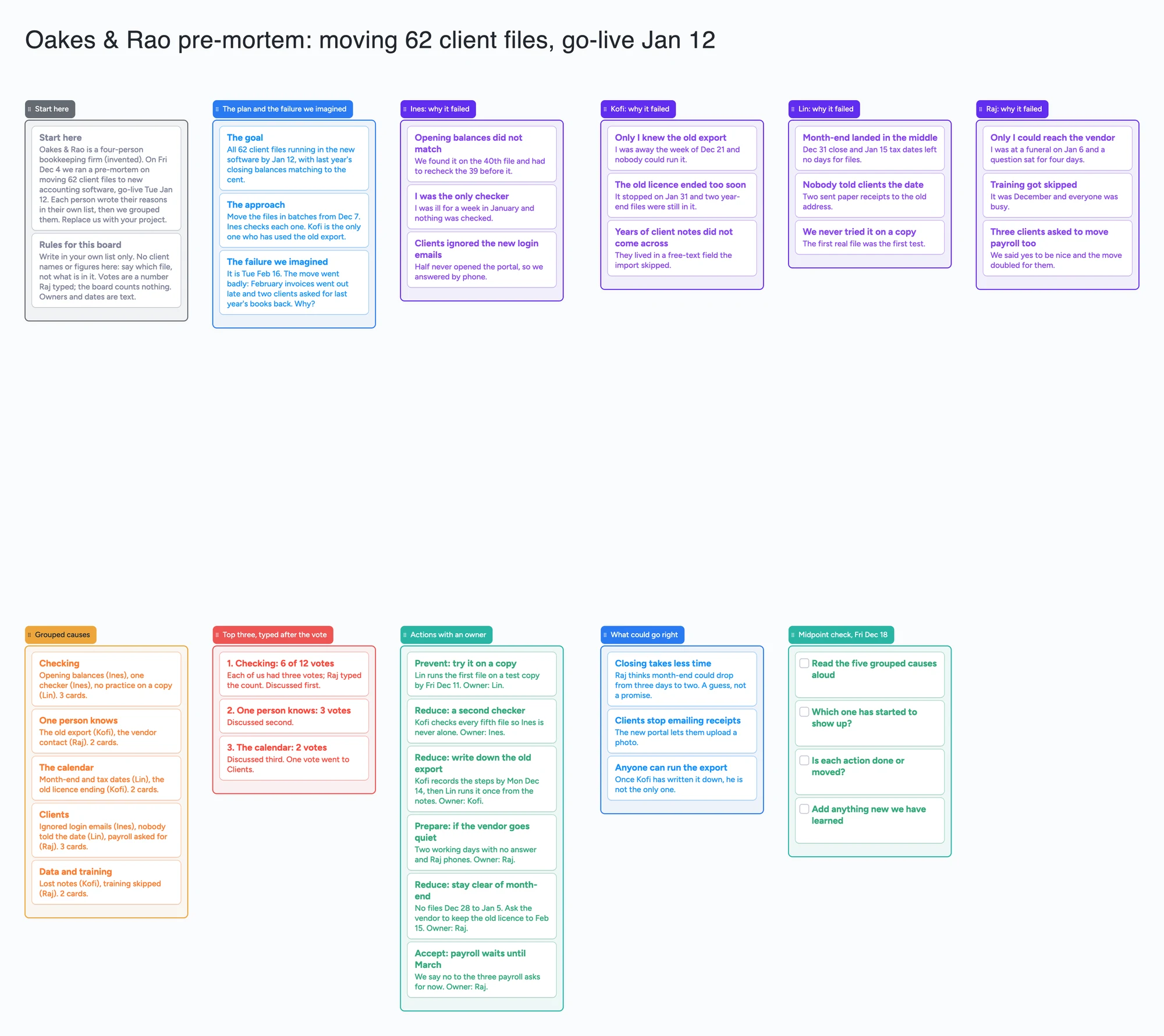
We make Instaboard, an online board. This page gives you a pre-mortem already laid out on it, filled in for an invented four-person bookkeeping firm: Oakes & Rao is moving 62 client files to new accounting software with go-live on January 12, and on December 4 the team imagines it is February 16 and the move went badly. Eleven lists: the plan and the imagined failure, one list of reasons for each person, the reasons grouped, the top three after a vote, actions with an owner, what could go right and a midpoint check. Open it, swap Oakes & Rao for your project and send the link to the people doing the work. It is a place to write the reasons down and sort them, not a facilitator: no voting, and no way to keep one person's list hidden while the others write. Below we say what that costs and when a different tool is better.
Opens in your browser. Anyone can view; a free sign-in lets you edit.
Updated
Read this first: what the board does and doesn't do
- What it is: one screen for the whole exercise: the plan, the failure you imagine, each person's reasons, the grouped causes, the top three and an action with an owner for each. The Oakes & Rao board uses 50 of your 150 free items.
- What it is not: no voting, no scoring and no reminders. The vote count and the owners and dates on the action cards are text someone types. A tick box can be ticked and unticked by anyone with edit access, and the board doesn't show who or when.
- The catch: the method says to write your reasons alone first. This board is live, and signed-in people who are on it see cards within seconds, so it cannot keep reasons apart while people write. A section below gives a way round it.
- Keep off it: names of clients, figures and anything private. A link board is not private. The example says which file, not what is in it.
- When to use something else: a scored risk register, owners and due dates that nag, or a facilitator that runs the clock. A section below lists them.
When another tool is the better way to run a pre-mortem
Start with the cases where this board is the wrong choice, because the method leans on things a shared board does not do.
- You want anonymous reasons. The method's value, as Rework's page puts it, is that people write alone so the loudest or most senior voice doesn't set the room's view. A board that others can see as you type doesn't give you that. A paper slip or a form that is not live does.
- You want a vote that counts itself. Atlassian's play gives each person three votes; Rework suggests dot voting. Here Raj types the count.
- You need a scored risk list. Rework and Rock both treat the pre-mortem as the step that finds risks and a risk register as the document that tracks them, with a matrix to rank them. A board has no score, no likelihood or impact fields and no totals.
- You need owners and dates that remind someone. Atlassian's play says to assign an owner and a due date to each action. On a board those are text on a card; nothing reminds or alerts anyone. Use a task tool for the actions.
- The risks are about people. A pre-mortem can surface things like a colleague's habits. A link board is the wrong place for those.
If the team is small, the plan is written down, and you want one place where everyone's reasons end up sorted into actions, a board does that part well.
Two versions of the method, and which one the board follows
The four method pages we read (all November 24, 2026) don't describe quite the same exercise.
- Assume it already failed. Asana, Rock and Rework all describe the version in which the team imagines the project has failed and works backward to the reasons. Rework adds that Gary Klein described it in Harvard Business Review in September 2007, and says to pick a date and a vivid result: "It's March 2027. The launch missed its date by four months...". The Oakes & Rao board uses this one; its "failure we imagined" card says it is Tuesday February 16.
- Look both ways. Atlassian's play is built on columns of questions such as "What could cause us to miss our deadline?" and "What are you excited about?", and starts by asking what could go wrong and what could go right. It does not ask the team to assume failure. Oakes & Rao's "What could go right" list is borrowed from that idea.
Atlassian's play is a trademarked method we use as a source only; this board is not affiliated with or endorsed by Atlassian. Klein's article is behind a paywall: we read its summary page, which says team members assume the project has just failed and then generate plausible reasons, and we rely on the four pages above for the steps.
Oakes & Rao's board, list by list
The example is invented. Ines, Kofi, Lin and Raj run a four-person bookkeeping firm. They are moving 62 client files to new software, a few at a time from December 7, with go-live on January 12. Each list answers one question in the order the exercise runs.
| List | The question it answers | In Oakes & Rao's board |
|---|---|---|
| The plan and the failure we imagined (blue) | What are we critiquing, and what went wrong? | "The goal", "The approach", "The failure we imagined": it is Feb 16, invoices went out late |
| One list per person (purple) | Why did it fail, in my own words? | Ines: "I was the only checker". Kofi: "Only I knew the old export". Lin: "We never tried it on a copy". Raj: "Only I could reach the vendor" |
| Grouped causes (orange) | Which reasons are really the same? | "Checking" (3 cards), "One person knows" (2), "The calendar" (2), "Clients" (3), "Data and training" (2) |
| Top three, typed after the vote (red) | Which do we talk about first? | "1. Checking: 6 of 12 votes", "2. One person knows: 3", "3. The calendar: 2" |
| Actions with an owner (green) | What do we do about each? | "Prevent: try it on a copy" Lin; "Reduce: a second checker" Ines; "Accept: payroll waits until March" Raj |
| What could go right (blue) | What good could we plan for? | "Anyone can run the export" once Kofi has written it down |
| Midpoint check, Fri Dec 18 (tick boxes) | When do we look again? | "Which one has started to show up?" |
Swipe the table sideways to see every column.
The board's own wording. Dates, vote counts and owners are text typed into a card; the board counts nothing and sends no reminders or due-date alerts. The tick boxes can be ticked and unticked by anyone with edit access, and the board doesn't show who ticked or when.
The first list, Start here, has two cards: what the board is and its rules (write in your own list, no client names or figures).
The live-board problem: how to write alone on a shared screen
Rework says to give everyone five to ten minutes to write why the project failed with no talking, because group discussion pulls people toward the loudest voice or the most senior opinion. Rock calls independent writing first "essential" and gives the same reason. A shared board works against that: signed-in people on the board see cards within seconds, so anyone can read Ines's list as she types it.
Three ways to keep the point of the step anyway. All are our suggestions, not something the pages say:
- Write first, type second. Everyone writes their reasons on paper or in a notes app for the five to ten minutes, then types them into their own list. Only the typing is shared.
- Ask the facilitator to open the board late. Share the link when the writing time is up, so nobody has seen anything yet.
- Accept it and say so. If the team is four people who trust each other, the risk of anchoring is smaller than in a room with a sponsor. Oakes & Rao are four peers with no sponsor in the room.
We don't claim the board can hide a card from another person; Pro adds invite-only boards and per-person permissions, but we haven't tested whether they help with this.
From one reason to one action: tracing "Checking"
The step that matters most, in all four sources, is turning the reasons into actions with an owner. Rock says a pre-mortem that ends with a list and no owners is a venting session. Here is the path of one cluster on the Oakes & Rao board:
- Three people wrote related reasons: Ines, "Opening balances did not match" and "I was the only checker"; Lin, "We never tried it on a copy".
- They went into one grouped card: "Checking: opening balances (Ines), one checker (Ines), no practice on a copy (Lin). 3 cards."
- It got the most votes: 6 of 12 (four people, three votes each; Raj typed the count).
- It became two actions: "Prevent: try it on a copy", Lin, by Fri Dec 11; and "Reduce: a second checker", Kofi checks every fifth file so Ines is never alone, owner Ines.
The four action labels are Rework's four possible responses to a top risk: prevent it, reduce it, prepare a contingency trigger, or accept it knowingly with a named owner. The board uses all four, and "Accept" is there on purpose: payroll waits until March. The vote and the dates are an invented example, not evidence of how often the method works.
What the "30%" figure is, and isn't
Three of the four pages repeat a figure from the research behind the method, and they don't say the same thing. We report each as the page states it:
- Asana says that, according to research (it links a Psychology Today post), prospective hindsight increases the ability to correctly identify reasons for future outcomes by 30%.
- Rock quotes a line it attributes to the 1989 Mitchell, Russo and Pennington study, reported in Harvard Business Review: imagining that an event has already occurred increases a person's ability to correctly identify reasons for future outcomes by about 30 percent.
- Rework says a review of that 1989 work reports a rise of about 30% in the number of reasons people generated, and notes that the authors did not assess how good the reasons were. Its own conclusion is that the safe takeaway is more reasons, faster, not 30% more accurate.
We haven't read the 1989 paper, so we don't choose between them. We only note that two pages say "correctly identify" and one says the study counted reasons. The board doesn't depend on the figure: it gives you a place to collect the reasons, whichever number is right.
Who is in the room and how long it takes: the pages differ
| Page | How many people | How long | Who |
|---|---|---|---|
| Atlassian (no page date shown) | 3-11 | 10 minutes prep, 60 minutes to run | The team; the play suggests three votes each |
| Asana (July 3, 2026) | Not given as a number | 30 to 60 minutes, and 15 for a short sprint | Led by the project manager or Scrum master, with core team, cross-functional partners and experts; says executive sponsors who aren't involved day to day needn't come, because their presence can make open discussion harder |
| Rock (May 29, 2026) | 3 to 10 | About 30 minutes | The people doing the work, not only managers |
| Rework (updated October 10, 2026) | 5 to 12 for a 45-minute session | 30 to 60 minutes | Also people outside the core team; says don't let the sponsor or manager speak first |
Swipe the table sideways to see every column.
From each page as read November 24, 2026. Oakes & Rao's four people and one hour sit inside every page's range except Rework's group size, which starts at five. Instaboard isn't affiliated with any of these.
None of this changes the board. It is the same whether you run 30 minutes or 60. What changes is how much you type: the more people and reasons, the more items you use, which the 150-item section below works out.
The midpoint check: look again before the risks show up
Atlassian's play says to revisit the document periodically so you stay aware of the risks and are actively addressing them. Asana suggests checking in at key milestones or in regular status meetings, and monthly for longer projects. Rework says to put a short check on the calendar at the project's midpoint, because risks from the first session often change shape once work is underway. Oakes & Rao's last list is that check as four tick boxes:
- Read the five grouped causes aloud.
- Which one has started to show up?
- Is each action done or moved?
- Add anything new we have learned.
The date is text. Put the check in each person's own calendar; the board won't remind anyone.
How much of your 150 items does a pre-mortem use?
Each card and each list is 1 of your 150 free items, across all your boards. The title text box counts too. Arrows, sections and pen strokes don't. Our arithmetic from Oakes & Rao's lists:
- As built: 11 lists + 38 cards + the title = 50.
- The fixed part: 7 lists + 26 cards + the title = 34. Each person adds one list plus their reasons.
- Four people, three reasons each: 34 + 4 x (1 + 3) = 50.
- Eight people, five reasons each: 34 + 8 x (1 + 5) = 82. A second board that size would be 164, over 150 by 14.
- Boards: a copy takes 1 of your 5 free boards.
The grouped causes in the example are summary cards, so each reason is typed twice. You could instead drag each reason card into a group list and drop the summary cards; we didn't, so the groups read at a glance. Pro removes the item limit: $5 a month billed yearly ($59.99 a year), or $7.99 monthly. One pre-mortem a quarter doesn't need it.
What a board can't do for a pre-mortem
- Keep reasons apart while people write. The board is live; see the section above.
- Vote or count. No dot voting, no tally. The vote line on a card is typed.
- Score a risk. No likelihood or impact fields, no matrix and no totals.
- Remind anyone. No reminders or due-date alerts. "Fri Dec 18" is text.
- Show who wrote or ticked what, or when. Anyone with edit access can change a card or untick a box.
- Hold private material. Anyone who has the link can view the board.
- Offline. Changes made offline are kept and sync when you're back online.
Where other tools do this better
Read November 24, 2026. Not listed means not on the page we read; it doesn't mean the tool lacks it. No ranking: they suit different teams.
| Option | What its page says | Better than a board at | Where a board fits |
|---|---|---|---|
| Atlassian Team Playbook: Pre-Mortem | A 60-minute play for 3-11 people with a Trello template and a Confluence template; has three votes each and says to assign an owner and a due date. No page date shown | A scripted workshop with timings and a vote | A team that has its own method and just needs a place to sort the reasons |
| Asana premortem guide | Six steps and a worked marketing example, with a risk matrix to rank by likelihood or severity and a risk register for larger work; links to an Asana premortem template. Pricing is not listed on that page (as of November 24, 2026) | Ranking risks and keeping a register inside a work tool | No account in a work tool needed; one screen |
| Rock pre-mortem page | Six steps, a worked website-build example and an interactive facilitator on the page that exports a first risk register; the page is vendor content for Rock. Pricing is not listed on that page (as of November 24, 2026) | A guided session that produces a list you can copy out | A board the team edits together and keeps |
| Rework pre-mortem page | Seven steps, a copy-into-a-sheet template with likelihood, impact, owner and due date columns, and a table of examples by function | A spreadsheet with scoring columns | No spreadsheet; the reasons sit beside the actions |
Swipe the table sideways to see every column.
From each page as read November 24, 2026. Rock and Rework are vendor or vendor-adjacent content. Instaboard isn't affiliated with any of these.
Set up your own, in order
- Write the plan first. Atlassian, Asana, Rock and Rework all start by making sure everyone has the same plan in front of them. Put it on the plan list, short.
- Write the failure as a date and a result. "It is [date]. The project failed because..." is Rework's wording.
- Create one list per person and tell everyone to write in their own list only. Use the paper-first method above if anchoring worries you.
- Share the reasons one at a time (Rock and Rework both say round-robin, no debating) and then group them into lists.
- Vote out loud or on paper, then type the top three. Discuss each and put an action with an owner and a date as text on a card.
- Add "what could go right" if you want Atlassian's both-ways version.
- Date a midpoint check and put it in everyone's calendar.
- Share it. Set the share setting so anyone who joins can edit ("Anyone who joins can edit"); new boards start view-only, and each person signs in free to write.
Limits of the free plan for this board
- Items. Each card and each list is 1 of 150 free items across your account; the example is 50. Arrows, sections and pen strokes don't count.
- Boards. 5 on the free plan. "Make a copy" takes 1 of them.
- Pictures. 3 per board. The example has none.
- Writing needs a free sign-in. Anyone with the link can read the board; to change it they sign in free, and the board then counts as 1 of their 5.
- Private risks. A link board is not the place for anything private; invite-only boards are a Pro feature.
Start from the ready board
It opens in your browser in a few seconds, with nothing to install. Sign in for free when you want to save it and share it.
Questions
What is a pre-mortem?
A meeting before a project starts where the team imagines the project has already failed and works backward to the reasons. Asana, Rock and Rework all describe it that way, and Rework and Rock say it comes from psychologist Gary Klein's 2007 Harvard Business Review article. Atlassian's version asks what could go wrong and what could go right, without assuming failure. The Oakes & Rao board uses the failure-first version.
How is a pre-mortem different from a post-mortem?
A pre-mortem runs before the work and is about preventing problems; a post-mortem or retrospective runs after it and is about learning from what happened. Asana's page sets the two out in a table by timing, purpose and focus, and Rock says they feed each other: what a post-mortem finds becomes the prompts for the next pre-mortem.
Who should be in a pre-mortem?
The people doing the work. Rock says to include them and not only managers, Asana adds cross-functional partners and subject experts, and Rework says to invite people from outside the core team and not to let the sponsor speak first. The page group sizes range from 3 to 12; Oakes & Rao's example has four.
Can a shared board keep each person's reasons private while they write?
No. The board is live, and signed-in people on it see cards within seconds. If independent writing matters, have people write on paper or in a notes app first and type their reasons in afterwards, or share the link only when the writing time is up. We make no claim that the board can hide a card.
How do you rank the risks?
The pages use a vote or a matrix. Atlassian gives each person three votes, Rework suggests dot voting, and Asana uses a risk matrix to pick risks that are high likelihood or high severity. The board has none of those tools: the example's vote count is typed by hand, and a scored risk list belongs in a register.
How much of the free plan does it use?
The example is 11 lists, 38 cards and the title, 50 of your 150 free items, and a copy takes 1 of your 5 free boards. Eight people with five reasons each come to 82 items. That is our arithmetic, and your other boards share the 150. Pro removes the item limit.
Sources
- Atlassian Team Playbook: Pre-Mortem (read in full November 24, 2026; no date shown; Atlassian's method, used as a source only, not affiliated)
- Asana: How to Run a Project Pre-Mortem Meeting (July 3, 2026; read in full November 24, 2026; vendor content)
- Rock: Pre-Mortem: How to Run One, With Template & Example (May 29, 2026; read in full November 24, 2026; vendor content)
- Rework: Pre-Mortem: Gary Klein's Technique for Spotting Project Failure Early (by Tara Minh, updated October 10, 2026; read in full November 24, 2026; vendor-adjacent)
- Harvard Business Review: Performing a Project Premortem (Gary Klein, September 2007; summary page only, the article is behind a paywall; used for the date and the one-line description)
Related
A decision log template on one shared board: open, decided, revisit, reversed
A decision log template on one shared board for two to five people: open questions, decided with the why, revisit on a date, reversed. When a spreadsheet or Notion is the better home.
An Eisenhower matrix template on one shared board
An Eisenhower matrix template as four lists on one shared board: Do first, Schedule, Delegate, Delete. No axes or auto-sort; Priority Matrix and Todoist do more.
A now next later roadmap template on one shared board
A now next later roadmap template on one shared board: problems not dates, a Not doing list, evidence beside it. Filled in for a three-person team. No timeline, votes or reminders.