For college and nursing students taking anatomy and physiology
How to take anatomy & physiology notes (with a filled example board)
An A&P chapter gives you new terms, several body systems and a lot of diagrams in a week. Notes that copy the slides in order stop being useful by the exam. This page shows one way to organize a chapter on a board instead: draw the process first, put the terms and worked examples in lists beside it, and finish with a self-quiz. The example is the homeostasis chapter, which is the first one in most courses. Open it, replace the text with your own lecture notes and keep it. It is a student-made study aid, not an answer key and not medical advice.
Updated
The short answer
- Draw the process before you write the terms. Most A&P chapters are about a process: a stimulus, a sensor, something that decides, something that acts. Draw it once with the pen, then hang the terms and examples around it.
- One list per example, one card per step. Blood glucose and body temperature each get a list. A card for what triggers it, a card for what happens, a card for how it switches off.
- Put the contrast on the board. The board has a positive feedback list next to the negative ones, because the chapter asks you to contrast them.
- End with a self-quiz and questions for class. Cover the board, redraw the loop, tick what you got right and redo the rest tomorrow. Write down what your course may handle differently.
- A printed study guide or your textbook is better in some cases. See below. The board is for building your own version.
The homeostasis chapter in one view
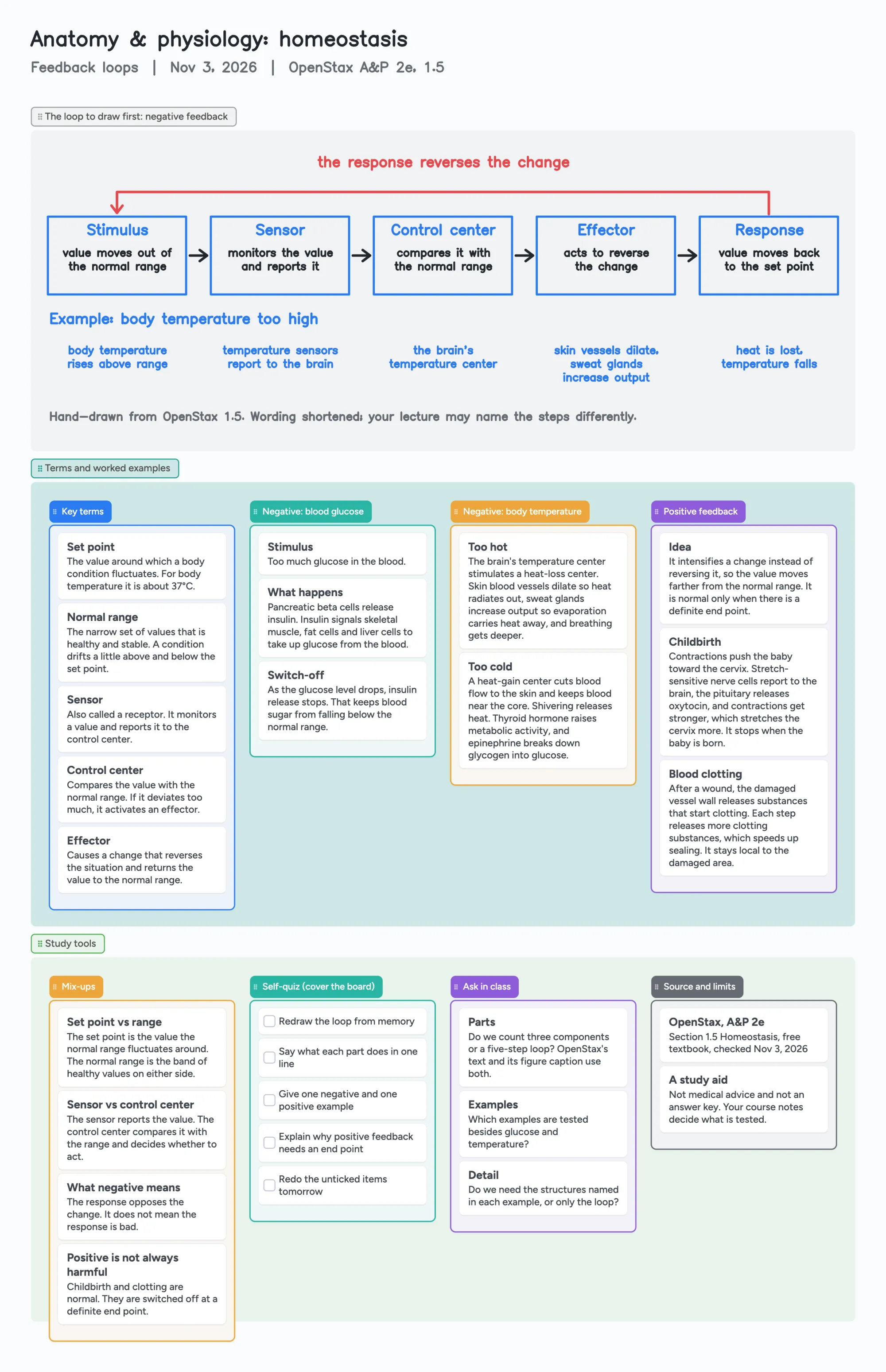
The summary below follows OpenStax Anatomy and Physiology 2e, section 1.5 (Homeostasis), read on November 3, 2026. The wording is shortened and paraphrased. Your course may name the steps differently or add other examples, so check your own notes.
| Piece of the chapter | What your notes need | On the board |
|---|---|---|
| Set point and normal range | The set point is the value a condition fluctuates around, about 37°C for body temperature. The normal range is the narrow band of healthy values around it. | Key terms list |
| Negative feedback | A mechanism that reverses a deviation from the set point. A sensor reports a value, a control center compares it with the normal range, and if it deviates too much an effector acts to bring it back. | The hand-drawn loop at the top |
| Example: blood glucose | Pancreatic beta cells release insulin when blood glucose is high. Skeletal muscle, fat cells and liver cells take up glucose. When the level drops, insulin release stops. | Negative: blood glucose list |
| Example: body temperature | Too hot: skin blood vessels dilate, sweat glands increase output and breathing gets deeper. Too cold: less blood flow to the skin, shivering, thyroid hormone and epinephrine. | Negative: body temperature list |
| Positive feedback | It intensifies a change instead of reversing it and is normal only with a definite end point. OpenStax gives childbirth (oxytocin, stronger contractions, stops at birth) and blood clotting after a wound. | Positive feedback list |
Swipe the table sideways to see every column.
From OpenStax Anatomy and Physiology 2e, section 1.5 Homeostasis, read November 3, 2026. Paraphrased and shortened for the board.
Build your own chapter board, step by step
- Draw the loop first, in ink, with a box for each part (stimulus, sensor, control center, effector, response) and a return arrow. Do it from the lecture slide or the textbook figure, not from memory of the board.
- Under each box, write the example from your own lecture in a second colour. The board uses body temperature.
- Make a Key terms list with one card per term. Put the textbook's wording in your own words.
- Make one list per worked example. Give each list the same three cards, Stimulus, What happens and Switch-off, so you can read across.
- Make a list for the contrast, here positive feedback, and write its end point on the first card.
- Make a Mix-ups list for the pairs you keep confusing, for example set point vs normal range, or sensor vs control center.
- Make a checklist for self-testing: cover the board, redraw the loop, give an example of each kind, tick what you got right and redo the rest tomorrow.
- Add an Ask in class list for anything your lecture did differently from the book.
The ready board above follows exactly this layout. The text is a worked example from the textbook section, so replace it with your own course notes. You can paste photos of your own diagrams next to it (3 images per board on the free plan).
Mix-ups the board lists
- Set point vs normal range. The set point is the value a condition fluctuates around. The normal range is the band of healthy values on either side.
- Sensor vs control center. The sensor monitors a value and reports it. The control center compares it with the normal range and activates the effector.
- What negative means. In negative feedback the response opposes the change. It does not mean the response is bad.
- Positive is not always harmful. OpenStax says positive feedback is normal only when there is a definite end point, and gives childbirth and clotting as normal examples.
- Three parts or five steps. OpenStax's text describes three components and its figure caption describes five steps. Ask which one your course uses.
Two more feedback loops to add as you go
Once the loop is on your board, you can reuse it. Two short Boardling lessons (the Instaboard team's biology lessons, each with a video, notes and a board you can copy) cover feedback loops in other systems. The lesson notes say how they were made, and each lists its sources.
- [The HPA axis](/learn/hpa-axis). The hypothalamus, pituitary and adrenal gland. The lesson explains how cortisol travels back to the brain and slows the hypothalamus and pituitary, which is negative feedback, and what happens when that switch-off fails.
- [The juxtaglomerular apparatus](/learn/juxtaglomerular-apparatus). A sensor in the kidney. The lesson describes tubuloglomerular feedback: more salt reaching the macula densa narrows the afferent arteriole and the filtration rate falls.
Both lessons are separate from the OpenStax homeostasis section above, so compare them with your own lecture before copying anything into your notes.
When something else is better
- You need the textbook's exact wording. Your course textbook and lecture notes decide what is tested. This board paraphrases one open textbook section.
- You want a ready-made study guide. Publishers and course platforms sell or give away printed study guides, cheat sheets and flashcards. They are a faster way to see a whole course outline than a board you build chapter by chapter.
- You want to search your handwriting. Notebook apps built for handwriting offer handwriting search and conversion to text. Instaboard does not.
- Your instructor gives you a required template. Use the one your course requires. A board is for building your own version.
- You want a practice question bank. The board has a self-quiz checklist but no question bank and no answer key.
Study aid, not medical advice
The board summarizes one textbook section for study. It is not an answer key, not clinical guidance and not advice about any person's health. Check your own course materials for what is tested.
What Instaboard doesn't do
- The layout is manual. There is no template that builds the chapter, no AI that writes your notes and no auto-drawn diagram. You draw the loop with the pen.
- No labelled anatomy diagrams. The board has no atlas or body images. Paste a photo of your own diagram if you want one.
- No handwriting search and no conversion of handwriting to text. The eraser removes a whole stroke at a time.
- Editing needs a free sign-in. Viewing a board by link doesn't. Instaboard's terms say users are not minors, so this page is written for college and nursing students.
- The free plan is 5 boards and 150 items (cards, lists, images, text boxes; pen strokes, sections and arrows don't count), with 3 images and 1 file per board. The ready board uses about 35 items, so one chapter per board is a sensible split.
- No import from other note apps. PDF import is the only route in. Full-board PDF export works only on drawing boards and trip planners; for a card board, selected cards and lists can be saved as an image.
- Changes made offline sync when you're back online, but Instaboard isn't built to work offline first.
Start from the ready board
It opens in your browser in a few seconds, with nothing to install. Sign in for free when you want to save it and share it.
Questions
How do you take notes for anatomy and physiology?
One way is to organize each chapter around its main process. Draw the process first, then add one list for the terms, one list per worked example and a self-quiz. The board above does this for the homeostasis chapter. Follow your instructor's format if they require one.
What is the difference between negative and positive feedback?
Per OpenStax A&P 2e section 1.5: negative feedback reverses a deviation from the set point and keeps a condition in its normal range, while positive feedback intensifies a change and is normal only when there is a definite end point, as in childbirth and blood clotting.
What are the parts of a negative feedback loop?
A sensor (also called a receptor) monitors a value and reports it, a control center compares it with the normal range, and an effector causes a change that returns the value to the normal range. OpenStax's text describes these three components, and its figure caption describes five steps.
Does this page give the answers to a worksheet?
No. It is a filled example of how to organize a chapter yourself, with a self-quiz checklist. If your instructor gave you a worksheet, fill it in from your own notes.
Can I use this board for my own class?
Yes. Open it, replace the text with your own notes and keep the layout. If your course uses different examples or names the steps differently, change them. Check with your instructor about what is tested.
Is Instaboard free?
Yes. The free plan includes 5 boards, 150 cards and items across your account (pen strokes, arrows and sections don't count), 3 images and 1 file per board, unlimited collaborators and video calls up to an hour. Pro is $5 a month billed yearly ($59.99 a year), or $7.99 monthly, and the people you invite join free.
Sources
Related
Make a biology concept map from your own notes
Turn your lecture notes into a biology concept map: concepts on cards, labelled arrows, feedback loops and a recall check. Worked example on the HPA axis, a ready board to copy, and a nursing version.
Build a nursing concept map for your patient
How to build a nursing concept map from your clinical notes, step by step: patient, pathophysiology, assessment data, labs, meds, priority problems, interventions and outcomes. A worked heart failure example you can open and edit.
Build an endocrine system concept map from your own notes
Build an endocrine system concept map from your notes: glands, hormones, target tissues and feedback loops. A sourced example board to edit. No answer key, no AI.
Cornell notes, digital: cue cards that stay linked to your notes
How to take Cornell notes on a screen: a filled example (glycolysis) with cue cards joined to note cards by arrows, a self-quiz checklist and a summary. What a board does that a printable can't, and where a printable is better.
A pharmacology concept map you can edit: one list per drug class
A filled pharmacology concept map you can open and edit: five blood pressure drug classes with the prototype drug, how it works, side effects, what to watch for and what to teach. How to build your own, and where a printable template is better.