For short film writers and directors outlining before the script
A short film outline on one shared board: three acts, minute marks, the payoff in one line
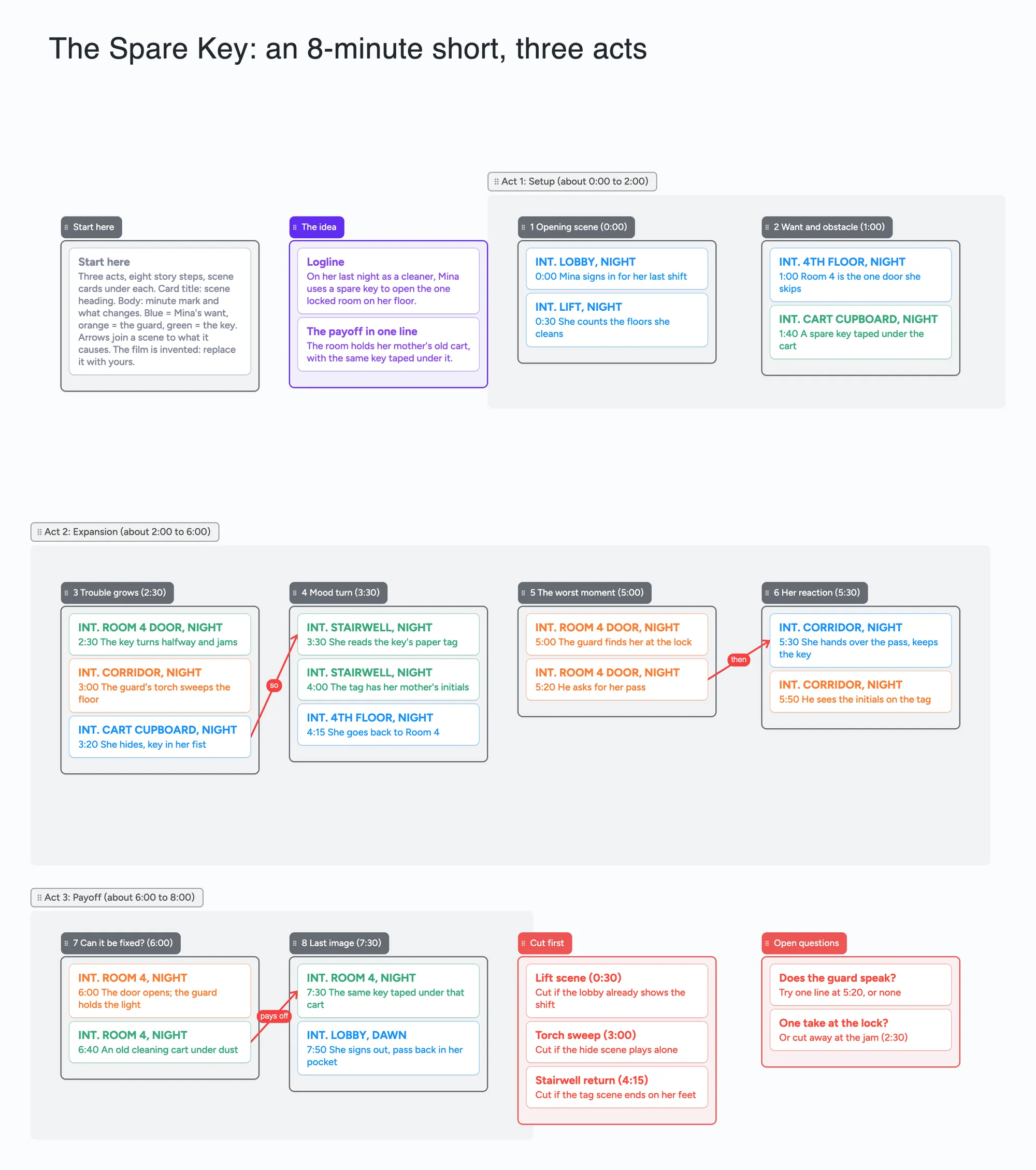
We make Instaboard, a free online board. This page gives you a short film outline already laid out on it: a logline and the payoff in one line, three act sections with minute marks for an 8-minute short, and scene cards under eight story steps, each a scene heading and what changes. The film is invented. Open it, replace the story with yours, and send one link to a co-writer, a director or a script reader. It is an outline of the story, not the production plan: nothing on it tracks locations, permits, casting or who owns a shoot task (that is the job of the [short film pre-production board](/short-film-pre-production-board)), and it is a text board, not a stills or mood board.
Opens in your browser. Anyone can view; a free sign-in lets you edit.
Updated
The short answer
- Idea first, then acts, then scenes. Two cards hold the logline and the payoff in one line. Three act sections group eight story-step lists, each titled with its minute mark. Each scene is a card: the scene heading on top, a minute mark and what changes underneath. Move a card to another step when a scene belongs somewhere else.
- Act lengths are a starting point. Open Screenplay's short-film outline lesson gives 25% / 50% / 25% as the long-standing split and 20% / 60% / 20% as a common modern one. The example uses 25 / 50 / 25 for 8 minutes: 2, 4 and 2 minutes (our arithmetic). The page numbers and minute marks on the board are typed text.
- What it doesn't have: no script editor or formatting, no timeline axis, no running time that adds up, no script import, no export to a screenwriting format, no pictures beyond 3 per board, no schedule or budget.
- Count the items before you copy it. Each list and each card is one item; the title text box counts too; sections, arrows and pen strokes don't. The example is 8 step lists, 18 scene cards, 12 more items in the Start here, idea, cut-first and open-question lists, and the title box: 39 of your 150 free items (our arithmetic). 100 scene cards would be 121.
- Pro lifts the limit: $5 a month billed yearly ($59.99 a year), or $7.99 monthly. The free plan keeps 5 boards, 150 items and 3 pictures per board.
- Anyone with the link can read it; writing takes a free sign-in. New boards start view-only. Set "Anyone with the link can edit" if a co-writer or director should add cards.
How this differs from our other film boards
Several of our film pages sit near this one. They hold different jobs, so pick the one that matches the question you are asking.
| Board | The question it answers | A card is | Example size |
|---|---|---|---|
| Short film outline (this page) | What happens, in what order, and what is the payoff? | A scene: heading, minute mark, what changes | 39 items |
| [Short film pre-production](/short-film-pre-production-board) | Who owns what, and what waits on what? | A task with an owner and a status | 63 items |
| [Documentary outline](/documentary-outline-board) | How do interviews, scenes to film and archive fit in acts? | An interview, scene or archive item | 50 items |
| [Shot list](/shot-list-board) | What shots do we need on shoot day? | One shot: size, lens, setup, owner | 57 items |
| [Index-card outline](/index-card-outline-for-novels-and-screenplays) | In what order do the scenes of a feature or novel run? | A beat in a run of ten per act | 50 items |
Swipe the table sideways to see every column.
Item counts are the example boards' own, each card and each list counting as one (our arithmetic).
Use the outline board first, to find the story. Once the scenes are fixed, the shot list and the pre-production board take over.
How to fill in a short film outline
Short films are not all three-act stories. Open Screenplay's lesson (read November 19, 2026) says narrative shorts "generally follow 3 Act Story Structure", while more experimental films "do not need to employ" it, and offers another way to think of the acts as setup, expansion and payoff. If your film is experimental, rename the step lists and drop the act sections.
- Write the payoff first. The payoff card sits next to the logline. In an r/Screenwriting thread on short film structure (December 2020), u/FlaminHot_Depression wrote that the most important story beat for a short film is "the (typically emotional/implicit) payoff". The example's payoff is one line.
- Set your length. The example is 8 minutes. Retype the minute marks in the list titles and the act headings for yours. Open Screenplay's table gives 2, 6 and 2 minutes for a 10-minute short at 20 / 60 / 20.
- Fill the opening scene, the worst moment and the last image first. A step with no scene is a gap you can see at a glance.
- Add scenes as cards, heading first. Scene heading in the title, minute mark and what changes in the body. The example prefixes colours for three threads (the lead's want, the guard, the key) so a colour scan shows when one thread goes quiet.
- Move doubtful scenes to Cut first. Short films are tight; the example keeps a list of three scenes to cut if the film runs long, with a reason on each.
- Draw an arrow when one scene causes another. An arrow joins a card in one list to a card in another and stays attached when you reorder cards or move a list. The example has three.
- Share it. In the share menu set "Anyone with the link can edit" (new boards start view-only). A co-writer or director signs in free and writes live. If you each own one thread, you never type in the same card; two people typing in one card merge letter by letter.
Writers disagree about how much structure a short needs. In an r/Screenwriting thread on writing a short (November 2022), u/Unis_Torvalds wrote that short-film writing is like joke-writing, with everything set up for the punch, and that the punch can be a twist, a reveal or a reversal. Another commenter in that thread called that a good formula for films under three minutes and said a longer film can do more. Those are single accounts, not a measurement. StudioBinder's short-film guide says a short should focus on one character, one situation and one emotional core. The board suits any of these views: steps are lists you can rename, reorder or delete.
Outlining tools for a short film, side by side
Each row is from the tool's own pages, read on November 19, 2026. Features and prices change, so check the page before you choose.
| Tool | What its page says | Where it beats a shared board | Where a shared board fits |
|---|---|---|---|
| Instaboard board | Free: 5 boards, 150 items. Pro $5 a month billed yearly ($59.99 a year), or $7.99 monthly | Nothing in this table on script formatting, guided steps or import | Scenes under steps on one screen, arrows between scenes, a co-writer on the same link after a free sign-in |
| Open Screenplay | Its lesson covers a story outline phase for guided and non-guided short film screenplays, with its own definitions of three acts and a length table by act; price not checked | Guided steps that lead from the outline into the script | An outline kept apart from the script, shared by link (a co-writer signs in free to write) |
| StudioBinder | A short-film writing guide with a five-page example script ("The Door") formatted in its free screenwriting software | Writing the script itself, and breaking it down after | A shared outline before there is a script |
| No Film School | An article with a 15-question short film outline and a free template; it suggests about twelve pages, four per act | A short list of prompts to start from | Your answers sit as cards you can reorder, with a co-writer |
| Final Draft | Final Draft 13 is listed at $199.99 (struck from $249.99) for macOS 12 or higher and Windows 11 or higher, and the page says "Not available on Chromebook". Its Beat Board is a pre-writing tool where beats can be grouped, coloured and placed anywhere (blog, September 5, 2025) | Beats and the script in one app | No purchase and nothing to install; a link a co-writer opens in a browser |
Swipe the table sideways to see every column.
From each tool's own pages, read November 19, 2026. No Film School's article shows no date on the page.
What a short film outline tool costs over three years
Prices are each tool's own page, read on November 19, 2026, multiplied by three years (our arithmetic). Sale prices change.
| Tool | Price on its page | Three years |
|---|---|---|
| Instaboard board | Free: 5 boards, 150 items. Pro $59.99 a year, or $7.99 a month | $0 on Free; $179.97 on Pro yearly (3 x $59.99); $287.64 on Pro monthly (36 x $7.99) |
| Scrībō | Free; Pro $4.99 a month or $49.99 a year (its page) | $0 on Free; $149.97 on Pro yearly (3 x $49.99) |
| StudioBinder script outline bundle | Offered as a free download (Save the Cat beat sheet, a simple outline template and others); whether it asks for an email was not checked | $0 for the bundle |
| Notion beat sheet template (NotoMantra) | Free marketplace template | $0 for the template |
| Arc Studio | Free $0 (2 scripts, PDF export with a watermark); Essentials $69 a year; Pro $99 a year | $0; $207 (3 x $69); $297 (3 x $99) |
| Highland Pro | $4.99 a month billed $59.99 annually; 30-day trial | $179.97 (3 x $59.99) |
| Final Draft 13 | $199.99 (struck from $249.99), one purchase | $199.99 |
Swipe the table sideways to see every column.
Each figure is from the tool's own page, read November 19, 2026; the three-year column is our arithmetic. Arc Studio, Highland and Final Draft write the script too, so they do more than an outline board.
Where each one runs
From each tool's own pages, read November 19, 2026. Where a page does not state a platform, none is claimed.
| Tool | What its page says it runs on |
|---|---|
| Instaboard board | In a browser, and in the iPhone, iPad and Android apps. Changes made offline are kept and sync when you reconnect; it is not an offline-first app |
| Scrībō | In any browser, its page says |
| Arc Studio | Free: no desktop app or iPhone and iPad app listed. Essentials and Pro list a desktop app and an iPhone and iPad app |
| Highland Pro | Mac, iPad and iPhone, with iCloud syncing |
| Final Draft 13 | macOS 12 or higher and Windows 11 or higher; "Not available on Chromebook" |
From each tool's own pages, read November 19, 2026.
Which outline tool for which job
No ranking: these are different jobs.
- Free web index cards, nothing else: Scrībō, which says it is a free index card app. Its guide says a short film might be ten cards.
- A free template to fill in: StudioBinder's script outline bundle, or the free template in No Film School's short film article.
- Reading about structure first: Open Screenplay's short film lesson, which gives act lengths and says experimental shorts need not use three acts.
- Writing the pages as well: Arc Studio Free (2 scripts), Final Draft or Highland Pro.
- A shared card board for a two-person team: this board. A co-writer signs in free to edit. It has no script pages, no script import or export and no link by name.
How many scenes fit
Open Screenplay's lesson (read November 19, 2026) says the majority of short films fall under 15 minutes or less, and Scrībō's guide says a short film might be ten cards. On this board the 8 step lists, the 12 items in the Start here, idea, cut-first and open-question lists and the title text box are 21 items before any scene:
- 10 scene cards: 21 + 10 = 31 of your 150 free items.
- 20 scene cards: 21 + 20 = 41.
- The most the free plan holds: 150 - 21 = 129 scene cards, with nothing else on the account.
- The example as it is (18 scene cards) is 39 items, so three outlines like it use 117 of the 150 across your boards and a fourth passes the limit (4 x 39 = 156).
Arrows, sections and pen strokes are free. This is our arithmetic; Pro removes the item limit.
When another tool is the better choice
- You want to write the script now. Use a screenwriting app. The board holds the plan, not the screenplay.
- You want guided steps from outline to script. Open Screenplay's guided mode does that; the board has no steps built in.
- You want shots, a schedule or call sheets. Use the shot list board for shots, or StudioBinder for schedules. The board has no schedule.
- You want to plan who does what on set. Use the pre-production board.
- You want a stills or mood board. This is a text board with 3 pictures allowed per board; use a tool built for images.
Limits of the free plan for a short film outline board
- Items. Each card and each list is 1 of your 150 free items, across all your boards. The example is 18 scene cards, 8 step lists, 12 more items and the title text box, 39 in all. Arrows, sections and pen strokes don't count.
- Boards. The free plan includes 5 boards. Keep the whole outline on one board.
- Photos. 3 images per board. The example has none, and this is not a stills or mood board.
- No script features. No script formatting, running-time sum, import, export to a screenwriting format, tagging or reminders.
- Writing needs a free sign-in. A co-writer who joins by link or code can add cards and arrows, and the board counts as one of their 5 boards.
- If you are under 18, check with a parent or your school before you sign up.
Start from the ready board
It opens in your browser in a few seconds, with nothing to install. Sign in for free when you want to save it and share it.
Questions
Is there a free short film outline template?
Yes, several. The ready board here has a logline and payoff list, three acts with minute marks and eight story-step lists with scene cards under them. It is free within 5 boards and 150 items, and you open it and replace the example film with yours. Turn on "Anyone with the link can edit" if a co-writer should write on it. It is a board you move cards on, not a formatted worksheet or a script editor. No Film School's article has a free template with a 15-question outline, and StudioBinder offers a free outline bundle.
How long is each act in a short film?
Open Screenplay's lesson gives 25% / 50% / 25% as the long-standing split and 20% / 60% / 20% as a common modern one, and says experimental shorts need not use three acts. For an 8-minute film the first split is 2, 4 and 2 minutes (our arithmetic). The board's minute marks are typed text you can change.
What goes in a short film outline?
At least a logline, the opening scene, what the lead wants, what stands in the way, the worst moment, how they react, and the last image. The example adds a one-line payoff and a list of scenes to cut first. A short is usually one character, one situation and one emotional core, according to StudioBinder's guide.
How do I outline a short film script before writing it?
Five steps. Write the premise as a logline and the payoff in one line. Pick the length, then set the three acts; Open Screenplay's lesson gives 25% / 50% / 25% or 20% / 60% / 20%, which for an 8-minute film is 2, 4 and 2 minutes with the first split. Fill the opening scene, the worst moment and the last image first. Add about ten scene cards, since a short film might be ten cards according to Scrībō's guide, and test the order by moving them. Then write the pages in a screenwriting app, because this board holds the plan, not the script.
Is there a free app to plan a short film story with cards?
Yes. Instaboard is free within 5 boards and 150 items and runs in a browser and in the iPhone, iPad and Android apps; a co-writer signs in free to edit the same cards. Scrībō is also a free index card app. Neither writes script pages. For the production side, the pre-production board on this site tracks tasks and owners.
How many scenes fit on the free plan?
Each card and each list is one item of the 150 across all your boards. With 8 step lists, 12 other items and the title text box, 100 scene cards is 121 items. That is our arithmetic. Arrows and sections are free.
How is this different from the pre-production board?
The outline board is the story: scenes in order with what changes. The pre-production board is the work: tasks with an owner and a status. Outline first, then plan the shoot.
Sources
- Open Screenplay: short film story outline structure (3-act definitions, 25/50/25 and 20/60/20, length table; read November 19, 2026)
- No Film School: how to write short films (15-question outline, about twelve pages; no date shown; read November 19, 2026)
- StudioBinder: how to write a short film (one character, one situation, one emotional core; five-page example; read November 19, 2026)
- Final Draft: Beat Board vs Index Cards (September 5, 2025; read November 19, 2026)
- Final Draft: Final Draft 13 product page (price, platforms; read November 19, 2026)
- Scrībō: how to outline a screenplay with index cards (a short film might be ten cards; read November 19, 2026)
- Scrībō: home page (free plan, Pro price; read November 19, 2026)
- StudioBinder: how to write a script outline (free outline template bundle; read November 19, 2026; page shows no date)
- Notion: Beat Sheet template by NotoMantra (free; read November 19, 2026)
- Arc Studio: pricing (read November 19, 2026)
- Highland: Highland Pro (platforms, price, trial; read November 19, 2026)
- r/Screenwriting: what is the structure for short films? (December 2020; replies are single accounts; read November 18, 2026)
- r/Screenwriting: how do you write a short film? (November 2022; replies are single accounts; read November 18, 2026)
Related
A short film pre-production board: who owns what, on one screen
Plan a short film with a director and a producer on one shared board: cast, crew, gear, permits, locations and shoot days. Free ready board, and where StudioBinder does more.
A documentary outline board: the story you hope to tell, and what you still need to get
Outline a documentary on one shared board: three act lists, interviews, scenes to film and archive, with arrows between them. Free ready board, and where Celtx, StudioBinder and Boords do more.
A shot list on a shared board: one card per shot, one list per scene
A shot list on one shared board: a list per scene, a card per shot with size, lens, owner and status. Free to open, and where StudioBinder does more.
Outline a novel or screenplay with index cards, on a board you can share
Outline a novel or screenplay on digital index cards: one list per act, 40 short cards, subplot arrows, a co-writer on the same board. Free to start; TV pilot too.
Sketch a rough storyboard by hand, with a co-writer or director on the same board
Sketch a rough storyboard by hand on one shared board: a frame is a section, the pen sketch sits inside it, a caption card goes under it. A filled example to copy.