For an author and the few people who help with one launch
A book launch plan board: who owns each task and which reader still owes a review
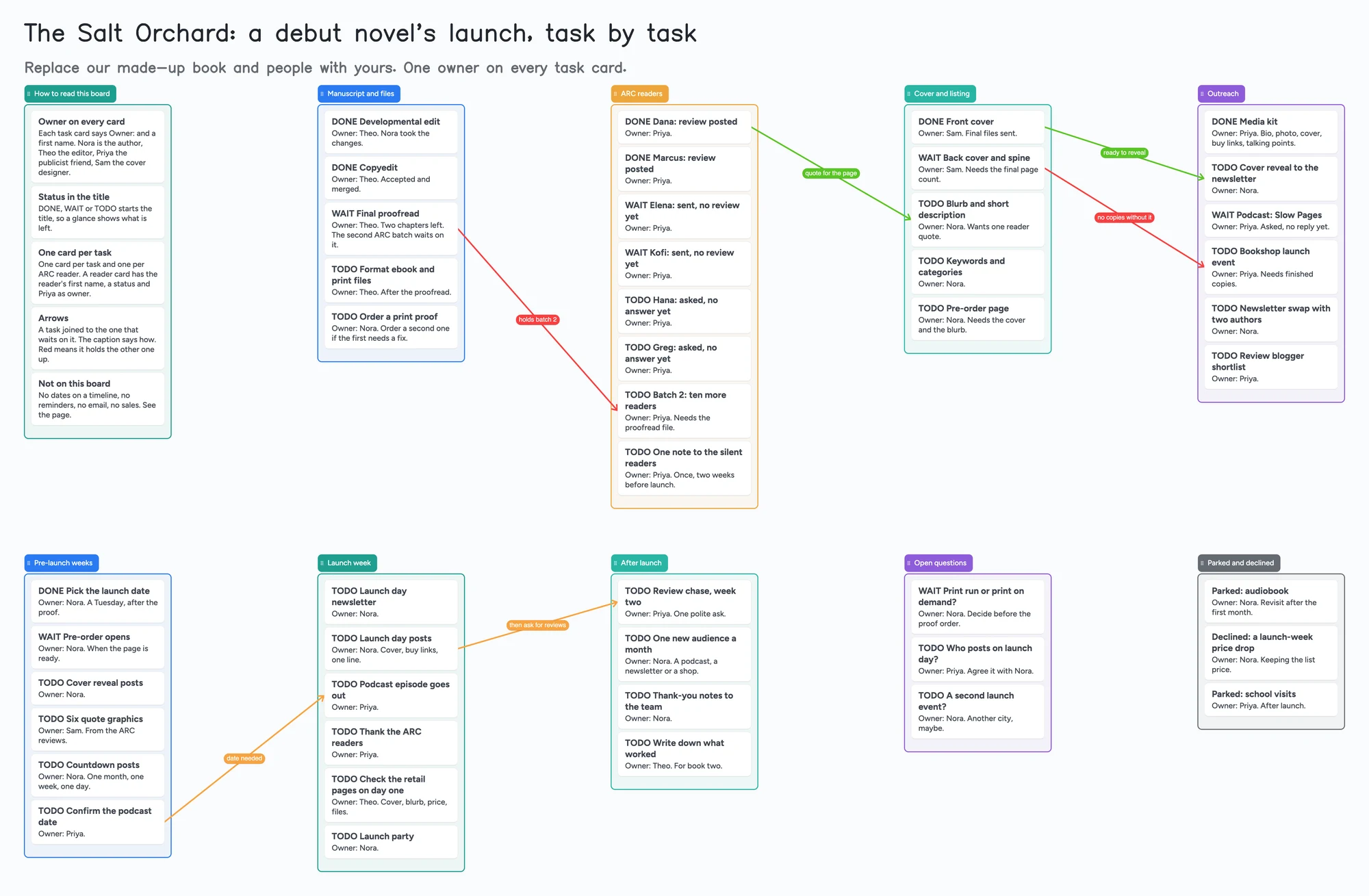
This is for an author and the one to three people helping with a single launch (an editor, a publicist friend, a cover designer, a co-author) who want one shared page that answers: what is still open, who owns it, and what is it holding up. It has lists for the manuscript and files, ARC readers, cover and listing, outreach, the pre-launch weeks, launch week and what comes after, plus open questions and parked ideas. Every task card names an owner and starts with DONE, WAIT or TODO, and every ARC reader is a card with a status. It has no timeline axis, no reminders, no email, and no sales or ranking numbers; the dates go in the card text. Storyflow, Reedsy's checklist and a spreadsheet are better at some of that, and the next section says where.
Updated
The short answer
- What it is: one board with a list for the manuscript and files, one for ARC readers, one each for cover and listing, outreach, the pre-launch weeks, launch week and after launch. Task cards say "Owner:" and a first name; DONE, WAIT or TODO starts the title; an ARC reader is a card with a first name and a status.
- What it isn't: no timeline axis, no reminders, no email or newsletter sending, no ARC distribution, no sales or ranking numbers. Nothing reminds anyone of a date; a comment on a card gives invited members a bell notice in the app, with no email.
- Arrows: an arrow joins a card in one list to a card in another, takes a caption and its own colour, and stays attached when a card moves. The example joins the unfinished proofread to the second ARC batch (red, "holds batch 2"), the finished front cover to the cover reveal (green) and the unconfirmed podcast date to the episode (orange).
- Free plan: the example is 61 of your 150 free items (51 cards and 10 lists, our count). Arrows, sections and pen strokes don't count. A second book on its own board takes it to 122, and a third passes 150.
Where Storyflow, Reedsy, BookBub's checklist and a template are better
Read on November 11, 2026, each from its own page. Storyflow's book launch planner page describes "the pre-order run, the ARC campaign, launch week, and the long tail" laid out on one visual timeline, with an AI that builds a phased plan from a publication date, and view-only links for a publicist or co-author. Its pricing page lists Storyflow AI in the app as coming late 2026; Plus works with Claude, ChatGPT, Gemini or Grok, 25 actions a week. Its pricing page says it is "paid-only during early access": Plus is $9.99 a month, or $7.99 a month billed yearly ($95.88 once a year), and a Free plan is "coming before the end of 2026"; anyone a paid member invites joins free. Storyflow's own page says it "does not send email, schedule posts, distribute ARCs, or report sales". If you want dates on an axis and a first draft of the plan generated for you, that is the better fit, and it is Storyflow's description of itself.
Reedsy's "How to Plan a Successful Book Launch in 5 Easy Steps" (last updated Aug 13, 2026) offers a free book launch checklist, delivered after you enter an email, and says about 20 reviews is the sweet spot. It also lists Reedsy Discovery: "For $299, commission a professional editorial review", delivered within 30 days. Reedsy's separate publicity-plan post, by publicist Coleen Hatrick, gives a month-by-month timeline and says it is "normal to start work 4-6 months before your publication date". BookBub's launch checklist, a guest post by author Debbie Macomber, runs from 6 months before launch through 3 months, 1 month, launch day and after, and says her publisher handles the BookBub Featured Deals, paid ads and tours while "a dedicated team of marketers" runs the rest.
Notion lists two author templates at 5 USD each: "Indie Author Launch Kit" (Get Ready Templates) and "Book Writing, Publishing & Marketing Plan" (Vladimir Burn). We read only the listings and prices, not what is in them, so we say nothing more about either.
Where these win
For a dated timeline and an AI-built first plan, use Storyflow. For a checklist and a month-by-month publicist schedule, use Reedsy's and BookBub's. For sending email, posting on a schedule, handing out ARCs and watching sales, use the tools built for each (Storyflow's page names ConvertKit, MailerLite, Buffer, BookFunnel and NetGalley for those jobs). Use this board next to them, or first, for the question a checklist doesn't answer: who owns each task, which reader still owes a review, and what each unfinished task is holding up.
A launch with a romance or mystery manuscript can start from a romance novel outline board, and an album release plan board has the same layout for music.
How to run a launch on the board
Authors disagree about timing, so the board holds no dates of its own; write each one into its card. In r/selfpublish the people answering a question on ARC lead time gave different numbers, one person each. In a 2024 thread, u/BriannaWritesBooks sends ARCs two weeks out and got about 20 early reviews; u/robulitski did a month but picked readers who finished within two weeks; u/dragonsandvamps says at least 3 weeks if the review has to land before release, and adds that the major publishers on NetGalley give months. On what share of readers review, u/Trevornoahbrother said "10% is the average around here", while u/BriannaWritesBooks reported 20 reviews from 25 Booksprout sign-ups on the first book and 22 from 39 on the second. In a 2024 thread on release timelines, u/Susyq918 wrote that a first-time author should not schedule anything until after the editor's feedback and the formatting are done, set the pre-order about 2 months out, send personal-list ARCs early with a deadline and a reminder two weeks before launch, and wait until about a month out to use ARC platforms; u/Birchwood_Goddess wrote that pre-orders usually want 60 to 90 days of lead time. Each is one person's method.
- Make a card for each task, with an owner. Put the person who does the work on the "Owner:" line, a first name only. The example has Nora (author), Theo (editor), Priya (publicist friend) and Sam (cover designer).
- Start each title with DONE, WAIT or TODO. WAIT is for a task that needs an answer or another task first. Nothing sorts by it, so scan for it by eye.
- Make one card per ARC reader. First name and a status in the title (review posted, sent, asked), one owner for the whole list. A short card is easy to move to Done when a review comes in.
- Join a task to the one waiting on it. The example draws a red "holds batch 2" arrow from the final proofread to the second ARC batch, a green "ready to reveal" arrow from the finished front cover to the cover reveal post, and a red "no copies without it" arrow from the back cover and spine to the bookshop event.
- Write the dates in the cards. A card that says "Owner: Priya. Needs the proofread file" or "A Tuesday, after the proof" tells the next person what it waits for. The board does not remind anyone when a date arrives.
- Keep Open questions and Parked and declined lists. A decision that isn't made yet (print run or print on demand) goes in the first; an idea you aren't doing (an audiobook, school visits) goes in the second with a line saying why, so it isn't raised again.
- Copy the board for the next book. It takes 1 of your 5 free boards.
On who does what, r/publishing shows two views in a 2024 thread. u/alexatd, an author, wrote that the happy medium is that the author "pays/does 60% of the planning and leg work" while the publicist helps with bookshop communication and scheduling; u/blowinthroughnaptime, who said they have worked at publishers, replied that publicists spend large amounts of time compiling spreadsheets of venues and pitching for every book. That is the case for one owner per task: with a publicist friend, a designer and an editor, nobody should have to guess whose card it is.
On ARC readers, u/dragonsandvamps wrote in a 2026 thread that finding readers on your own on social media, 10% is pretty typical, and the poster, u/AdPitiful8880, reported 10 downloads and one reader committed to review; u/Clean_Insect5042 advised quality over quantity and asking each reader for a link to their public review profile, and said Booksprout is $9 a month and BookSirens $10 plus $2 per download (one commenter's prices; we didn't read either vendor's page). A card per reader makes the silent ones easy to see.
This board vs Storyflow vs a checklist vs a template
| Tool | What we read (Nov 11, 2026) | Good at | Not what you get |
|---|---|---|---|
| Instaboard board | Free: 5 boards, 150 items. Pro $5/mo billed yearly | Who owns each task, which reader owes a review, what holds up what | A dated timeline, reminders, email, sales |
| Storyflow | Paid-only early access; Plus $9.99/mo, $7.99/mo billed yearly; Free plan coming before the end of 2026; invited people join free | A visual timeline with phases, an AI-built first plan (in-app AI listed as coming late 2026), view-only links | Sending email, scheduling posts, distributing ARCs, sales reports (its own page) |
| Reedsy checklist and posts | Checklist free after an email form; Discovery review $299 | A step list, a publicist timeline, how-tos | A shared board for several people |
| Notion author templates | Two listed at 5 USD each; contents unread | Not read, so not claimed | Not read, so not claimed |
Swipe the table sideways to see every column.
From each tool's own pages, read November 11, 2026. We name no tool as the best; they do different jobs.
Limits of the free plan for a book launch
- Items. Each card and each list is 1 of your 150 free items, across all your boards. The example is 51 cards and 10 lists, 61 in all (our count). Arrows, sections and pen strokes don't count. A second book, on its own board, takes it to 122; a third passes 150.
- Long ARC lists. The example has six reader cards. Thirty readers as one card each adds 24 more cards, 85 items (our arithmetic). Keep only the readers who still owe something as cards, or put a batch on one card.
- Boards. The free plan includes 5 boards. Making your own copy of the example uses 1 of them; a card that opens its own board uses another, so the example keeps everything on one board.
- Files and photos. 3 images and 1 file per board. A manuscript, a cover file and a media kit won't fit; put links in the cards. On the web a link card's preview picture no longer counts toward the 3 images, but the iPhone, iPad and Android apps still count it until their next update.
- No timeline axis and no dates that act. A date is text in a card. Nothing warns anyone when it passes.
- No reminders or sorting. Nothing reminds anyone of a date, and nothing sorts by DONE, WAIT or TODO. A comment on a card gives invited members a bell notice in the app (no email); someone who joined by link or code gets nothing, so tell them yourself. Card colour is the border and text only.
- No email, no ARC sending, no sales. The board holds the plan. Sending, hosting files and watching rankings happen in other tools.
- Writing needs a free sign-in. An editor or publicist who joins by link or code can add cards and arrows, and the board counts as one of their 5.
Start from the ready board
It opens in your browser in a few seconds, with nothing to install. Sign in for free when you want to save it and share it.
Questions
Is there a free book launch plan template?
Yes. Open the board, replace the example book, tasks and readers with yours and set Share to "Anyone with the link can edit" if your editor or publicist needs to write on it. It is a board of cards, lists and arrows, not a spreadsheet and not a calendar.
Does it show a timeline with dates?
No. There is no timeline axis. Write the date in a card, such as "Pre-order opens" with its day, and read the lists left to right. Storyflow draws a dated timeline if that is what you need.
Can it send my ARCs or newsletter?
No. It doesn't send email, post for you, host files or show sales. Keep those in the tools built for them and use the board to track who owns what.
Will it remind my publicist when a task is due?
No. The board sends no reminders and no email. If your publicist is invited to the board, a comment on the card gives them a bell notice in the app; if they joined by link, tell them yourself.
How many tasks and readers fit on the free plan?
Each card and each list is one item of the 150 across all your boards. The example is 61. That is our arithmetic. Arrows are free.
Sources
- Storyflow: Free Book Launch Planner (read November 11, 2026; the vendor's own description)
- Storyflow: pricing (read November 11, 2026)
- Reedsy: How to Plan a Successful Book Launch in 5 Easy Steps (last updated Aug 13, 2026)
- Reedsy: How to Create an Effective Book Publicity Plan (read November 11, 2026)
- BookBub Partners Blog: Book Launch Checklist, a guest post by Debbie Macomber (read November 11, 2026)
- Notion: Indie Author Launch Kit (listing and price only)
- Notion: Book Writing, Publishing & Marketing Plan (listing and price only)
- r/selfpublish: how early do you send your book out to ARC readers (2024; replies are single accounts)
- r/selfpublish: timelines for release date (2024; replies are single accounts)
- r/selfpublish: debut romance author, sanity check on pre-launch and ARC strategy (2026; replies are single accounts)
- r/publishing: who plans author events (2024; replies are single accounts)
Related
A romance novel outline board: one list for each lead, one for the beats they share
Outline a dual-POV romance on one shared board: a chapter list for each lead and a middle list of shared beats, with arrows between them. Free ready board, and where PlotProse and Plottr do more.
An album release plan board: tracks, artwork, distribution and weekly posts, each with an owner
Plan an album or single release on one shared board: tracks, artwork, distributor, pitching and a week-by-week plan, with an owner on every card for the artist and the producer. Free ready board.
A mystery novel outline board for suspects, clues and red herrings
Outline a mystery novel on one board: a list per suspect, clues, red herrings and reveal order. A free ready board, and where Plottr and Sheets do more.