For people studying for the PMP certification exam around a job
A PMP exam study plan board: three domains, ten weeks, one shared list
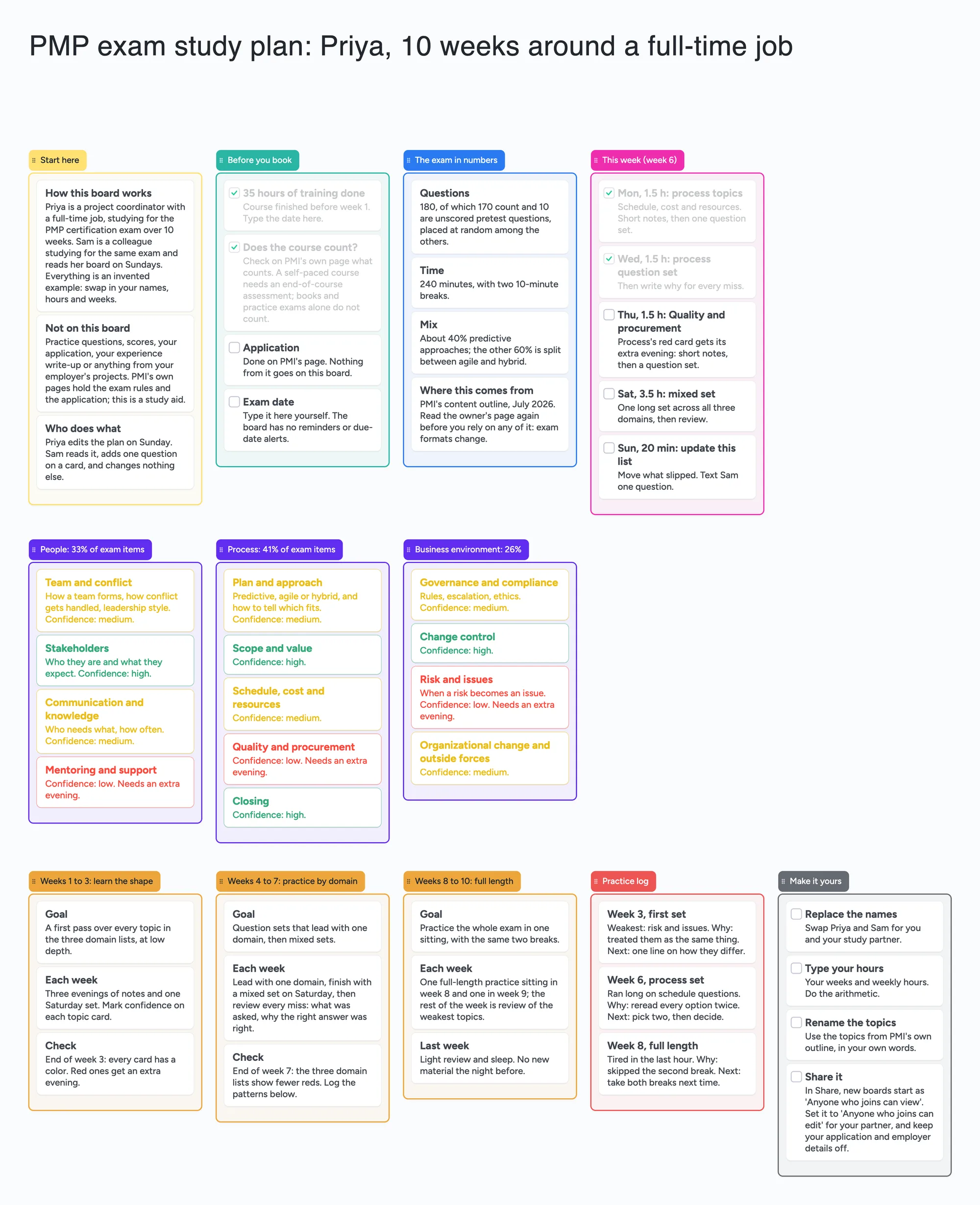
We make Instaboard, an online board. This page gives you a PMP exam study plan laid out on one, filled in for an invented pair: Priya, a project coordinator with a full-time job, and her colleague Sam, who is studying for the same exam and reads her plan on Sundays. If you want a spreadsheet that fills in your progress percentage, or a course or a question bank, this is not that: you type the weeks and tasks yourself. It holds no practice questions, no scores and no application, and it has no reminders or due-date alerts. It is a study aid, not PMI's.
Opens in your browser. Anyone can view; a free sign-in lets you edit.
Updated
Before you start: a plan to fill in, not a file, and what stays with PMI
- It is a plan, not a file. Searchers often want a spreadsheet to download or a course. This is a shared board you fill in by hand. A spreadsheet that fills in your progress percentage is better at counting, and the page says where.
- What it holds: a check on the 35 hours of training, the exam numbers from PMI's July 2026 outline, one list per exam domain with a colored card per topic, a week plan, three phase lists and a practice log. Priya's plan is invented: swap in your own weeks, hours and topics.
- What it leaves off: practice questions, scores, your application and your experience write-up. PMI's own pages hold the exam rules and the application, and this page does not restate them. The board has no reminders or due-date alerts, so type your exam date yourself.
- Free plan: the example is 58 of your 150 free items (45 cards, 12 lists and 1 title text box, our count). Arrows and pen strokes don't count. Writing needs a free sign-in, and a reader can open the link signed out. Pro removes the item limit.
Before week 1: the 35 hours, and what PMI's outline says counts
Priya's board opens with a list called Before you book, because PMI's outline puts training ahead of the exam. We read PMI's July 2026 content outline on November 25, 2026. It says candidates must have taken at least 35 hours of commercial training in project management that lines up with the outline's topics. The providers it lists include PMI Authorized Training Partners, a China Registered Education Provider, PMI Global Accreditation Center programs, employer or company-sponsored programs, training companies or consultants, self-paced on-demand courses that include an end-of-course assessment, and project management courses from accredited higher education institutions. It also says books and practice exams alone will not be accepted, and that an active CAPM holder does not need to document the 35 hours.
- 35 hours of training done (ticked on the example): Priya types the date the course ended, before week 1.
- Does the course count? (ticked): a note to check PMI's own page, since a self-paced course needs the end-of-course assessment.
- Application (open): done on PMI's page. Nothing from it goes on this board.
- Exam date (open): typed by hand, because the board has no reminders or due-date alerts.
PMI's page decides, not this one
The outline also says PMI does not endorse or control third-party training providers and urges caution with any organization that guarantees exam success. We have not checked any course against these rules, and the experience and education paths for eligibility are on PMI's page, not here.
The exam in numbers, from PMI's outline
These are the numbers on the card list called The exam in numbers, read from the July 2026 outline (the PDF shows © 2026). They are the part of a plan most likely to go stale, so the board's last card tells you to read PMI's page again before relying on any of it.
| Item | PMI's July 2026 outline says | On the board |
|---|---|---|
| Questions | 180 questions, of which 170 are scored and 10 are unscored pretest questions; all are placed at random | A Questions card with the same split |
| Time | 240 minutes, with two 10-minute breaks: the first after the case-study section, the second about midway through the independent question portion | A Time card: 240 minutes, two 10-minute breaks |
| Approach mix | About 40% predictive; the other 60% divided between agile and hybrid, found throughout all three domains | A Mix card with the same split |
| Question types | Case or scenario, enhanced matching, graphic-based, multiple-choice, multiple-response, point and click, matching and pull-down list; some only at a test center | None: the board holds no questions |
| Attempts | Up to three within a one-year eligibility period; after three, a one-year wait | Not on the board |
Swipe the table sideways to see every column.
Read November 25, 2026 in PMI's own outline. The PM PrepCast guide (article footer © 2015-2023; see the closing notice in the table below) gives 230 minutes and 175 scored questions; the figures differ from PMI's July 2026 outline, and the board uses PMI's. Not affiliated with PMI.
Three domains, thirteen topic cards, and the tasks with no card
PMI's outline splits the exam into three domains with fixed shares: People 33%, Process 41% and Business Environment 26%. Each domain has tasks, 26 in all (8, 10 and 8). The board gives each domain a list and groups the tasks into 13 topic cards, so a card is ours and not PMI's heading. The cards are colored by how sure Priya feels, and the grouping below is our reading of the outline's task names.
| Domain list | Share of exam items | Topic cards on the board | Outline tasks the cards group |
|---|---|---|---|
| People | 33% | Team and conflict; Stakeholders; Communication and knowledge; Mentoring and support | Manage conflicts; lead the project team; engage, align and manage stakeholders (mentoring is an enabler under aligning expectations); help ensure knowledge transfer; plan and manage communication |
| Process | 41% | Plan and approach; Scope and value; Schedule, cost and resources; Quality and procurement; Closing | Develop the integrated plan; scope; value-based delivery; resources, finance and schedule; procurement and quality; project closure |
| Business environment | 26% | Governance and compliance; Change control; Risk and issues; Organizational change and outside forces | Governance; compliance; manage and control changes; remove impediments and manage issues; risk; support organizational change; evaluate external changes |
Swipe the table sideways to see every column.
Shares and task names from PMI's July 2026 outline, read November 25, 2026. The grouping into cards is ours.
Three tasks have no card
Develop a common vision (People), Evaluate project status (Process) and Continuous improvement (Business environment) are in the outline but have no card on Priya's board. Add your own, or drop the cards you already know. The 13 cards group the other 23 tasks.
Make it yours in about ten minutes
- Open the board and read Start here. It says what is not on the board: practice questions, scores, your application, your experience write-up and anything from your employer's projects.
- Untick and retype the 35 hours. A copy keeps the example's ticks, so untick both Before you book cards that are ticked, then type the date your course ended and tick them only when they are true. Check on PMI's own page that your course counts.
- Type your numbers. Your exam date, your number of weeks and your weekly hours. Do the multiplication yourself.
- Rename the topic cards. Use the topics from PMI's own outline in your own words. Delete the cards for tasks you already know, and add one for each of the three tasks with no card.
- Color every card by the end of week 3. Green, yellow or red. Give each red card an extra evening.
- Fill This week. One tick-box card per session, with the topic and the time.
- Share it. In Share, new boards start as "Anyone who joins can view". Set it to "Anyone who joins can edit" if a study partner will write on it, and keep your application and employer details off the board.
- Update it on Sunday. Clear the ticks, move what slipped and write one line in the practice log for each miss: what happened, why and what to do next.
Color as a status light, and the weeks around it
The board's own idea is that every topic card carries a color: green for high confidence, yellow for medium, red for low. By the end of week 3 every card has one, and a red card gets an extra evening. None of the pages we read prescribes this. u/Inevitable-Concern-5 on r/pmp marks practice questions low or medium confidence in Study Hall for a similar reason, and reviews those along with the wrong answers.
| Phase list | What it holds on the board | Idea it borrows |
|---|---|---|
| Weeks 1 to 3: learn the shape | A first pass over every topic card at low depth; three evenings of notes and one Saturday set; a color on every card at the end | The PM PrepCast guide says to find your strengths and weaknesses first (it suggests a practice exam to benchmark); the board starts with notes and colors instead |
| Weeks 4 to 7: practice by domain | One domain leads each week, a mixed set on Saturday, then a review of every miss | u/Independent-Soup4020 says reviewing all wrong answers helped most; u/Inevitable-Concern-5 reviews wrong, low and medium-confidence questions |
| Weeks 8 to 10: full length | A full-length sitting in weeks 8 and 9 with the same two breaks, then review of the weakest topics; a light last week with no new material the night before | Yassine Tounsi's page says to complete at least one full mock exam under real exam conditions; u/Inevitable-Concern-5 does light review only the day before |
Swipe the table sideways to see every column.
The mapping is ours. Each idea is that page's or poster's own view.
The This week list shows week 6: Monday 1.5 hours, Wednesday 1.5, Thursday 1.5 and Saturday 3.5, which is 8 hours of study, plus a 20-minute update on Sunday (our arithmetic). If every week matched week 6, ten weeks would come to 80 hours. The board does not set that figure for you, and Priya's weeks 1 to 3 don't state hours at all.
What a full-length sitting looks like, and why the breaks are on the board
Two things from the exam numbers matter once the weeks reach 8 and 9. PMI's outline says that once you review your responses and start a break you cannot return to the questions from the previous section, and that online proctored candidates may be asked for identification after a break. So the board's Week 8 practice-log card, an invented one, records a missed second break as a lesson: "Tired in the last hour. Why: skipped the second break."
- PM PrepCast's guide (a vendor's page) suggests a timetable of three passes through the exam: first the short questions you know, then the marked longer ones, then anything still unanswered. It writes the block as 230 minutes, so only the pass idea carries over to PMI's 240.
- A June 2025 post by u/Inevitable-Concern-5 says its online exam was divided into three sections of 60 questions, with a separate 10-minute break timer, and that the main timer started at 230 minutes. That differs from PMI's July 2026 outline (240 minutes, first break after the case-study section), and we say only that they differ.
- u/Independent-Soup4020 (April 2026) splits a four-hour mock into 60-question sections with 10-minute breaks, and does light revision only in the final days.
How long people say they studied, one account at a time
Four r/pmp threads, read on November 25, 2026 through an archive (arctic-shift); the counts below are what we read in an archived copy. Dates are UTC from the archive. Each reply is one person's account, and none asks for a shared board by name.
- "Is 80-100 study hours accurate?" (u/Hoya2003, 2023-08-28; 17 comments read). The poster's bootcamp instructor said to plan 80 to 100 hours on top of the 35. u/AMinMY (6 points) says about 10 weeks at an average of at least 3 hours a day, so at least 210 hours; in another reply (4) says the instructor's figure sounds about right. u/LoboAdobo22 (3) took a three-day bootcamp, then about 40 hours over 24 days with practice exams until scoring 80% or more consistently. u/YourCaptainSpeaking_ (2) felt closer to 50 to 60 hours including the 35-hour course, and u/AdelaideGem (2) spent at least 30 hours on practice tests and around 20 on content.
- "Studying For PMP While Working" (u/raft2021, 2021-02-06; 8 comments read). The poster asks about studying while working 50 to 60 hours a week. u/NBGXX (3 points) carved out 90 minutes a day on work days and a 2 to 3 hour block on weekends; in another reply (2) the same poster says four months of serious study, then two weeks of practice exams. u/toriflakes (2) crammed 8 hours a day on weekends for 2.5 weeks instead, and says "you will be miserable". u/Hourz1 (2) says at least an hour a day, more on weekends.
- "Passed PMP (AT/AT/T) while working full-time" (u/Independent-Soup4020, 2026-04-27; 71 comments read). The poster prepared for about 3 to 4 weeks, did 700+ questions in PMI Study Hall, averaged about 70% on mini exams and scored 79% and 73% on two mocks. In a reply (8 points) they say they have 16 years in the field and still found the PMI mindset hard to fit against real-life situations.
- "AT/AT/AT PMP Pass: my study plan" (u/Inevitable-Concern-5, 2025-06-07; 32 comments read). A twelve-step plan from the 35-hour course in week 1 to a light day before the exam. Its rule: schedule the exam one week out if both mock averages are 80% or higher, two weeks at 70% or higher, three below that. That is one person's rule, and it differs from the 65% minimum on Yassine Tounsi's page.
Two things come out of the threads. The totals range from about 40 hours to more than 200, so the board's numbers are meant to be overwritten. And the posters who describe a working schedule describe different ones, from 90 minutes after work to long weekend blocks. The PM PrepCast guide, a vendor, says studying for an hour or two every day is generally more effective than only large weekend blocks, which is its claim and not something we tested.
Other places to keep a PMP plan, and who each one suits
| Option | What its own page says (read November 25, 2026) | Better for | Not what you get |
|---|---|---|---|
| Yassine Tounsi's spreadsheet template (page shows 19 December 2024) | Three sheets for normal, relaxed and accelerated paces; milestone dates are set once, and completing course sections and mock exams is "automatically reflected" in a progress percentage; the page says to click Make a copy | A progress percentage that fills itself in | A card per topic that a study partner can read and move |
| Notion listing: PMP Exam Helper | Nine Week Study Plan (page shows Last updated 4 months ago; 5.0 from 2 ratings) | Describes resource links, skill and goal tracking and a course and certification log; the creator writes that the links are "as of 2024 exam" and that the resources have not been updated "to reflect the 2026 exam" | People who already work in Notion | The template itself: we read the listing only |
| PM PrepCast (course vendor; article footer © 2015-2023, site footer © 2008 - 2026; its banner prints "The PM PrepCast is closing. All product access ends December 4, 2026 at 3pm PST.") | Says "Taking practice exams with an online PMP exam simulator is an absolute must" and that "Having a study partner who holds you responsible for meeting your study targets is an incredible help" | Reading its plan outline; its own banner says product access ends December 4, 2026, so read the notice before buying anything | A plan you design and own yourself |
| PMI Study Hall (named by two r/pmp posters; PMI's own page not read) | u/Independent-Soup4020 did 700+ questions there; u/Inevitable-Concern-5 used it for practice questions, mini exams and two full mocks | Question practice and mock exams | A plan around the questions |
Swipe the table sideways to see every column.
From each page, read November 25, 2026. Not affiliated with any of them.
Where these win
If you want a percentage that fills itself in, use a spreadsheet. If you want questions and mock exams, use a question bank or a course. Use this board when one working person needs a plan by domain with a color on every topic, a practice log and a study partner who looks at the same list.
What the board cannot do, and what copies cost on the free plan
- Not PMI's rules. The exam format, the application, eligibility and fees are set by PMI; take them from its own pages. The numbers on the board come from the July 2026 outline and may change.
- No questions or scores. The board holds the plan around the practice. Don't put real exam questions, scores, your application or your employer's project details on a link board.
- Items. Each card, list and text box is 1 of your 150 free items, across all your boards. The example is 45 cards, 12 lists and 1 title text box, 58 in all. Arrows and pen strokes don't count.
- Copies add up. Our arithmetic: a second copy takes you to 116 items, and a third passes 150 (174). Pro removes the item limit ($5 a month billed yearly, $59.99 a year, or $7.99 monthly).
- Boards. The free plan includes 5 boards, and making a copy takes 1 of them.
- Photos. 3 images per board. The example has none.
- Not private by default. New boards start with "Anyone who joins can view", so anyone with the link can read every card. Invite-only boards are a Pro feature.
- No reminders or due-date alerts. The board doesn't tell anyone when to study or when the exam is.
- Writing needs a free sign-in. A study partner who joins to write signs in once; a reader can open the link signed out and can't change anything.
“PMP” is a mark of Project Management Institute, Inc., which is not affiliated with and does not endorse this page.
Start from the ready board
It opens in your browser in a few seconds, with nothing to install. Sign in for free when you want to save it and share it.
Questions
Is there a PMP exam study plan template I can share by link?
Yes. Open the board, replace Priya and Sam with your own names and share the link. It holds a 35-hour check, the exam numbers from PMI's July 2026 outline, one list per domain, a week plan, three phase lists and a practice log. It is a board you fill in, not a spreadsheet to download or a course.
How many hours does it take to study for the PMP exam?
The accounts we read give very different totals. On r/pmp one poster says about 40 hours over 24 days, another at least 210 hours over about 10 weeks, and Yassine Tounsi's page suggests 7 hours a week for two to three months. The 80-hour figure on this page is our arithmetic for ten weeks at the eight hours of the example week, not a recommendation.
Do books and practice exams count toward the 35 hours?
PMI's July 2026 outline says books and practice exams alone will not be accepted as eligible commercial training. It does accept self-paced on-demand courses that include an end-of-course assessment. PMI's own page decides what counts, so check it before you pay for a course.
Does the board give practice questions, mock exams or scores?
No. It holds the plan around the practice: which topic you study when, a color for how sure you are, and a log of what you missed and why. Questions and mock exams come from your course or the materials you use.
Is this PMI's study plan?
No. We make Instaboard, and we are not affiliated with PMI. The plan is an invented example for a made-up candidate, built from PMI's public content outline and from the accounts listed in the sources.
How many cards fit on the free plan?
Each card, list and text box is one of the 150 items across all your boards. The example is 58, so a third copy passes 150 (our arithmetic). Arrows are free, and Pro removes the item limit.
Sources
- PMI: Project Management Professional (PMP) Examination Content Outline, July 2026 (read November 25, 2026; the PDF shows © 2026; “PMP” is a mark of Project Management Institute, Inc., which is not affiliated with and does not endorse this page)
- PM PrepCast: Creating Your PMP Study Plan (read November 25, 2026 in a browser; article footer © 2015-2023, site footer © 2008 - 2026, reader comments dated to January 2026; the banner prints "The PM PrepCast is closing. All product access ends December 4, 2026 at 3pm PST."; vendor of PMP courses and a practice exam simulator)
- Yassine Tounsi: PMP Study Plan, Download Free Template (read November 25, 2026 in a browser; page shows 19 December 2024; a PMP author's personal site)
- Notion Marketplace: PMP Exam Helper | Nine Week Study Plan by Christina Warmbrunn (read November 25, 2026 in a browser; listing only; page shows Last updated 4 months ago and 5.0 from 2 ratings)
- r/pmp: Is 80-100 study hours accurate? (2023-08-28 UTC; read November 25, 2026 through an archive; replies are single accounts)
- r/pmp: Studying For PMP While Working (2021-02-06 UTC; read November 25, 2026 through an archive; replies are single accounts)
- r/pmp: Passed PMP (AT/AT/T) while working full-time (2026-04-27 UTC; read November 25, 2026 through an archive; one poster's account)
- r/pmp: AT/AT/AT PMP Pass, my study plan and exam reflection (2025-06-07 UTC; read November 25, 2026 through an archive; one poster's account)