For a teacher planning one text-based discussion, not for grading students
Plan a Socratic seminar on one shared board, before and after the talk
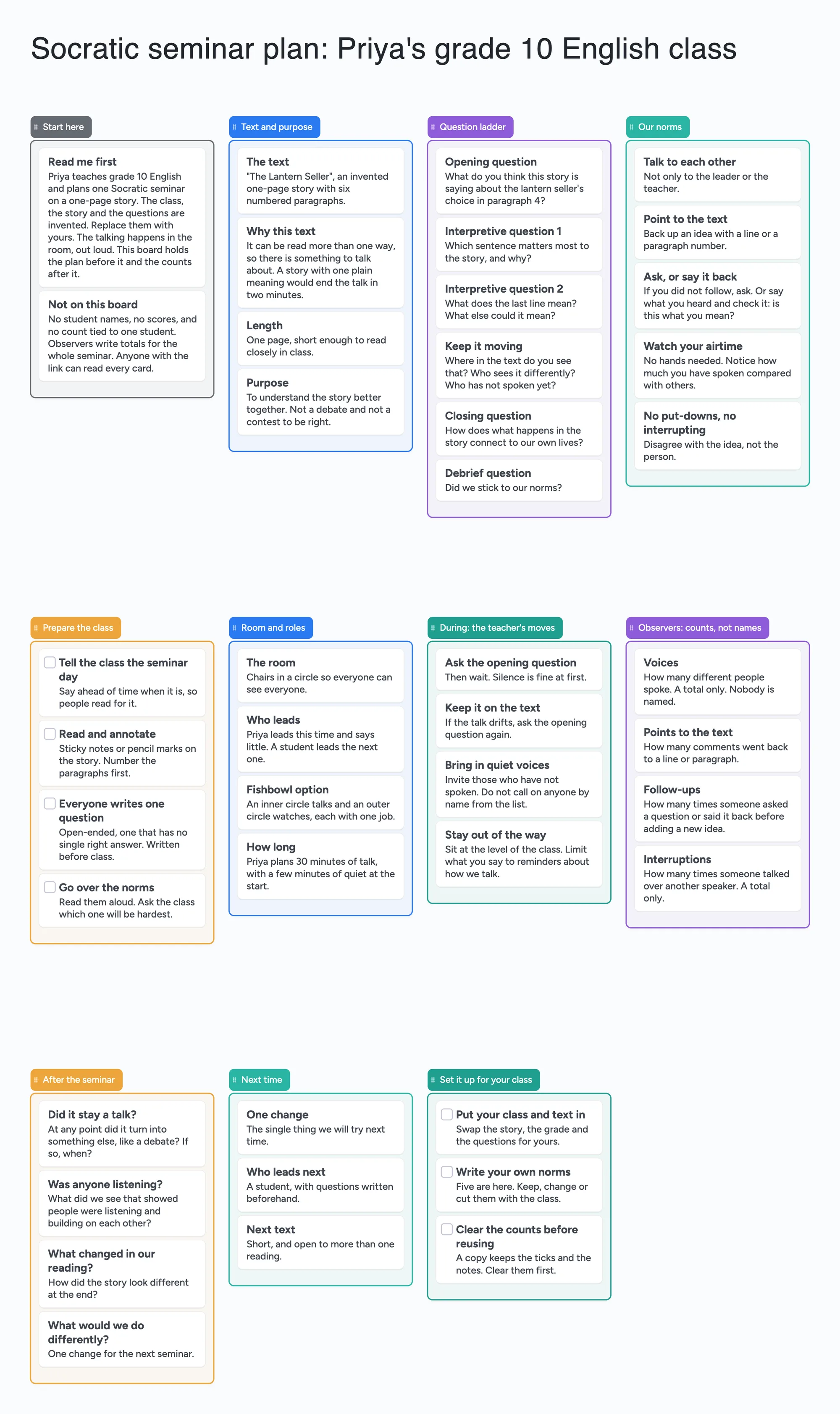
We make Instaboard, an online board for planning with other people. A Socratic seminar happens out loud, in a room, so no board can run it. What a board can hold is the plan before it and the counts after it. This page gives you one already laid out and filled in for an invented grade 10 English class: Priya's, reading an invented one-page story, "The Lantern Seller". It has lists for the text, a ladder of questions, five norms, the room and roles, the teacher's moves, tallies for observers, a debrief and a next-time list. The class, the story and the questions are made up; replace them with yours. It holds no student names and no scores, and it sends no reminders.
Opens in your browser. Anyone can view; a free sign-in lets you edit.
Updated
Read this first: what the board can't do
- The talk is spoken. Students talk to each other in the room. Nothing on the board is typed by students during the seminar, and it does not run a discussion for you.
- What it holds: the plan before (text, questions, norms, room) and short notes after (observer totals, debrief, one change for next time).
- No names, no scores. Observers write totals for the whole seminar, like how many people spoke. Nothing is tied to a student, because anyone with the link can read every card. Grades belong in your school's own system.
- The class and story are invented. "The Lantern Seller" and its questions are ours, so they teach nothing real. Put your own text over them.
- Free plan: 5 boards, 150 items, 3 pictures per board. Copying the board takes 1 of your 5 boards. Writing on it needs a free sign-in. New boards start with "Anyone who joins can view".
A seminar is a conversation: what goes on a board and what stays in the room
The pages we read describe the same shape: the group reads a text beforehand, the teacher poses open-ended questions, students talk to each other about the text, and the group looks back on the talk afterwards. Only some of that can sit on a board.
- On the board: the text and why you chose it, the questions in the order you plan to use them, the norms, the seating and who leads, the teacher's own reminders, the observers' totals, and the after-talk questions.
- In the room: the talking, the silences, the moment a student changes the subject. A card can say "silence is fine at first" but cannot make anyone comfortable with it.
- Not on the board: names, grades, rubric scores, or who said what. The post we read that grades while the talk runs puts check marks beside student names; this board has no place for that, and a shared link is the wrong place for it.
The question ladder: opening, interpretive, keep-moving, closing, debrief
The NWABR background sheet sorts questions into four kinds: a key interpretive question to open, questions that move the talk along, closing questions that bring it back to students' own lives, and debriefing questions about the process. It says questions must be open-ended with "no 'one right answer'". ReadWriteThink says to start and end with questions that relate to students' lives, a suggestion it attributes to Elfie Israel.
Priya's ladder on the board has six cards in that order. The wording is ours and fits our invented story:
- Opening question: about the lantern seller's choice in paragraph 4.
- Interpretive question 1: which sentence matters most, and why.
- Interpretive question 2: what the last line means, and what else it could mean.
- Keep it moving: where in the text, who sees it differently, who has not spoken yet.
- Closing question: how the story connects to students' own lives.
- Debrief question: did we stick to our norms?
Whether a question is really open is the teacher's judgement. The board cannot tell you if a question has one right answer.
Observer counts without names: four tallies for the whole seminar
Facing History describes a fishbowl version where an outer circle watches with specific jobs. NWABR's fishbowl variation says the outer circle can take notes or use an evaluation form, and its Discussion Partner Evaluation handout asks an observer to write the name of the person watched, tick each meaningful contribution and give 1-to-5 scores. That is the one thing this board leaves out. ReadWriteThink suggests judging the seminar by how much of the time was text-centred student talk. None of the pages gives whole-group totals, so the four tallies on the board are our own:
| Tally | What the observer writes | What it can show |
|---|---|---|
| Voices | How many different people spoke, as one total | Whether a few people carried the talk |
| Points to the text | How many comments went back to a line or paragraph | Whether the talk stayed on the text |
| Follow-ups | How many times someone asked a question or said it back before adding a new idea | Whether people were building on each other |
| Interruptions | How many times someone talked over another speaker | Whether the norm about interrupting held |
Swipe the table sideways to see every column.
Our design, not taken from any source. A total can't say who. Counts depend on what the observer decides to count, so two observers may differ.
Totals are the point. If an observer would need a name to make a tally mean something, it belongs in a conversation in the room, not on a shared card.
Four pages, four views of how a seminar runs
We read these pages in full on November 25, 2026. A date is printed only where the page shows one.
| Page | What it says about running one | Who it is from |
|---|---|---|
| Facing History & Ourselves, "Socratic Seminar" (published May 12, 2020) | Five steps: choose a text, have students prepare, set up a classroom contract of norms, hold the talk (at least 15 minutes, often 30 or more, silence is fine), then reflect. Mentions a fishbowl, with observers who have specific jobs | Facing History & Ourselves |
| ReadWriteThink, "Socratic Seminars" strategy guide by Scott Filkins, NCTE (page shows no date; it cites Israel 2002) | Choose the text, prepare students and questions, set norms with students, keep your own interruptions to "helpful reminders about procedures", and judge success by how much "text-centered student talk dominated" | Published by NCTE |
| NWABR, "Socratic Seminar" teaching background (PDF, no printed date) | Text, classroom environment and questions are the key elements; number the paragraphs; before, during and after structure; norms include no hand-raising and watching air time; a fishbowl variation; handouts for a named-partner evaluation and for writing questions | NWABR; credits Walter Parker (University of Washington) and Washington state teachers, and cites the National Paideia Center |
| Building Book Love, "How to host a Socratic Seminar in Secondary ELA" (byline shows 11 Mar, no year) | A teacher's blog: hold the seminar and grade it while it runs with check marks beside student names; sells a Talking Toolkit of its own | One teacher-seller's blog. Its method is its own and one the board deliberately skips |
Swipe the table sideways to see every column.
Pages read November 25, 2026. The Facing History page returned an error to our script and we read it in a browser. The NWABR PDF's file data shows 2008, which is not a date printed in it. Our summaries, except where in quotation marks.
The first three agree on the core: a text students have read, open-ended questions, norms the group agrees on, and a teacher who steps back. They differ on length and on assessment. The board follows the first three and leaves out the grading approach.
Where others do this better
| Tool | What it does | Better for |
|---|---|---|
| Facing History & Ourselves page | Five steps, the classroom contract and the fishbowl on one page | Reading the steps in order before you plan |
| NWABR PDF | Background pages plus printable handouts: a Discussion Partner Evaluation and an Open-Ended Questions sheet, and a rubric mentioned for assessment | Printed handouts, including the named-partner evaluation this board leaves out |
| ReadWriteThink strategy guide | Practice steps plus related resources on the same site | Reasoning behind each step, with a citation to Israel (2002) |
| Instaboard board | 5 boards, 150 items, 3 pictures per board on the free plan | Co-teachers or observers adding to the same plan and totals on one link |
Swipe the table sideways to see every column.
Read November 25, 2026. Our wording, not theirs. We did not open the rubric the NWABR sheet mentions.
Where these win
If you plan alone and want a sheet to hold while the seminar runs, a printout from NWABR is lighter than a board, and it has the named-partner form if you want that. A board earns its place when more than one person adds to the plan or tallies the counts, and you want the result in one place afterwards.
The teacher's moves: four reminders for the person who talks least
Facing History, ReadWriteThink and NWABR each leave the talk to the students once it starts. The board gives the teacher a short list to glance at, in plain words:
- Ask the opening question, then wait. Facing History says silence is fine.
- Keep it on the text. NWABR says that if the conversation drifts, restate the opening question.
- Bring in quiet voices. NWABR suggests inviting those who have not spoken. Our card adds "do not call on anyone by name from the list", which is our choice, because a list of names is exactly what the board leaves out.
- Stay out of the way. NWABR says to sit at the level of the students; ReadWriteThink limits the teacher to procedure reminders.
Priya leads this time. A student leads the next one, with questions written beforehand: ReadWriteThink says students may eventually run the session, and the board lists that under "Next time". How soon your class can lead is your judgement.
Our norms, and where each came from
The board has five norm cards. ReadWriteThink recommends making norms with students, so these five are a starting set to keep, change or cut, not a final list. Each has a source page that says something close:
- Talk to each other: Facing History's typical rules and NWABR's "address comments to the group".
- Point to the text: NWABR's "base any opinions on the text" and Facing History's rule to refer to it.
- Ask, or say it back: Facing History's rule to ask or paraphrase.
- Watch your airtime: NWABR's "monitor air time", along with its no-hands-raised norm.
- No put-downs, no interrupting: Facing History's rules against both; NWABR's "not interrupt others".
How many seminars fit in 150 items?
Each card and each list is 1 of your 150 free items, across all your boards. The title text box counts too. Arrows, sections and pen strokes don't. Our arithmetic from the example:
- As built: 11 lists + 43 cards + 1 title = 55.
- Three boards (three texts or three classes) are 3 x 55 = 165, which is past 150 and uses 3 of your 5 boards.
- Reusing one board: a copy keeps whatever is written on it, so clear the counts and the ticks first. Two boards are 110.
- With Pro, the item limit is removed.
After the talk: the debrief and one change for next time
Facing History's last step asks the group to reflect on whether the talk turned into something other than dialogue and on evidence of listening. ReadWriteThink points to reflection by both teacher and students. NWABR's debriefing questions ask whether students understand the text more deeply, whether they stuck to the norms and what they noticed.
The board's After list has four questions of its own: did it stay a talk, was anyone listening, what changed in our reading, and what would we do differently. "Next time" holds one change, who leads and the next text. The answers are the class's words, said aloud first; the card holds a summary, not who said it.
Setting it up for your class
- Open the board and sign in free when it asks you to write.
- Replace the story and class on the Text and purpose list with yours. Number its paragraphs first.
- Rewrite the questions on the ladder, then keep, change or cut the five norms with your class.
- Tick the preparation cards as students are told, read and write a question.
- Give observers the counts list and have them write totals, no names.
- Share the link with co-teachers or observers. Set Share to "Anyone who joins can edit" for them; each person who writes signs in free.
Start from the ready board
It opens in your browser in a few seconds, with nothing to install. Sign in for free when you want to save it and share it.
Questions
What is a Socratic seminar?
A discussion built on a text, led by open-ended questions, in which students talk to each other rather than to the teacher. The NWABR background sheet quotes the National Paideia Center's description of it as a "collaborative, intellectual dialogue facilitated with open-ended questions about a text".
How long should a Socratic seminar last?
Facing History says at least 15 minutes and often 30 or more. Priya's example plans 30 minutes of talk with a few minutes of quiet at the start; that is a choice for an invented class, not a rule.
Can students use this board during the seminar?
It is built for the teacher and any observers, not for students typing during the talk. A seminar is spoken, so the board holds the plan and the totals around it.
How do I keep student names off the board?
Keep tallies as totals for the whole seminar, and keep names, grades and scores in your school's own system. A board is shared by link, and anyone with the link can read every card.
Can co-teachers or observers add to the same board?
Yes. New boards start with "Anyone who joins can view". Set it to "Anyone who joins can edit" and each person who writes signs in free. Instaboard sends no reminders, so tell people when the seminar is.
Is Instaboard free?
There is a free plan: 5 boards, 150 cards and items across your account (pen strokes, arrows and sections don't count), and 3 pictures and 1 file per board. Writing on a board takes a free sign-in. Pro removes the item limit and adds invite-only boards: $5 a month billed yearly ($59.99 a year), or $7.99 monthly.
Sources
- Facing History & Ourselves: Socratic Seminar (published May 12, 2020; read November 25, 2026)
- ReadWriteThink (NCTE): Socratic Seminars, strategy guide by Scott Filkins (page shows no date; read November 25, 2026)
- NWABR: Socratic Seminar, teaching background (PDF, no printed date; read November 25, 2026)
- Building Book Love: How to host a Socratic Seminar in Secondary ELA (byline shows 11 Mar, no year; read November 25, 2026)