For two to four people turning interview notes into themes
An affinity diagram template for interview notes: one remark per card, sorted into themes on a shared board
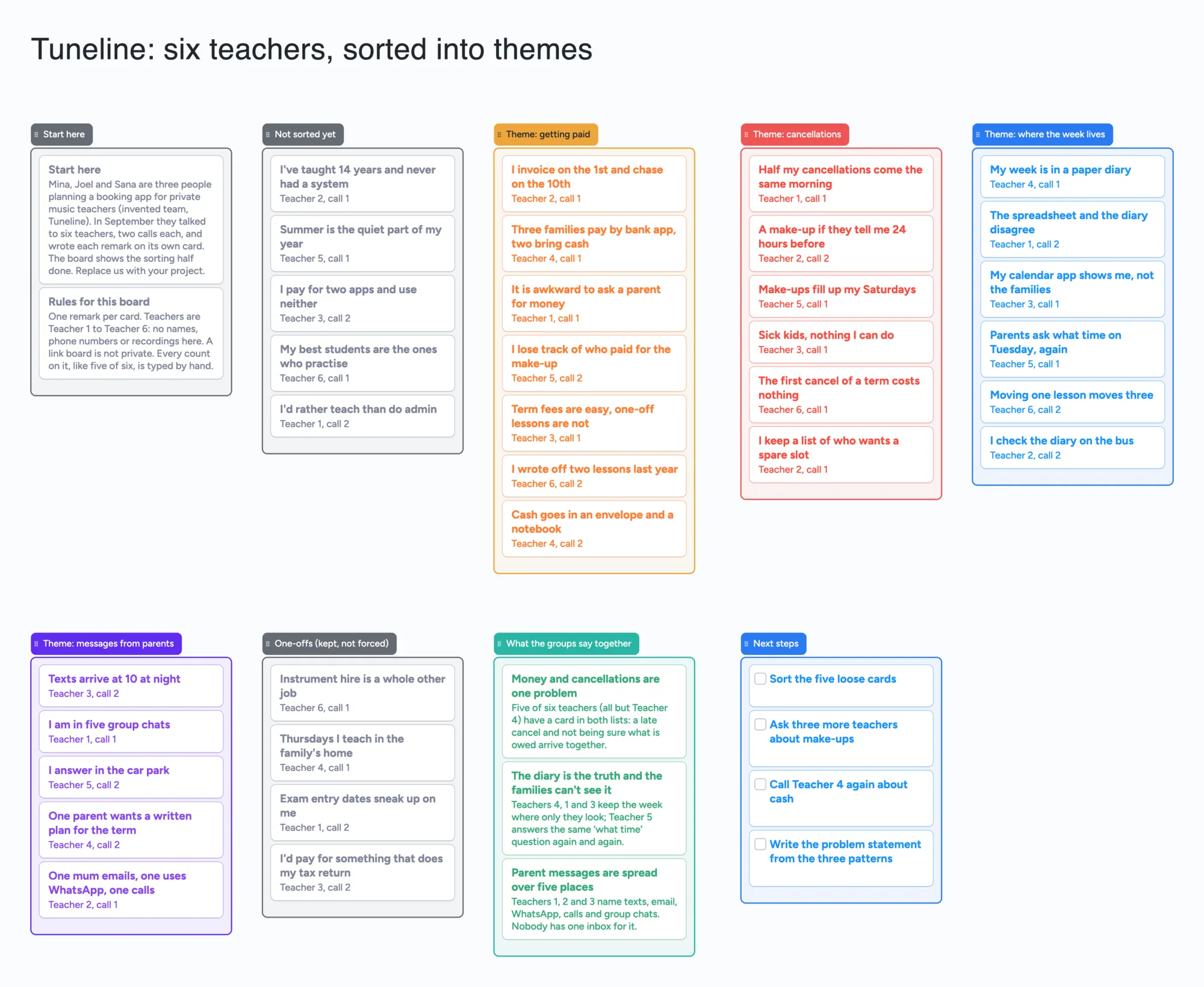
We make Instaboard, an online board. This page gives you an affinity diagram already laid out on it and half sorted, filled in for an invented three-person team: Mina, Joel and Sana are planning a booking app for private music teachers and have talked to six teachers, two calls each. The board holds 33 remarks on their own cards, five of them still unsorted, four themes, a list of one-offs they chose not to force anywhere, and three cards that say what the themes say together. Nothing on it counts, scores or groups for you: you move the cards, and the limits are below before the method.
Opens in your browser. Anyone can view; a free sign-in lets you edit.
Updated
Read this first: what the board does and doesn't do
- What it is: a shared page where each remark from an interview sits on its own card and the team drags cards into lists named for themes. The example holds 33 remarks, 3 notes on what the themes say together, and uses 52 of your 150 free items.
- What it is not: nothing groups the cards for you, nothing counts a theme or tells you which one matters most, there is no dot voting, no reminders or due-date alerts, and no record of who moved a card or when. A count such as "five of six teachers" is a sentence somebody typed.
- Where the method needs more than a board: NN/g says the last step may include votes and suggests dot voting when a team can't agree on which clusters matter most. Here a vote is a number someone writes on a card.
- Keep off it: names, phone numbers, email addresses and recordings. The example calls people Teacher 1 to Teacher 6. A link board is not private.
- When to use something else: a spreadsheet for a large pile of notes, or a tool with voting. Two sections below say when.
What goes on a card: one remark, one teacher, one call
The pages we read all begin with single notes: break the interviews into units before anything is grouped. NN/g's first step is to write ideas on separate sticky notes, and its note says that for research the notes can hold direct user quotes or observations. The Atlassian guide says each idea should be distinct and captured on a separate card so it can be moved on its own.
The example follows that. The card's title is the remark in the teacher's own words, and the second line says where it came from: Teacher 4, call 1. That line is what lets you count later, and it lets someone ask a teacher again without the teacher's name ever being on the board.
| Remark on the card | Source line | Why it is one card |
|---|---|---|
| Half my cancellations come the same morning | Teacher 1, call 1 | One fact. A card that said "cancellations are late and make-ups are hard" would belong in two lists |
| A make-up if they tell me 24 hours before | Teacher 2, call 2 | A rule one teacher uses, kept apart from how many cancel |
| I check the diary on the bus | Teacher 2, call 2 | Small, but it says where the week lives |
| I'd rather teach than do admin | Teacher 1, call 2 | Doesn't fit a theme yet, so it waits in Not sorted yet |
Swipe the table sideways to see every column.
Remarks are invented for the example. The source line format is ours.
On r/UXResearch someone asked how to do one for an app project (thread 1huj7ln, 2025-01-05, 10 comments we read). u/tiredandshort answered that a quote from each interview goes on its own sticky note with a little context, such as the page or the task for a usability test, and the notes are grouped until a pattern shows. In a follow-up reply the same account suggested keeping each subject to about 10 quotes: if a group gets bigger, either it is a huge problem or the category is too big and can be broken up. That is one account's view, not a rule from the pages we read.
The first sort: quick, quiet and allowed to be wrong
The pages differ on how much to talk during the first pass and agree that it should be rough. Four of the pages we read, all on November 25, 2026, say this:
- NN/g (April 26, 2024; "Last reviewed Aug. 7, 2026"): give the team a set time to write the notes, typically 5 to 10 minutes, so they don't overanalyse. Then the team sorts the notes into clusters; to keep things moving it can help to group by content first and decide the theme label after. When in doubt, duplicate a note and put it in both clusters.
- Atlassian's guide (no date printed in the text): sort without speaking. If a note feels like it belongs in another group, move it, even one someone else placed. If one idea truly sits in two themes, make a duplicate.
- Maze (Oct 17, 2025): start with four boxes, put the first note in one and ask of each next note whether it relates; stack repeats, with the most explanatory note on top; keep a part of the map for things to come back to.
- GroupMap (no date printed): sort silently so the grouping follows what the notes say rather than an argument; two teams can cluster the same notes differently, and a confident voice can steer the themes.
On the board the duplicate is a second card with the same remark typed again. Dragging a card from one list to another is the whole move, and a joiner who has signed in sees it within seconds. To keep a repeat from taking a second place, put "x2, Teacher 3 too" on the card instead of copying it.
Loose cards and one-offs: keep them, don't force them
Tuneline's board has two lists for notes that did not land: Not sorted yet (5 cards) and One-offs (4). They are different things. A card in Not sorted yet is waiting for a theme. A card in One-offs was looked at and left alone on purpose: instrument hire, teaching in the family's home, exam entry dates, a wish for help with a tax return.
Two of the pages go further. NN/g says only that a small cluster should not be discounted because it has few notes; it can show that diverse perspectives were represented. The Atlassian guide says not to worry if some ideas are "loners", because they may be unique insights worth a separate look later. The Miro page says it is okay if some concepts seem to defy a grouping, and to come back to them. Keeping the one-offs on the board, in their own list, lets a teammate see that nothing was thrown away.
The example is invented, so the one-offs here are ours; the advice to keep them is from those pages.
Tuneline's board, list by list
- Start here (2 cards). Who they are, what they did and the rules: one remark per card, teachers are numbers, every count is typed by hand.
- Not sorted yet (5). Remarks waiting for a theme, each with its teacher and call.
- Theme: getting paid (7). Invoicing, bank app against cash, how awkward it is to ask a parent, make-up lessons nobody paid for.
- Theme: cancellations (6). Same-morning cancels, the make-up rule one teacher uses, Saturdays filling up, the first cancel of a term that costs nothing.
- Theme: where the week lives (6). Paper diary, a spreadsheet that disagrees with it, a calendar app the families can't see.
- Theme: messages from parents (5). Texts at night, five group chats, one parent who wants a written plan.
- One-offs (4). Looked at and left on purpose.
- What the groups say together (3). Three cards: one sentence each, covered in the next section.
- Next steps (4). Tick boxes: sort the five loose cards, ask three more teachers about make-ups, call Teacher 4 again about cash, write the problem statement. Ticking is just a mark on the card.
Themes are not the answer: reading across them
A board full of neatly named lists can still be a summary. On r/UXResearch someone asked whether to keep a sorted diagram in a portfolio case study (thread 17sxiyw, 2023-11-11, 5 comments we read). u/Appropriate-Dot-6633 replied that the notes looked like the base layer: the next step is to look at how the groups relate, whether one explains, contradicts or affects another, and to write a sentence about each group of groups. Without two more levels of grouped insight, that account wrote, it is summarising what users said without analysis. That is one account's view of what a hiring manager would want.
The vendor pages say the same thing in their own words. Maze's last step links clusters to find what they say together. Miro's last step combines groups into supergroups.
Tuneline's green list does that with three typed cards:
- Money and cancellations are one problem. Five of the six teachers (all but Teacher 4) have a card in both lists: a late cancel and not being sure what is owed arrive together.
- The diary is the truth and the families can't see it. Teachers 4, 1 and 3 keep the week where only they look, and Teacher 5 answers the same question about what time on Tuesday again and again.
- Parent messages are spread over five places. Texts, email, WhatsApp, calls and group chats, named by three teachers.
The counts on those cards are by hand. If you add a theme and the count on a green card goes stale, nothing on the board will tell you.
What a board can't do for an affinity diagram
- Group the notes. Nothing clusters cards for you. You drag them. GroupMap's page says its tool offers AI grouping as a first pass; we don't.
- Vote. No dot voting and no score field. If you vote, type the number on the theme's card.
- Count. No totals, no "five of six". Counts are typed.
- Remind anyone. No reminders or due-date alerts. The next steps are tick boxes.
- Show who moved a card, or when. Anyone with edit access can drag any card.
- Hold recordings or transcripts. One reply in the sxuhvw thread (u/CJP_UX) says to record audio when possible because it is the ground truth for interview data; keep those somewhere private.
- Offline. Changes made offline are kept and sync when you're back online.
When a spreadsheet is the better place for the notes
Three accounts in the r/UXResearch threads we read use or suggest a sheet or a database, and for some jobs we agree.
- Many notes. u/Lumb3rCrack (thread sxuhvw, 2022-02-21) said sticky notes are fun on a wall but a pain to move around and form themes compared with a sheet, and that affinity diagrams work best with limited data and several researchers.
- You want columns per interview. u/bbybrahim (thread 1huj7ln) uses one column per interview or session, puts the direct quotes under it and looks for connections that way, finding it easier to see all the data than on post-its.
- You want tags. u/Shaskola (thread 17sxiyw) suggested Airtable with a tag system, saying that with 1,000 post-its it is much harder to cohort them.
A board is for the part a sheet does worse: three people dragging the same cards into lists and seeing the themes together. On the free plan it also stops at about 130 remarks (our arithmetic below). u/Blahblahblahrawr (thread 1huj7ln) says cells pasted from Google Sheets into Miro become separate post-its; we make no claim about pasting a column of cells here, and we don't import spreadsheets.
Six pages, what each adds
We read these six in full on November 25, 2026. Dates are only those the page prints. NN/g is a research consultancy that sells training; the other five are software vendors, so each is the writer's own view.
| Page | What it adds that the others don't |
|---|---|
| NN/g (April 26, 2024; Last reviewed Aug. 7, 2026) | Three steps, a 5 to 10 minute writing time, colour-coded notes for quotes against observations, dot voting if the team can't agree, nominate one person for the action items |
| Maze (Oct 17, 2025) | Six steps incl. adding supporting content to a cluster and linking clusters; stack repeated notes; a part of the map for things to come back to; an Airbnb redesign case study from a designer |
| Atlassian guide (no date printed) | Silent simultaneous sorting, move anyone's note, duplicate notes that fit two themes, and in its own tool convert groups into Jira issues |
| Confluence template page (no date printed) | A template page. Its step text sits in the page's how-to markup, not in the text we saw in a browser, so we cite nothing from it beyond that it offers a template |
| Miro template (no date printed) | Five steps ending in supergroups; "it's okay" for concepts that defy a grouping |
| GroupMap (no date printed) | A worked example of about sixty notes from eight interviews becoming four themes; says grouping is interpretive and does not by itself say which theme matters most |
From each page as read November 25, 2026. Maze sells a research tool, Atlassian sells Confluence, Miro and GroupMap sell whiteboards, NN/g sells training. Instaboard isn't affiliated with any of them.
If your team already works in one of these
Read November 25, 2026. Not listed means not on the page we read; it doesn't mean the tool lacks it. No ranking: they suit different teams.
| Option | What its page says | Better than a board at | Where a board fits |
|---|---|---|---|
| A spreadsheet | Three r/UXResearch accounts use a sheet or a database (see above) | Many notes, columns per interview, tags, counting | Seeing and moving the themes together |
| GroupMap | Dot voting, AI grouping as a first pass you accept or dismiss, convert top clusters into action items; a 14-day free trial is printed; plan prices are not listed on that page (as of November 25, 2026) | Voting and a first-pass grouping | A plain shared board with no trial |
| Miro | A template with five steps ending in supergroups; "Use template"; price and free-plan limits are not listed on that page (as of November 25, 2026) | A large canvas and many templates | A short list of lists you can read at once |
| Confluence whiteboards | A template page (its steps are in the page's how-to markup, not in text we saw in a browser); groups can be converted into Jira issues per Atlassian's guide; plan limits are not listed on those pages (as of November 25, 2026) | Turning themes into issues | A team not on Atlassian |
| Maze | A research tool with an affinity guide; plan limits are not listed on that page (as of November 25, 2026) | Collecting the research as well | Only sorting notes you already have |
Swipe the table sideways to see every column.
From each page as read November 25, 2026. Vendor content. Instaboard isn't affiliated with any of these.
Set up your own, in order
- Open the board and replace the Tuneline cards as you go, so it is never half music teachers.
- Number your people (Participant 1 to N) on the Start here card and delete the example's rules only after you have written yours.
- One remark per card, with its source line. Type the same remark twice if it truly fits two themes.
- Sort for 5 to 10 minutes, then name the lists. NN/g suggests grouping first and naming after.
- Move the leftovers. Cards still unplaced stay in Not sorted yet; ones you decide not to place go to One-offs.
- Write the three cards in the green list after you have read across the themes, and put any count in words ("five of six").
- Share it. Set the share setting so anyone who joins can edit ("Anyone who joins can edit"); new boards start view-only, and each person signs in to write.
How many notes fit in 150 items, and the other free-plan limits
Each card and each list is 1 of your 150 free items, across all your boards. The title text box counts too. Arrows, sections and pen strokes don't. Our arithmetic from Tuneline's lists:
- As built: 9 lists + 42 cards + the title = 52. Of the 42 cards, 33 are remarks, 3 are what the groups say together, 4 are next steps and 2 are the Start here cards.
- Everything that isn't a remark: 9 lists + 9 other cards + the title = 19. That leaves 150 - 19 = 131 for remarks.
- A bigger round: at 8 remarks a call, 16 calls is 128 remarks, so 128 + 19 = 147. A seventeenth would pass 150.
- GroupMap's example: about 60 notes would be 60 + 19 = 79 here.
- Copies: two copies of the example as built are 2 x 52 = 104; a third would be 156. A copy takes 1 of your 5 free boards.
Pro removes the item limit: $5 a month billed yearly ($59.99 a year), or $7.99 monthly. One interview round doesn't need it.
The other limits of the free plan for this board:
- Boards. 5 on the free plan. "Make a copy" takes 1 of them.
- Pictures. 3 per board. The example has none; photos of a wall of sticky notes would use them up.
- Writing needs a free sign-in. Anyone who joins can view the board; to change it they sign in, and the board then counts as 1 of their 5.
- Private notes. A link board is not the place for names or recordings; invite-only boards are a Pro feature.
Start from the ready board
It opens in your browser in a few seconds, with nothing to install. Sign in for free when you want to save it and share it.
Questions
What is an affinity diagram?
A way to cluster a large number of notes, ideas or observations into groups by how they relate, with the themes coming from the notes themselves. NN/g says it is also called affinity mapping or collaborative sorting; Maze, GroupMap and Atlassian add that it is also called the KJ method; Maze and Atlassian name Jiro Kawakita, and Atlassian dates his work to the 1960s.
How many notes should one interview produce?
None of the pages we read gives a number. One r/UXResearch commenter suggested keeping each subject to about 10 quotes and splitting a group that grows past it. GroupMap's example is about sixty notes from eight interviews. On this board, 8 remarks a call over 16 calls is 147 items, our arithmetic.
Can the whole team sort at the same time?
Yes, with a caveat. Anyone who has signed in can drag cards on a shared link and others see it within seconds. Someone who only opened the link signed out can look but not change anything. Each person who joins signs in for free, and the board counts as 1 of their 5 boards.
Does the board vote, count or group for us?
No. It has no dot voting, no totals and no automatic grouping. NN/g and GroupMap both suggest voting after the sort; on this board you type the number on the theme's card. If you need the tool to do it, GroupMap's page describes voting and an AI first pass.
Is a spreadsheet better than a board for interview notes?
For a large pile, often yes. Three accounts on r/UXResearch use or suggest a sheet or a database for the quotes, with a column per interview or a tag column, and one compares it favourably with sticky notes for moving notes into themes. A board is better for three people dragging the same cards and seeing the themes together.
Should I put names or recordings on the board?
No. A link board is not private. The example calls people Teacher 1 to Teacher 6 and the source line on each card says only which teacher and which call. Keep names, contact details and audio or transcripts somewhere private.
Sources
- Nielsen Norman Group: Affinity Diagramming for Collaboratively Sorting UX Findings and Design Ideas (April 26, 2024; "Last reviewed Aug. 7, 2026"; read in full November 25, 2026)
- Maze: Affinity diagrams: How to turn UX data into design insights (Oct 17, 2025; read in full November 25, 2026; vendor content)
- Atlassian: Affinity diagrams: How to organize ideas effectively (no date printed in the text; read in full November 25, 2026; vendor content)
- Atlassian: Free Affinity Diagram Template, Confluence (no date printed in the text; read in full November 25, 2026; vendor content)
- Miro: Affinity Diagram Templates and Examples (no date printed in the text; read in full November 25, 2026; vendor content)
- GroupMap: Affinity Diagram Template, Examples and How-To (no date printed in the text; read in full November 25, 2026; vendor content)
- r/UXResearch: I want to know how to do affinity map (2025-01-05; 10 comments read)
- r/UXResearch: Affinity Diagram Keep or Delete? (2023-11-11; 5 comments read)
- r/UXResearch: Are there any other research synthesis methods (for qualitative data) apart from Affinity Diagramming? (2022-02-21; 14 comments read)
Related
A pre-mortem template on one shared board: imagine it failed, list why, assign the fixes
A pre-mortem template on one shared board: the plan, the failure you imagine, each person's reasons, top risks, actions with owners and a midpoint check.
A lessons learned log template on one shared board: lessons by kind, what worked, a review before the next job
A lessons learned log on one shared board: lessons by kind, what worked, a review before the next job, and whether each lesson was used.