For master's and PhD students getting ready to defend, and the people who practice with them
A thesis defense board for your committee, your talk and your practice runs
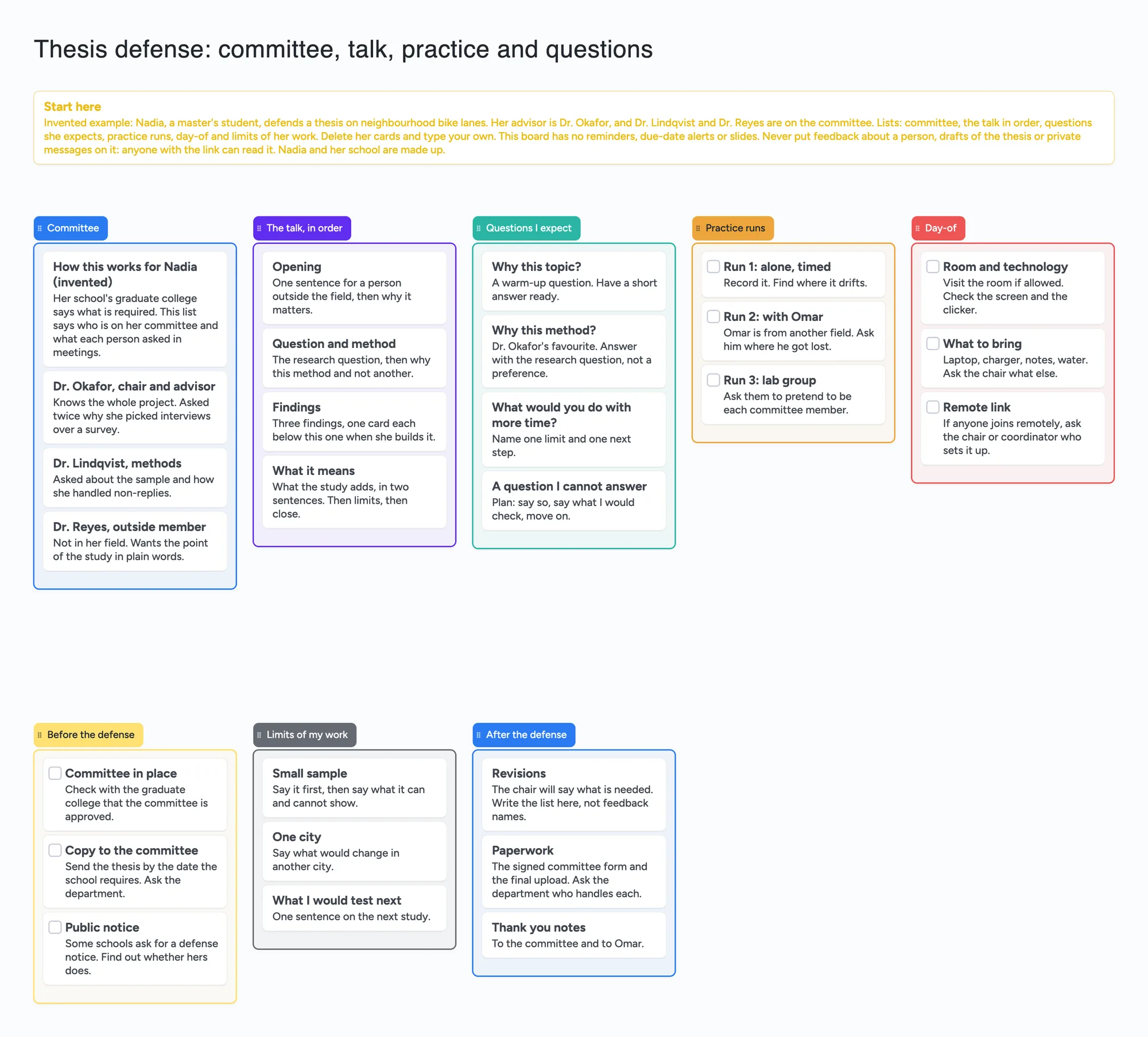
We make Instaboard, an online board. This page gives you a defense plan laid out on it and filled in for an invented master's student, Nadia, who is defending a thesis on neighbourhood bike lanes, with her advisor Dr. Okafor, two more committee members and a friend from another field who practices with her. Lists hold what each committee member has asked, the talk in order, the questions she expects, three practice runs, the day itself, the limits of her work and what comes after. The board does not hold slides, your thesis or anyone's feedback, and it has no reminders or due-date alerts: your graduate school's own pages set the deadlines. Nadia, her committee and her school are made up.
Opens in your browser. Anyone can view; a free sign-in lets you edit.
Updated
Read this first: what the board does and doesn't do
- Nothing private goes on it. No feedback quoted by a person's name, no drafts of the thesis, no unpublished data and no private messages. New boards start with "Anyone who joins can view", so anyone with the link can read it.
- It does not hold your slides. Build the talk in your presentation software. The board holds the order of the talk, the questions you expect and what your practice runs showed.
- It has no reminders or due-date alerts. Your graduate school sets the deadlines for the committee copy, the defense notice and the forms; take them from its own pages and put them in a calendar or on a card's due date yourself.
- Your school's rules win. The two graduate schools we read below differ on the forms, the lead times (Syracuse's Request for Examination at least three weeks ahead; Boise State's Defense Notification at least two weeks, and its doctoral Graduate Faculty Representative request four) and who sets up a remote link. Treat Nadia's cards as a shape, not as your rules.
- What it is: a prep board. One list per job: committee, talk, expected questions, practice runs, day-of, limits and what comes after. The example uses 37 of your 150 free items.
- Free plan: 5 boards, 150 items, 3 pictures per board. Copying the board takes 1 of your 5 boards. Writing on it needs a free sign-in. New boards start with "Anyone who joins can view". This page is for master's and doctoral students.
What two graduate schools require before the day
Schools differ, and yours is the one that counts. These two publish their steps, which shows the shape of the "Before the defense" list. Both pages were read on November 24, 2026.
- Boise State University, Graduate College ("Preparing for your Thesis or Dissertation Defense"; page data modified August 19, 2026). The student confirms the supervisory committee is approved. Doctoral students request a Graduate Faculty Representative at least four weeks before the intended defense date. The student submits a Graduate Defense Notification at least two weeks before, gives the full thesis or dissertation to all voting committee members at least two weeks before, and prepares a Defense Committee Decision form to bring on the day. The page says the committee chair or program coordinator can set up a Zoom meeting for a remote defense.
- Syracuse University, Graduate School ("Thesis/Dissertation Defense Checklist"; read November 24, 2026). The student files a Request for Examination at least three weeks before the proposed defense and gives copies to every member of the committee at least two full weeks before; the page says the deadline is strictly enforced and the defense may be canceled if a member does not have a copy in time. A master's committee has four voting members including the advisor and the oral exam chair; for a doctoral defense the chair comes from outside the student's program. Defenses may be in person or remote, and the student is responsible for contacting all committee members about a remote option and giving the video link on the form.
Both give two weeks for the committee copy, and they differ on the forms, the lead times and who sets up a remote link. That is why Nadia's "Before the defense" list holds checks like "find out whether hers does" instead of dates: the date and the form come from your own school.
Nadia's board, list by list
Nadia, Dr. Okafor, Dr. Lindqvist, Dr. Reyes and Omar are invented, and so are the questions each of them asked. Read it left to right, top row then bottom row.
- Committee. A card on how it works at her school, then one card per member with what they asked in meetings: Dr. Okafor, her advisor and chair, asked twice why she chose interviews over a survey; Dr. Lindqvist asked about the sample and non-replies; Dr. Reyes, from outside her field, wants the point of the study in plain words.
- The talk, in order. Opening for a listener outside the field, question and method, findings, what it means. Four cards; the slides themselves stay in her presentation software.
- Questions I expect. Why this topic, why this method, what she would do with more time, and a card for the question she cannot answer, with a plan for it.
- Practice runs. Three tick-box cards: alone and recorded, with Omar who is from another field, and with her lab group playing the committee.
- Day-of. Three tick-box cards: the room and technology, what to bring, and the remote link.
- Before the defense. Three tick-box cards: committee approved, copy to the committee, public notice.
- Limits of my work. Small sample, one city, what she would test next, each as a sentence she can say aloud.
- After the defense. Revisions (the list, not who said what), paperwork, thank-you notes.
Practice runs: who to ask and what to write down
The University of Central Florida Writing Center's guide "Preparing for a Thesis Defense" (Benton, H., printed as 2026; read November 24, 2026) recommends attending at least one defense in your program, practicing the presentation multiple times, and doing a mock defense in front of a writing-center tutor, friends or family. It also suggests visiting the room to see the technology, and asking your chair what to bring.
Replies in the threads below are single accounts, not research, and these are the comments we read. All were read on November 24, 2026.
- In r/PhD ("Definitely do the mock defense", OP u/WinterSparklers, May 18, 2024), the poster held a mock defense with faculty, past professors, friends and family, asked them for hard questions and had a friend take notes on the questions and feedback. They say the mock questions were harder than the real ones. u/ProposalAcrobatic421 advises two mock defenses, with the full committee if possible.
- In r/PhD ("How did you/are you prepping for your defense?", OP u/shaybee377, July 11, 2024), u/Thalassiosiren practiced with lab mates and non-lab scientists; the non-lab listeners helped cut details, and people who knew the committee pretended to be its members. u/Scientific-method recorded themselves against a 20-minute limit, made extra slides for questions each committee member might ask and did three mock defenses with people inside and outside the program. u/ipini attended every defense they could and pretended to be their own examiner.
- In r/PhD ("Defence prep: please tell me what you did…", OP u/OkUnderstanding19851, January 19, 2025), u/mpjjpm says their department had a tradition: candidates organized their own mock defense about a week before and invited PhD students and postdocs.
- In r/GradSchool ("FINAL THESIS DEFENSE TIPS & HACKS", OP u/mcrointhemaking, April 26, 2024), u/Rayna18 rehearsed for friends who knew nothing about the thesis, to see whether it made sense to someone outside the lab.
This is why "Practice runs" is a tick-box list with a short note for each run, and why the note says what to ask the listener. The board keeps the questions you were asked; the recording and the slides stay with you.
The questions to expect depend on where you defend
In r/PhD ("How to Successfully Defend Your Dissertation", OP u/DrJohnnieB63, March 24, 2025), the poster says that after attending about ten defenses before their own they saw committees usually ask: what the topic is and why it was picked, the research questions and how they fit the literature, the contribution, the theoretical framework and why, the method and why, the findings, the conclusions and what they mean for the field, and what research could follow. Their approach was to answer those questions inside the presentation itself.
Replies are single accounts. u/Bjanze, who says their experience is from the Nordics, disagrees somewhat: in Finland, they say, a defense under one and a half hours would be a disappointment and it is the opponent's job to keep it going, so answering every easy question in advance leaves the harder ones. They still say to be ready for all of them. u/AdEmbarrassed3566 asks whether the defense is essentially a formality in most countries and says that in the US it is once the committee lets you defend. Those two views point opposite ways, which is why the board has a "Questions I expect" list you fill from your own committee and not a fixed one.
In the r/PhD "Defence prep" thread (OP u/OkUnderstanding19851), u/Scrambles94 re-read their own thesis and went over the research interests of the examiners, especially the external one, as a way to predict questions. Nadia's "Committee" list is that idea as cards: one per member with what they asked.
Your limits, and the question you cannot answer
The UCF guide says that admitting you have not considered something, or that it falls outside the scope of your project, is an acceptable answer, and suggests asking your chair for commonly asked questions and preparing answers about gaps or limitations. In r/GradSchool (OP u/mcrointhemaking), u/RabbitEfficient824 says to identify the assumptions you made and prepare to justify them, because faculty will ask about them, and u/LemmingLou says to get ahead of the "gotcha" moments in an opening statement by naming weak points as directions for later work.
The "Limits of my work" list is where those sentences live, one per card, short enough to say aloud. The card "A question I cannot answer" on the questions list holds the plan for the moment itself.
How much of the 150 it uses
Our arithmetic: the example is 8 lists, 28 cards and a title, 37 items. Of the cards, 9 are tick-box cards. Twenty more expected-question cards and two more committee cards for a five-person doctoral committee make 59. Someone who writes on your board adds the cards they type to their own 150. A copy takes 1 of your 5 free boards. Pro removes the item limit.
What a board can't do
- No slides. It does not present or rehearse your talk; your presentation software does that.
- No reminders or due-date alerts. It will not tell you the committee copy is due. Put your school's deadlines in a calendar or on a card's due date yourself.
- No forms or signatures. The Defense Committee Decision form, the Request for Examination and the like live in your school's system.
- No private feedback. Anyone with the link can read the board, so keep what a committee member said about you, in writing or aloud, off it unless it is a question you are happy to share.
- Ticks don't say who or when. Anyone with edit access can untick a box, and a copy keeps its ticks, so untick the lists before you reuse the board.
- A copy takes 1 of your 5 free boards, and the example uses none of the 3 pictures allowed per board.
Where other tools do this better
Read on November 24, 2026; pages change, so check them. A date is printed only where a page shows one.
| Tool | What we read | Better for |
|---|---|---|
| Your graduate school's pages and forms | Boise State (page data modified August 19, 2026) and Syracuse describe their own deadlines, forms and committee rules | Real deadlines, who may sit on the committee, which forms to file |
| Writing center guide | The UCF Writing Center guide (printed as 2026) covers conduct, what to wear and bring, nerves and what happens after | Advice on how to behave on the day |
| Presentation software | Not read for this page | The slides and timing the board does not hold |
| Shared doc or spreadsheet | Not read for this page | A long list of questions you want to sort or search |
| Instaboard board | Free plan: 5 boards, 150 items, 3 pictures per board. Lists and cards you type, shared by link. No slides, forms, reminders or due-date alerts | Keeping the committee's questions, the talk's order and your practice notes on one screen that a lab mate or friend can read and write on |
Swipe the table sideways to see every column.
From each page or comment named, read November 24, 2026: boisestate.edu graduate college defense preparation, graduateschool.syr.edu defense checklist, the UCF Writing Center PDF, and the four Reddit threads in the sources. Our wording, not theirs.
Where these win
Use your school's pages for deadlines and forms, your presentation software for the talk and a calendar for dates. Use this board when you want the committee's questions, the order of the talk and your practice notes in one place that someone else can read and write on.
How to use it, in about fifteen minutes
- Open the board and sign in free when it asks you to write. Delete Nadia's cards and keep the lists.
- Put your committee on the first list, one card per member, with what each has asked in meetings. Ask your chair what else to expect.
- Write the order of the talk in four to six cards. Keep the slides in your presentation software.
- Fill the questions list from your committee's interests and the questions you are afraid of, and write the plan for the one you cannot answer.
- Book the practice runs with people from inside and outside your field, and note on each card what you want them to tell you.
- Copy your school's steps onto the "Before the defense" list from its own graduate college page, not from Nadia's.
- To share it, set Share to "Anyone who joins can edit" if a lab mate or practice partner should write. Each person who writes signs in for free. Keep thesis drafts and private feedback off it.
Start from the ready board
It opens in your browser in a few seconds, with nothing to install. Sign in for free when you want to save it and share it.
Questions
What should be on a thesis defense checklist?
Your school's own graduate college page sets the required steps, such as approved committee, a request or notice form and a date for sending the thesis to the committee. The board adds the preparation around them: the committee's questions, the order of the talk, practice runs, limits and what happens after.
How do I prepare for the questions?
Several people in the threads we read prepared by reading their thesis from an examiner's view, going over each committee member's interests and doing mock defenses with a friendly audience. The board's questions list and committee list are places to write those down.
Can I put my slides or thesis on the board?
It is not meant for them. Keep the slides in your presentation software and the thesis in your own files. Anyone with the link can read the board, so keep drafts, unpublished data and private feedback off it.
Does the board remind me of deadlines or file forms?
No. It has no reminders, due-date alerts or forms. Take deadlines from your school's graduate college pages and put them in a calendar or on a card's due date.
Can my practice partner write on it?
Yes. New boards start with "Anyone who joins can view", so anyone with the link can read it. Set it to "Anyone who joins can edit" if they should write; each person who writes signs in for free.
Is Instaboard free?
Yes. The free plan includes 5 boards, 150 cards and items across your account (pen strokes, arrows and sections don't count), 3 images and 1 file per board, unlimited collaborators and video calls up to an hour. Pro is $5 a month billed yearly ($59.99 a year), or $7.99 monthly, and the people you invite join free.
Sources
- Boise State University Graduate College: Preparing for your Thesis or Dissertation Defense (page data modified August 19, 2026; read November 24, 2026)
- Syracuse University Graduate School: Thesis/Dissertation Defense Checklist (read November 24, 2026)
- University of Central Florida University Writing Center: Preparing for a Thesis Defense (Benton, H., printed as 2026; read November 24, 2026)
- r/PhD: Definitely do the mock defense (OP u/WinterSparklers, May 18, 2024; replies are single accounts; read November 24, 2026)
- r/PhD: How did you/are you prepping for your defense? (OP u/shaybee377, July 11, 2024; replies are single accounts; read November 24, 2026)
- r/PhD: How to Successfully Defend Your Dissertation (OP u/DrJohnnieB63, March 24, 2025; replies are single accounts; read November 24, 2026)
- r/PhD: Defence prep: please tell me what you did, both practically and with superstition, to feel prepared for your PhD defence (OP u/OkUnderstanding19851, January 19, 2025; replies are single accounts; read November 24, 2026)
- r/GradSchool: FINAL THESIS DEFENSE TIPS & HACKS (OP u/mcrointhemaking, April 26, 2024; replies are single accounts; read November 24, 2026)