For the few relatives who plan the family reunion
A family reunion planning board for the organizing committee: venue, date, headcount, food and who owns what
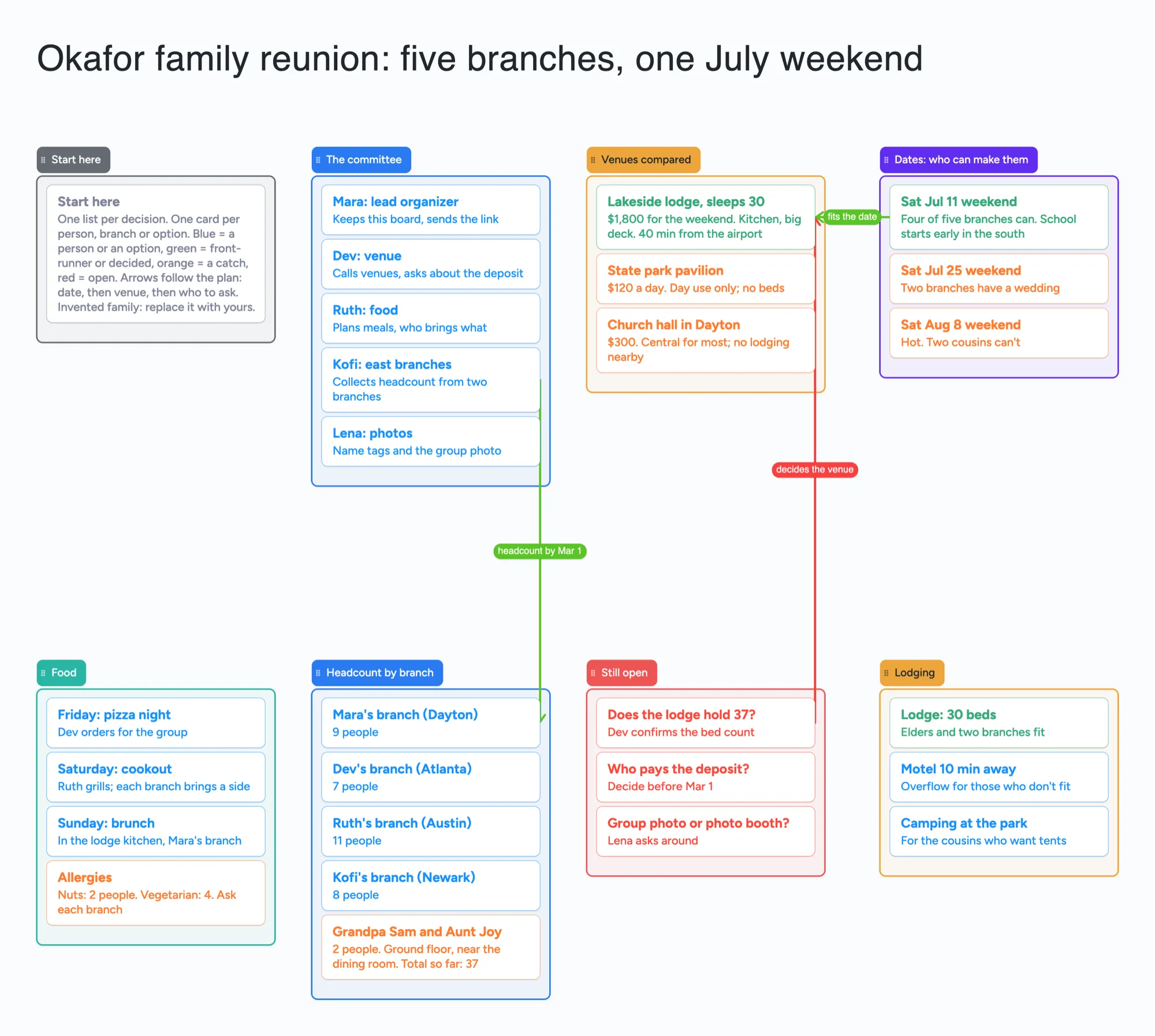
We make Instaboard, a free online board. This page gives you a family reunion plan already laid out on it, for the few people who organize: who owns what, venues compared, dates by who can make them, headcount by branch, food, lodging and what is still open. The family is invented. Reunly does the parts a board can't: RSVPs, payments and a hub for the whole family to open. This board is only the committee's working plan, shared by link with a handful of siblings and cousins. Open it, replace the family with yours, and send one link.
Opens in your browser. Anyone can view; a free sign-in lets you edit.
Updated
The short answer
- For the committee, not the whole family. One list per decision: who owns what, which venue, which date, headcount by branch, food, lodging, what is still open. Each person, venue or date is a card.
- What it is not: no RSVP form, no payments, no email or text to relatives, no guest directory, no family tree and no reminders. For a hundred cousins who each need to answer and pay, use a reunion tool such as Reunly; a board can't do that.
- Count the items before you copy it. The example is 8 lists, 27 cards and the title text box: 36 of your 150 free items. Arrows, sections and pen strokes don't count (our arithmetic).
- Pro lifts the limit: $5 a month billed yearly ($59.99 a year), or $7.99 monthly. The free plan keeps 5 boards, 150 items and 3 pictures per board.
- Anyone with the link can read it; writing takes a free sign-in. New boards start view-only. Set "Anyone with the link can edit" so each committee member can add a card.
How this differs from our other planning boards
Our other planning boards hold a different job. This one holds a family's working plan.
| Board | The question it answers | A card is |
|---|---|---|
| Family reunion (this page) | What do the organizers still have to decide, and who owns it? | A person, a venue, a date, a branch or a task |
| Group trip planning board | Which friends, dates and stay for one trip? | A person, a date, a stay or a booking |
| Wedding guest list board | Who is invited, household by household? | A household |
| Office holiday party board | What does one evening for a team need? | A task, a person or an item |
Swipe the table sideways to see every column.
The shapes are those of each page's own text (our reading).
Those boards: group trip planning, wedding guest list and office holiday party.
How to fill in a family reunion board
- Start with the committee. One card per organizer with what they own: the venue, the food, a branch's headcount, photos. People who own a line get asked about it, so the owner is written on the card.
- Put the dates before the venue. Each date option is a card with who can come. In the example one weekend works for four of five branches, so the arrow marks it as the date to plan around.
- Compare venues with the same fields on every card. The price, what it holds, and the catch. The example writes "$1,800 for the weekend. Kitchen, big deck. 40 min from the airport" next to a pavilion with no beds and a hall with no lodging nearby.
- Collect headcount by branch. One card per branch with a number, written by the person who owns that branch. The example's total is 9 + 7 + 11 + 8 + 2 = 37 (our arithmetic), and the open question is whether the lodge holds that many.
- Write each meal as a card with its owner. Friday pizza, Saturday cookout where each branch brings a side, Sunday brunch. Allergies go on one card.
- Keep the open questions in one red list. Who pays the deposit. Does the lodge hold 37. An arrow from a question to the venue it decides shows what is waiting on it.
- Share it. In the share menu set "Anyone with the link can edit" (new boards start view-only). Each committee member signs in free to write live. If two people type in one card at once, the edits merge letter by letter, so give each branch lead their own card.
People who plan reunions describe how big the job gets. In an r/partyplanning thread (August 2025), u/herfivefoottwo asked for software for a reunion of about 200 invited and 75 expected, with a web page, email and SMS, three registrations (a fee, lodging and flights) and a chat, and u/Prestigious-Fan3122 replied that it is simpler to send everyone a few hotel options and let them book their own. In an r/Genealogy thread (September 2019), u/justadad561 wanted a non-Facebook place for a few dozen far-flung relatives to plan the venue, dates, program, lodging and meals, and u/genie_logic suggested a Facebook group and a spreadsheet. Those are single accounts, not a measurement. The first asker's job is the one this board cannot do; the second is the one it fits.
Family reunion tools, side by side
Each row is from the tool's own pages, read on November 19, 2026. Features and prices change, so check the page before you choose.
| Tool | What its page says | Where it beats a shared board | Where a shared board fits |
|---|---|---|---|
| Instaboard board | Free: 5 boards, 150 items. Pro $5 a month billed yearly ($59.99 a year), or $7.99 monthly | Nothing in this table on RSVPs, payments or guest lists | The committee's working plan, on one link after a free sign-in |
| Reunly | Its pricing page lists a Free plan with unlimited guests, a budget tracker, a planning checklist and timeline, payment tracking and reunion-level RSVP; "This Reunion" at $49 one time adds a public hub, per-event RSVPs and an event kit; "Forever" is $79 a year. Its pricing page says guests RSVP and pay with no account | RSVPs, payment tracking and a public hub for the whole family | A plan the committee can move around freely before it goes into a tool |
| Reunacy | Its pricing page lists a Free group with up to 10 members and up to 3 events; "Per Event" is $49 one time (or a 7% ticket fee with nothing up front), with unlimited members, photo albums and a message board; "Annual" is $99 a year | A private group page, directory, photo albums and message board | A plan with no group to join |
| AARP's tools article | A June 1, 2022 article naming Zoom, Facebook, websites, reunion apps and single-task apps such as Doodle for polling a date | A list of ways to reach relatives | A board is one of the planning surfaces, not a way to reach relatives |
| Facebook group and a spreadsheet | Suggested in the r/Genealogy thread by u/genie_logic | Messages, photos and the whole family's reach | A plan that isn't a feed of posts |
Swipe the table sideways to see every column.
From each tool's own pages or the thread, read November 19, 2026. Reunly's own pages disagree on co-planner numbers (its collaboration page says the Free plan is solo only; its pricing page says unlimited co-planners on This Reunion), so no count is printed here.
Which tool for which job
No ranking: these are different jobs.
- Collecting RSVPs and fees from the family: Reunly or Reunacy, which both list RSVPs and ticket or fee payments on their pricing pages.
- Keeping relatives in touch all year, with a directory and photo albums: Reunacy's group plans.
- Reaching relatives who already use it: a Facebook group, which AARP's article describes for reunion information and photos.
- Sums and a column for everything: a spreadsheet.
- A shared working plan for the organizers: this board. A committee member signs in free to edit. It has no RSVPs, payments, email or reminders.
How many cards fit
On this board the 8 lists and the title text box are 9 items before any card:
- 27 cards (the example): 9 + 27 = 36 of your 150 free items.
- A reunion with 10 branches: 9 + 10 branch cards + 20 other cards = 39.
- The most the free plan holds: 150 - 9 = 141 cards, with nothing else on the account.
- The example as it is is 36 items, so four reunions like it use 144 of the 150 across your boards and a fifth passes the limit (5 x 36 = 180).
Arrows, sections and pen strokes are free. This is our arithmetic; Pro removes the item limit. One card per person would run out fast, so one card per branch is the shape here.
When another tool is the better choice
- You need RSVPs. The board has no form. Use a reunion tool or an invitation tool.
- You need to collect money. The board tracks no payments and holds no balances.
- You need to reach 100 relatives. The board can't email or text anyone.
- You want a family tree or a directory. Reunly lists a tree builder and Reunacy a print directory; the board has neither.
- You want reminders. The board sends none; a date on a card is text.
Limits of the free plan for a family reunion board
- Items. Each card and each list is 1 of your 150 free items, across all your boards. The example is 27 cards, 8 lists and the title text box, 36 in all. Arrows, sections and pen strokes don't count.
- Boards. The free plan includes 5 boards. Keep the whole reunion on one board.
- Photos. 3 images per board. The example has none.
- Writing needs a free sign-in. A relative who joins by link or code can add cards and arrows, and the board counts as one of their 5 boards. Someone who is not signed in can open the link and read everything, but can't change anything. Not every relative will want to sign in, so the committee is the right size for this.
- Offline. Changes made offline are kept and sync when you are back online.
Start from the ready board
It opens in your browser in a few seconds, with nothing to install. Sign in for free when you want to save it and share it.
Questions
Is there a free family reunion planning template?
Yes, several. The ready board here has lists for the committee, venues compared, dates by who can make them, headcount by branch, food, lodging and what is still open. It is free within 5 boards and 150 items, and you open it and replace the example family with yours. Reunly lists a free plan with a budget tracker and a checklist. The board is a shared working plan, not an RSVP form.
What should a family reunion planning checklist include?
Who owns what, the date, the venue, headcount by branch, food and allergies, lodging, and what is still open. The example board has a list for each, with a card per person, option or task. It doesn't send reminders, so put a date on each open question and ask the owner.
What is the best software for family reunion planning?
It depends on the job. Reunly and Reunacy list RSVPs and payments on their pricing pages, which suits a larger family. A Facebook group and a spreadsheet are what people suggested in an r/Genealogy thread. For the organizers' own working plan, a shared board like this one holds it, but it has no RSVPs, payments or email.
How do I plan a family reunion with siblings and cousins?
Give each organizer one line to own, settle the date before the venue, compare venues with the same fields on every card, collect headcount by branch, and keep the open questions in one list with a date to answer by. Then send the details to the whole family by whatever they use. The board is the plan, not the invitation.
How do I share a reunion plan so everyone can edit?
In the share menu set "Anyone with the link can edit", then send the link. Each committee member signs in free (Google, Apple or email) to write; someone who isn't signed in can open the link and read, but can't change anything. Give each branch lead their own card so you never type in the same one at once.
How many items does a family reunion board use on the free plan?
Each card and each list is one item of the 150 across all your boards. With 8 lists and the title text box, 27 cards is 36 items, and the most a board holds is 141 cards. That is our arithmetic. Arrows and sections are free.
Sources
- r/partyplanning: looking for family reunion software for 150 people (August 2025; replies are single accounts; read November 19, 2026)
- r/Genealogy: reunion collaboration tools (September 2019; replies are single accounts; read November 19, 2026)
- Reunly: pricing (Free, This Reunion $49, Forever $79 a year; read November 19, 2026; page shows no date)
- Reunly: family reunion planner (read November 19, 2026; page shows no date)
- Reunly: collaboration (co-planner access; read November 19, 2026; page shows no date)
- Reunacy: pricing (Free, Per Event $49, Annual $99; read November 19, 2026; page shows no date)
- AARP: 5 top digital tools for organizing events like family reunions (June 1, 2022; read November 19, 2026)
Related
A group trip planning template on one shared board: who's going, which dates, which stay, who books what
A group trip planning template to open and edit: who is going, dates by who can make them, stays side by side, who books what, the budget split and what is still open.
A wedding guest list board for your names and both sets of parents' names
Wedding guest list tracker on one shared board: your list and each parent's, A/B tiers, headcount vs venue. A Google Sheets template alternative.
An office holiday party planning board: who owns what, in one place
Plan the office holiday party with a small committee on one shared board: budget, venue, food, gift swap rules and the evening. Free ready board, and where SignUpGenius does more.
Home renovation planner: a shared board for the decisions
Decide paint, floor and sofa together: a list per decision, a few candidates, who decides and an order-by date. A shared board, not a floor-plan or budget tool.