For novelists planning where the story turns
Novel beat sheet calculator: see where each of 15 beats falls in your book
We make Instaboard, a free online board. Type how long your novel will be and the table below shows where each of 15 story beats falls, as a page, word or chapter number. The beat idea and the shares come from the Save the Cat method as adapted for novels by Jessica Brody; the beat names are our own words. It is arithmetic, not an AI outline generator, and it needs no account. Save the Cat's own Beat Sheet Mapper does this too and also takes your project type, so use it if you want that.
Updated
Enter your book's length
Estimates are rounded to the nearest page. An estimate of your finished length is fine.
| Beat | Falls at | Share |
|---|---|---|
| 1. First pictureOne scene that shows the hero's world as it is. | pages 1 to 3 | 0% to 1% |
| 2. Idea hintedSomeone says, almost in passing, what the story is really about. | page 16 | about 5% |
| 3. Life beforeThe hero's routine, flaws and wants. | pages 3 to 32 | 1% to 10% |
| 4. The disruptionAn event knocks that routine off course. | page 32 | about 10% |
| 5. HesitationThe hero weighs the risk and stalls. | pages 32 to 64 | 10% to 20% |
| 6. Choosing inA decision sends the hero into the new situation. | page 64 | about 20% |
| 7. The helperA new relationship arrives that will teach the hero something. | page 70 | about 22% |
| 8. Promise of the premiseThe new situation in action: what the book's idea was sold on. | pages 64 to 160 | 20% to 50% |
| 9. Midpoint turnThe stakes jump, with a false win or a false loss. | page 160 | about 50% |
| 10. Pressure buildsOpposition tightens and the hero's own flaws bite. | pages 160 to 240 | 50% to 75% |
| 11. Everything lostThe lowest point; something ends. | page 240 | about 75% |
| 12. Darkest hourThe hero takes in the loss before acting. | pages 240 to 256 | 75% to 80% |
| 13. The new planA realization shows what has to be done. | page 256 | about 80% |
| 14. Final testThe hero acts on it and meets the opposition. | pages 256 to 317 | 80% to 99% |
| 15. Last pictureA closing scene that mirrors or contrasts the first. | pages 317 to 320 | 99% to 100% |
Then put your scenes under the beats
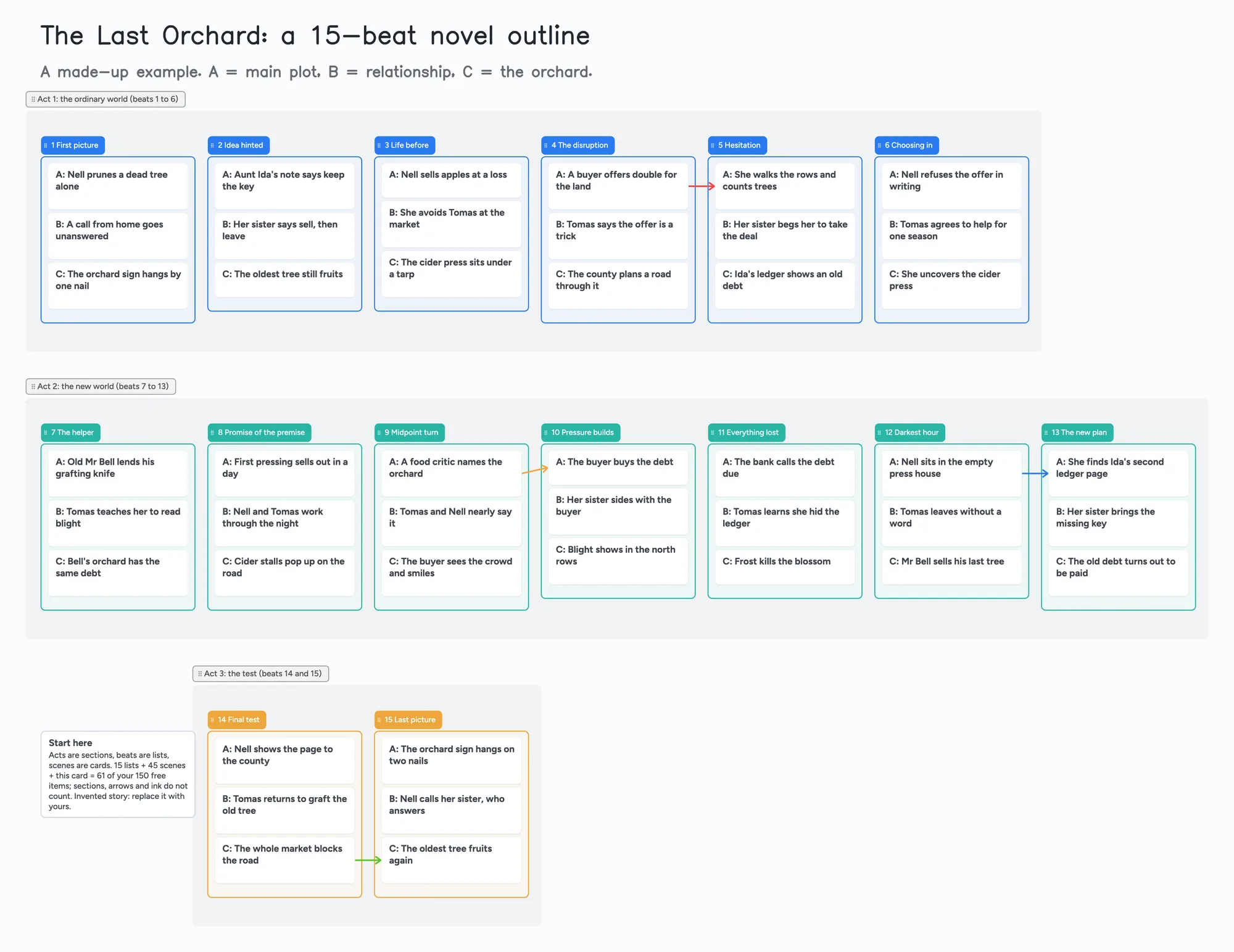
The table tells you where a beat should land. It does not hold your story. The ready board has the same 15 beats as lists, three act sections and three scene cards under each beat for an invented novel; replace the story with yours.
Opens in your browser. Anyone can view; a free sign-in lets you edit.
How the numbers are worked out
Each beat has a share of the book, taken from Jessica Brody's novel guide (November 30, 2020): an opening picture in the first 1%, a statement of the theme at 5%, the disruption at 10%, the choice to enter the new situation at 20%, the midpoint at 50%, the lowest point at 75%, the new plan at 80% and a closing picture in the last 1%. Some beats are a stretch rather than a point, such as the promise of the premise, which she places from 20% to 50%.
The calculator multiplies each share by your length. In pages it rounds to the nearest page and in words to the nearest 100. In chapters it names the chapter that contains the position, counting every chapter as equal length, which real books are not. Brody says the calculations are based on an average of all novels, so your book may vary, and treats the result as a guideline only. Reedsy says the same of the shares in its guide: a guide, not a prescriptive formula. Reedsy shows the break into act two at 30% where Brody shows 20%; we use Brody's.
- Not affiliated. This page is not affiliated with or endorsed by Save the Cat! or Blake Snyder Enterprises, LLC. Save the Cat! is a trademark of its owner; its terms of use (updated February 24, 2026) say use without written permission is prohibited. We name the method only as the source of the 15-beat idea, and the beat names in the table are our own wording.
- Nothing here knows your story. A beat at 50% of 320 pages is page 160 whatever happens in it. If your midpoint falls at page 140 and the book works, the book wins.
When another tool is the better choice
| Tool | What its page says | Where it beats this page |
|---|---|---|
| Save the Cat Beat Sheet Mapper | A free, interactive beat sheet: enter your page count and project type and it shows where every beat lands | Takes your project type as well as your page count. It is the method owner's own tool; this page has one set of shares |
| Jessica Brody's Novel Calculator | Enter total pages or words and it gives a page or word count for each of 15 beats; a guideline only | Genre averages next to the tool, and the author of the novel guide behind the shares |
| Reedsy's beat sheet template | A fillable template with recommended page allotments for each beat, sent to your email | A worksheet you can print and write in, with a guide to each beat |
| beatsheetcalculator.com | Its home page text explains the MICE quotient, three acts and a 40-card beat sheet for screenplays; no page-count input appeared in the text we read | Screenplay card structure. It is not a novel page-count tool |
From each tool's own pages, read November 18, 2026. Features change; check the page before you choose.
- You want to draft where you plot. A writing app with a manuscript editor holds the book; a board holds the plan.
- You distrust fixed shares. Use the index-card outline and let the structure come from the order of your scenes.
- You plan by chapter. The chapter-by-chapter outline board puts three beats in each of 24 chapters.
Limits
- One method. The table has one set of 15 beats and one set of shares. It does not cover other structures, genres or a different number of acts.
- The board does not use the numbers. The ready board is a plan with no page counts or percentages on it. Copy the calculator results into the list names or cards if you want them there.
- Free plan. 5 boards and 150 items across all your boards, 3 pictures per board. Each list and each card is one item; sections and arrows are not. The ready board is 15 lists, 45 cards, a Start here card and a title text box, 62 items (our arithmetic). Pro lifts the limits: $5 a month billed yearly ($59.99 a year), or $7.99 monthly.
- Writing takes a free sign-in. Viewing the board needs no account; editing does, and a co-writer who joins by link signs in free too.
- If you are under 18, check with a parent or your school before you sign up.
Start from the ready board
It opens in your browser in a few seconds. Sign in for free when you want to save it and share it.
Questions
How do I use this novel beat sheet calculator?
Pick pages, words or chapters, type the length you expect your finished book to be, and read down the table. Each of the 15 beats shows where it falls in that length and its share of the book. An estimate is enough; change the number whenever your plan changes.
Where do the percentages come from?
From Jessica Brody's novel guide to the Save the Cat beat sheet (November 30, 2020), which gives each beat a share of the book, for example the midpoint at 50% and the break into act three at 80%. Reedsy's guide for the same method lists nearly the same shares; it shows the break into act two at 30% where Brody shows 20%, and the opening image at 1% where she shows 0 to 1%. We use Brody's. All of them are guidelines, and the beat names in the table are our own wording.
How many pages or words should a novel be?
Brody's own calculator page gives rough averages: general fiction 280 to 400 pages or 70,000 to 100,000 words, science fiction and fantasy 360 to 400 pages or 90,000 to 100,000 words, thriller, horror and mystery 280 to 360 pages or 70,000 to 90,000 words, young adult 240 to 360 pages or 60,000 to 90,000 words. Those are her averages, not rules for your book.
Can I use it for a 24-chapter or 27-chapter outline?
Choose chapters and type 24 or 27. Each beat then shows the chapter it falls in, counting chapters as equal length. For a chapter-by-chapter board with three beats in each chapter, see the chapter outline page linked below.
Is it an AI outline generator?
No. It does one piece of arithmetic: a fixed share of the book multiplied by your length. It invents no plot and writes nothing for you.
Is this affiliated with Save the Cat?
No. This page is not affiliated with or endorsed by Save the Cat! or Blake Snyder Enterprises, LLC. The method is named only as the source of the 15-beat idea and its percentages.
Do I need an account?
Not for the calculator. The ready board opens in your browser and anyone with the link can view it; editing it takes a free sign-in.
Sources
- Jessica Brody: how to outline and write your novel using the Save the Cat beat sheet (November 30, 2020; shares per beat; read November 18, 2026)
- Jessica Brody: Save the Cat Novel Calculator (December 18, 2020; guideline only, genre averages; read November 18, 2026)
- Reedsy: Save the Cat beat sheet guide (15 beats, shares are a guide; read November 18, 2026)
- Save the Cat!: Beat Sheet Mapper (free, interactive; page count and project type; read November 18, 2026)
- Beat Sheet Calculator (beatsheetcalculator.com; home page text read November 18, 2026)
- Save the Cat!: terms of use (trademarks, updated February 24, 2026; read November 15, 2026)
Related
A novel beat sheet on one shared board: 15 beats, three acts, scenes under each beat
A 15-beat novel outline to open and edit: 3 act sections, a list per beat, scene cards under each. Free-plan item counts and where other tools are better.
24-chapter novel outline board: acts, chapters and beats on one shared board
A filled 24-chapter novel outline to open and edit: four act sections, a list per chapter, three beat cards each. Item counts for the free plan stated, and where other tools are better.
Outline a novel or screenplay with index cards, on a board you can share
Outline a novel or screenplay on digital index cards: one list per act, 40 short cards, subplot arrows, a co-writer on the same board. Free to start; TV pilot too.
A character arc template board: how each character changes, tied to the plot
A shared character arc template: a list per character with want, lie, first change, midpoint shift, low point and end state, tied to your plot beats by arrows. Free to open.
A mystery novel outline board for suspects, clues and red herrings
Outline a mystery novel on one board: a list per suspect, clues, red herrings and reveal order. A free ready board, and where Plottr and Sheets do more.
A romance novel outline board: one list for each lead, one for the beats they share
Outline a dual-POV romance on one shared board: a chapter list for each lead and a middle list of shared beats, with arrows between them. Free ready board, and where PlotProse and Plottr do more.