For new online tutors
Your first tutoring session: what to ask, what to do and what to send
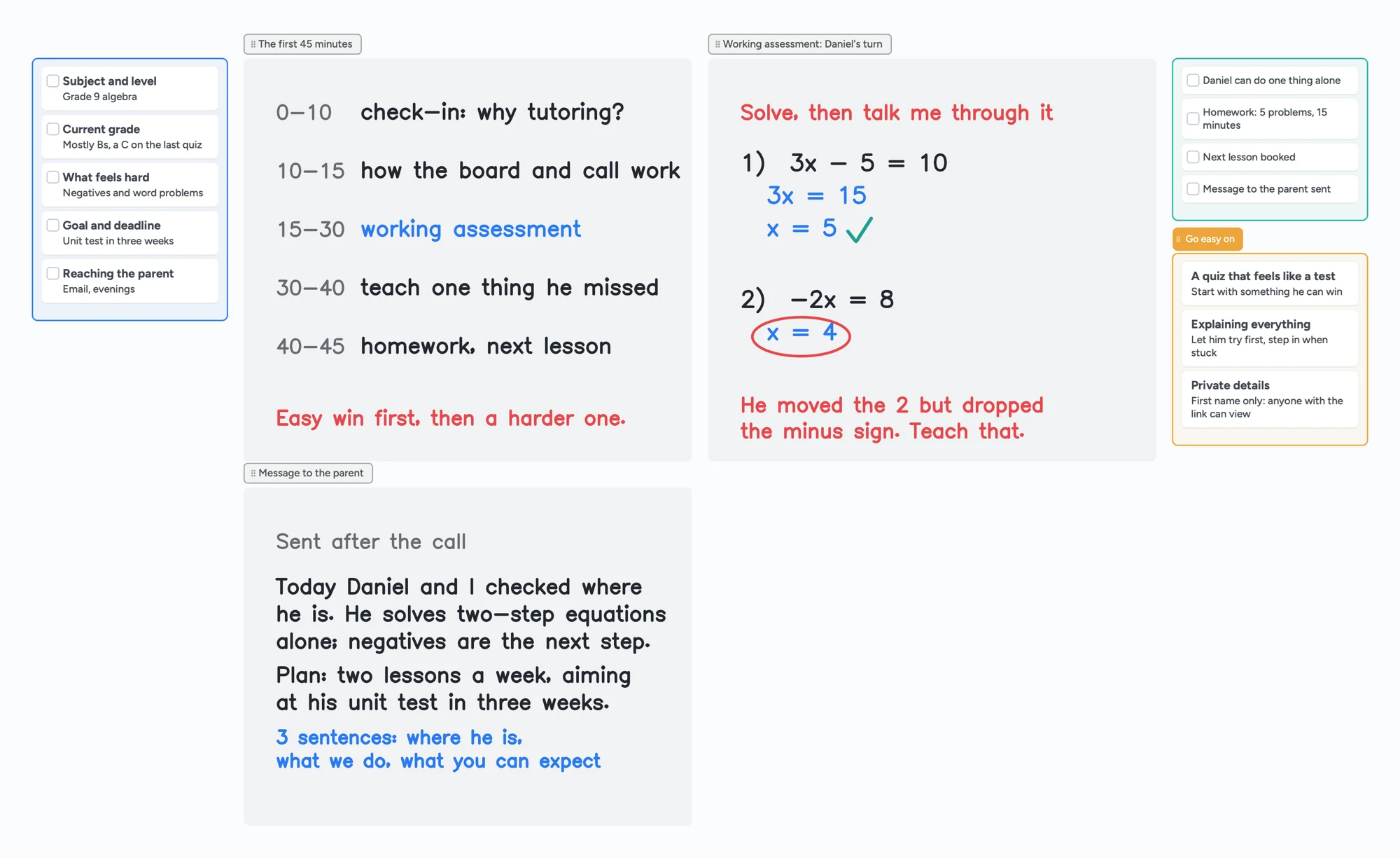
A first tutoring session is mostly an assessment with a conversation around it. You find out what the student can do, what they find hard and what the parent wants, then you teach one small thing so the hour feels like tutoring. Most guides give you a list of tips. This page gives you a filled plan for an invented student, Daniel, in grade 9 algebra: what to ask before day one, a 45-minute agenda, a short working assessment he writes on, and the message you send afterwards. Open the board, replace Daniel with your student and send the link.
Opens in your browser. Anyone can view; a free sign-in lets you edit.
Updated
The short answer
- Treat the first session as a working assessment. u/mrszachanese on r/TutorsHelpingTutors calls it exactly that; u/fitacola says the first session mainly produces a work plan.
- Ask five things before day one: subject and level, current grade, what feels hard, the goal and its deadline, and how to reach the parent. Tutorful's guide lists the same core.
- Let the student write. Give them one problem to solve on the board and to talk you through. Their method tells you more than their answer.
- End with something they can do alone, homework, and the next lesson booked.
- Send the parent three sentences afterwards: where the student is, the plan, and what to expect.
Five things to ask before day one
Tutorful's guide puts this first: whether you can deliver a good first lesson is often about whether you have the information beforehand. Its list is subject, age or level, exam board where there is one, current working level, areas the student feels they struggle in, and what they expect from tutoring. The board keeps five of those as a checklist:
| Ask | Why | Daniel's card |
|---|---|---|
| Subject and level | Tutorful lists subject and age or level first, plus the exam board if there is one. | Grade 9 algebra |
| Current grade | Tutorful: grades achieved let you pitch the material roughly right. | Mostly Bs, a C on the last quiz |
| What feels hard | Tutorful: the areas the student feels they struggle in, if they can name them. | Negatives and word problems |
| Goal and deadline | Tutorful asks whether the student wants long-term tuition or a one-off lesson. Learn To Be suggests asking older students to share the reason they signed up for tutoring. | Unit test in three weeks |
| Reaching the parent | Learn To Be suggests asking a parent how they prefer to be contacted: email, call or text. | Email, evenings |
Swipe the table sideways to see every column.
Left and middle columns summarise Tutorful, "First Tutoring Session - Top Ten Tips", and Learn To Be, "How to Have a Great 1st Tutoring Session", both read November 13, 2026. The right column is invented.
A 45-minute agenda
The minutes are our suggestion. What goes in each block comes from the guides and tutors below.
| Minutes | What happens | Where the idea comes from |
|---|---|---|
| 0 to 10 | Check-in: why they are here, what they like, what they find hard. | Learn To Be: a first session is about forming a relationship, not solely academics; it suggests icebreaker games such as charades, tic-tac-toe, 20 questions or Pictionary for shy, younger students. |
| 10 to 15 | Show how the board and the call work, and check that they can write. | Learn To Be: show them how to view the whiteboard and make sure they can write on it. |
| 15 to 30 | Working assessment: they solve, you watch. | u/Tabgap on r/TutorsHelpingTutors: "Your first session is an assessment." |
| 30 to 40 | Pick one thing they got wrong and teach it. | Tutorful: choose an area where the student made a mistake and teach that skill. |
| 40 to 45 | Homework, and the next lesson booked. | Tutorful: always leave something to practise; ask the parent when they want the next session. |
Swipe the table sideways to see every column.
Tutorful and Learn To Be read November 13, 2026; the r/TutorsHelpingTutors thread is from September 17, 2022. Tutorful also tells in-person tutors to give parents at least 10 minutes at the end, on top of the lesson time.
Two habits from the guides help the first session survive a wrong guess. Keep a few backup tasks pitched at other levels, as Learn To Be advises, in case the student isn't where you assumed. And start a little easier than the student described: Tutorful suggests a couple of easy wins first, then a harder question to see whether to move faster.
The working assessment: give them the pen
Daniel's board has two equations. He solves 3x - 5 = 10 and gets x = 5, which is right. He solves -2x = 8 and writes x = 4, ringed in red: he moved the 2 and dropped the minus sign. Telling you why he did it is the useful part, so ask him to talk you through each step.
Other tutors describe the same move. In an April 2026 thread, u/Band-Suspicious, who tutors a young learner in person, asks the student to read the problem, put the work on a dry-erase board and talk through their problem-solving. In an August 2024 thread, u/Icy-Investigator7166 says to have students walk you through a problem so you know they are doing it correctly and not just copying you.
On a board you both write on, the student's turn is just ink in another colour. Anyone with the link can view the board without an account; to write, your student signs in once for free with Google, Apple or email, so tell them before the lesson and do the check-in step (10 to 15 minutes) with them writing a first line.
Not every tutor opens with small talk
These are individual tutors' habits, not a standard.
- Talk first. u/Blechhotsauce (2022) spends the first sessions mostly on intro: 15 to 20 minutes getting to know the student, 5 on the tutor, then the syllabus and a plan for future sessions. u/tunable_art (May 2026) also spends the first 15 to 20 minutes asking what the student finds hard, what their teacher says and what they've tried.
- Jump in. u/Appropriate_Tree5304 (2024) says hello, pulls up a whiteboard document and asks the student to fill them in on where they are, so it feels productive rather than like small talk.
- Mix. u/fitacola (2026), who teaches 14 to 17 year olds, uses the first session mainly to make a work plan: difficulties, expectations, whether the student wants homework, and a small placement test if needed.
The board fits any of the three: the check-in card, the assessment and the plan are all on the same page, so you can start wherever you like.
The message to the parent
u/fitacola sends the parent a message or email after the first session explaining the plan, how many sessions a week they recommend and what kind of improvement to expect. Tutorful's guide also stresses building a relationship with the parents in the first session. Three sentences do both:
- Where the student is: what you checked and what they can do alone.
- The plan: how often you will meet and what you will work on first.
- What to expect: what should change, and by when.
For Daniel: "Today Daniel and I checked where he is. He solves two-step equations alone; negatives are the next step. Plan: two lessons a week, aiming at his unit test in three weeks." Send it with the board link, then use session notes after each lesson and the monthly progress report once a month.
Use the board as your plan in four steps
- Open the first-session board above and make it yours.
- Rename it for one student and replace Daniel's answers in "Ask before day one". Use a first name only.
- Replace the two equations with problems from your student's subject, one you expect them to get right and one you expect them to miss.
- Send the board link before the lesson, with a reminder that writing needs a free sign-in. Setting up your camera, sound and connection? See online tutoring setup.
A first session in math is a different lesson from the first full lesson on a topic: for a worked example and the student's turn, see how to teach math online.
When another format is the better choice
- You tutor in person, or want a longer list of tips. Tutorful's ten tips and Learn To Be's guide go further on dress, arriving on time, icebreaker games and talking with parents.
- You want a printable intake form. A form is built for paper; this is one shared page.
- You run a tutoring business and want booking, reminders and onboarding emails. Tutoring management software does that. Instaboard sends nothing for you.
- You want a graded placement test. The board holds your problems; it does not mark them.
What Instaboard doesn't do for a first session
- No scheduling, reminders or emails. You book the lesson and send the link yourself.
- No intake form and no grading. You write the answers in by hand.
- Free covers 5 boards. One board per student fits five students. Cards and lists count toward 150 items across your account; pen strokes don't. Pro lifts the limits.
- Writing needs a free sign-in. Anyone with the link can view without an account.
- Free boards are shared by link, so use first names only. Invite-only boards are on Pro.
- Calls are built in and free: up to 60 minutes per call, with a warning 10 minutes before the end, and a free sign-in to start or join. A 45-minute first session fits.
- Instaboard is meant for students 13 and older. The example is a grade 9 student; for younger children use something else.
Start from the ready board
It opens in your browser in a few seconds, with nothing to install. Sign in for free when you want to save it and share it.
Questions
What should I do in a first tutoring session?
Ask what the student finds hard and why they are there, show how the call and board work, give them a short working assessment to solve and explain aloud, teach one thing they missed, then set homework and book the next lesson. Treat it as an assessment with a conversation around it.
What questions should I ask before the first tutoring session?
Subject and level, current grade, what feels hard, the goal and its deadline, and how the parent likes to be contacted. Tutorful's guide also asks for the exam board where there is one.
How long should a first tutoring session be?
It depends on your booking. The plan on this page is 45 minutes. One tutor on r/TutorsHelpingTutors says students tire after about an hour and breaks help; that is one person's view.
What do I tell the parent after the first session?
Three sentences: where the student is, the plan, and what to expect. Send the board link with it.
Does Instaboard send intake forms or reminders?
No. You write the answers on the board by hand and send the link yourself. Tutoring management software handles forms and reminders.
Is Instaboard free?
Yes. The free plan includes 5 boards, 150 cards and items across your account (pen strokes, arrows and sections don't count), 3 images and 1 file per board, unlimited collaborators and video calls up to an hour. Pro is $5 a month billed yearly ($59.99 a year), or $7.99 monthly, and the people you invite join free.
Sources
- Tutorful: First Tutoring Session - Top Ten Tips (read November 13, 2026)
- Learn To Be: How to Have a Great 1st Tutoring Session (read November 13, 2026)
- Reddit r/TutorsHelpingTutors: What to do on the first session? (September 17, 2022; read November 13, 2026)
- Reddit r/TutorsHelpingTutors: How do you start the first session? (August 26, 2024; read November 13, 2026)
- Reddit r/TutorsHelpingTutors: New tutor here! What worked for you on your first session? (April 5, 2026; read November 13, 2026)
Related
A tutoring session notes template, filled in so you can see how it reads
A tutoring lesson plan template plus session notes, filled in for an invented student: outcome, next task, parent note. Copy it as one board link.
A tutoring progress report template for parents, filled in so you can see how it reads
A monthly tutoring progress report for a parent: sessions held, one number that moved, a win, what is still hard and next month's plan. A filled example board you can send as one link.
Online tutoring setup: what you need before your first lesson
What you need to start tutoring online: sound, light, camera, internet, a way to write, and a board your student writes on too. A plain checklist with a five-minute test call and a ready board to open.
How to teach math online: your first lesson, step by step
How to tutor math online as a beginner: what you need, how to run a first lesson on a board your student writes on too, with Zoom, Google Meet or no video app at all, and what to do without a whiteboard.
An online whiteboard for tutoring that works the way you teach
A free whiteboard for online tutoring: paste the worksheet, write with a pen, and your student answers on the same board. Call on it or beside Zoom.
Free online whiteboard for tutoring: what each free plan really allows
What the free plans of Zoom Whiteboard, Explain Everything, Ziteboard, Bitpaper, Miro, Lessonspace, WooWhiteboard, Excalidraw and Instaboard really allow a tutor, read from each vendor's own page on November 5, 2026.