For engineers preparing for the Fundamentals of Engineering exam while working full time, alone or with a study partner
An FE exam study plan board you can copy and edit
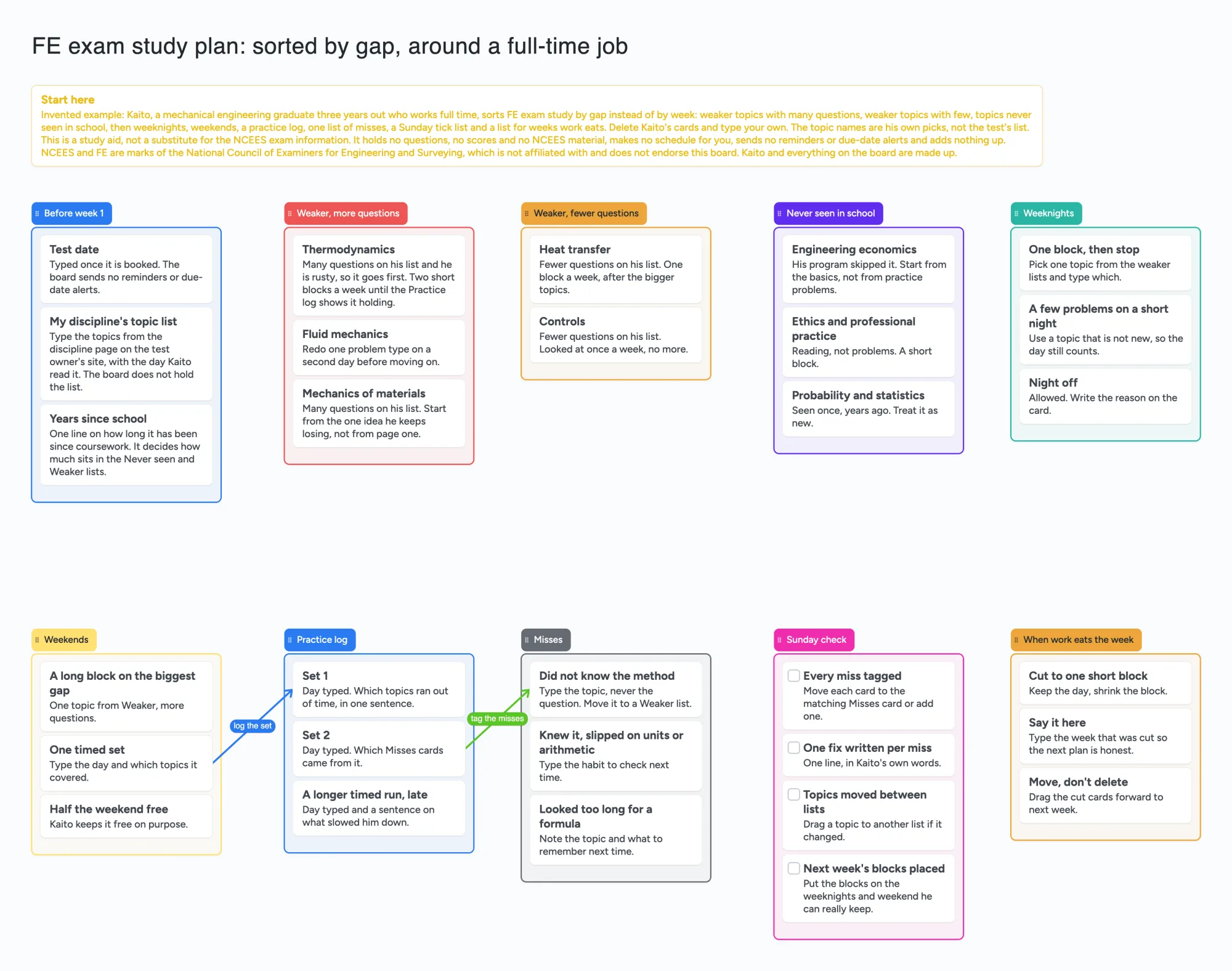
Google's suggestions for this search split by discipline (civil, mechanical, electrical, our reading), and this board is neither a schedule maker nor a question bank. We make Instaboard, an online board. This page gives you an FE exam study plan already laid out on it and filled in for one invented engineer, Kaito, a mechanical engineering graduate three years out who works full time. Instead of one list per week it has one list per kind of gap: weaker topics with many questions, weaker topics with few, and topics his program never taught. After those come weeknights, weekends, a practice log, one list of misses, a Sunday tick list and a list for the weeks work eats. It is a study aid, not a substitute for the NCEES exam information. It holds no questions, no scores and no NCEES material, makes no schedule for you, sends no reminders or due-date alerts and adds nothing up. NCEES and FE are marks of the National Council of Examiners for Engineering and Surveying, which is not affiliated with and does not endorse this page.
Opens in your browser. Anyone can view; a free sign-in lets you edit.
Updated
Not a schedule and not a question bank
- It makes no schedule. You type the blocks yourself. The only plan on the page is Kaito's, and it is invented.
- It holds topics and fixes, not questions. No practice questions, answers or scores, and nothing from NCEES or from a prep company. Type the topic and your fix, never the question.
- It sends no reminders or due-date alerts. A card can carry a due date (a whole day, no time of day), but nothing warns you. Put the test date in a calendar app that does.
- What it is: one screen where you, and anyone you choose, can read and write which gaps come first and what slipped this week. The example uses 42 of your 150 free items.
- Free plan: 5 boards, 150 items, 3 pictures per board. Copying the board takes 1 of your 5 boards. Writing on it needs a free sign-in. New boards start with "Anyone who joins can view".
Why sort by gap and not by week
Read on November 25, 2026 in a browser. PrepFE's blog post "How long should I study for the FE exam?" (no date shown in the text we read) sorts exam topics into buckets and studies them in this order: "weaker topics w/ more questions > weaker topics w/ fewer questions > topics I'm good at > topics I never saw in school > remainder of topics". For someone who graduated fewer than two years ago and has about 3 months, it suggests 40%, 30%, 10%, 15% and 5% of two-hour study blocks to those buckets. For someone more than two years out it suggests evenly distributing study blocks among all topics, in the same order. PrepFE sells FE practice exams, so this is the company's own method, and it says the percentages "are certainly subjective".
Kaito is three years out, so his board uses PrepFE's buckets only as lists, with no percentages. It has no list for topics he is good at or for the remainder, and the left-to-right order is not a priority order. PPI's page "Preparing for the FE Exam: Tips, Strategies, and Study Plans" ("By: PPI, March 8, 2023"; PPI sells prep courses) gives the same idea in its step 3, "Identify Your Weaknesses": use diagnostic exams "to determine how much you should study in the various knowledge areas".
A single Reddit post sorts by gap too. In r/FE_Exam, "FE Study Schedule" (OP u/SSAguilar2, April 29, 2021 UTC; Reddit shows 25; we read 26 in an archived copy), the OP, who says they passed the FE Civil, posts a spreadsheet and adds "The order of my study schedule is from weakest to strongest category for me." Asked how many tries it took, the OP answered "I did it on the 4th attempt, but the first two were before July 2020." We did not open the spreadsheet.
Studying around a full-time job: what people wrote
These are single accounts in public threads, not research. Our view: the hours differ widely, and they range from an hour a night to two sittings a day.
- In r/FE_Exam, "Studying for FE while working full time?" (OP u/akosiiwayner1315, May 3, 2023 UTC; Reddit shows 39; we read 40 with text in an archived copy, where one comment is posted twice, and 2 more were removed or deleted), the OP writes "I didn’t realize how much my job would drain me after work and just completely lose motivation to study lol". u/Treehighsky answers "On work night I studied just like an hour, on the weekends I put in about 6-8 hours for about 3 months prior to my exam." u/ojlenaghan writes "I work 11-7 and study every night 8-10:30 and then 4-6 hrs on days off" and "I try to take at least one night off a week". u/SCEngineer writes "I was fortunate enough to be able to study 2 or 3 hours every day during work hours." u/smoothiiies_ writes "time block, time block, time block."
- In r/FE_Exam, "For anyone who studied for the FE exam while working full time, how did you guys do it?" (OP account shows [deleted]; October 26, 2024 UTC; Reddit shows 12; we read 14 in an archived copy), u/Eternalfaerie writes "an hour each night monday through Thursday and 2 to 3 hours on the weekend" and calls work burnout "very real right now". u/jvolley writes "Ideally 2 hours a night but even if you just get 1 hour staying consistent is what will help the most" and "anything more than 2 hours after a full day of work might cause some burnout". u/Fit-Put-1256, who says they have a family, writes "5AM - 7AM, 8 PM-10PM". u/Banananutcracker writes "Studied about 6 weeks and passed (mechanical)" and "I graduated four years prior but I made sure I was confident in 95% of the material before moving on to the next." u/WorldTallestEngineer writes "I used vacation time during studying."
Kaito's board has two lists for this, Weeknights and Weekends, plus a Night off card, because u/ojlenaghan, above, takes one a week. It does not say how many hours either list should hold.
Before you copy it: what it won't do
- No schedule. It will not turn a test date into a plan or a week into blocks.
- No reminders or due-date alerts. It does not know the test is next month.
- No questions and no scoring. There is a countdown timer widget you can drop on the board, but it does not know your problem set.
- No counts. It will not tell you which topic you missed most; a spreadsheet does that better.
- Sort and Filter work on one list at a time, not across the board.
- Ticks don't say who or when, and a copy keeps its ticks, so untick them before you reuse the board.
- Not private by default. New boards start with "Anyone who joins can view".
Keep these off a board you share
A board you share by link is readable by anyone who has the link. These are our rules for this page, not advice from NCEES. It is a study aid, not a substitute for the NCEES exam information.
- No exam questions or answers, and nothing copied from the owner or from a prep company. Type the topic and your fix.
- No logins or passwords for a testing account or an application account.
- No scores you want private. If you type one, you are sharing it.
- No other people's details. A study partner appears by first name.
Kaito's board, list by list
Kaito and everything on his board are invented, including the topics, the order and the fixes. None of it is a benchmark or a plan to copy, and the topic names are his own picks, not the test's list. Read it left to right, top row then bottom row.
- Before week 1. Three cards: the test date, a card telling him to type the topics from the discipline page on the test owner's site with the day he read it (the board does not hold the list), and one line on how many years since coursework.
- Weaker, more questions. Three cards: thermodynamics first, fluid mechanics, and mechanics of materials, each with a line on how he starts.
- Weaker, fewer questions. Two cards: heat transfer and controls, one block a week, after the bigger topics.
- Never seen in school. Three cards: engineering economics, ethics and professional practice, and probability and statistics. The cards say to start from the basics or treat the topic as new.
- Weeknights. Three cards: one block then stop, a few problems on a short night, and a night off with the reason typed on the card.
- Weekends. Three cards: a long block on the biggest gap, one timed set, and half the weekend free on purpose.
- Practice log. Three cards: sets 1 and 2, each with a day and a sentence, and a longer timed run late.
- Misses. Three cards, one per cause: did not know the method, knew it but slipped on units or arithmetic, and looked too long for a formula. Each asks for a topic or a habit, never the question.
- Sunday check. Four tick boxes: every miss tagged, one fix written per miss, topics moved between lists, and next week's blocks placed. A tick does not say who or when.
- When work eats the week. Three cards: cut to one short block, say it here, and move the cut cards forward instead of deleting them.
- Two arrows with captions. One runs from the One timed set card to the first Practice log card ("log the set"), the other from the second Practice log card to the first Misses card ("tag the misses").
Where the hours in a plan come from
Read on November 25, 2026 in a browser. Of the four prep company pages we read, three give study time in months or weeks, and none of the four is the test's owner. Each is the company's own claim.
- PrepFE (no date shown in the text we read): "The typical study time for the Fundamentals of Engineering exam is about 2 to 3 months." It adds "When people study for 2-3 months, it's not a full-time commitment. Most of them are studying a handful of hours during the week and several hours on weekends while working or completing their degrees." For someone out of school longer it says "Plan to study for 3+ months if you've been out of school for 3 years or longer" and "Even 6+ months is appropriate for those that need to balance work and other responsibilities".
- Projectific, by A. Togay Koralturk ("Last updated on October 17, 2026"; Projectific sells practice exams): "Plan on two to three months of consistent study, roughly 8 to 12 weeks, and extend that if you graduated more than a year ago."
- Genie Prep, "4-Month FE Exam Study Plan" ("12/06/2024" as shown, by Genie Prep Team; Genie Prep sells prep): a four-month plan, and "If 4 months of preparation isn’t enough because you’re balancing a full-time job or you’re struggling finding study time" it points to its own six-month plan.
- PPI ("By: PPI, March 8, 2023"): says you "must develop and adhere to a review schedule" and to use diagnostic exams to decide how much to study each area. We did not find a total study time on the part of the page we read.
So the board gives Kaito no number either. His first list asks for the test date and the years since school, and Weeknights and Weekends hold the blocks he can really keep.
What the test's owner prints
From the National Council of Examiners for Engineering and Surveying's page "FE Exam", cited as plain text and not linked (the page shows no date, only a 2026 copyright; read November 25, 2026 in a browser). NCEES and FE are marks of the National Council of Examiners for Engineering and Surveying, which is not affiliated with and does not endorse this page. We state only the facts we read there:
- The exam includes 110 questions and is delivered year-round at NCEES-approved Pearson test centers.
- The appointment is 6 hours: a 2-minute nondisclosure agreement, an 8-minute tutorial, 5 hours and 20 minutes for the exam and a 25-minute scheduled break.
- The exam fee is $225, payable directly to NCEES.
That is why Kaito's first list has a card telling him to read the owner's discipline page himself and type the day he read it. The board does not hold the topic list; the owner's page does. Any prep company's list of what is on the exam is that company's reading, so check the owner's page.
Set it up in a lunch break
- Open the board and sign in free when it asks you to write. Delete Kaito's cards and keep the lists.
- Type the test date and how long since coursework on the first list.
- Sort your topics into the three gap lists from your own sense of where you are weak. Move a topic if the practice log says it changed.
- Fill Weeknights and Weekends with the blocks you can really keep, and put one card on the list for weeks work eats.
- After each timed set, add a card to the practice log with the day and one sentence, and add the misses by cause.
- To share it, set Share to "Anyone who joins can edit" only if the other person should write; each person who writes signs in for free.
Counting to 150
Each card and each list is 1 of your 150 free items, across all your boards. The title text box counts too. Arrows, sections and pen strokes don't. Our arithmetic from the example:
- As built: 10 lists + 31 cards + 1 title = 42 items.
- Ten practice sets instead of three: seven more cards, so 42 + 7 = 49.
- Fifteen misses typed as cards instead of the three on the board: 12 more cards, so 42 + 12 = 54.
- More than one copy: a second copy is another 42, so three copies come to 126 and four to 168, which is over 150. Each copy takes 1 of your 5 boards. Pro removes the item limit.
The week work eats
Several accounts above mention burnout, a night shift or a family; none says what it did when a week went wrong. Kaito's last list is for that week. It has three cards: cut to one short block (keep the day, shrink the block), say it here (type which week was cut so the next plan is honest), and move, don't delete (drag the cut cards forward). Nothing on the board marks a week as late or warns you; you move the cards.
On Sunday the tick list asks him to tag every miss, write one fix per miss, move topics between lists and place next week's blocks on the weeknights and weekend he can really keep. If you only keep one habit from the page, that is the one.
Trademark notice
NCEES and FE are marks of the National Council of Examiners for Engineering and Surveying, which is not affiliated with and does not endorse this page. This page uses no NCEES logo, question or other NCEES material. Source for the facts about the test, as plain text: National Council of Examiners for Engineering and Surveying, "FE Exam" page, no date shown, read November 25, 2026.
Start from the ready board
It opens in your browser in a few seconds, with nothing to install. Sign in for free when you want to save it and share it.
Questions
Can this board make my FE exam study schedule?
No. You type the blocks yourself. Some prep companies describe plans on their own pages; the board is for the cards you add after you pick one, such as the practice log and the misses.
How long should I study for the FE exam?
The prep company pages we read say about 2 to 3 months, or 8 to 12 weeks, and more if you graduated a while ago; PrepFE says 3+ months if you have been out of school 3 years or longer and 6+ months if you balance work, and Genie Prep points to a six-month plan for someone with a full-time job. They are companies that sell prep, and the test's owner page we read gives no study time. In the threads we read, people reported anything from an hour a night to two sittings a day.
Why sort by gap instead of by week?
Because the plan changes when work does. PrepFE, a company that sells FE practice exams, suggests studying weaker topics with more questions first, then weaker topics with fewer. Kaito's board keeps those as lists and lets you move a topic from one to another; a week-by-week list would have to be rewritten.
Does the board hold FE questions or scores?
No. It holds a plan, a practice log and a list of misses that you type. It has no questions, answers or scores, and you should not type exam questions on a board you share.
Can a study partner write on it?
Yes. New boards start with "Anyone who joins can view", so anyone with the link can read it. Set it to "Anyone who joins can edit" if your partner should write too; each person who writes signs in for free.
Is Instaboard free?
There is a free plan: 5 boards, 150 cards and items across your account (pen strokes, arrows and sections don't count), and 3 pictures and 1 file per board. Anyone with the link can read a board; writing on it takes a free sign-in. Pro removes the item limit and adds invite-only boards: $5 a month billed yearly ($59.99 a year), or $7.99 monthly.
Sources
- PrepFE Blog: How long should I study for the FE exam? (no date shown in the text we read; a company that sells FE practice exams; read in a browser November 25, 2026)
- Projectific: How to Study for the FE Exam: Study Plan & Schedule [2026] (by A. Togay Koralturk, "Last updated on October 17, 2026"; a company that sells practice exams; read in a browser November 25, 2026)
- Genie Prep: 4-Month FE Exam Study Plan: How to Pass the FE Exam! ("12/06/2024" as shown, by Genie Prep Team; a company that sells prep; read in a browser November 25, 2026)
- PPI: Preparing for the FE Exam: Tips, Strategies, and Study Plans ("By: PPI, March 8, 2023"; a company that sells prep courses; read in a browser November 25, 2026)
- r/FE_Exam: Studying for FE while working full time? (OP u/akosiiwayner1315, May 3, 2023 UTC; replies are single accounts; Reddit shows 39; we read 40 with text in an archived copy; November 25, 2026)
- r/FE_Exam: For anyone who studied for the FE exam while working full time, how did you guys do it? (OP account shows [deleted]; October 26, 2024 UTC; replies are single accounts; Reddit shows 12; we read 14 in an archived copy; November 25, 2026)
- r/FE_Exam: FE Study Schedule (OP u/SSAguilar2, April 29, 2021 UTC; replies are single accounts; Reddit shows 25; we read 26 with text in an archived copy and 1 was deleted; spreadsheet not opened; November 25, 2026)