For college students going on exchange, and the family member or friend helping
A study abroad board for course approval, checklists and a helper at home
We make Instaboard, an online board. This page gives you a study abroad plan laid out on it and filled in for an invented junior, Farah, who is spending a semester at a partner university in Lisbon while her dad, Kwame, helps from home. One group of lists follows each course through the approval chain at her home university, one shows who signs what, three tick-box lists run by how far out she is from leaving, and two more hold the money notes and what her dad handles. The board is not where the approval happens: your school's own form is. It has no reminders or due-date alerts, and nothing private belongs on it. Farah, Kwame and their school are made up.
Opens in your browser. Anyone can view; a free sign-in lets you edit.
Updated
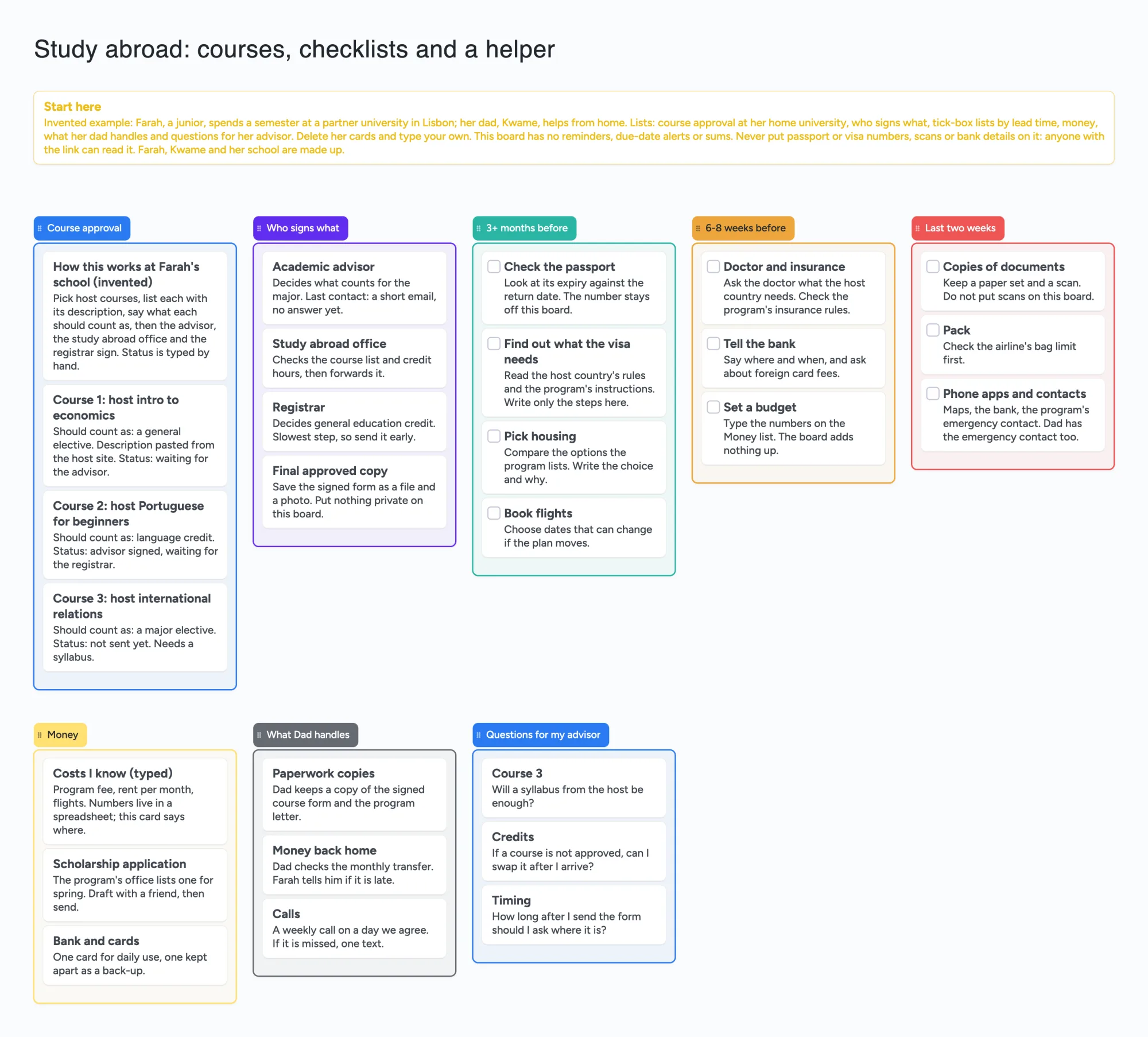
Before you copy it: what this board is for, and what it is not
- Nothing private goes on it. No passport or visa numbers, no scans, no bank or card details. New boards start with "Anyone who joins can view", so anyone with the link can read it. Go Overseas's guide suggests emailing yourself scans in case originals go missing; a link board is the wrong place for them.
- It is not where courses get approved. Your home school's form is. The board holds the status of each course, typed by hand, so you and a parent or friend can see which course is waiting on whom. It cannot send a form, collect a signature or remind anyone.
- It has no reminders or due-date alerts, and no sums. Deadlines come from your school's own pages; put them in whatever calendar you already use or on a card's due date yourself. Numbers for the budget live in a spreadsheet; the board's Money list says where.
- What it is: a status board. A course list with one card per course, a list of who signs what, tick-box lists by lead time, a money list, a list for the helper at home and a list of questions for your advisor. The example uses 37 of your 150 free items.
- Free plan: 5 boards, 150 items, 3 pictures per board. Copying the board takes 1 of your 5 boards. Writing on it needs a free sign-in. New boards start with "Anyone who joins can view". This page is for students in college or older.
Who signs a course before you go: what two schools print
Schools differ, and yours is the one that counts. Two schools publish their steps, which shows the shape of the chain the board's second list follows. Both pages were read on November 24, 2026; neither prints a date.
- University of New Hampshire (UNH): the student lists each course on a Study Away Course Planning Form, picks the credit type they think it should count as, pastes in the host course description and signs. The page says that choice is "what YOU think the course should count as": the academic advisor decides whether major or minor requirements are met, and the registrar's office decides gen ed. It then goes to the advisor, the global education advisor, the registrar and the dean's office, and the page says the final copy typically arrives in April for summer and fall programs and in November for J-Term and spring programs.
- SUNY Geneseo: courses go on a Course Planning Form submitted through AdobeSign. A course has to be in the school's Study Abroad Course Articulation Database first, or be articulated on a separate form, which asks for a course description at minimum, and also learning outcomes and the syllabus. The page gives deadlines (May 1 for summer or fall, December 1 for winter or spring), says the Office of Advising reviews every form, and asks students to submit proof of their registered courses within four weeks of starting classes abroad. A course added after arrival that was not on the form means repeating the process.
That is why the board has a "Who signs what" list that names the role of each person and what each one decides, not their names. The names and the order are the part to replace with your own school's.
Farah's board, list by list
Farah and Kwame are invented, and so are her school's steps. Read it left to right, top row then bottom row.
- Course approval. A card on how it works at her school (pick host courses, list each with its description, say what each should count as, then the advisor, the study abroad office and the registrar sign; status is typed by hand), then one card per course. Course 1, host intro to economics, is waiting for the advisor. Course 2, host Portuguese for beginners, has the advisor's signature and is waiting for the registrar. Course 3, host international relations, has not been sent and needs a syllabus.
- Who signs what. Academic advisor, study abroad office, registrar, and a card for the final approved copy that says to save the signed form as a file and a photo and to put nothing private on the board.
- 3+ months before. Four tick-box cards: check the passport against the return date, find out what the visa needs, pick housing, book flights with dates that can change.
- 6-8 weeks before. Three tick-box cards: doctor and insurance, tell the bank, set a budget.
- Last two weeks. Three tick-box cards: copies of documents (a paper set and a scan, kept off the board), pack, and phone apps and contacts.
- Money. Three cards: costs she knows, typed, with a note on where the numbers live in a spreadsheet; a scholarship application the program's office lists for spring; and the bank and cards (one for daily use, one kept apart as a back-up).
- What Dad handles. Three cards: paperwork copies, the monthly transfer, and a weekly call on an agreed day with one text if it is missed.
- Questions for my advisor. Three cards: whether a syllabus from the host is enough for Course 3, what happens to credits if a course is not approved and she swaps after arriving, and how long to wait before asking where a form is.
How to use it, in about fifteen minutes
- Open the board and sign in free when it asks you to write. Delete Farah's cards and keep the lists.
- Rewrite "Who signs what" with your school's roles, from your school's own page, in the order it routes the form.
- Add one card per host course with what you think it should count as and its status. Change the status when the form moves.
- Fill the three tick lists with what your program's office tells you, and drop any box that does not apply.
- Write the helper's list together with whoever is helping, so each card is something that person does.
- Put your questions for the advisor on the last list and cross them off when you have the answer.
- To share it, set Share to "Anyone who joins can edit" if your helper should write. Each person who writes signs in for free. Keep passport, visa and bank details off it.
Checklists by lead time, and where Farah's differ from a guide
Go Overseas, a site that lists study abroad programs, publishes "How to Prepare for Studying Abroad: 10 Things to Do Before Your Trip" (last updated September 24, 2026 on the page; read November 24, 2026). It carries a Holafly promotion, so read it as a vendor guide. Its timeline table says:
- 3+ months before: passport and visa, a housing decision, book flights.
- 6-8 weeks before: doctor visit and travel insurance, tell your bank and set a budget.
- 2-4 weeks before: language basics, local laws and etiquette, download key apps.
- Final week: pack, save digital copies of your documents, confirm how you will stay in touch.
Farah's board uses three lists, not four: the first two follow the guide's first two rows, and the third list merges its last two (it is shorter: two weeks, not the guide's four). It leaves out language basics and local laws, which are things to learn, not boxes to tick. The guide also says to check a passport's validity (it says immigration officers may turn away travelers with less than six months left) and that students are responsible for their own visa requirements. Farah's card only says to compare the expiry with the return date and to write the steps on the board without the numbers.
The list for the person helping from home
A parent or friend can read and write on the board once you set Share to "Anyone who joins can edit" and they sign in free. Kwame's list is the part that exists only for this plan: a copy of the signed course form and the program letter kept on paper at home, the monthly transfer, and a weekly call on an agreed day. Everything on it is something he does, not something he reads about her.
What stays off the board is the rest of the helper's job: passport and visa numbers, scans, the address of the housing, and card or bank details. Those stay in email, a password manager or a drawer. The Money list holds only the shape (which card is the back-up, where the spreadsheet lives).
What students say about the learning agreement
Erasmus students in Europe sign a learning agreement with their home and host universities. It is not the same form as a US course planning form, but the problem is the same: the home school decides what counts. Replies in these threads are single accounts, not research, and they do not agree with each other. Each thread was read on November 24, 2026, in an archived copy: in the first the archive has 20 comments, 1 removed (19 with text); 14 in the second, 6 in the third.
- In r/Erasmus ("Anyone else that took courses unrelated to their degree?", OP u/Puzzleheaded-Top4418, October 27, 2025), u/andutzZa says their uni required an equivalent course or they would fail, and that each home uni has its own rules. u/Novel-Vanilla9133 says the home university has to validate and sign the learning agreement, so the choice has to be somewhat coherent. u/TheTwistedBlade took unrelated courses in a bachelor's and says the uni was relaxed about it, while the master's uni they moved to is stricter. u/Alternative-Slice244 says all their courses were unrelated to their degree, u/Agitated_Parking9206 says the local language classes (about 20 ECTS) were left off their learning agreement, and u/Apprehensive_Baby387 says the uni made clear which courses could be chosen instead.
- In the same thread, u/Ambitious_Bison6208 took two courses unrelated to their studies that their uni allowed but that were not accredited toward the degree; they say they were doing an extra year at home anyway because their faculty requires the thesis to be done on campus in spring, so the 10 unaccredited credits fit in it. That is one person's view of one faculty.
- In r/Erasmus ("No one noticed my OLA had the wrong academic year typed in.", OP u/kowaliki, July 22, 2024 UTC), u/Achillus, who says they are a former mobility officer, says the learning agreement can be modified before and during a mobility unless the home or host university objects.
- In r/Erasmus ("Learning Agreement is stressing the shit out of me", May 10, 2022, OP account deleted; six comments), the replies differ. u/mangusta123 says that, per their own university, courses from a different study cycle that the host lets exchange students pick are always accepted; u/Herranee says it is up to the home university and it is allowed to refuse, for example a policy against bachelor's courses on a master's programme.
None of these is advice to copy. They show why Farah's board has a "Questions for my advisor" list and a status on every course: the answer depends on the school.
When a school page, guide or spreadsheet is the better tool
Read on November 24, 2026; pages change, so check them. A date is printed only where a page shows one.
| Tool | What we read | Better for |
|---|---|---|
| Your school's own pages and forms | UNH's instructions and SUNY Geneseo's course approval page describe their own forms, routing and deadlines | The approval itself, the real deadlines and who is allowed to sign |
| Go Overseas guide | A ten-step guide with a timeline table by lead time (last updated September 24, 2026 on the page); carries a Holafly promotion | A first read of what to do and in what order |
| Notion template | Notion's "Student-moving overseas planner" template listing: $5.00, "Last updated last month" on the page; the template's contents were not read. The only reply in the r/Notion thread (OP u/lvlynelen, June 14, 2025 UTC) is a link to it from u/ibeinghuman539 | People who already keep their life in Notion |
| Spreadsheet | Not read for this page | Costs and sums, which the board does not add up |
| Instaboard board | Free plan: 5 boards, 150 items, 3 pictures per board. Lists and cards you type, shared by link. No reminders, due-date alerts, forms or sums | Showing a parent, friend or advisor which course is waiting on whom, on one screen that they can read and write on |
Swipe the table sideways to see every column.
From each page or comment named, read November 24, 2026: unh.edu study away course planning form instructions, geneseo.edu study abroad course approval and credit transfer, gooverseas.com/blog/study-abroad-prep, notion.com/templates/student-moving-overseas-planner and the four Reddit threads in the sources. Our wording, not theirs.
Where these win
Use your school's pages for the approval and the deadlines, a calendar for dates and a spreadsheet for money. Use this board when you want course status, checklists and a helper's list in one place that someone at home can read and write on.
Things the board will not do for you
- No reminders or due-date alerts. It will not tell you the form is due. Put the school's deadlines in a calendar or on a card's due date yourself.
- No forms or signatures. The approval is in your school's system; the board only shows the status you type.
- No sums. The Money list points to a spreadsheet.
- No booking, visa or packing tools. It does not know which visa you need or how heavy a bag may be.
- Ticks don't say who or when. Anyone with edit access can untick a box, and a copy keeps its ticks, so untick the lists before you reuse the board.
- Not private by default. New boards start with "Anyone who joins can view", so anyone with the link can read it.
- A copy takes 1 of your 5 free boards, and the example uses none of the 3 pictures allowed per board.
Item count: 37 of the 150
Our arithmetic: the example is 8 lists, 28 cards and a title, 37 items. Of the cards, 10 are tick-box cards and 3 are course cards. Four more courses and five more checklist cards make 46. A second semester at a different program on a copy of the board is another 37, so 74 across two boards, which also takes 2 of your 5 free boards. Someone who writes on your board adds the cards they type to their own 150, not yours. Pro removes the item limit.
Start from the ready board
It opens in your browser in a few seconds, with nothing to install. Sign in for free when you want to save it and share it.
Questions
How do I keep track of course approval for study abroad?
At the two schools we read (UNH and SUNY Geneseo), a course planning form goes through an advisor and other offices; yours may differ. The board has one card per host course with a status you type by hand, plus a list of who signs what, so you and whoever helps can see which course is waiting on whom. The approval itself stays in your school's system.
What should I put on a study abroad checklist?
One guide, from Go Overseas, groups tasks by lead time: passport, visa, housing and flights first, then doctor, insurance, bank and budget, then packing and copies of documents. Farah's board follows three lead-time lists. Use the list your program's office gives you where it differs.
Can a parent or friend help from home?
Yes. Set Share to "Anyone who joins can edit" and they can write after a free sign-in. The board has a list for what the helper handles. Keep passport and visa numbers, scans and bank details off it, because anyone with the link can read it.
Does the board remind me about deadlines or send forms?
No. It has no reminders, due-date alerts or forms. Take deadlines from your school's pages and put them in a calendar or on a card's due date; the board shows status only.
How much of the free plan does it use?
The example is 37 of the 150 free items, and a copy takes 1 of your 5 free boards.
Is Instaboard free?
Yes. The free plan includes 5 boards, 150 cards and items across your account (pen strokes, arrows and sections don't count), 3 images and 1 file per board, unlimited collaborators and video calls up to an hour. Pro is $5 a month billed yearly ($59.99 a year), or $7.99 monthly, and the people you invite join free.
Sources
- UNH Global: Study Away Course Planning Form Instructions (read November 24, 2026)
- SUNY Geneseo Study Abroad: Study Abroad Course Approval and Credit Transfer (read November 24, 2026; the page prints no date)
- Go Overseas: How to Prepare for Studying Abroad, 10 Things to Do Before Your Trip (last updated September 24, 2026 on the page; read November 24, 2026)
- Notion: Student-moving overseas planner template (listed at $5.00, "Last updated last month" on the page; read November 24, 2026)
- r/Erasmus: Anyone else that took courses unrelated to their degree? (OP u/Puzzleheaded-Top4418, October 27, 2025; archive has 20 comments, 1 removed (19 with text); replies are single accounts; read November 24, 2026)
- r/Erasmus: No one noticed my OLA had the wrong academic year typed in (OP u/kowaliki, July 22, 2024 UTC; 14 comments read in an archived copy; replies are single accounts; read November 24, 2026)
- r/Erasmus: Learning Agreement is stressing the shit out of me (May 10, 2022, OP account deleted; 6 comments read in an archived copy; replies are single accounts; read November 24, 2026)
- r/Notion: Study Abroad template (OP u/lvlynelen, June 14, 2025 UTC; 2 comments read in an archived copy; read November 24, 2026)