For pre-med students planning MCAT study, alone or with a partner
An MCAT study schedule you can copy and edit as one board
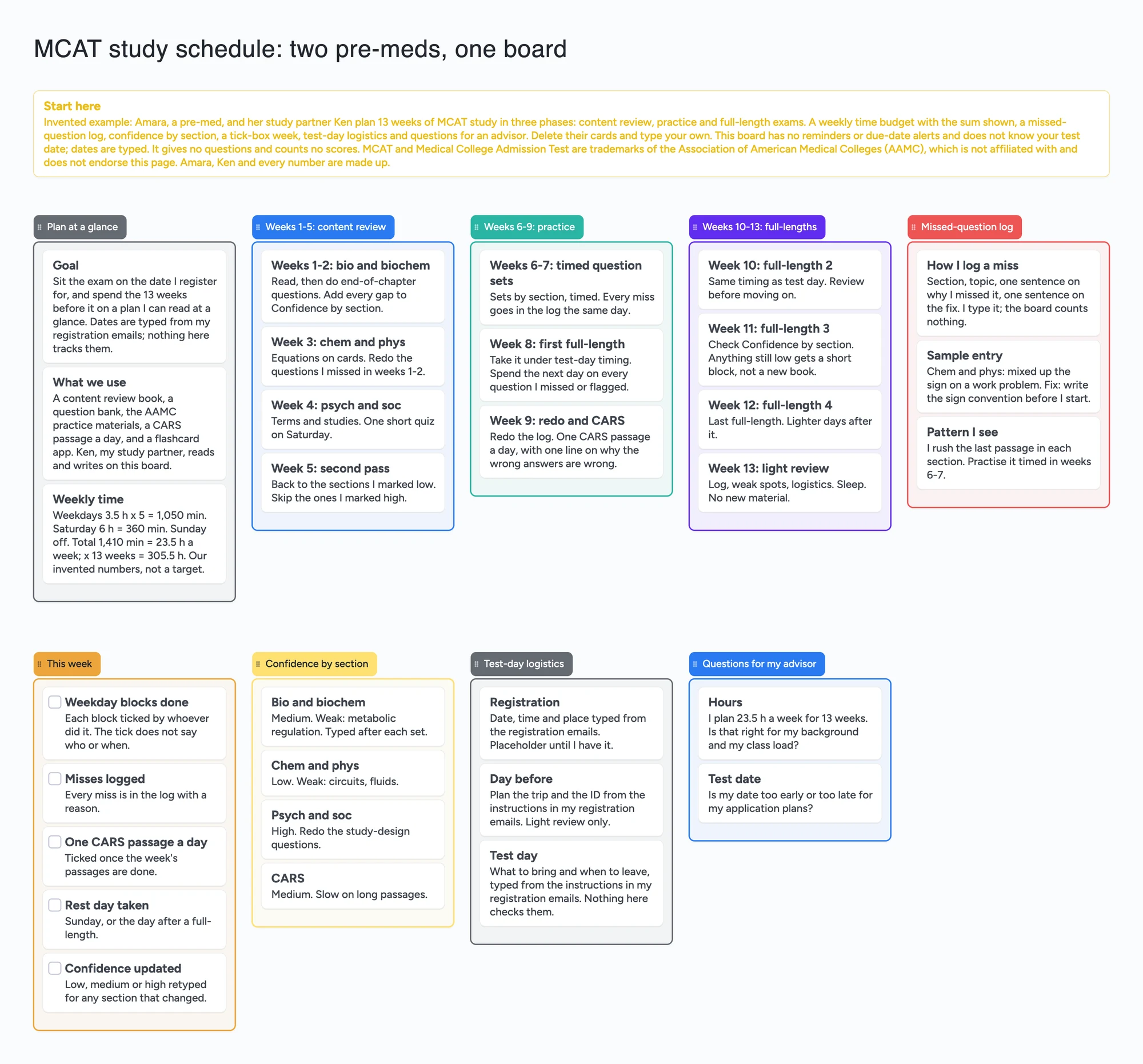
We make Instaboard, an online board. This page gives you an MCAT study schedule already laid out on it and filled in for two invented pre-med students, Amara and Ken, who share it. It has 13 weeks in three phases (content review, practice, full-length exams), a weekly time budget with the sum shown, a missed-question log you type by hand, confidence by section, a tick-box week, test-day logistics and questions for an advisor. It does not know your test date, and it has no reminders or due-date alerts: every date on it is typed from your registration emails. It does not build a plan for you, give you questions or count your scores. If you only want a file or a generator, say so below and use one. Amara, Ken and their numbers are made up. MCAT and Medical College Admission Test are trademarks of the Association of American Medical Colleges (AAMC), which is not affiliated with and does not endorse this page.
Opens in your browser. Anyone can view; a free sign-in lets you edit.
Updated
Read this first: what the board does and doesn't do
- If you want a file, use a file. Most people who search for an MCAT study schedule want a spreadsheet, a PDF or a generator. Those exist (see the table below), and a generator will lay out the weeks for you. This board does not: you type every week and every date.
- No reminders or due-date alerts, no auto-built plan. The board does not know your test date. Nothing warns you about it, and nothing rearranges your weeks when you fall behind.
- No questions, no scoring. The missed-question log and the confidence cards hold what you type. The board does not count, grade or compare anything. Use a question bank and the AAMC's practice materials for that.
- What it is: one screen where you and a study partner can both read and write the plan, the log and the week's tick boxes. The example uses 42 of your 150 free items.
- Free plan: 5 boards, 150 items, 3 pictures per board. Copying the board takes 1 of your 5 boards. Writing on it needs a free sign-in. New boards start with "Anyone who joins can view". If you are under 18, check with a parent or your school before you put anything on a shared board.
When a spreadsheet, a PDF or a generator is enough
If you study alone and want the weeks laid out for you, a file does that better than a board. Shemmassian Consulting's blog post says its schedules come as PDFs for 1 to 6 months, and mcatstudyplanner.com's roundup (updated 10/6/2025) promotes its own generator, which it says builds a plan from your timeline and materials. Both read November 25, 2026; those are their statements about their own products, and we did not try the generator.
A board earns its place in a narrower case: two people, or you and an advisor, who both want to read and write the same plan and the same list of misses, on one screen, without passing a file back and forth. If that is not you, close this tab and download a template.
What the AAMC's own planning page says
The AAMC's page "Creating Your MCAT Exam Study Plan" (page shows no date, read in full November 25, 2026) describes a plan built around a baseline and a cycle rather than a number of weeks. It points to the free Unscored Sample Test (sign-in needed) as a baseline, suggests rating your confidence as low, medium or high for each content area against the AAMC's Content & Skills Breakdown, and describes a study-and-practice cycle of recall, practice and reflection. It says to take a full-length practice exam under test-day timing and to review every question you got wrong or flagged. The page we read gives no hours and no number of weeks.
Two lists on the board copy that structure: Confidence by section (low, medium or high, typed) and the Missed-question log. The sections on the board are our own grouping, not the AAMC's list of content areas.
Amara and Ken, list by list
Amara and Ken are invented. Every number on their board is made up, including the 23.5 hours a week and the four full-lengths, and none of it is a benchmark. The phases are ours. Read the board left to right, top row then bottom row.
- Plan at a glance. The goal, what they use (a content review book, a question bank, the AAMC practice materials, a CARS passage a day, a flashcard app) and a weekly time budget with the sum shown: five weekdays of 3.5 hours is 1,050 minutes, plus 360 on Saturday is 1,410 minutes, or 23.5 hours; thirteen weeks of that is 305.5 hours.
- Weeks 1-5: content review. One card per stretch: biology and biochemistry, chemistry and physics, psychology and sociology, then a second pass over what Amara marked low.
- Weeks 6-9: practice. Timed question sets by section, the first full-length under test-day timing with the next day set aside to review every miss, then a redo week with one CARS passage a day.
- Weeks 10-13: full-lengths. Three more full-lengths, one a week, and a last week with no new material.
- Missed-question log. How to log a miss, a sample entry and a pattern card. They type it; the board counts nothing.
- This week. Five tick-box cards: blocks done, misses logged, a CARS passage a day, a rest day and confidence updated. The tick does not say who or when.
- Confidence by section. Low, medium or high, with one weak topic each.
- Test-day logistics. Dates and rules copied from registration emails, with a placeholder card and a day-before card.
- Questions for my advisor. Hours and test date, as cards the advisor can answer on the card.
How to use it, in about fifteen minutes
- Open the board and sign in free when it asks you to write. Delete Amara and Ken's cards and keep the lists.
- Fill in Plan at a glance: your goal, what you will use and your weekly minutes with the sum shown.
- Rename the phase lists to the weeks you chose. Move a week card between phases by dragging it.
- Rate each section low, medium or high on Confidence by section, and retype it after each set.
- After each practice set, put every miss on the log with its four parts.
- Once a week, go down the five tick-box cards, then untick them.
- Copy dates and rules into Test-day logistics only from your registration emails.
- To share it with a partner, set Share to "Anyone who joins can edit" if they should write. Each person who writes signs in for free. Keep personal details off it.
How long to study: the sources disagree
This page does not tell you how many weeks or hours to study. Here is what each source we read says, in its own words and by its own numbers.
| Timeline in Shemmassian's schedules | Hours a day it lists | Total hours it lists |
|---|---|---|
| 1 month | 7-8 | about 210-240 |
| 2 months | 5-6 | about 300-360 |
| 3 months | 3.5-4 | about 315-360 |
| 4 months | 3-3.5 | about 360-420 |
| 5 months | 2.75-3.25 | about 410-490 |
| 6 months | 2.5-3 | about 450-540 |
Swipe the table sideways to see every column.
From Shemmassian Consulting's MCAT study schedule post ("Updated: November 3, 2026"), read in full November 25, 2026. Their numbers, from a company that sells tutoring and a question bank. The same post says its minimum is 300-350 hours and that many students need 500 or more.
- Shemmassian describes a 3-month plan as 13 weeks (91 days): content review on days 1-36 at two chapters a day, six days a week, then practice and AAMC exams on days 37-91. Its schedule has six AAMC full-lengths; Amara and Ken's invented plan has four.
- MedSchoolCoach (a tutoring company; page shows no date, read in full November 25, 2026) gives 300-500 hours as a planning estimate and says to divide your total hours by your hours a week to get weeks. Its 3-month example is weeks 1-6 content, 7-9 practice and 10-12 AAMC full-lengths, and it says to reassess every week.
- mcatstudyplanner.com's roundup (updated 10/6/2025) describes Shemmassian's 3-month plan as about 3 hours a day. Shemmassian's own current page lists 3.5-4. We don't know why they differ.
- A commenter on r/Mcat (u/[deleted], July 21, 2023) says the AAMC "and many other resources" recommend 200-400 hours in total. We did not find that range on the AAMC page we read.
Four sources, four different numbers. The board holds a Weekly time card with the sum shown so that whatever number you choose is written down and checkable. Your advisor and your own diagnostic know your starting point better than a template does.
Where a file, a generator or the AAMC do this better
Read on November 25, 2026; pages change, so check them. A date is printed only where the page shows one.
| Resource | What the page says | Better for |
|---|---|---|
| AAMC: Creating Your MCAT Exam Study Plan (no date) | Baseline with the Unscored Sample Test, confidence by content area, a recall-practice-reflection cycle, full-lengths under test-day timing; no hours or weeks given | What the exam is and how the AAMC suggests you plan |
| Shemmassian Consulting schedules (post updated November 3, 2026) | PDF schedules for 1 to 6 months with hours a day and totals; sells tutoring and a question bank | A finished day-by-day plan you follow as written |
| MedSchoolCoach schedule tips (no date) | Hours-to-weeks formula, 1-, 3- and 6-month outlines, a weekly checklist table; sells tutoring | Choosing a length and a weekly shape |
| mcatstudyplanner.com (roundup updated 10/6/2025) | Compares four study-plan templates and promotes its own planner, which it says adapts to your timeline | A plan generated from your date and materials |
| Notion Marketplace: MCAT Study Planner (page shows 'Last updated 3 months ago') | Listing shows a price of 16 USD and the creator MJ Pixel Master; we read only the listing, not the template | A planner inside Notion if you already live there |
| A spreadsheet | Not read for this page | A log you can count and sort as a whole, with sums that calculate themselves |
| Instaboard board | Free: 5 boards, 150 items, 3 pictures per board. Lists per phase and per purpose, cards you type, shared by link. No generator, reminders or scoring | Your plan, misses and week on one screen that a study partner can read and write on |
Swipe the table sideways to see every column.
From each page, read November 25, 2026: students-residents.aamc.org, shemmassianconsulting.com, medschoolcoach.com, mcatstudyplanner.com, notion.com. Our wording, not theirs.
Where these win
Use the AAMC page for what the exam is, a PDF or a generator when you want the weeks laid out for you, and a spreadsheet when you want to count your misses. Use this board when you want your plan, your log and your week where a study partner can see them.
The missed-question log: the card that does the work
The AAMC page says to review every question you missed or flagged. Shemmassian's schedules include a Missed Questions Log, and the r/Mcat poster below kept an Excel mistake sheet. On this board it is one list: a card that says how to log a miss, a sample entry and a pattern card.
- A miss, in four parts: the section, the topic, one sentence on why you missed it, one sentence on the fix. Amara's sample: "Chem and phys: mixed up the sign on a work problem. Fix: write the sign convention before I start."
- A pattern card: after a few sets, Amara sees that she rushes the last passage in each section, and moves a timed-practice line into weeks 6-7.
- What a sheet does better: a spreadsheet can count your misses by topic and sort the whole log at once. The board has no totals, and its Sort and Filter work on one list at a time, so if you want counts, keep the log in a sheet.
What students post about schedules on r/Mcat
Three threads, each one person's account, not research. We read each post and 25, 25 and 12 of their comments.
- r/Mcat "520 in 4 months in depth schedule" (OP u/Individual_Bed9817, March 11, 2025; 97 comments, 25 read): the poster describes four months: content review in month 1, question practice at 59 a day in month 2, the AAMC question bundle and two full-lengths in month 3 and full-lengths every few days in month 4, plus an Excel mistake sheet. Several commenters (u/footer09, u/Realistic-King-8478, u/icdCoffee9, u/No-Tangerine-2637) ask for the poster's spreadsheet or topic sheet, and u/Old_Football5258 says it is the first time they could follow the timetables people post.
- r/Mcat "My Full Guide to scoring a 520+" (OP u/cheeze1617, November 3, 2023; 264 comments, 25 read): the poster says the linked guide holds a schedule template, and in replies says the study day ran from "2 or 3 hours a day minimum to 9-10 hours a day max", and that they aimed for 60 questions a day but sometimes managed 30-45. Commenters ask how many hours, how they split the questions and how many flashcards a day.
- r/Mcat "MCAT STUDY PLAN" (OP u/Calm_Cheesecake_7219, July 21, 2023; 12 comments, all read): the top reply asks for the test date, work schedule, weekly hours and materials before giving any plan. Later commenters (u/Standard_Baby257, May 11, 2026) say there is so much to do that they don't know where to begin.
What these threads show is that people want to see a schedule and ask for the sheet behind it. They do not show that any plan works for you.
How much of the free plan does a 13-week schedule use?
Each card and each list is 1 of your 150 free items, across all your boards. The title text box counts too. Arrows, sections and pen strokes don't. Our arithmetic from the example, counted as if one account made everything:
- As built: 9 lists + 32 cards + 1 title = 42 items.
- Thirteen weeks of use: three new missed-question cards a week is 39 more, so 42 + 39 = 81. A card for each of four full-lengths makes 85.
- A second plan on a copy (for example a retake): another 42, so 84. Three come to 126, four to 168, which is over 150. Each copy takes 1 of your 5 boards.
- Past 150: Pro removes the item limit.
What a board can't do
- No reminders or due-date alerts. It does not know your test date, and nothing warns you about it.
- No generated plan. It does not turn a test date and a number of hours into weeks. You type the weeks.
- No questions, no grading, no scores. The log and the confidence cards are text you type.
- No totals or counts. The weekly total on the first card is typed and checked by you. Sort and Filter work on one list at a time, not across the board.
- Ticks don't say who or when. Anyone with edit access can untick a box, and a copy keeps its ticks, so untick the five cards before you reuse the board.
- Not private by default. New boards start with "Anyone who joins can view". Anyone you give the link to can read it. Put no personal details, ID numbers or score reports on it.
- A copy takes 1 of your 5 free boards, and the example uses none of the 3 pictures allowed per board.
Start from the ready board
It opens in your browser in a few seconds, with nothing to install. Sign in for free when you want to save it and share it.
Questions
How many weeks should an MCAT study schedule be?
This page does not say. The sources we read give different answers: Shemmassian lists 1 to 6 months with hours that fall as the timeline lengthens, MedSchoolCoach gives 300-500 hours as a planning estimate, and the AAMC page we read gives no number. Your own diagnostic and your advisor know your starting point best.
Does the board build a study plan from my test date?
No. It has no generator. You type the weeks, and the board does not know your test date. A planner that says it builds plans from a date and your materials, such as mcatstudyplanner.com, does that; we did not try it.
Does the board send reminders or track my practice scores?
No. It has no reminders or due-date alerts and counts nothing. The missed-question log and the confidence cards hold what you type. Use a question bank and the AAMC's practice materials for questions and scores.
Is a spreadsheet better than a board for an MCAT schedule?
For counting and sorting your misses, yes. For one screen where a study partner reads and writes the plan and the week's tick boxes alongside you, a board can be easier. The page says where each wins.
Can a study partner write on it?
Yes. New boards start with "Anyone who joins can view", so anyone with the link can read it. Set it to "Anyone who joins can edit" if your partner should write too; each person who writes signs in for free. Keep personal details off it.
Is Instaboard free?
There is a free plan: 5 boards, 150 cards and items across your account (pen strokes, arrows and sections don't count), and 3 pictures and 1 file per board. Anyone with the link can read a board; writing on it takes a free sign-in. Pro removes the item limit and adds invite-only boards: $5 a month billed yearly ($59.99 a year), or $7.99 monthly.
Sources
- AAMC: Creating Your MCAT Exam Study Plan (students-residents.aamc.org; page shows no date; read in full November 25, 2026)
- AAMC: Website Terms and Conditions, Trademarks (MCAT and Medical College Admission Test are trademarks of the AAMC; read November 25, 2026)
- Shemmassian Consulting: MCAT study schedule ("Updated: November 3, 2026"; read in full November 25, 2026; the company sells tutoring and a question bank)
- MedSchoolCoach: tips for creating an MCAT study schedule that works (page shows no date; read in full November 25, 2026; the company sells tutoring)
- mcatstudyplanner.com: Best MCAT Study Plan Templates ("Updated 10/6/2025"; read in full November 25, 2026; the site promotes its own planner)
- Notion Marketplace: MCAT Study Planner (listing only; in a browser the page shows 'Last updated 3 months ago'; read November 25, 2026)
- r/Mcat: 520 in 4 months in depth schedule (OP u/Individual_Bed9817, March 11, 2025; replies are single accounts; 25 of 97 comments read November 25, 2026)
- r/Mcat: My Full Guide to scoring a 520+ on the MCAT (OP u/cheeze1617, November 3, 2023; replies are single accounts; 25 of 264 comments read November 25, 2026)
- r/Mcat: MCAT STUDY PLAN (OP u/Calm_Cheesecake_7219, July 21, 2023; replies are single accounts; 12 of 12 comments read November 25, 2026)