For two or three people with a fixed launch date and more requests than days
A MoSCoW template on one shared board: four lists, days on every card, and the 60% check you do by hand
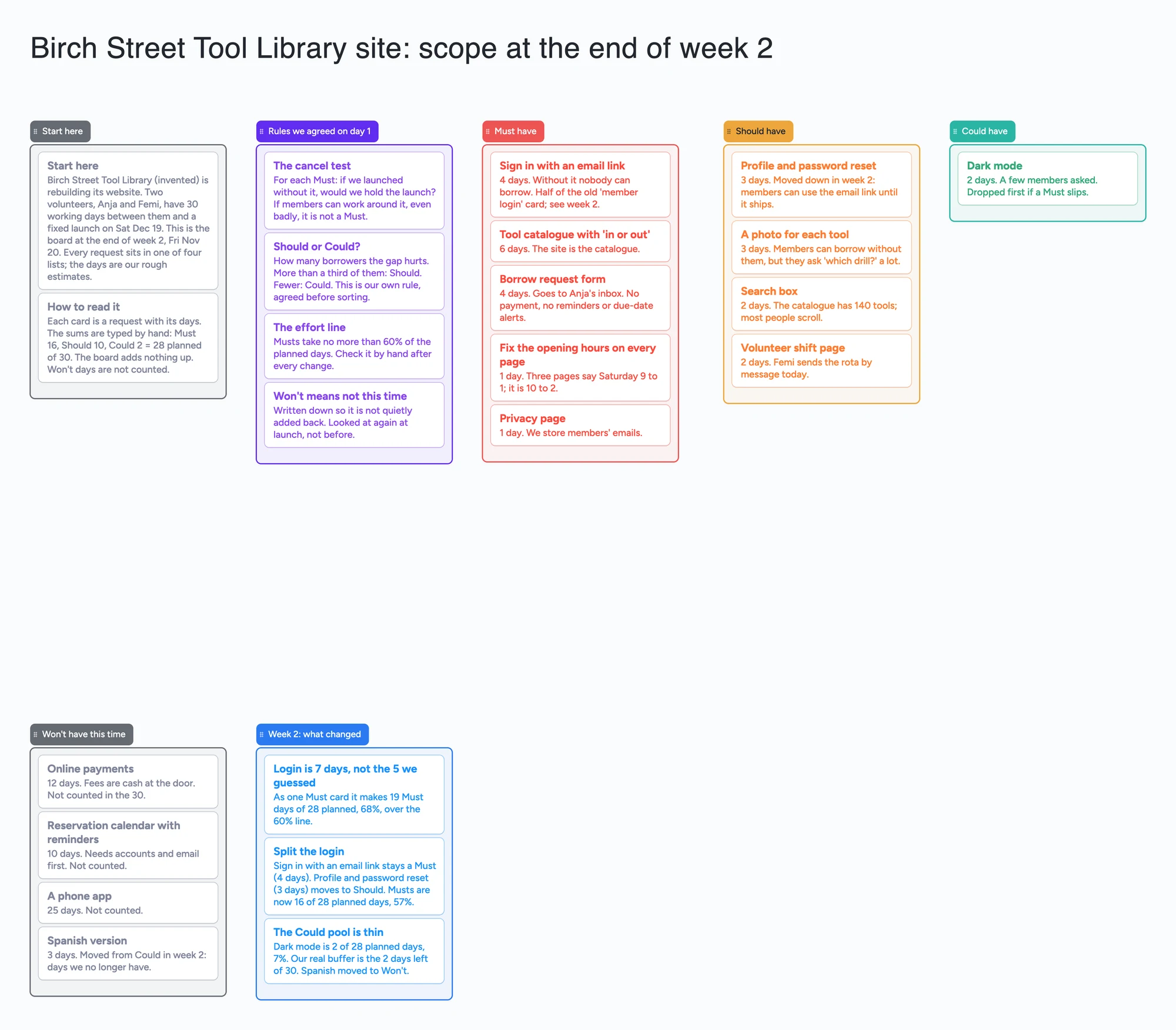
We make Instaboard, an online board. This page gives you a MoSCoW scope board already laid out on it, filled in for an invented two-volunteer project: the Birch Street Tool Library is rebuilding its website with 30 working days between Anja and Femi and a fixed launch on Saturday, December 19. The board shows scope at the end of week 2. Seven lists: the day-1 rules the two agreed, Must have, Should have, Could have, Won't have this time, and a list that records what changed in week 2 and why. Every request is a card with its days written on it. Open it, swap in your own project and send the link to the people sorting the list. It is a place to see and move the four buckets, not a calculator: the board does not add days, does not show a percentage and cannot warn you when the Musts pass 60%. You add the days up yourself, and below we show how and what the pages we read say about the share. We also say when a scoring tool or a spreadsheet is the better choice.
Opens in your browser. Anyone can view; a free sign-in lets you edit.
Updated
Read this first: what the board does and doesn't do
- What it is: a shared page where the crew sorts requests into four lists and sees at a glance what is guaranteed, what flexes and what was ruled out. Each card carries its estimate in days. The example holds 14 requests plus the rules and notes, and uses 31 of your 150 free items.
- What it is not: no sums, no percentages, no warning when Musts pass 60%, no reminders or due-date alerts, and no record of who moved a card or when. The days on the cards are typed text.
- What the method needs that a board can't give: MoSCoW says what is in and what is out; it does not say how to score a request. ProductPlan's page says it has no objective method for ranking items against each other and you bring your own.
- Keep off it: names of members, addresses and anything private. A link board is not private. The example uses first names for the two volunteers only.
- When to use something else: a spreadsheet that adds the days, or a tool that scores. A section below lists them.
When a spreadsheet or a scoring tool is the better choice
Start with what the pages we read say MoSCoW needs that a shared board does not do.
- You need the effort share to add itself. The Agile Business Consortium page says to keep Must effort to typically no more than 60% and to check it as work changes; WishKit's worked example and EM Tools both tell you to validate the split. On this board you add the days by hand. A sheet adds them for you.
- You need a score. ProductPlan says MoSCoW doesn't include an objective methodology for ranking and lists weighted scoring, value versus complexity, Kano, buy-a-feature and opportunity scoring as ways to bring one. A board holds the result of scoring, not the scoring.
- You need votes from people outside the room. WishKit's example settles Should versus Could by vote counts from a feedback board. A shared board of cards has no votes.
- You want an automatic flag. Taskade's page describes an automation that can flag the moment Must-have items pass 60%. A board has no automation.
- Someone's private details would go in it. Member names, addresses and payment details don't belong on a link board.
If the list is short, the crew is two or three people and you mainly want everyone to see the same four lists, a board does that part well.
The test that decides a Must: would we hold the launch?
Every page we read hangs the method on one question. The Agile Business Consortium's page (dated 28 May, 2026) says to ask "what happens if this requirement is not met?" and that if the answer is cancel the project, it is a Must; if there is a workaround, even a manual and painful one, it is a Should or a Could. It calls the Musts the Minimum Usable SubseT and says ranking something a Should or a Could doesn't mean it won't be delivered, only that delivery is not guaranteed. Here is how the question sorts the library's five Musts and the one that nearly was:
| Request | Would we hold the launch without it? | Where it went |
|---|---|---|
| Sign in with an email link | Yes: nobody can borrow without it | Must, 4 days |
| Tool catalogue with in or out | Yes: the site is the catalogue | Must, 6 days |
| Borrow request form | Yes: there is no other way to ask | Must, 4 days |
| Fix the opening hours on every page | Yes: three pages say Saturday 9 to 1 and it is 10 to 2 | Must, 1 day |
| Privacy page | Yes: the library stores members' emails | Must, 1 day |
| Profile and password reset | No: members can use the email link until it ships | Should, 3 days (moved from Must in week 2) |
| Search box | No: the catalogue has 140 tools and most people scroll | Should, 2 days |
Swipe the table sideways to see every column.
The example is invented and the days are our rough estimates. The question is the Agile Business Consortium's; the answers are the example's own.
Two more tests from the same page are worth putting on a card. It also says to ask whether you would stop the deployment the night before if the item were missing, and that a Must cannot depend on anything but a Must. Taskade puts the second the other way round: a Should that blocks a Must becomes a Must in practice, so map the links before locking the lists.
The library's board, list by list
The example is invented. Anja and Femi have 30 working days and a launch they can't move. Each list answers one question, and the last one exists only for a re-sort.
| List | The question it answers | In the library's board |
|---|---|---|
| Rules we agreed on day 1 (purple) | How do we decide, so we don't argue card by card? | The cancel test, a Should-or-Could rule (how many borrowers a gap hurts), the 60% line, Won't means not this time |
| Must have (red) | What do we hold the launch for? | Five cards, 16 days |
| Should have (orange) | What hurts to leave out but doesn't stop us? | Four cards, 10 days |
| Could have (teal) | What goes first if a Must slips? | One card, dark mode, 2 days |
| Won't have this time (grey) | What did we agree not to build? | Online payments, a reservation calendar, a phone app, a Spanish version: 12 + 10 + 25 + 3 = 50 days, not counted |
| Week 2: what changed (blue) | What moved since day 1, and why? | The login took longer, was split, and the Must share fell back under the line |
Swipe the table sideways to see every column.
The board's own wording. The days are typed into the cards; the board has no number field and adds nothing up. The seventh list, Start here, has two cards: what the board is, and how to read it.
The 60% check, by hand, in three lines
The Agile Business Consortium's page says to plan typically no more than 60% of effort on Musts and to keep a Could pool of around 20%, and that when you calculate effort for a timeframe the Won't Haves are left out. On the library's board it comes to this (our arithmetic from the cards):
- Add each list. Must 4 + 6 + 4 + 1 + 1 = 16 days. Should 3 + 3 + 2 + 2 = 10. Could 2. Planned work is 16 + 10 + 2 = 28 of the 30 days. The Won't days don't count.
- Divide. Musts are 16 / 28 = 57%, under the line. Shoulds are 10 / 28 = 36%. Coulds are 2 / 28 = 7%.
- Compare with the line, then write the result on a card. The Start here card has the sums, typed.
Two things to say plainly. First, the library's Could pool is 7%, well under the 20% the page calls typical. Its real cushion is the 2 days of 30 not planned at all, and the Week 2 list says so. Second, the sources don't agree on the Should share. The Agile Business Consortium's page gives figures for Must and Could only; EM Tools and Taskade add Should at about 20%, and Taskade calls 60/20/20 "a planning guide, not a law". We follow the first page and treat the rest as someone's rule of thumb.
Week 2: one request that outgrew its estimate
The Agile Business Consortium says priorities should be kept under review as work is completed and, at a minimum, reviewed at the end of each timebox. For a 30-day project, the library's two volunteers look at the lists on Fridays. At the end of week 2 the login turned out to be 7 days, not the 5 they guessed:
- Re-add the plan. With the login at 7 days as one Must card: Must 7 + 6 + 4 + 1 + 1 = 19, Should 3 + 2 + 2 = 7, Could 2 + 3 (dark mode and the Spanish version) = 5. That is 31 days for 30. Spanish goes to Won't, so the plan is 28 days.
- Check the share. Musts are 19 / 28 = 68%, over the line.
- Look at what the Must really is. Signing in is needed; profile and password reset is not, because members can use the email link until it ships.
- Split it. "Sign in with an email link" stays a Must at 4 days. "Profile and password reset" at 3 days moves to Should.
- Re-add. 4 + 3 = 7, the same 7 days, now 16 Must days of 28 (Should is 3 + 3 + 2 + 2 = 10, Could 2), 57%.
- Say why, on a card. The Week 2 list holds the three cards that say what changed.
This follows the Agile Business Consortium's point that believing everything is a Must is often a sign of insufficient decomposition, and that a requirement can often be split into parts of different priority. The wording of the example is ours.
Five pages, what each adds
We read five pages in full on November 24, 2026. Three print a date: the Agile Business Consortium (28 May, 2026), EM Tools (Last updated 23 November 2026) and WishKit (byline Oct 5, 2026; its quotation notes say "accessed October 5, 2026"). ProductPlan and Taskade print none in their text; their page data gives August 7, 2026 and October 1, 2026 (modified). Four are vendor content (the fifth is the method's own handbook), so each is the writer's own view.
| Page | What it adds that the others don't |
|---|---|
| Agile Business Consortium (28 May, 2026) | The rules: Must = the Minimum Usable SubseT, Won't = recorded so they are not informally reintroduced, 60% / 20% figures, three levels of priority (project, increment, timebox), and agree up front how a Should differs from a Could |
| ProductPlan glossary (no page date printed; page data August 7, 2026) | No objective ranking method of its own, so bring a scoring system; agree how disputes are settled; get all relevant stakeholders' input |
| EM Tools template (page prints Last updated 23 November 2026) | A 60 to 90 minute workshop; each person sorts silently for five minutes first; check the effort split at the end |
| Taskade wiki (title says 2026; no date printed; page data modified October 1, 2026) | The 60% rule as a planning guide, dependencies that promote a Should, re-sort every round |
| WishKit worked example (byline Oct 5, 2026) | A 40-day release in which the first pass makes eight Musts and 70 days; the cancel test leaves three Musts and 22 days, 55%, and the Won'ts' 47 days are left out |
From each page as read November 24, 2026. Taskade and WishKit sell a task tool and a feedback board; ProductPlan sells roadmap software; EM Tools sells engineering-management material. Pricing is not listed on the ProductPlan, EM Tools or WishKit pages, and Taskade's page names no plan limits (as of November 24, 2026). Instaboard isn't affiliated with the Agile Business Consortium or any of these.
We also read WishKit's arithmetic: 2 + 6 + 14 = 22 Must days, 5 + 2 + 3 = 10 Should days and 5 + 1 + 2 = 8 Could days, which makes 40, and 22 / 40 = 55%. It adds up.
How many projects fit in 150 items?
Each card and each list is 1 of your 150 free items, across all your boards. The title text box counts too. Arrows, sections and pen strokes don't. Our arithmetic from the library's lists:
- As built: 7 lists + 23 cards + the title = 31. Of those cards, 14 are requests, 4 are rules, 3 are week 2 notes and 2 are the Start here cards.
- Room left: 150 - 31 = 119 items.
- Four projects as copies: 4 x 31 = 124. A fifth would be 155, over the limit.
- One project that keeps growing: with no new lists, 119 more cards. A second week's worth of notes adds 3.
- Boards: a copy takes 1 of your 5 free boards.
Pro removes the item limit: $5 a month billed yearly ($59.99 a year), or $7.99 monthly. A small project doesn't need it.
What a board can't do for MoSCoW
- Add the days or show a percentage. No number field, no totals. You type the sums.
- Warn you when Musts pass 60%. No rules, no automation.
- Remind anyone. No reminders or due-date alerts. "Fri Nov 20" is text.
- Score a request. Cards have no vote or score field. Dragging a card from list to list is the whole method.
- Show who moved a card, or when. Anyone with edit access can drag any card.
- Lock a list. Nothing stops someone dragging a Won't back into Must.
- Offline. Changes made offline are kept and sync when you're back online.
Where other tools do this better
Read November 24, 2026. Not listed means not on the page we read; it doesn't mean the tool lacks it. No ranking: they suit different teams.
| Option | What its page says | Better than a board at | Where a board fits |
|---|---|---|---|
| A spreadsheet | WishKit says a five-column sheet is all you need: request, votes or who asked, effort, MoSCoW, why; then check the Must days against 60% | Adding the days and the share for you | Seeing the four lists side by side and moving a card |
| Taskade | Says a board view with Must, Should, Could and Won't columns, owners and a status field can be generated from a prompt, and an automation can flag Musts over 60% of effort. Its links say to build a board "free"; plan limits are not listed on that page (as of November 24, 2026) | Automation and owners on every card | A plain board with no automation, shared by link |
| WishKit and similar feedback boards | Collects feature requests with votes, so the Should-versus-Could call has a number behind it. Pricing is not listed on that page (as of November 24, 2026) | Gathering votes from outside the team | Sorting the requests once you have them |
| ProductPlan | Roadmap software with weighted-scoring prioritisation. Pricing is not listed on that page (as of November 24, 2026) | Scoring and portfolio views | A single small project and no scoring |
Swipe the table sideways to see every column.
From each page as read November 24, 2026. Vendor content. Instaboard isn't affiliated with any of these.
Set up your own, in order
- Open the board and delete the library's cards as you replace them, so it is never half Birch Street.
- Write your days and your date on the Start here card before you sort anything: the total number of days you have, and the date that doesn't move.
- Agree the rules first. Write the cancel test, your Should-or-Could rule and the 60% line on the rules cards. The Agile Business Consortium says to agree the Should-versus-Could boundary before the requests are captured.
- Put every request in Won't first, then argue each one up. The Agile Business Consortium suggests starting with everything as a Won't and justifying a higher priority.
- Write the days on every card as you place it.
- Add up the lists and check the Must share by hand, and write the sums on the Start here card.
- Share it. Set the share setting so anyone who joins can edit ("Anyone who joins can edit"); new boards start view-only, and each person signs in to write.
Limits of the free plan for this board
- Items. Each card and each list is 1 of 150 free items across your account; the example is 31. Arrows, sections and pen strokes don't count.
- Boards. 5 on the free plan. "Make a copy" takes 1 of them.
- Pictures. 3 per board. The example has none.
- Writing needs a free sign-in. Anyone who joins can view the board; to change it they sign in, and the board then counts as 1 of their 5.
- Private lists. A link board is not the place for member details; invite-only boards are a Pro feature.
Start from the ready board
It opens in your browser in a few seconds, with nothing to install. Sign in for free when you want to save it and share it.
Questions
What does MoSCoW stand for?
Must have, Should have, Could have and Won't have this time. The Agile Business Consortium's page lists the four, and EM Tools and WishKit both say the two lowercase o letters carry no meaning and only make the word pronounceable. Several of the pages credit Dai Clegg at Oracle as its creator.
How do we decide whether something is a Must?
The Agile Business Consortium says to ask what happens if the requirement is not met: if the answer is to cancel, it is a Must, and if a workaround exists, even a manual and painful one, it is a Should or a Could. The example board writes that test on its first rules card.
How much of the work can be Must?
The Agile Business Consortium says typically no more than 60% of effort, with a Could pool of around 20%, and that going above 60% adds risk unless estimates are accurate, the approach is well understood, the team is performing and the environment is low-risk. EM Tools and Taskade add about 20% for Should; Taskade calls 60/20/20 a planning guide, not a law. The example is at 57%.
Does the board add up the days?
No. It has no number field and no totals, so the sums are typed on a card. If you want it added for you, a spreadsheet does that; this board is for seeing and moving the four lists together.
What goes in Won't have this time?
Requests the team has agreed not to build in this timeframe. The Agile Business Consortium says to record them so they are not informally reintroduced later. The example's four Won'ts add up to 50 days and are left out of the 30 planned.
How much of the free plan does it use?
The example is 7 lists, 23 cards and the title, 31 of your 150 free items, and a copy takes 1 of your 5 free boards. Four projects as copies are 124 items. That is our arithmetic, and your other boards share the 150. Pro removes the item limit.
Sources
- Agile Business Consortium: What is MoSCoW Prioritization? (28 May, 2026, as printed on the page; page data modified September 9, 2026; read in full November 24, 2026; the method's DSDM handbook publisher)
- ProductPlan: MoSCoW Prioritization glossary (no page date printed; page data datePublished and dateModified August 7, 2026; read in full November 24, 2026; vendor content)
- EM Tools: MoSCoW Prioritisation Template (page prints Last updated 23 November 2026; read in full November 24, 2026; vendor content)
- Taskade: MoSCoW Method (title says 2026; no date printed; page data modified October 1, 2026; read in full November 24, 2026; vendor content)
- WishKit: MoSCoW Prioritization, A Worked Example (byline Oct 5, 2026; its quotations say accessed October 5, 2026; read in full November 24, 2026; vendor content)