For law graduates and attorneys studying for a state bar exam around a job
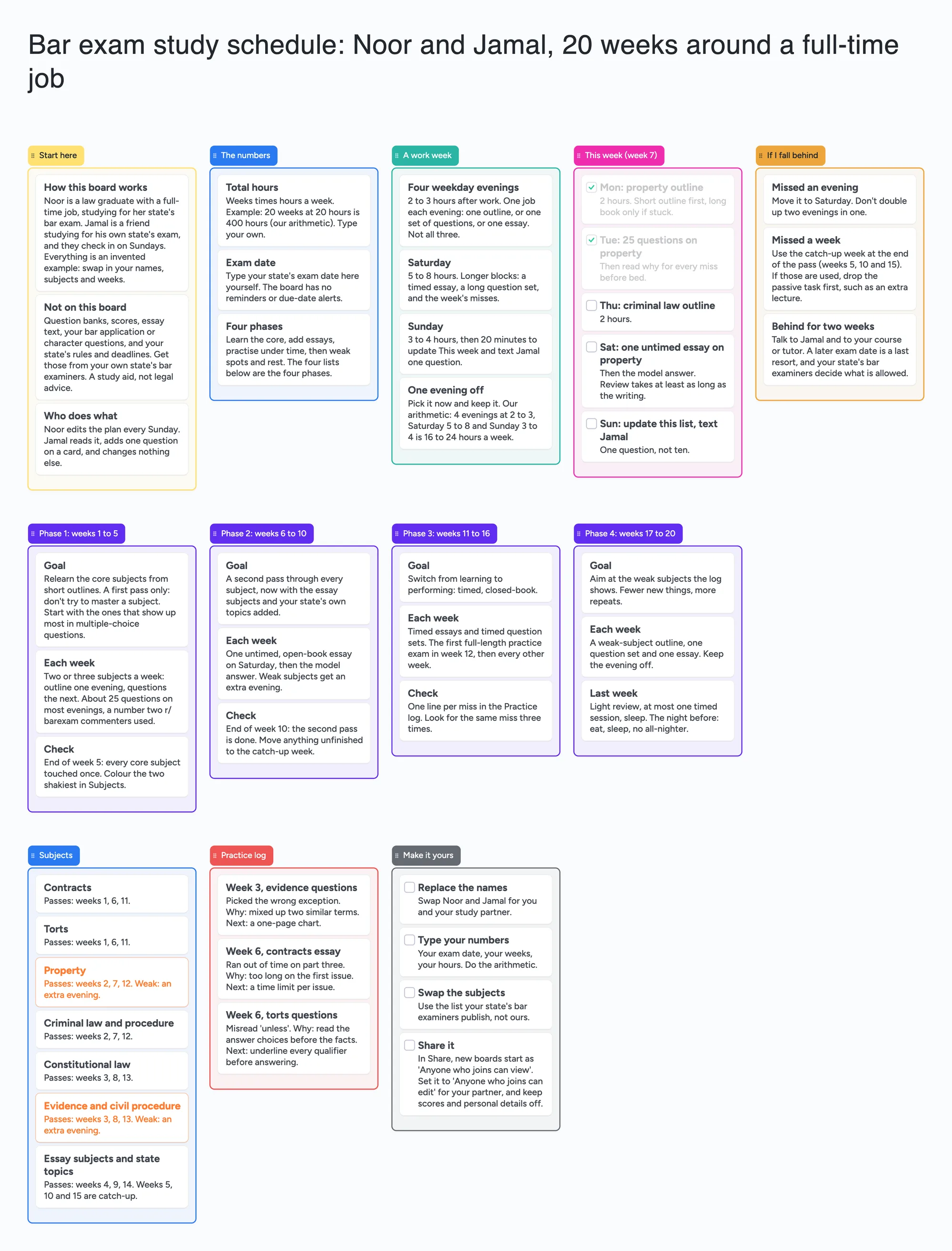
A bar exam study schedule board for twenty weeks around a full-time job
We make Instaboard, an online board. This page gives you a bar exam study schedule laid out on one, filled in for an invented pair: Noor, a law graduate who works full time, and her friend Jamal, who is studying for a different state's exam and reads her plan on Sundays. If you want a downloadable spreadsheet or a generator that builds a schedule from your exam date, this is not that: you type the weeks and tasks yourself. It holds no practice questions, no essay text and no scores, and it has no reminders or due-date alerts. It is a study aid, not legal advice.
Opens in your browser. Anyone can view; a free sign-in lets you edit.
Updated
Read this first: what this board does and what it leaves to others
- It is a plan, not a file. Searchers often want a spreadsheet to download or a tool that builds the schedule from an exam date. This is a shared board you fill in by hand. A spreadsheet that adds up your hours is better at counting, and the page says where.
- What it holds: the numbers (total hours, exam date), a work week in hours, this week's tasks, four phase lists, a catch-up rule, a subject list with passes and a practice log. Noor's plan is invented: swap in your own weeks, hours and subjects.
- What it leaves off: practice questions, essay answers, scores, your state's rules, deadlines and application. Your state's bar examiners publish those, and the page takes none from them. The board has no reminders or due-date alerts, so type your exam date yourself.
- Free plan: the example is 57 of your 150 free items (44 cards, 12 lists and 1 title text box, our count). Arrows and pen strokes don't count. Writing needs a free sign-in, and a reader can open the link signed out. Pro removes the item limit.
Start from the hours: what five bar-prep pages say
Every schedule starts from a total. The five pages below were read on November 25, 2026, and they agree more than they differ. Four are bar-prep vendors or coaches selling something (Barbri, Themis, JD Advising and Make This Your Last Time), so their numbers are one view each.
| Page | Total time | Full-time plan | Working or part-time plan |
|---|---|---|---|
| Emory University law library guide (page shows Last Updated Nov 19, 2026) | Roughly 400 to 600 hours | 8 to 10 weeks, 40 to 50 hours a week | 18 to 26 weeks (4 to 6 months), about 20 to 25 hours a week (the Kansas City Star's plan, as Emory quotes it): weekday evenings of 2 to 3 hours, weekends of 5 to 8 |
| Barbri blog (vendor; page shows Published Date: Aug 10, 2026) | 400 to 500 hours, which "many students believe" they need | 8 to 10 weeks, 40 to 50 hours a week | Not stated on the page |
| Themis blog (vendor; no date printed) | About 400 hours | Start 8 to 10 weeks out at 40 to 50 hours a week | As much as 4 months out at 16 to 25 hours a week; leave 3 to 4 weeks at the end for review and mock exams |
| JD Advising blog (tutoring company; no date printed) | Not stated | 40 to 50 hours a week for first-time takers who study full time | 20 to 30 hours a week for working professionals |
| Make This Your Last Time (a bar-prep coach's blog; page shows Posted on May 23, 2026) | Says no number can be right for everyone | Plan on about 10 to 12 weeks of effort; 4 to 5 months full time is probably the most you want | Spread it out, but try not to pass 4 to 5 months; if you work weekdays, most study hours land on weekends |
Swipe the table sideways to see every column.
Read November 25, 2026. Each cell is that page's own view. Not affiliated with any of them.
Noor's example overlaps the working-taker rows: 20 weeks at 20 hours a week is 400 hours (our arithmetic), a figure that sits inside the ranges three of the pages give (400 to 600, 400 to 500 and about 400). It is an example of how the board adds up, not a recommendation of how long you need. Whether 400 hours is enough for you is a question for your own program or tutor.
Noor's work week, in hours
The Emory guide quotes a newspaper's part-time plan with weekday evenings of 2 to 3 hours and weekends of 5 to 8, and Make This Your Last Time says a working student's study time mostly lands on days off. Noor's week follows that shape, and the "A work week" list holds it:
| Block | Hours | What goes in it |
|---|---|---|
| Four weekday evenings | 2 to 3 each, so 8 to 12 | One job per evening: one outline, or one question set, or one essay |
| Saturday | 5 to 8 | A timed essay, a long question set, the week's misses |
| Sunday | 3 to 4 | Review, then 20 minutes to update This week and text Jamal one question |
| One evening off | 0 | Picked in advance and kept |
| Total | 16 to 24 a week | Our arithmetic: 8 + 5 + 3 = 16 at the low end, 12 + 8 + 4 = 24 at the high end |
Swipe the table sideways to see every column.
The block sizes for weekday evenings and weekends are the Kansas City Star's part-time plan as the Emory guide quotes it; the Sunday block and the evening off are ours.
Across 20 weeks that range is 320 to 480 hours (our arithmetic), so the 400-hour example is in the middle. Make This Your Last Time says you "can't predict where you'll be 47 days from now at 1:30 PM", which is why the board assigns a job to each block and not a clock time.
The four phase lists, and where each idea comes from
The board splits 20 weeks into four lists: weeks 1 to 5, 6 to 10, 11 to 16 and 17 to 20. Most lists hold a goal, a weekly routine and a check. The week numbers are Noor's, not a standard. The ideas behind them are from the pages above:
| Phase list | What it holds on the board | Idea it borrows |
|---|---|---|
| Weeks 1 to 5 | A first pass from short outlines, two or three subjects a week, about 25 questions on most evenings | Emory's quoted newspaper plan starts the first phase with relearning the core subjects and question practice; Make This Your Last Time says cycle through every subject several times and not linger |
| Weeks 6 to 10 | A second pass, now with the essay subjects and the state's own topics, one untimed essay a Saturday | Make This Your Last Time: learn first, then perform; it says to shift to performance around one-third or midway through prep |
| Weeks 11 to 16 | Timed, closed-book work; a first full-length practice exam in week 12, then every other week | The ten-week plan Emory quotes puts the first full mock exam in weeks 6 and 7 of 10; ours is later because the plan is longer |
| Weeks 17 to 20 | Weak subjects from the practice log, fewer new things, a light last week | Themis says to leave 3 to 4 weeks at the end for review and mock exams; the ten-week plan Emory quotes ends with a rest week |
Swipe the table sideways to see every column.
The mapping is ours. None of the pages gives a 20-week plan.
Why the review time matters
Make This Your Last Time says to assume practice takes about double the time you allocate, because the learning happens in the review of your answers. JD Advising suggests a 60/30/10 split: 60% active practice, 30% targeted review and 10% passive review. The board does not enforce either; it has an "each week" card per phase that says what to do, and the practice log is where the review gets written down.
When a week goes wrong
A working person loses evenings. A plan with no slack turns one missed week into a missed month, so the board has a list for it, "If I fall behind", and a catch-up week after each pass (weeks 5, 10 and 15).
- A missed evening moves to Saturday. Two evenings don't double up in one, because the evening limit is the point.
- A missed week uses the next catch-up week. If those are used, the passive task goes first, such as one more lecture. Make This Your Last Time lists a buffer day, and "even entire columns or rows", as something many students build in.
- Behind for two weeks is a conversation with your study partner and your course or tutor. A later exam date is a last resort, and your state's bar examiners decide what is allowed. The board takes no view on it.
- The practice log keeps one line per miss: what happened, why and what to do next. Three misses of the same kind in a row are a sign to move a subject up the list.
What working bar takers say on r/barexam
Three r/barexam threads, read on November 25, 2026 through an archive (arctic-shift), which returned each thread's comments; each count is what we read in an archived copy, and Reddit's own count may differ. Each reply is one person's account, and none asks for a shared board by name.
- "Bar Study Schedule with Full Time Work?" (u/Screenpeekin, 2021-05-28; 17 comments we read). The poster has a family and a job and asks what to cut. u/surfinbenji (7 points) says to get a prep program for the schedule and tasks, and describes about 25 multiple-choice questions a night and rewriting one-page outlines per subject, with one or two practice essays on weekends. u/kpod67 (3) also does at least 25 questions a day and chose not to pay for a prep course, because "the clock/countdown would make me crazy with anxiety" and the lectures were "a waste of time". u/ChevyEsq (2) studies 6 to 11 in the evening and all day on weekends, and says they are "already burned out".
- "Bar prep study schedule with 9-5 WFH job" (u/Tiny-Maintenance-273, 2022-11-17; 77 comments we read). u/larkspur298 (31 points) describes an hour at 6 am, 7 to 11 pm evenings and weekends until 1 or 2, and says "I am not having fun". u/coffeeatnight (14) says to plan in advance what each evening will cover, because there are only two or three productive hours, and gives "all of personal jurisdiction" as an example of one session's job. u/amalehuman (12) says energy and attention are the limit, and to do fewer passive tasks and more past questions. u/RSCM24 (11) worked full time with two small children, studied from 9:30 pm to 1 or 2 am, passed, and says to take the essay half seriously.
- "[Template - Google Sheets] Bar Exam Study Tracker" (u/Shyam09, 2021-11-19; 15 comments we read). One person shares a spreadsheet with day-by-day scheduling, a workout tracker, a question tracker and an essay tracker, with a "Make a Copy" instruction. Replies thank them, and two ask how to adapt it for a different question bank.
Two things come out of the threads. The plan is mostly a list of one job per evening, which is what the board's "A work week" list holds. And the people who describe the schedule that worked for them describe very different ones, from 2 hours after work to 9:30 pm until 2 am, so the board's numbers are meant to be overwritten.
A spreadsheet, a prep course or this board
| Option | What its own page says (read November 25, 2026) | Better for | Not what you get |
|---|---|---|---|
| A spreadsheet tracker (the r/barexam Google Sheets thread above) | Day-by-day scheduling, a workout tracker, a question tracker and an essay tracker, as copied by a poster | Counting hours and questions per day | A card per task that a study partner can read and move |
| Themis (course vendor) | Its page says its course generates a personalized study schedule with monthly, weekly and daily assignments; a banner on the page reads "The best bar review at $2,995" | Someone who wants tasks handed to them with the lectures and questions behind them | A plan you design and own yourself |
| Barbri (course vendor) | Its page says its Personal Study Plan "takes the guesswork out of studying"; the Emory guide says its schedule comes from an adaptive scheduling tool | A student who wants the course's own adaptive plan | A plan with a friend's name on a card |
| Emory law library guide | Sample plans for full-time (8 to 10 weeks) and part-time (18 to 26 weeks) study, quoted from newspapers, plus links to commercial schedules | Reading how others split the weeks | A board to edit |
| A notebook or a text to a friend | Not read; one r/barexam reply says to plan the evenings in advance and nothing more | People who need no structure | A list a second person can read |
Swipe the table sideways to see every column.
From each page, read November 25, 2026. Prices are what the page showed that day. Not affiliated with any of them.
Where these win
If you want questions, lectures and a schedule that adapts, a prep course does what a board can't. If you want to count hours per day and chart them, use a spreadsheet. Use this board when one working person needs a plan with slack in it, a catch-up rule and a place to write down misses, and a friend or tutor who looks at the same list.
Make it yours in about ten minutes
- Open the board and read Start here. It says what is not on the board: questions, scores, essay text, your application and your state's rules.
- Type your numbers. Your exam date, your number of weeks and your weekly hours on The numbers list. Do the multiplication yourself.
- Replace the subjects. Use the subject list your own state's bar examiners publish, not Noor's. Each subject card carries its passes, so move them to match your weeks.
- Set the work week. Which four evenings, which one is off, how long Saturday and Sunday are. Be conservative: Make This Your Last Time says to plan the minimum you will do on a given day and add more if you can.
- Fill This week. One tick-box card per task, with the job and the time.
- Share it. In Share, new boards start as "Anyone who joins can view". Set it to "Anyone who joins can edit" if a study partner will write on it, and keep scores, your application and personal details off the board.
- Update it on Sunday. Clear the ticks, move what slipped and write one line in the practice log for each miss.
Limits of the board and of the free plan
- Not legal advice, and not your state's rules. It is a study aid. The exam's format, dates, fees, application and character questions are set by your state's bar examiners; take them from its own pages. We are not affiliated with any bar examiner or prep company.
- No questions, essays or scores. The board holds the plan around the practice. Don't put real essay answers, scores or application details on a link board.
- Items. Each card, list and text box is 1 of your 150 free items, across all your boards. The example is 44 cards, 12 lists and 1 title text box, 57 in all. Arrows and pen strokes don't count.
- Copies add up. Our arithmetic: a second copy takes you to 114 items, and a third passes 150 (171). Pro removes the item limit ($5 a month billed yearly, $59.99 a year, or $7.99 monthly).
- Boards. The free plan includes 5 boards, and making a copy takes 1 of them.
- Photos. 3 images per board. The example has none.
- Not private by default. New boards start with "Anyone who joins can view", so anyone with the link can read every card. Invite-only boards are a Pro feature.
- No reminders or due-date alerts. The board doesn't tell anyone when to study or when the exam is.
- Writing needs a free sign-in. A study partner who joins to write signs in once; a reader can open the link signed out and can't change anything.
Start from the ready board
It opens in your browser in a few seconds, with nothing to install. Sign in for free when you want to save it and share it.
Questions
Is there a bar exam study schedule template I can share by link?
Yes. Open the board, replace Noor and Jamal with your own names and share the link. It holds a total-hours card, a work week, this week's tasks, four phase lists, a catch-up rule, a subject list and a practice log. It is a board you fill in, not a spreadsheet to download or a generator.
How many hours does a bar exam study schedule need?
The pages we read give different answers. The Emory law library guide says roughly 400 to 600 hours, Barbri's blog says many students believe 400 to 500 and Themis's says about 400, usually over 8 to 10 weeks for full-time study. Make This Your Last Time says no number is right for everyone. The 400-hour example on the board is our arithmetic, not a recommendation.
Can I study while working full time?
The sources we read plan for it with a longer stretch: the Emory guide gives 18 to 26 weeks at about 20 to 25 hours a week, and Themis says to start as much as four months out at 16 to 25 hours. The board's example is 20 weeks at 16 to 24 hours. Your own hours, exam date and program decide your plan.
Does the board give practice questions, essay feedback or scores?
No. It holds the plan around the practice: when you do an outline, a question set or an essay, and a log of what you missed and why. Questions and feedback come from your course, your tutor or the materials you use.
Does it work for my state's exam?
The structure does, but the example is generic. The subjects, the essay topics, the exam dates and the rules differ by state and are set by your state's bar examiners. Put your own subject list on the Subjects list and take the dates from your state's own pages. The board is a study aid and not legal advice.
How many cards fit on the free plan?
Each card, list and text box is one of the 150 items across all your boards. The example is 57, so a third copy passes 150 (our arithmetic). Arrows are free, and Pro removes the item limit.
Sources
- Emory University School of Law library guide: Scheduling Bar Prep Study (read November 25, 2026; page shows Last Updated Nov 19, 2026; a university library guide quoting newspaper plans and commercial courses)
- Barbri: How Many Hours Do I Need to Study for the Bar Exam? (read November 25, 2026; page shows Published Date: Aug 10, 2026; read in full in a browser; vendor)
- Themis: How to Make a Bar Exam Study Schedule, 5 Tips with Examples (read November 25, 2026; no date printed; vendor)
- JD Advising: How to Create a Daily Bar Exam Schedule That Works (read November 25, 2026; no date printed; tutoring company)
- Make This Your Last Time: How to Make Your Own Bar Prep Study Schedule (read November 25, 2026; page shows Posted on May 23, 2026; a bar-prep coach's blog)
- r/barexam: Bar Study Schedule with Full Time Work? (2021-05-28; read November 25, 2026 through an archive; replies are single accounts)
- r/barexam: Bar prep study schedule with 9-5 WFH job (2022-11-17; read November 25, 2026 through an archive; replies are single accounts)
- r/barexam: [Template - Google Sheets] Bar Exam Study Tracker (2021-11-19; read November 25, 2026 through an archive; one person's spreadsheet)