For a team of teachers running a lesson study cycle, not for student work
A lesson study cycle on one shared board, from plan to report
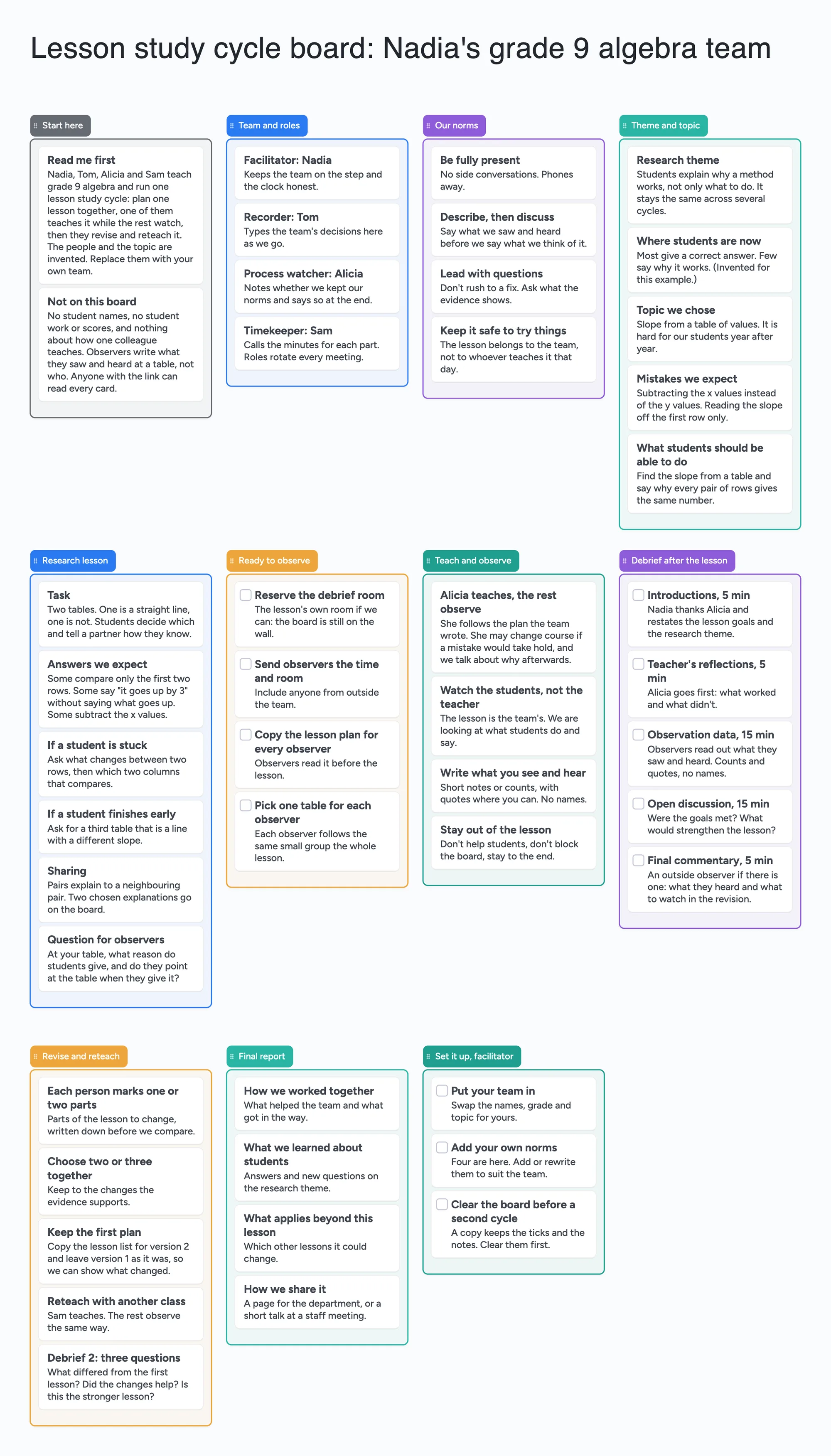
We make Instaboard, an online board for planning with other people. This page gives you a lesson study cycle already laid out on it, filled in for four invented grade 9 algebra teachers: Nadia, Tom, Alicia and Sam. There is a list for the team's roles and norms, one for the research theme and topic, one for the research lesson they plan together, a checklist for getting observers ready, a list for the day one of them teaches, a debrief list with the minutes for each part, a list for revising and reteaching, and a short final report. Open it, swap in your own team and topic, and send the link to the colleagues who plan with you. It holds the team's plan and decisions. It holds nothing about a student, and it sends no reminders about your meetings.
Opens in your browser. Anyone can view; a free sign-in lets you edit.
Updated
Read this first: what the board does and doesn't do
- What it is: the team's working page for one cycle. The lists run in the order the cycle does: team and norms, theme and topic, the research lesson, getting ready, teaching and observing, the debrief, revising and reteaching, the report. The example uses 58 of your 150 free items.
- What it isn't: not a place for observation data about students, and not a meeting planner with alerts. Nothing on it counts hours, books a room or sends a reminder. Minutes and dates on the cards are text the team typed.
- No student information: a board is shared by link, and anyone with the link can read it. Put no student names, no student work or scores, and nothing about how one colleague teaches. Take that to the debrief on paper, or keep it in the school's own system.
- Three pages, one cycle: the pages we read describe it in different steps, and the two that give hours disagree. The section on length below lays them side by side.
- Free plan: 5 boards, 150 items, 3 pictures per board. Copying the board takes 1 of your 5 boards. Writing on it needs a free sign-in. New boards start with "Anyone who joins can view". Pro adds invite-only boards.
What this board can't do, before you copy it
- It does not record what students did. Lesson study depends on observers collecting evidence of student thinking. On a board whose link anyone can open, that evidence has to stay anonymous, in counts and quotes with no names, or stay on paper.
- It sends no reminders. Instaboard has due dates and a calendar view for lists; this board uses neither. Every day, room and minute is typed into a card, and nothing sends a reminder or a due-date alert.
- It does not tick off for you. Three lists are checklists. A tick shows the box is done, nothing more, and a copy keeps whatever was ticked, so clear them before a second cycle.
- It does not replace the forms. If your school or district asks for its own lesson plan form or observation sheet, use that. The board is where the team agrees what goes in it.
- It is not private by default. New boards start with "Anyone who joins can view". Set it to "Anyone who joins can edit" only if the team should write on it, and each person who writes signs in free.
- A copy takes 1 of your 5 free boards, and the example uses 58 of your 150 items.
How long does a cycle take? Three pages, two with hours
We read three pages describing the cycle in full on November 25, 2026. They agree on the shape; the two that give hours disagree, so the board puts no hours of its own on any list.
| Page | Team | Steps | Hours |
|---|---|---|---|
| The Lesson Study Group, "Conduct a Cycle" (footer shows (c)2022, no other date) | 3 to 6 teachers, who need not teach the same grade | Prepare, Study, Plan, Teach, Reflect | About 12: eight weekly meetings of 1 hour, 3 hours for the research lesson and post-lesson discussion, 1 hour for a final reflection; two cycles a year |
| Education Northwest, Lesson Study Participant Guide (cover says September 2019) | Not given as a number; four meeting roles: facilitator, recorder, process watcher, timekeeper | Ten steps in four stages: study and plan, teach and observe, debrief and revise, reteach, reflect and report | Each step has its own estimate; our sum is 13.5 to 19.5 hours (our arithmetic) |
| William Paterson University Center for Lesson Study, "About" (page shows no date) | Teams "often said" to work best at 4 to 6 people | Investigate materials, plan, teach and observe, discuss and revise, reteach, discuss, write a report | Not given |
Swipe the table sideways to see every column.
Pages read November 25, 2026: lessonresearch.net, educationnorthwest.org and wpunj.edu (links in Sources). The Education Northwest total adds that guide's step estimates: 30 minutes, 1, 2, 3 to 6, 1, 1 to 2, 1, 1 to 3, 2 and 1 hours. Our wording, not theirs.
Nadia's team in the example is four people, inside the range both sources give. The example never says how many hours the cycle takes; each list is a step, not a time slot.
Nadia's team, list by list
The team, the school and the topic are invented. Read the board across the top row, then the middle row, then the bottom row.
- Start here. What the cycle is and the line that no student names, no student work and nothing about one colleague's teaching goes on the board.
- Team and roles. The four roles from the Education Northwest guide, one per person: facilitator (Nadia), recorder (Tom), process watcher (Alicia), timekeeper (Sam). The guide says to define and assign roles for each meeting; the card's "roles rotate every meeting" is our own wording.
- Our norms. Four, written as cards: be fully present, describe before you discuss, lead with questions, keep it safe to try things. The guide says five to eight norms work well; the example stops at four so your team has room to add its own.
- Theme and topic. A research theme that lasts across cycles (students explain why a method works), where students are now, the topic chosen (slope from a table of values), the mistakes the team expects and what students should be able to do.
- Research lesson. The plan itself: the task, the answers the team expects, what to do if a student is stuck or finishes early, how pairs share, and the question observers carry to their table.
- Ready to observe. A checklist: reserve the debrief room, send observers the time and place, copy the lesson plan, pick one table for each observer.
- Teach and observe. Alicia teaches and the rest watch the students. The cards tell observers to write what they see and hear, with no names, and not to help students or block the board.
- Debrief after the lesson. Five parts with their minutes, ticked off as the debrief goes.
- Revise and reteach. Mark the parts to change, choose two or three, keep the first plan, reteach with another class, and answer three questions at the second debrief.
- Final report. How the team worked together, what it learned about students, what applies beyond this lesson, how to share it.
- Set it up, facilitator. Three tick-box cards for whoever copies the board.
Which teacher is facilitator, who teaches and what the topic is are all examples. The invented topic is not advice about how to teach slope.
What observers write on a board anyone with the link can read
This is the one part of lesson study that doesn't carry straight over, so the board handles it on purpose. The Education Northwest guide asks observers to collect the data the planning team requested, to "refrain from assisting or instructing students", to "avoid disrupting the teacher" and to focus on the same small group of students over the entire lesson. It says comments in the debrief should focus on what was seen and heard and avoid subjective statements.
- Write counts and quotes, not people. "Four of six pairs pointed at the table when they explained" can go on the board. A student's name next to a mistake cannot.
- Follow a table, not a child. The board's cards say "Pick one table for each observer". A table is a place in the room, and nothing on the board says who sat there.
- Keep the raw notes on paper. Observers bring handwritten notes to the debrief and read from them. The recorder types the summary.
- Nothing about the teacher. The lesson is the team's. A card that says what one colleague did well or badly doesn't belong on a link board.
If your school has rules on observing, or a written agreement for students in the room, follow those. The board adds no rule of its own.
The debrief in 45 minutes
The Education Northwest guide gives the debrief five parts with minutes. The board's debrief list has the same five, as tick-box cards, so the team can mark each part done as it goes.
| Part | Minutes | What the board card says |
|---|---|---|
| Introductions | 5 | Nadia thanks Alicia and restates the lesson goals and the research theme |
| Teacher's reflections | 5 | Alicia goes first: what worked and what didn't |
| Observation data | 15 | Observers read out what they saw and heard, as counts and quotes with no names |
| Open discussion | 15 | Were the goals met, and what would strengthen the lesson |
| Final commentary | 5 | An outside observer if there is one: what they heard and what to watch in the revision |
Swipe the table sideways to see every column.
Minutes are from the Education Northwest guide (Appendix, debriefing protocol). 5 + 5 + 15 + 15 + 5 = 45 (our arithmetic). The guide writes the second debrief with the same minutes.
The guide ends the first debrief with each team member sharing one success, one challenge and one question after outside observers leave. The board doesn't carry that step; it is a conversation, not a card.
Version 1, version 2: keeping the first plan
After the first lesson the Education Northwest guide has the team save the original lesson plan and make a new file for the revised one, called Lesson Plan 2, so the team can show how the second differs from the first.
- On this board: copy the Research lesson list and rename the copy "Research lesson, version 2". Edit the copy. Leave the first list as it was.
- Cost: the Research lesson list is 7 items (6 cards and 1 list), so a version 2 adds 7 and the board goes from 58 to 65.
- Two cycles a year: a second cycle on a fresh copy is another board (1 of your 5) and another 58 items. Delete last year's board when you no longer need it, or two cycles together reach 116 of your 150.
Where other tools do this better
Read on November 25, 2026; plans and pages change, so check the page. A source date is printed only where the page shows one.
| Tool | What the page says | Better for |
|---|---|---|
| The Lesson Study Group tools page (footer shows (c)2022, no other date) | Lists downloads: a meeting agenda template, a teaching-learning plan template (Google Docs and Word), observation protocols, a pre-lesson and a post-lesson discussion agenda, an end-of-cycle reflection, a sample schedule and a PowerPoint template | Ready-made forms and protocols to print and hand out, written by people who run cycles |
| Education Northwest Participant Guide (cover says September 2019) | A 38-page PDF with discussion questions for each of the ten steps. It says Google Docs and Word documents are available for the team's notes | Prompts at every step, and a notebook the team fills in |
| Google Docs or Word | Not read for this page | A lesson plan form your school may require, with comments and version history |
| Instaboard board | 5 boards, 150 items, 3 pictures per board on the free plan | Four teachers seeing the cycle's steps, roles and decisions in one place and moving cards, with one link in place of an attachment |
Swipe the table sideways to see every column.
Pages read November 25, 2026: lessonresearch.net and educationnorthwest.org (links in Sources). We did not open the downloads themselves. Our wording, not theirs.
Where these win
If you want the observation protocol or a lesson plan form, take it from The Lesson Study Group or Education Northwest and use their wording. Use this board when the team wants the whole cycle on one screen and a shared place to record what it decided, without putting a student's name on it.
How many cycles fit in 150 items?
Each card and each list is 1 of your 150 free items, across all your boards. The title text box counts too. Arrows, sections and pen strokes don't. Our arithmetic from the example:
- As built: 11 lists + 46 cards + 1 title = 58.
- With a version 2 of the research lesson: 58 + 7 = 65.
- Two teams on two boards: 2 x 58 = 116, and 2 of your 5 free boards.
- Three teams: 3 x 58 = 174, over 150.
- With Pro, the 150-item limit is removed.
How to use it with your own team
- Open the board and sign in free when it asks you to write. Replace Nadia, Tom, Alicia and Sam with your team, and the algebra topic with yours.
- Agree the roles and the norms first. Four of each are on the board. Add or rewrite them with the team.
- Write the theme and the topic together, then draft the research lesson list as a team, one card at a time.
- Send the link to the team and to any observer from outside it. Set Share to "Anyone who joins can edit" for the team, and view for guests.
- On lesson day, observers bring paper. The recorder types the debrief summary under the debrief list.
- Revise on a copy of the lesson list, keep version 1, and finish with the final report list.
Start from the ready board
It opens in your browser in a few seconds, with nothing to install. Sign in for free when you want to save it and share it.
Questions
What is lesson study?
A way for a small team of teachers to improve instruction together. The pages we read describe the same shape: the team plans one lesson, one member teaches it while the others observe the students, the team debriefs and revises it, and then it is taught again and written up. The William Paterson University page says teams often work best at 4 to 6 people.
How is lesson study different from a PLC meeting?
The PLC meeting board covers one weekly meeting. A lesson study cycle is a longer piece of work around one research lesson that the team plans, teaches, observes and revises, in the steps the sources above describe. The board here covers the cycle; for the weekly meeting there is a separate PLC meeting board.
Can I put observation notes about students on the board?
No. A board is shared by link, and anyone with the link can read it. Keep notes about individual students on paper or in your school's system, and put only counts and anonymous quotes on the board. Don't put anything on it about how one colleague teaches.
Can my team write on the same board?
Yes. New boards start with "Anyone who joins can view", so anyone with the link can read it. Set it to "Anyone who joins can edit" if the team should write too; each person who writes signs in free.
How many cycles fit on the free plan?
The example is one cycle and 58 of your 150 free items. A version 2 of the research lesson makes it 65, and two teams on two boards is about 116, with three over the limit (our arithmetic). Copying the board takes 1 of your 5 free boards.
Is Instaboard free?
There is a free plan: 5 boards, 150 cards and items across your account (pen strokes, arrows and sections don't count), and 3 pictures and 1 file per board. Anyone with the link can read a board; writing on it takes a free sign-in. Pro removes the item limit and adds invite-only boards: $5 a month billed yearly ($59.99 a year), or $7.99 monthly.
Sources
- The Lesson Study Group: Conduct a Cycle, overview (footer shows (c)2022, no other date; read November 25, 2026)
- The Lesson Study Group: Tools for Lesson Study Cycles (footer shows (c)2022, no other date; read November 25, 2026)
- Education Northwest: Lesson Study Participant Guide (PDF, cover says September 2019; read November 25, 2026)
- William Paterson University Center for Lesson Study: Lesson Study, About (page shows no date; read November 25, 2026)