For novelists planning a chain of scenes and reactions
A scene and sequel board: goal, conflict, disaster, reaction, dilemma, decision
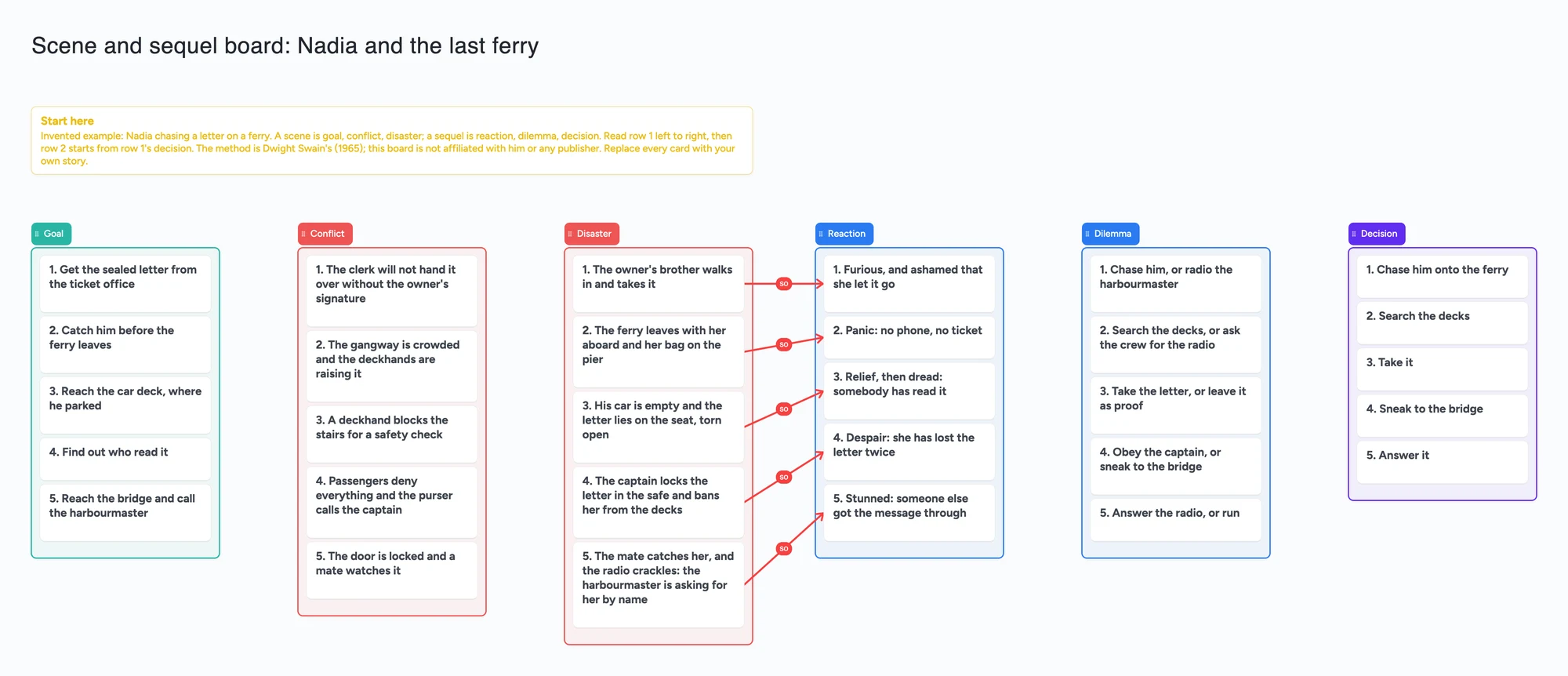
Scene and sequel is a way to chain a novel: a scene (goal, conflict, disaster) is followed by a sequel (reaction, dilemma, decision) that sets the next goal. This board lays the six parts in six lists, one row per scene-and-sequel pair, with an arrow from each disaster to its reaction. It is a planning board, not a manuscript, and Dabble's Plot Grid does more.
Opens in your browser. Anyone can view; a free sign-in lets you edit.
Updated
The short answer
- What it is: six lists in reading order: Goal, Conflict, Disaster (the scene) then Reaction, Dilemma, Decision (the sequel). Card 1 in each list belongs to the first scene-and-sequel pair, card 2 to the second, and so on. The decision in one row becomes the goal in the next.
- The arrows: a red "so" arrow runs from each Disaster card to the Reaction card in its row. Arrows stay attached when a card or list moves. Lists can drift out of line when a card is taller than its neighbour, which is why the cards are numbered and the arrows draw the link.
- The example is invented: Nadia chasing a sealed letter on a ferry. Replace every card with yours.
- What it isn't: no manuscript, scene word counts, chapter numbers, timeline, character tracking or export. It also doesn't judge whether a disaster is big enough.
- Sharing: anyone with the link can read the board with no account. Writing takes a free sign-in, and new boards start view-only, so set Share to "Anyone who joins can edit" for a co-writer.
- Free plan: the example is 38 of your 150 free items (31 cards, 6 lists and the title text box, our count). Arrows don't count. Each pair costs 6 cards.
Where scene and sequel comes from, and what it means
Wikipedia's "Scene and sequel" entry (read November 20, 2026) credits the technique to Dwight V. Swain's 1965 book Techniques of the Selling Writer. This board is not affiliated with Swain's estate or any publisher; the cards use our own wording.
Dabble's "Scene and Sequel: The Formula for an Unputdownable Novel" (read November 20, 2026; the page shows no date) defines a scene as an action unit with three ingredients: a goal that is clear and specific, conflict from obstacles that stand in the way, and a disaster, so that a scene "should always end with" a new problem unless it is the final battle. It defines a sequel as a reaction unit: the character's emotional reaction, a dilemma with no good options, and a decision that sets a new goal. The six lists on the board are those six parts.
Dabble's article presents this as a formula for pacing: each unit "cascades into the next". Other writers use it loosely or not at all; this page doesn't claim that every good novel is built this way.
How to plan scene and sequel on the board
- Open the board and make it yours. The ferry story is invented; replace every card.
- Write the first goal in row 1 of the Goal list. Make it small and specific: a thing your character can try to get in one scene.
- Write the obstacle and the disaster. The conflict is what stands in the way; the disaster is how the scene ends badly, even if the character wins the fight.
- Write the reaction, the dilemma and the decision. The reaction is the feeling; the dilemma is the choice between bad options; the decision is the next goal.
- Copy the decision into the next row's goal. That is the chain. If you cannot, the pair is not connected.
- Draw the arrows. A captioned arrow from each Disaster to its Reaction shows the cause. Add arrows from a Decision to the next Goal if you want the whole chain visible.
- Share the link so a co-writer or editor can move cards. Set Share to "Anyone who joins can edit"; they sign in free.
How this differs from our beat sheet, chapter and index-card boards
The novel beat sheet board is organised by where a beat falls in the whole story. This board is organised by the cause chain between one scene and the next, at any point in the story. The novel chapter outline board lists chapters; a chapter can hold one pair, half of one, or several. The index-card outline board holds one card per scene without saying how scenes connect. Use this board when you know the story's shape and want to test whether each scene pushes into the next.
Where Dabble and a spreadsheet are better
Read November 20, 2026, from Dabble's own pages. Its Plot Grid documentation describes plot lines as columns and plot points as cards, and says a grid can be linked to real chapters and scenes in your book. It also says the Plot Grid is a premium feature. Dabble's pricing page lists Writer, the plan with the Plot Grid, at $15 a month billed annually ($180 a year) with a 14-day trial. If you want your scenes and this plan side by side, that is the better tool; our lists are not linked to anything you write.
Where a spreadsheet wins
A spreadsheet keeps rows aligned however long the text is, sorts, and counts. On a board the lists can drift out of line when cards differ in height, and nothing counts for you.
This board vs Dabble's Plot Grid
| Tool | What we read (Nov 20, 2026) | Good at | Not what you get |
|---|---|---|---|
| Instaboard board | Free: 5 boards, 150 items, 3 images per board. Pro $5 a month billed yearly ($59.99 a year), or $7.99 monthly | Six lists of scene and sequel parts; captioned arrows; shared by link | Manuscript link, word counts, aligned rows |
| Dabble | Plot Grid is premium; Writer $15 a month billed annually ($180 a year); 14-day trial; grid can link to a book's scenes | Outline beside the scenes you write | Free outlining beyond the trial: not listed on its pricing page (as of Nov 20) |
Swipe the table sideways to see every column.
From Dabble's own pages, read November 20, 2026. Prices change; check the page.
Limits of the free plan for a scene and sequel board
- Items. Each card and each list is 1 of your 150 free items, across all your boards. The example is 31 cards, 6 lists and a title text box, 38 in all (our count). Every pair adds 6 cards, so with the 6 lists, the Start here card and the title, 20 pairs is 6 + 1 + 1 + 120 = 128 items, and the most a single board can hold is 23 pairs (146 items), before anything else is on your free plan (our arithmetic).
- Rows can drift. Cards differ in height, so the same row in two lists may not line up. Numbers and arrows carry the link.
- Arrows are free but hand-drawn. They don't count toward 150, but you place them.
- Boards. The free plan includes 5 boards. Making your own copy of the example uses 1.
- No export. Use Copy as image to send the plan to someone without the link.
- Writing needs a free sign-in. Viewing doesn't.
Start from the ready board
It opens in your browser in a few seconds, with nothing to install. Sign in for free when you want to save it and share it.
Questions
What is scene and sequel?
A way to link scenes: a scene has a goal, conflict and disaster; a sequel has a reaction, a dilemma and a decision that sets the next goal. Wikipedia credits it to Dwight Swain's 1965 book Techniques of the Selling Writer. Dabble's article explains each part.
Is there a free scene and sequel template?
Yes. Open the board, replace the example with your story, and set Share to "Anyone who joins can edit" if a co-writer needs to write on it. It is six lists of cards joined by captioned arrows, not a document.
What is the difference between a scene and a sequel?
Dabble's article calls a scene an action unit and a sequel a reaction unit. In a scene the character pursues a goal, meets conflict and ends in disaster. In a sequel the character reacts, faces a dilemma and decides what to do next.
How do I plan scene and sequel for a whole novel?
Write one row per pair: goal, conflict, disaster, reaction, dilemma, decision. Make each decision the next row's goal. A 23-pair board is the most one free board can hold; most novels will need two boards or a leaner shape, such as one card per pair.
How many cards fit on the free plan?
The example is 38 items of your 150. Each pair adds 6 cards, so 20 pairs is 128 items. That is our arithmetic. Arrows are free.
Is Instaboard free?
Yes. The free plan includes 5 boards, 150 cards and items across your account (pen strokes, arrows and sections don't count), 3 images and 1 file per board, unlimited collaborators and video calls up to an hour. Pro is $5 a month billed yearly ($59.99 a year), or $7.99 monthly, and the people you invite join free.
Sources
Related
A novel beat sheet on one shared board: 15 beats, three acts, scenes under each beat
A 15-beat novel outline to open and edit: 3 act sections, a list per beat, scene cards under each. Free-plan item counts and where other tools are better.
24-chapter novel outline board: acts, chapters and beats on one shared board
A filled 24-chapter novel outline to open and edit: four act sections, a list per chapter, three beat cards each. Item counts for the free plan stated, and where other tools are better.
Outline a novel or screenplay with index cards, on a board you can share
Outline a novel or screenplay on digital index cards: one list per act, 40 short cards, subplot arrows, a co-writer on the same board. Free to start; TV pilot too.
A character arc template board: how each character changes, tied to the plot
A shared character arc template: a list per character with want, lie, first change, midpoint shift, low point and end state, tied to your plot beats by arrows. Free to open.