For thriller writers who want the whole plot on one screen
A thriller novel outline board: spine, truth line, false lead and stakes clock
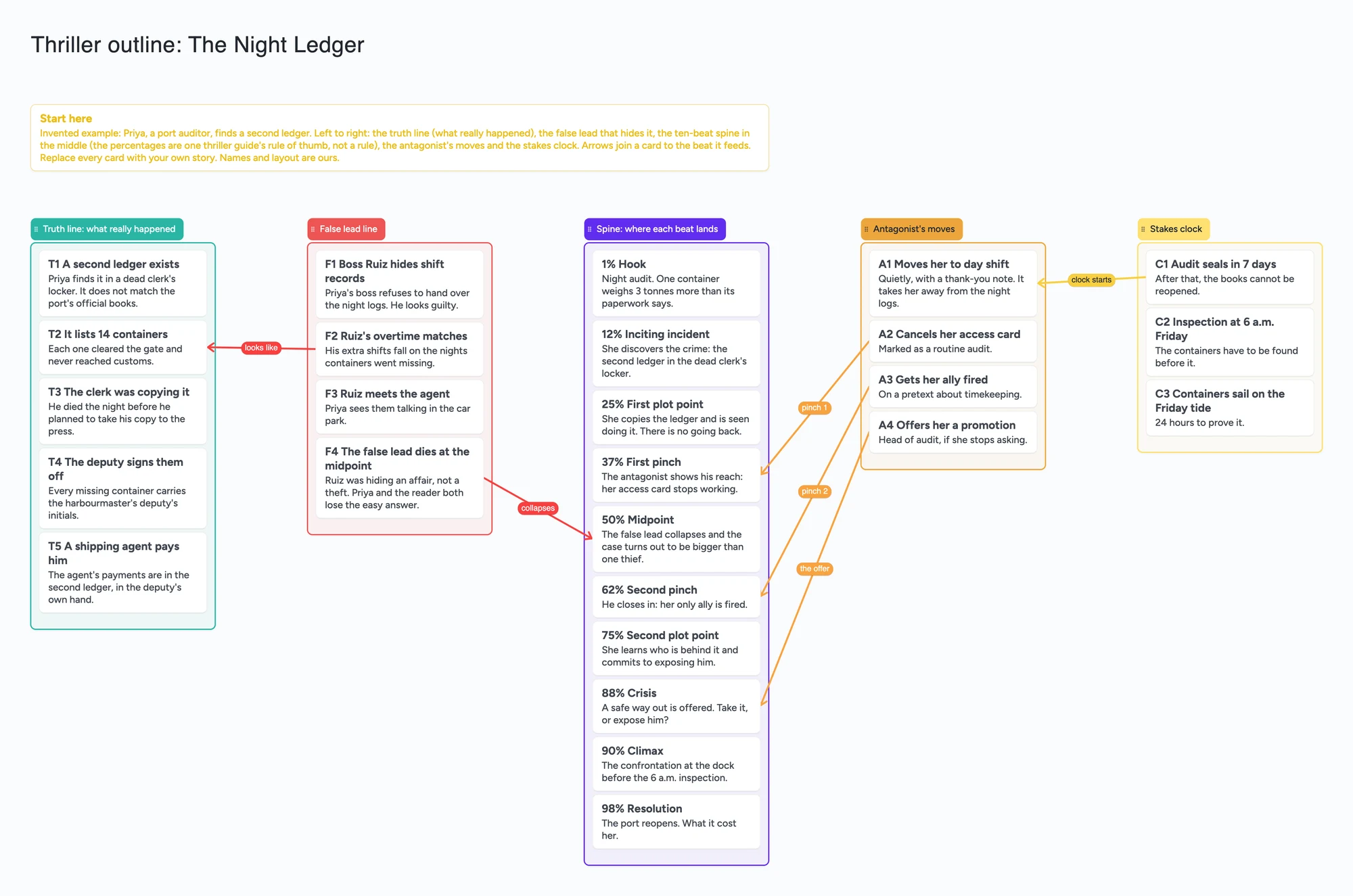
This is a thriller outline you can see all at once, and it is not a writing app: five lists hold a ten-beat spine, what really happened, the false lead that hides it, the antagonist's moves and a stakes clock, joined by captioned arrows. It has no manuscript, word count, timeline view or export, and Plottr or Dabble do more. Use it to see the plot on one screen and to share it by link.
Opens in your browser. Anyone can view; a free sign-in lets you edit.
Updated
The short answer
- What it is: five lists. Spine has ten beats with a rule-of-thumb percentage on each (1% hook to 98% resolution). Truth line is what really happened. False lead line is the wrong answer the reader and your hero chase. Antagonist's moves are what the villain does to stop your hero. Stakes clock holds the deadlines.
- Why arrows: a captioned arrow from a false-lead card to the truth card it imitates, or from an antagonist move to the pinch it causes, stays attached when a card or list moves. That is the part a plain list can't show.
- The example is invented: Priya, a port auditor, finds a second ledger. Replace every card with yours. The percentages are one guide's rule of thumb (see below), not a law.
- What it isn't: no manuscript, word count, chapter count, timeline view, character database, export or sorting. Plottr, Dabble and a spreadsheet each do things this board doesn't.
- Sharing: anyone with the link can read the board with no account. Writing takes a free sign-in, and new boards start view-only, so set Share to "Anyone who joins can edit" for a co-writer or editor.
- Free plan: the example is 33 of your 150 free items (27 cards, 5 lists and the title text box, our count). Arrows don't count.
What the thriller guides say, and what the board takes from them
Savannah Gilbo's thriller outline guide (read November 20, 2026; the page shows no date) uses the three-act structure on an 80,000-word example and names ten moments with a percentage for each: hook around 1%, inciting incident 12%, first plot point 25%, first pinch 37%, midpoint 50%, second pinch 62%, second plot point 75%, crisis 88%, climax 90%, resolution 98%. It says the inciting incident in a thriller is "ALWAYS the discovery of a crime". The spine list on the board follows those ten, in our own wording. The percentages are hers; a different guide may place them differently.
Reedsy's "How to Write a Thriller in 7 Heart-Stopping Steps" (read November 20, 2026) separates the genres: in a mystery, quoting its editor Anne Brewer, "the plot is driven forward by the protagonist, a sleuth"; in a thriller the action is driven "by elements beyond the protagonist's control", and you might meet the villain on the first page. That is why this board has an Antagonist's moves list and a Stakes clock, where the mystery outline board has suspect lists.
In an r/writing thread "Honestly, how do writers write thrillers?" (145 votes, March 24, 2026), one writer who plots thrillers says they start with the inciting incident and the ending, then plot two lines between them: the truth and the false lead, plus a line for the villain. That is one person's method, and it is the shape of the two middle lists. Other replies in the same thread say a thriller and a mystery are "two very different genres" and that one writer outlines nothing and rewrites in a second draft. Not everyone plots first.
How to outline a thriller on the board
- Open the board and make it yours. The Night Ledger is invented; replace every card.
- Start with the two ends. Fill the Hook and the Resolution on the spine, then the Inciting incident, which in this method is the discovery of the crime.
- Write the truth line. One card per fact the hero has to uncover, in the order the villain did them, not the order she learns them.
- Write the false lead line. Cards the reader will believe, each one pointing at a truth card it resembles. Draw a captioned arrow ("looks like") from it to that truth card. Decide where the false lead dies; the example kills it at the midpoint.
- List the antagonist's moves. Each move should land as a pinch or a crisis on the spine. Draw an arrow ("pinch 1", "pinch 2", "the offer") to that beat.
- Set the clock. Deadlines in the stakes list, with an arrow to the move that starts each one.
- Share the link so a co-writer or editor can move cards. Set Share to "Anyone who joins can edit"; they sign in free.
How this differs from our mystery, beat sheet and chapter pages
The mystery outline board is built around a sleuth working out which suspect did it: a list per suspect with motive, alibi and lie. A thriller often shows the villain early, so this board tracks pressure instead: what he does to stop her, and how much time is left. The novel beat sheet board has 15 beat lists for any genre, with a scene list under each. The novel chapter outline board lays the book out chapter by chapter. This board is the thriller spine plus the two lines that cross it, small enough to read at a glance.
Where Plottr, Dabble and a spreadsheet are better
Read November 20, 2026, from each company's own pages. Plottr is outlining software for novelists: its pricing page lists Plottr at $60 a year or $150 once (Windows and Mac, works offline) and Plottr Pro at $9.99 a month or $99 a year, which adds a browser app that works on tablets, cloud sync and real-time collaboration. It is built for visual outlining and a series bible, with templates for the beats; this board has none.
Dabble's Plot Grid documentation describes plot lines as columns and plot points as cards, one grid linked to a book so each plot point sits beside the scene it belongs to, and says the Plot Grid is a premium feature. Dabble's pricing page lists Writer at $15 a month billed annually ($180 a year) with a 14-day trial. If you want your outline beside your manuscript, that is the better tool. Our spine list is not linked to anything you write.
Where a spreadsheet wins
A spreadsheet sorts, filters and adds up word counts per beat. A board doesn't. If you want 'what is at 62% of 90,000 words', use a sheet.
This board vs Plottr vs Dabble
| Tool | What we read (Nov 20, 2026) | Good at | Not what you get |
|---|---|---|---|
| Instaboard board | Free: 5 boards, 150 items, 3 images per board. Pro $5 a month billed yearly ($59.99 a year), or $7.99 monthly | One-screen thriller plot; captioned arrows; shared by link | Manuscript, word counts, timeline, export |
| Plottr | $60 a year or $150 once; Pro $9.99 a month or $99 a year (browser app, cloud sync, real-time collaboration) | Visual outlining, templates, a series bible | A free plan: not listed on its pricing page (as of Nov 20) |
| Dabble | Plot Grid is premium; Writer $15 a month billed annually ($180 a year); 14-day trial | Outline linked to the scenes you write | Free outlining beyond the trial |
Swipe the table sideways to see every column.
From each company's own pages, read November 20, 2026. Prices change; check the page.
Limits of the free plan for a thriller outline
- Items. Each card and each list is 1 of your 150 free items, across all your boards. The example is 27 cards, 5 lists and a title text box, 33 in all (our count). A longer spine with 20 truth cards, 15 false-lead cards, 10 antagonist moves, 10 clock cards, the ten spine cards and a Start here card is 66 cards plus 5 lists and a title, 72 items (our arithmetic).
- Arrows are free but hand-drawn. They don't count toward 150, but you place them.
- Percentages are not calculated. The board holds the numbers you type; it doesn't turn 62% into a word count.
- Boards. The free plan includes 5 boards. Making your own copy of the example uses 1.
- No export. Use Copy as image to send the plot to someone without the link; there is no PDF of a card board.
- Writing needs a free sign-in. Viewing doesn't.
Start from the ready board
It opens in your browser in a few seconds, with nothing to install. Sign in for free when you want to save it and share it.
Questions
Is there a free thriller outline template I can edit online?
Yes. Open the board, replace the example with your story, and set Share to "Anyone who joins can edit" if a co-writer needs to write on it. It is a board of cards, lists and captioned arrows, not a document. Plottr and Dabble also offer outlining with more features; each is described above.
How do you outline a thriller novel?
One common method is the three-act structure with ten moments: hook, inciting incident (in a thriller, the discovery of a crime), first plot point, first pinch, midpoint, second pinch, second plot point, crisis, climax and resolution. Savannah Gilbo's guide gives a percentage for each. Many writers add a second line for the false lead and a third for the villain. The ready board puts each on its own list.
What is the difference between a thriller and a mystery outline?
Reedsy's guide says a mystery is driven by a sleuth investigating, while a thriller is driven by forces beyond the hero's control, and the villain may be known from the start. So a mystery outline tracks suspects and clues, and a thriller outline tracks the antagonist's moves, the false lead and the clock. Our mystery board covers the first shape; this board covers the second.
Do I have to outline a thriller before writing it?
No. In one r/writing thread (March 2026) a thriller writer says they write a rough draft and go straight to a second draft with no outline, and another says professional writers outline mysteries extensively. These are single people's methods. The board is for writers who want the plot visible before or while drafting.
How many cards fit on the free plan?
The example is 33 items of your 150. A larger thriller outline with 66 cards would be 72 items. That is our arithmetic. Arrows are free.
Is Instaboard free?
Yes. The free plan includes 5 boards, 150 cards and items across your account (pen strokes, arrows and sections don't count), 3 images and 1 file per board, unlimited collaborators and video calls up to an hour. Pro is $5 a month billed yearly ($59.99 a year), or $7.99 monthly, and the people you invite join free.
Sources
- Savannah Gilbo: How to Outline a Thriller Novel (read November 20, 2026)
- Reedsy: How to Write a Thriller in 7 Heart-Stopping Steps (read November 20, 2026)
- r/writing: Honestly, how do writers write thrillers? (March 24, 2026)
- Plottr: pricing (read November 20, 2026)
- Dabble: Plot Grid overview (read November 20, 2026)
- Dabble: pricing (read November 20, 2026)
Related
A mystery novel outline board for suspects, clues and red herrings
Outline a mystery novel on one board: a list per suspect, clues, red herrings and reveal order. A free ready board, and where Plottr and Sheets do more.
A novel beat sheet on one shared board: 15 beats, three acts, scenes under each beat
A 15-beat novel outline to open and edit: 3 act sections, a list per beat, scene cards under each. Free-plan item counts and where other tools are better.
24-chapter novel outline board: acts, chapters and beats on one shared board
A filled 24-chapter novel outline to open and edit: four act sections, a list per chapter, three beat cards each. Item counts for the free plan stated, and where other tools are better.
A character arc template board: how each character changes, tied to the plot
A shared character arc template: a list per character with want, lie, first change, midpoint shift, low point and end state, tied to your plot beats by arrows. Free to open.