For mystery writers keeping suspects and clues straight
A mystery novel outline board for suspects, clues and red herrings
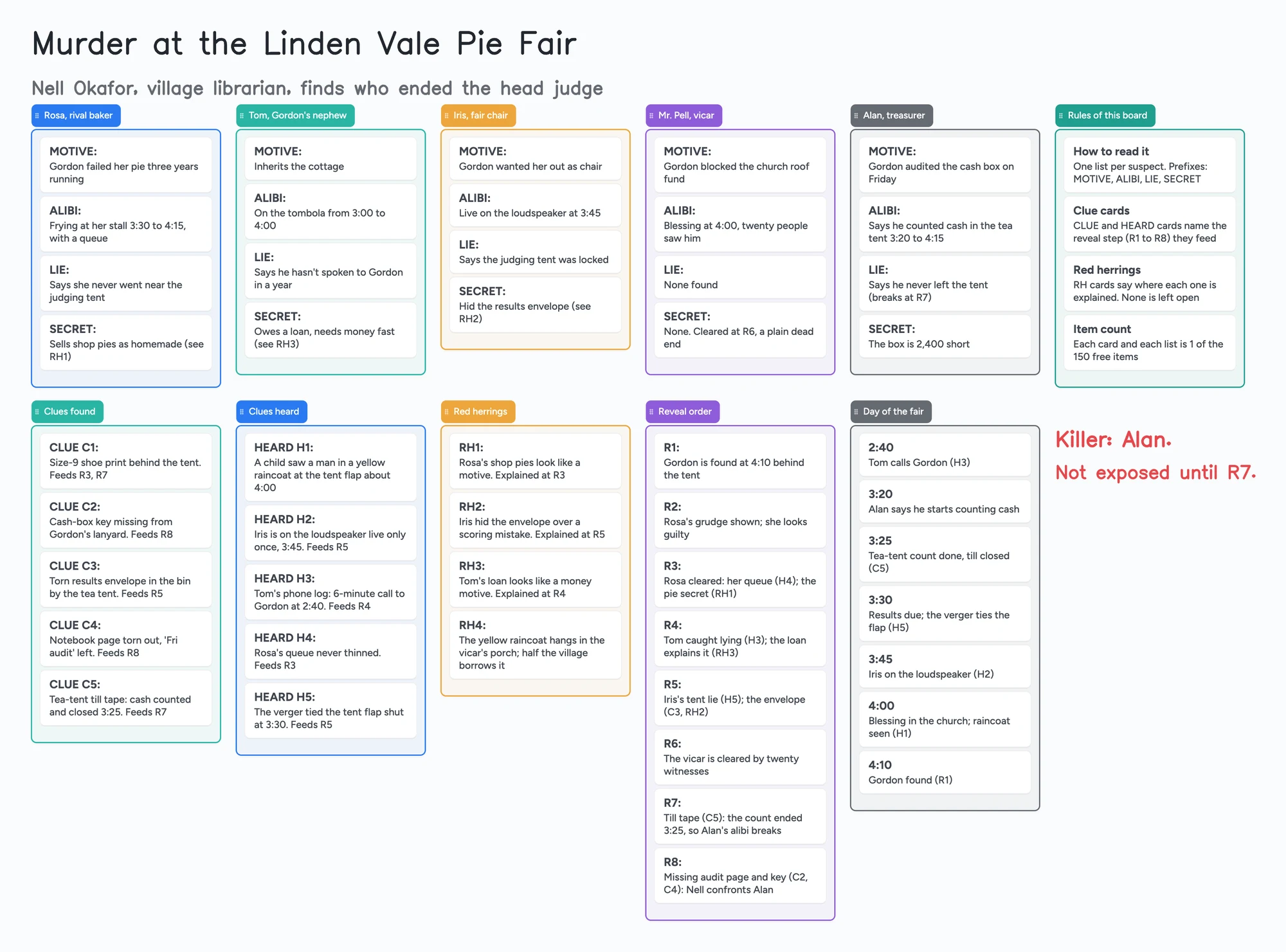
This is a mystery plot outline you can see all at once: one list per suspect with motive, alibi, lie and secret, a list of clues, a list of red herrings and the order you reveal things in. It isn't a writing app. It has no manuscript, script formatting, word count, timeline view, character database, sorting or formulas, and it can't export to Plottr or Scrivener. Plottr and Novel Factory are built for mysteries and do more; a spreadsheet adds things up and filters. Use the board when you want the whole case laid out on one screen.
Updated
The short answer
- What it is: one board with a list for each suspect, a list of clues, a list of red herrings, a reveal order and a day-of-the-crime timeline. It's an outline you can read at a glance, not a draft.
- What it isn't: no manuscript, script formatting, word count, timeline view, character database, sorting or formulas. Plottr, Novel Factory and a spreadsheet each do things this board doesn't.
- Links by labels, with arrows if you want them. Each clue card ends with the reveal it feeds ("Feeds R7"), and each red herring says where it's explained. Cards start with a prefix such as MOTIVE, ALIBI, LIE, CLUE or RH so you can scan them. You can also draw an arrow from a card in one list to a card in another, give it a caption and its own colour (say a red "LIE" arrow from a suspect to the clue that breaks the alibi). It stays attached when either card is reordered or a whole list moves. The example board uses labels only: across ten lists the arrows ran behind cards and hid each other's captions.
- Free plan: the example uses 64 of your 150 free items (53 cards and 11 lists, our count). A full novel with a timeline for every suspect passes 150, which is where the free plan runs out (Pro is $5/mo billed yearly).
What this mystery outline board doesn't do, and where Plottr and Novel Factory are better
Read on November 7, 2026 from each company's own pages. Plottr is outlining software for novelists. Its 12 Step Mystery Formula is a template that opens in Timeline view, with a card for each beat, and Plottr offers a free 30-day trial. Plottr Pro, listed at $9.99 a month or $99 a year, adds a browser app, cloud sync and real-time collaboration; the desktop Plottr is listed at $60 a year or $150 once.
The Novel Factory's mystery post (September 2023, updated March 2026) says its mystery template is built into its software, which has a digital corkboard and index cards, a free 30-day trial and export if you decide to leave. Neither tool is what this board is. A shared board has no timeline view, no character sheets and no templates for the beats; you write the structure yourself.
Where a spreadsheet wins
In one r/writing thread (April 2026) a writer kept a tab for each character with means, motive and opportunity, and a timeline tab with every character's day and the killer's lie. That is one person's method, and it's good: a sheet filters and sorts, a board doesn't.
How to outline a mystery novel on the board
- Decide who did it first and write it where you'll see it. The example has a red note in the corner. Everything else on the board hangs off that one decision.
- One list per suspect, four cards each. Start each card with MOTIVE, ALIBI, LIE or SECRET. Give the killer a lie that breaks at a stated time; give the innocent ones a secret that is not the murder.
- Put clues in two lists. One for things the sleuth finds, one for things the sleuth hears. Number them (C1, H1) and end each card with the reveal it feeds.
- Explain every red herring. Each RH card says where the book explains it. A red herring with no explanation is a plot hole.
- Write the reveal order as its own list. R1 to R8 in the order the reader learns things. This is the list you move cards around in when the pacing is off. Lists reorder on their own, and a card can be dragged from one list into another.
- Colour the cards you'll look for. Each card can have its own colour, separate from its list's, so the killer's lie or the one clue that breaks the case stands out.
- Add a day-of-the-crime timeline. One card per time, with the clue that proves it. It's where the killer's alibi gets checked.
- Share it. In the share menu set Share to "Anyone with the link can edit". A writing partner signs in free and writes live; you both see each other's changes within seconds. The 4-digit join code expires after 2 hours of inactivity, so send the link to anyone you'll need later.
Mystery plot beats to put in the reveal list
You don't need a formula, but two published ones agree on a shape, and it's a useful shape for the reveal list. Both are the companies' own templates, not rules. Plottr's 12 Step Mystery Formula has 12 beats in four acts: it opens by disclosing the mystery and putting the sleuth on the case, builds suspects and a wider investigation in the second act, reveals hidden motives and reviews the case in the third, and weighs the evidence and confronts the culprit in the fourth. The Novel Factory's template starts with the crime, the sleuth and plausible suspects, adds complications, then has a false solution before the sleuth returns to a clue overlooked in the first act and confronts the perpetrator.
Our reading: both put a clue planted early and misread until late. On the example board that is the till tape, found at C5 and only understood at R7. Seeing the planted clue and the reveal in two lists side by side is the one thing the board does well, because you can check that every reveal has something planted before it.
How other writers keep suspects and clues straight
These are single posts, not surveys. In the April 2026 r/writing thread, the person asking said their spreadsheet was "a mess" and joked about ending up with a pegboard of string. One reply kept a separate document for each character's timeline, then built one final timeline from them to choose which scenes the reader sees; another recommended Obsidian for linking notes; others said Scrivener and Aeon Timeline, Freeform, or a real corkboard. A 2017 r/writing thread has a writer with one chapter per row in Excel and a column for red herrings, who said real index cards would have meant over 200 of them.
What these have in common is that the same facts get written in several places: the suspect, the timeline and the clue list. The board keeps one copy of each fact on screen at the same time. It doesn't keep them in sync for you.
Mystery outline board vs spreadsheet vs Plottr vs Novel Factory
| Tool | Cost (read Nov 7, 2026) | Good at | Not what you get |
|---|---|---|---|
| Instaboard board | Free: 5 boards, 150 items. Pro $5/mo billed yearly | One screen, suspects, clues and reveals side by side; a partner can add cards after a free sign-in | Timeline view, sorting, formulas, templates, character sheets, export to writing apps |
| Excel or Google Sheets | Varies by tool | Tabs per character, timelines, filters, formulas (as one writer described) | A visual layout; a writer called theirs a mess |
| Plottr | Desktop $60/yr or $150 once; Pro $9.99/mo or $99/yr; free 30-day trial | 12 Step Mystery Formula template, Timeline view, real-time collaboration on Pro | Not free after the trial |
| The Novel Factory | Free 30-day trial; price not read | Mystery template on digital index cards, writing guides | Not free after the trial |
Swipe the table sideways to see every column.
From each company's own pages and the two r/writing threads, read November 7, 2026. The spreadsheet row reflects one person's description, not a product page.
Limits of the free plan for a mystery outline
- Items. Each card and each list is 1 of your 150 free items, across all your boards. The example is 53 cards and 11 lists, 64 in all. Pen strokes, sections and arrows don't count.
- A full novel passes 150. Our arithmetic: one card per chapter for a 60-chapter book is 60 items before you add a timeline for each suspect. That is where the free plan runs out; Pro is $5 a month billed yearly.
- Boards. The free plan includes 5 boards. A card that opens its own board uses one of them, so the example keeps everything on one board.
- Photos. 3 images per board. The example has none; a link card with a picture preview takes one of the 3 photo slots.
- Writing needs a free sign-in. A partner who joins by link or code can add cards, and the board counts as one of their 5.
- No sorting and no totals. You move cards by hand.
Start from the ready board
It opens in your browser in a few seconds, with nothing to install. Sign in for free when you want to save it and share it.
Questions
Is there a free mystery novel outline template?
Yes. Open the board, replace the example story with yours and share the link with "Anyone with the link can edit" turned on. It's a board of cards, not a document template; for beat-by-beat templates, Plottr and The Novel Factory publish theirs and offer free trials.
Can I track clues and suspects on it?
Yes, with lists and card prefixes: one list per suspect, a list of clues found, a list of clues heard and a list of red herrings. Each clue card names the reveal it feeds. You can draw a captioned arrow between two cards. It doesn't sort them or check the links for you.
Is it a replacement for Plottr or Scrivener?
No. It has no manuscript, timeline view, word count or character database, and no export to those apps. Use it to see the whole case at once, and Plottr, Scrivener or a spreadsheet for the rest.
Can a co-writer work on it with me?
A co-writer who opens the link and signs in free writes on it live, and you each see the other's changes within seconds. The board counts as one of their 5 free boards and the cards they add count toward their own 150 items.
How many items will a whole novel need?
More than the free 150 once you add a card per chapter and per suspect timeline. That's our arithmetic, not a measured figure: the example case is 64 items for five suspects and eight reveals.
Sources
- Plottr: pricing (read November 7, 2026)
- Plottr: 12 Step Mystery Formula (read November 7, 2026)
- The Novel Factory: A Mystery Novel Template/Cheatsheet/Outline (September 2023, updated March 2026, read November 7, 2026)
- r/writing: Any tools for keeping track of things while writing a mystery? (April 2026, replies are single accounts)
- r/writing: Diagramming a Mystery Plot? (April 2017, replies are single accounts)
Related
Outline a novel or screenplay with index cards, on a board you can share
Outline a novel or screenplay on digital index cards: one list per act, 40 short cards, subplot arrows, a co-writer on the same board. Free to start; TV pilot too.
Character relationship map: a filled template two people can edit
A filled character relationship map to copy: factions, a card per character and captioned arrows for who wants what. Edit it together with a co-writer. Free plan limits stated.
A digital corkboard for your scene cards, free to start
A digital corkboard for outlining a novel with scene cards: colour by point of view, drafted ticks, subplot arrows. Honest comparison with Cork, Corkulous, Plottr, Scrivener and Milanote.