For two to five people who share one work goal, not for a personal goal or an individual's performance review
A SMART goals board: one team goal, written five ways
We make Instaboard, an online board. This page gives you a SMART goals board already filled in for one invented goal: Mina, Joel and Ruth answer customer emails for Fernhill Plants, a small online plant shop, and their first draft of a goal is "Get better at answering customers." Five lists, one for each SMART question, hold what they answered, what they dropped and what they changed. A green card at the end holds the goal as one sentence. Copy it, swap in your own goal, and send the link to the people who share it. It is a shared board, not a worksheet file: it does not measure anything for you, and it does not give you a PDF. The pages below do some of these jobs better, and our summaries of them are ours. Nobody named here reviewed the board.
Opens in your browser. Anyone can view; a free sign-in lets you edit.
Updated
What this board is for: three people meaning the same sentence
- The job: a team that shares a goal writes it down once, in a form every member can read the same way, before the work starts. The board does that by asking five questions in five lists and keeping the answers next to the sentence they produced. The example uses 26 of your 150 free items.
- What it holds: the vague first version of the goal, each list's answer, what the team dropped or changed on the way, the finished goal in one sentence, three check-ins with tick boxes, and a list for ideas that are real but belong to a different goal.
- What it leaves to you: the measuring. Joel pulls a number from the inbox and types it onto a card; nothing here counts anything, draws a chart or tells anyone a date has passed. There are no reminders or due-date alerts, and a tick records neither who ticked nor when.
- Where it fits badly: a goal that is really a job description, or work where priorities change every month. Several commenters in the Reddit thread below say so, and the board is no help there.
- Free plan: 5 boards, 150 items, 3 pictures per board. Copying the board takes 1 of your 5 boards. Writing on it needs a free sign-in. New boards start with "Anyone who joins can view".
Fernhill's goal, one question at a time
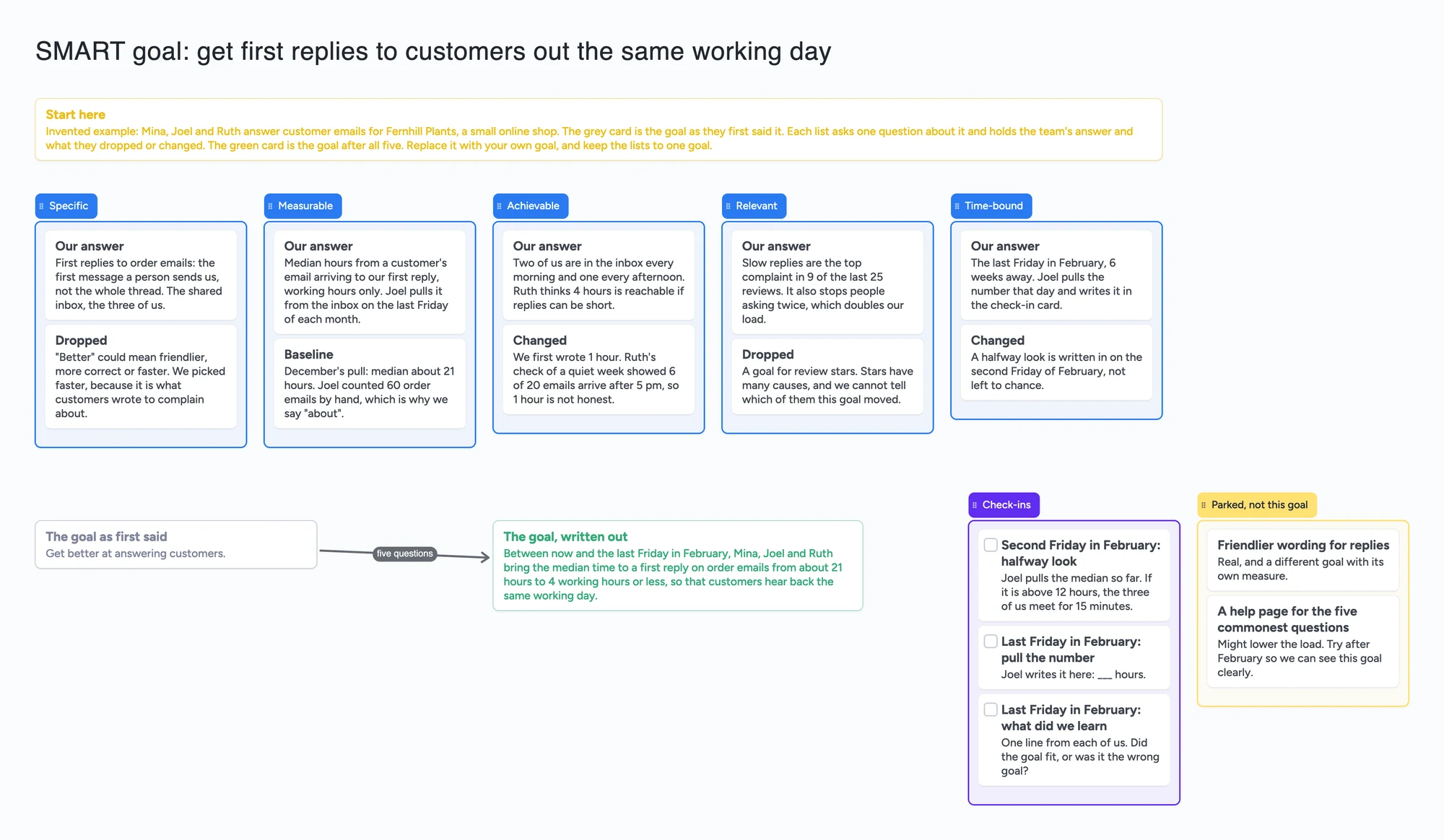
The board is set in mid-January. Mina, Joel and Ruth share one inbox at Fernhill Plants, and customers have been complaining about slow replies. The grey card on the board is the goal as they first said it: "Get better at answering customers." Each list changes it a little.
- Specific. The answer names what is counted: first replies to order emails, meaning the first message a person sends, not the whole thread. The Dropped card records why they chose faster over friendlier or more correct: it was what customers wrote to complain about.
- Measurable. The answer is the median hours from an email arriving to the first reply, working hours only, pulled by Joel from the inbox on the last Friday of each month. The Baseline card holds December's pull, about 21 hours from 60 order emails Joel counted by hand, which is why the card says "about".
- Achievable. The first draft said 1 hour. Ruth's check of one quiet week found 6 of 20 emails arriving after 5 pm, so the Changed card says 1 hour is not honest and the goal moves to 4 working hours.
- Relevant. Slow replies are the top complaint in 9 of the last 25 reviews, and a late reply makes people write twice. The Dropped card sets aside a goal for review stars, because stars have many causes and the team could not tell which one the goal moved.
- Time-bound. The last Friday in February, six weeks away. The Changed card adds a halfway look on the second Friday, so the date is not left to chance.
The green card then reads: between now and the last Friday in February, bring the median time to a first reply on order emails from about 21 hours to 4 working hours or less. Nothing in that sentence was in the grey card; every part of it is in a list beside it, with the reason.
Why half the cards say Dropped or Changed
Most SMART templates give you a box per letter and stop there. This board keeps a second card in each list for what the team gave up, because that is where the disagreement usually was. In Fernhill's example it shows three things:
- A word that meant three things. "Better" could be friendlier, more correct or faster. Writing which one they chose, and that they dropped the others, is the whole Specific step.
- A number that failed a reality check. The 1 hour target was cut after Ruth looked at when emails actually arrive. Atlassian's blog has the same move, scaling four platforms back to three, and Miro's guide cuts 50% to 40%. In all three the Achievable step is where an early draft gets smaller.
- A goal that sounded relevant but could not be told apart from other causes. Review stars were dropped from this goal. They stay possible later; the Parked list is for exactly that.
The Parked, not this goal list holds two ideas that are real and belong elsewhere: friendlier wording for replies, and a help page for the five commonest questions. Putting them there keeps a good idea from being lost and keeps it out of the sentence.
The check-ins, and who pulls the number
Miro's guide says: "Timeframes keep goals alive. Deadlines build urgency and promote frequent check-ins rather than last-minute surprises." On this board a check-in is a tick-box card with a date typed into its title: a halfway look on the second Friday in February, the pull on the last Friday, and a last card asking what the team learned and whether it was the right goal.
- Joel types the number. The pull card says "Joel writes it here" with a blank to fill in. Nothing reads the inbox for you.
- The 12-hour line is a rule the team wrote. If the halfway median is above 12 hours, the three of them meet for 15 minutes. The board does not notice that it is.
- Nothing alerts anyone. Cards can carry a due date, but no one is told when it passes. If it matters, put the date in a calendar that does.
- Anyone with edit access can tick or untick a card. Everyone sees it live, and nothing records who or when. If one person owns a check-in, write the name in the card.
Who wrote the five letters, and who does more with them
Read November 25, 2026. A cell says only what its page says, and pages change, so check them. The five letters are not fixed: the 1981 article that gave us the acronym used different words for three of them.
| Source | What the page says | Better for |
|---|---|---|
| Doran, "There's a S.M.A.R.T. way to write management's goals and objectives" (a scanned copy hosted on eval.fr; the footer of page 35 prints November 1981) | Objectives should be Specific, Measurable, Assignable, Realistic and Time-related. It says the acronym does not mean every objective will have all five criteria, and that the objective and its action plan are the pair that matters | The origin of the idea, and the point that the criteria are a guide |
| Atlassian blog, "How to write SMART goals" (December 26, 2023) | Uses Specific, Measurable, Achievable, Relevant and Time-Bound, a fill-in goal sentence, and a worked example in which a product manager scales a plan from four social platforms back to three | A written walk-through with a fill-in sentence |
| Atlassian, SMART goals template page (page shows no date) | Lists its key features as Goal Setting, Goal Tracking and Task Planning; its Use template link goes to a Confluence sign-up. It does not list plan prices | Teams that already keep their pages in Confluence |
| Miro, "What are SMART goals?" guide (last update February 20, 2026, by Miro Team) | Says a SMART goal starts broad and is refined by five questions, with an example where a 50% target is cut to 40% at the Achievable step. Plan limits and prices are not on the page | A workshop on a big canvas, with many example goals |
| Miro, SMART goal templates collection (page shows no date) | Lists several templates. Its intro spells the letters Specific, Measurable, Achievable, Relevant and Time-bound, while the description of its SMART Goals Template says Attainable and Timely; OKR and mandala chart templates sit in the same collection | Choosing between several template shapes |
| Instaboard board | Five lists and one goal sentence you edit together by link: 5 boards, 150 items and 3 pictures on the free plan | A small team agreeing the wording and keeping the reasons beside it |
Swipe the table sideways to see every column.
From each page, read November 25, 2026 in a browser or, for the Doran article, from the scanned pages: eval.fr, atlassian.com/blog/productivity/how-to-write-smart-goals, atlassian.com/software/confluence/templates/smart-goals, miro.com/strategic-planning/smart-goals, miro.com/templates/smart-goals. Our wording, not theirs. Prices and limits not stated on a page as read are not given.
Where these win
If you want the history and the caution that not every goal needs all five letters, read Doran's two pages. If you want a fill-in sentence and a worked example, use Atlassian's blog. If you want a facilitated session on a big canvas, use Miro. If your team lives in Confluence, its template keeps the goal where your other pages are. Use this board when a few people want to agree the wording together and keep the reasons next to the sentence.
The board uses today's letters, Achievable and Relevant, because that is what the Atlassian pages and Miro's guide use. Doran's Assignable is not lost: the Specific and Measurable cards name who counts what. If your team prefers his words, rename the lists; nothing else on the board depends on them.
When a SMART goal is the wrong tool
The five letters are not the only way to set a goal, and the people who use them at work are not all fans. Every voice below is one person, read November 25, 2026. Forum dates are month and year only, because they shift with the reader's time zone.
From an r/managers thread (November 2024; Reddit shows 13 comments; we read 13 in an archived copy and one more was removed), the original poster, u/steptb, shared a summary of a research paper comparing SMART goals, "do your best" goals and open-ended goals, which said creative performance was statistically similar across the three. We read the summary and did not open the paper. u/Johnsonyourjohnson, the top comment, wrote that their team does highly technical work that needs a lot of innovation, that SMART goals do not fit most of what they do, and that open-ended goals leave them room to succeed in different ways. u/cl4ud wrote that priorities at their company change roughly every month and that after being reorganised twice the goals added no value. u/21jps, a newish manager, asked how to set goals for a team that does the same scheduling work every week, because the goals seemed to restate the job duties. u/KingSlareXIV wrote that it must be nice to work on a team that can know what it will be working on over the next year, and that their own plans get tossed out when upper management decides on yet another urgent thing.
Three things follow for this board. A goal that only restates the job is not a goal, and filling in five lists will not make it one. If the work changes monthly, a goal with an end date six weeks out may be fine, and one that runs for a year is not. And nobody in the thread asked for a shared board; this is a place to hold the wording, not a claim that people want one.
Write your own goal, about 30 minutes
- Open the board and sign in free when it asks you to write. Read the Start here card, then replace the Fernhill cards one by one.
- Write the goal the way someone would say it in a meeting. Put it on the grey card. If it is a duty, not a result, stop and choose another.
- Answer each list in turn, in the Our answer card. Write the reason for the choice, not only the choice.
- Use the second card to say what you gave up. Dropped, Changed or Baseline, whichever fits. If a list has nothing to give up, ask whether the question was hard enough.
- Write the goal as one sentence on the green card, using the answers. Read it aloud to the other people. Anyone who hears it differently has found a gap.
- Set the check-ins. Put dates in the card titles and name who pulls each number.
- To share it, set Share to "Anyone who joins can edit" if the others should write on it. Each person who writes signs in free.
- To start another goal, copy the board. A copy takes 1 of your 5 boards and keeps its ticks, so untick them first.
What 26 items leaves you of the 150
Each card and each list is 1 of your 150 free items, across all your boards, and the title text box counts too. The arrow and pen strokes don't. Our arithmetic from the example:
- As built: 7 lists + 18 cards (ten answer cards, Start here, the grey and green goal cards, three check-ins and two parked ideas) + 1 title = 26.
- A second goal on the same board: five more lists, ten answer cards, two goal cards and three check-in cards is 20 more items, so two goals come to 46. A seventh would reach 146, and an eighth pass 150.
- One copy per goal: each copy is 26 items and takes 1 of your 5 boards, so five copies use 130 items and all five boards.
A SMART goals board is small on purpose, and it counts against the same 150 as your other boards.
What a board of cards can't do for a goal
- No measuring. The cards hold what you type. Nothing counts replies, draws a trend or compares the number with the target.
- No test that the goal is SMART. The lists ask the questions; nothing checks that an answer is specific or achievable.
- No reminders or due-date alerts. A date in a card title is text, and a card's due date alerts no one.
- No who or when on a tick. Anyone with edit access can tick or untick a card.
- No private lists. New boards start with "Anyone who joins can view", so anyone with the link can read the lot. Keep to a team goal, not one person's review or targets.
- No file. Nothing here gives you a PDF, Word or Excel version of the goal. Atlassian's and Miro's pages say what they offer.
- 3 pictures per board. The example has none.
Start from the ready board
It opens in your browser in a few seconds, with nothing to install. Sign in for free when you want to save it and share it.
Questions
What does SMART stand for?
The Atlassian pages and Miro's guide that we read use Specific, Measurable, Achievable, Relevant and Time-bound. Miro's templates page prints both versions: Achievable and Time-bound in its intro, and Attainable and Timely in the description of one template. The 1981 article that introduced the acronym used Assignable, Realistic and Time-related for three of the letters.
Who came up with SMART goals?
George T. Doran, in a two-page article titled "There's a S.M.A.R.T. way to write management's goals and objectives". The copy we read is a scan, and the footer of its page 35 reads November 1981. The article says the acronym is a guide and that not every objective will have all five criteria.
Does a team goal have to be SMART?
No. Several commenters in the Reddit thread we read say SMART goals do not suit innovation work or work whose priorities keep changing, and one new manager asks how to set them for a team whose work is the same every week. The research summary the original poster shared says creative performance was statistically similar across three goal types. It is a way to agree wording, and some goals do not need it.
Can my team edit the same board?
Yes. New boards start with "Anyone who joins can view", so anyone with the link can read it. Set it to "Anyone who joins can edit" if the others should write too; each person who writes signs in free.
Does the board track whether we hit the goal?
No. It holds the cards you write. Someone pulls the number from wherever it lives and types it onto the check-in card, and your team decides whether the goal was met.
Is Instaboard free?
There is a free plan: 5 boards, 150 cards and items across your account (pen strokes, arrows and sections don't count), and 3 pictures and 1 file per board. Anyone with the link can read a board; writing on it takes a free sign-in. Pro removes the item limit and adds invite-only boards: $5 a month billed yearly ($59.99 a year), or $7.99 monthly.
Sources
- Doran, G. T., "There's a S.M.A.R.T. way to write management's goals and objectives" (scanned copy hosted by eval.fr; the footer of page 35 prints November 1981 and page 36 prints AMA FORUM; the scan has no text layer, so we read the scanned pages November 25, 2026)
- Atlassian: How to write SMART goals (December 26, 2023; read in a browser November 25, 2026)
- Atlassian: SMART goals template (page shows no date; read in a browser November 25, 2026)
- Miro: What are SMART goals? (last update February 20, 2026, by Miro Team; read in a browser November 25, 2026)
- Miro: SMART goal templates (page shows no date; read in a browser November 25, 2026)
- r/managers thread (November 2024; replies are single accounts; Reddit shows 13 comments; we read 13 in an archived copy and one more was removed; read November 25, 2026)