For a small team writing down how it works together
A team working agreement template on one shared board: how we work, where we talk, what we agreed
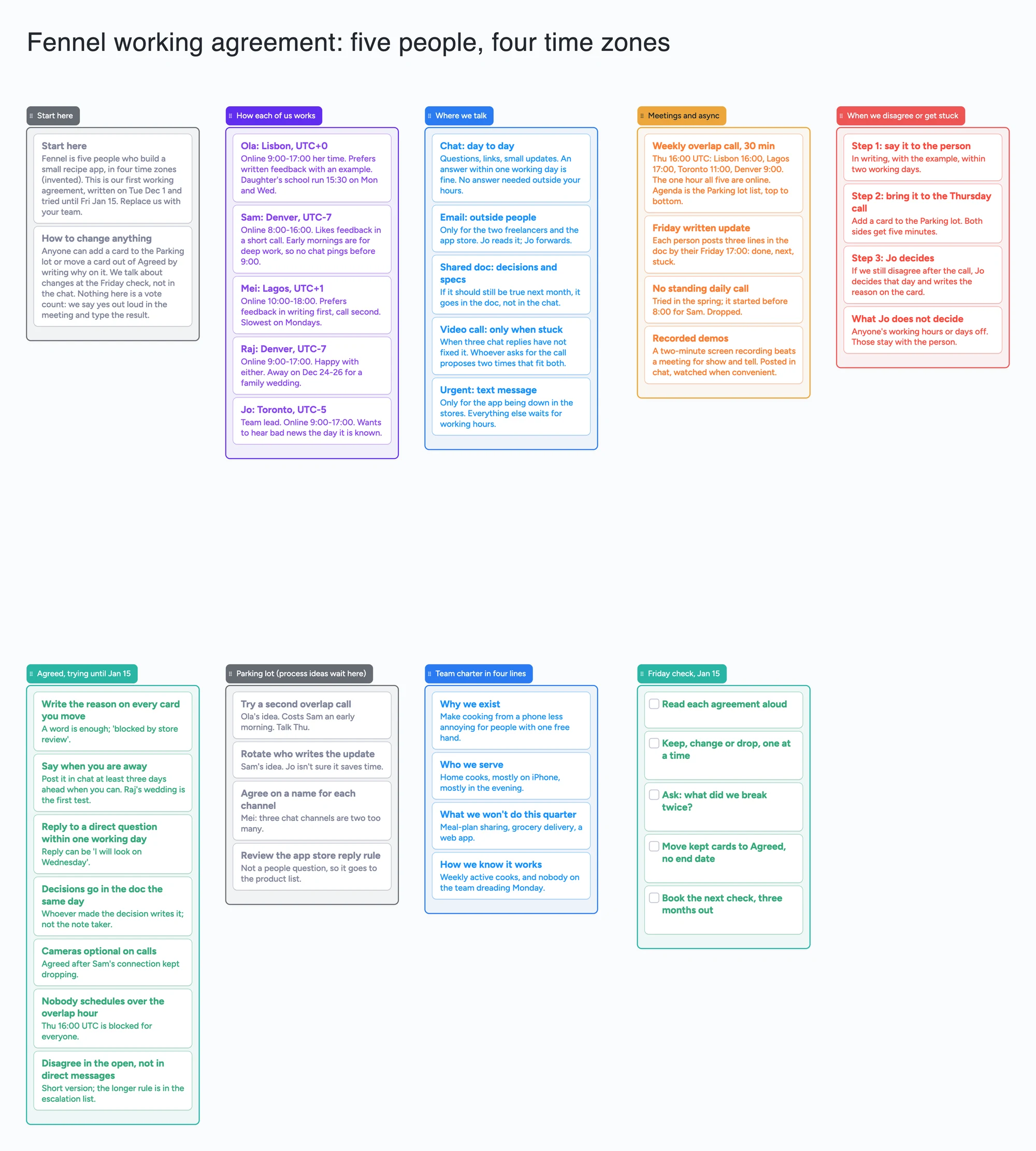
We make Instaboard, an online board. This page gives you a team working agreement already laid out on it, filled in for an invented five-person team: Fennel builds a small recipe app, and its people sit in Lisbon, Lagos, Toronto and Denver. Nine lists: how each person works, where the team talks, meetings and written updates, what happens when two people disagree, the agreements themselves, a parking lot for ideas about process, a four-line team charter and a list for the review. Open it, swap Fennel for your team and send the link to everyone who has to live by it. It is a page the team reads and edits together, not a way to hold a vote: no voting, no sign-off and no record of who agreed. If you need a signature, a poll or reminders that someone broke an agreement, use another tool, and below we say which.
Opens in your browser. Anyone can view; a free sign-in lets you edit.
Updated
Read this first: what the board does and doesn't do
- What it is: one screen the whole team can read in five minutes: how each person works, where the team talks, when it meets, what happens when two people disagree, and the few agreements it is trying. The Fennel board uses 50 of your 150 free items.
- What it is not: no voting, no sign-off, no record of who agreed and no reminder when an agreement is broken. A tick box can be ticked and unticked by anyone with edit access, and the board doesn't show who or when.
- Why a board: the agreements sit next to the people who made them. Anyone can add a card to the parking lot or write a reason on a card they move, and the team sees it within seconds. Anyone who joins can view it; to change it they sign in free.
- Keep off it: performance notes about a person, anything private, passwords. A link board is not private.
- Try it, then review it: the example is dated for a trial from December 1 to January 15, with a review list at the end. A working agreement that is never revisited gets ignored.
When something other than a board is the better way to do this
Start with what a shared board cannot do for a working agreement, because the common methods lean on those things.
- You want to vote. Atlassian's Team Playbook play on working agreements says to use voting to arrive at a comfortable compromise (page read November 24, 2026). A board here has no vote tool; the example says yes out loud in a call and types the result.
- You want agreements enforced by your tools. Swarmia, a company that sells engineering analytics, argues that the most efficient way to make people follow an agreement is to automate it, for example code style checks, pull request rules and Slack reminders (its guide is dated December 2021, updated May 2025). A board checks nothing and reminds nobody.
- You need a signed document. A contract clause or a company policy belongs in a document with a signature, not on a link board.
- You are writing about people, not about how you work. Feedback on someone's performance does not belong on a page anyone with the link can read.
If the team is small, the agreements are about ways of working, and you want one place everyone reads and edits, a board does it.
Find the overlap hour before you write anything else
A distributed team's first real agreement is often the one hour when everyone is awake. Fennel's people are in four time zones, so the board starts from arithmetic, not from values. Our arithmetic, using winter offsets:
| Person | Where | Offset | Online (their time) | Thursday 16:00 UTC is |
|---|---|---|---|---|
| Ola | Lisbon | UTC+0 | 9:00-17:00 | 16:00, her last hour |
| Mei | Lagos | UTC+1 | 10:00-18:00 | 17:00, her last hour |
| Jo | Toronto | UTC-5 | 9:00-17:00 | 11:00 |
| Sam | Denver | UTC-7 | 8:00-16:00 | 9:00 |
| Raj | Denver | UTC-7 | 9:00-17:00 | 9:00 |
Swipe the table sideways to see every column.
Invented team. Offsets are the winter ones; when clocks change in March the hour moves for some of the five, so the review in the example is also the time to check it again.
Thursday 16:00 UTC is the one hour all five are inside their working day, which is why the board's weekly call, its blocked slot and the parking lot's agenda all point at it. Atlassian's play suggests mapping collaboration windows when a team spans time zones; this table is our way of doing that on a board.
Fennel's board, list by list
Atlassian's play (page read November 24, 2026; it shows no date) has each person fill in a short profile before the workshop: name, working location and time zone, working hours and commitments, working environment and preferences, how they like receiving feedback, and context about themselves. It also has the leader draft the communication channels and the escalation process first. Fennel's lists follow that outline. Atlassian's play is a trademarked method we use as a source only; this board is not affiliated with or endorsed by Atlassian.
| List | The question it answers | In Fennel's board |
|---|---|---|
| How each of us works (purple) | When is each person online, and how do they like to hear things? | "Sam: Denver" online 8:00-16:00, no chat pings before 9:00; "Ola" has a school run on Mon and Wed |
| Where we talk (blue) | Which channel is for what? | "Chat: day to day", "Video call: only when stuck", "Urgent: text message" only for the app being down in the stores |
| Meetings and async (orange) | When do we meet, and what do we write instead? | "Weekly overlap call, 30 min", "Friday written update", "No standing daily call" |
| When we disagree or get stuck (red) | What are the steps, and who has the last word? | Step 1 say it to the person; step 2 the Thursday call; step 3 Jo decides and writes the reason |
| Agreed, trying until Jan 15 (green) | What have we said we will do? | "Say when you are away", "Decisions go in the doc the same day" |
| Parking lot (grey) | Where do process ideas wait so they don't take over the call? | "Rotate who writes the update", "Try a second overlap call" |
| Team charter in four lines (blue) | Why does this team exist? | Why we exist, who we serve, what we won't do this quarter, how we know it works |
| Friday check, Jan 15 (tick boxes) | How do we review it? | "Read each agreement aloud", "Keep, change or drop, one at a time" |
Swipe the table sideways to see every column.
The board's own wording. Dates here are text typed into a card; the board sends no reminders or due-date alerts. The tick boxes can be ticked and unticked by anyone with edit access, and the board doesn't show who ticked or when.
The ninth list, Start here, has two cards: what the board is, and how to change anything on it.
The escalation list: who decides when two people disagree
Atlassian's play has the team lead write the escalation section first: who is the decider, how an escalation is handled, how transparent it will be, and how others are told of the outcome. Fennel's board turns that into three cards in a row and one fourth card that says what the decider does not get to decide.
- Say it to the person, in writing, with the example, within two working days.
- Bring it to the Thursday call as a card in the parking lot. Both sides get five minutes.
- The lead decides that day and writes the reason on the card.
The fourth card, "What Jo does not decide", keeps working hours and days off with each person. That is Fennel's choice, not a rule from any source; write your own. Atlassian also advises compromise over consensus, with the promise that an agreement is a starting point to test and adjust. The board's "trying until Jan 15" is that promise made visible.
A parking lot so process ideas don't eat the meeting
Atlassian's play gives the facilitator a tip that this board copies: when ideas about process come up, create a Parking Lot and set up a separate time to talk about them, so the group stays focused on how people work together. On the board it is a list. Anyone can add a card; the weekly call goes through it top to bottom. Fennel's four cards show what belongs there: ideas about the meeting rhythm, who writes the update, how many chat channels there should be, and one that is not a people question and so goes to a different list.
Which agreements can be checked, and which can only be discussed
Swarmia separates agreements a tool can enforce from ones a team can only talk about. Its examples of the second kind are subjective or abstract, such as leaving the codebase better than you found it or being transparent and honest; it suggests code reviews and retrospectives for those. Scrum.org's page on creating a working agreement (read November 24, 2026, undated) gives a similar example: an agreement that members don't disturb each other at certain times of the day. Fennel's list sits mostly on the second kind:
- Can be checked by a person looking: "Decisions go in the doc the same day", "Say when you are away" (the doc and the chat show it).
- Can only be discussed: "Disagree in the open, not in direct messages". The board can say it; it cannot see a direct message.
That is why the review at the end of the trial asks "what did we break twice?" and not "who broke it?". The board doesn't know either.
A team charter in four lines, on the same board
Some teams write a short statement of purpose beside the working agreement. Atlassian's page mentions a separate Team Poster for the team's purpose and objectives; we haven't read that page, so nothing here is taken from it. Fennel's four cards are our own: why the team exists, who it serves, what it won't do this quarter and how it knows the work is going well. Four cards is a size limit we chose, not a rule from any source. If your charter needs more than four lines it is probably a document, not a card.
Review it: the Friday check
All three sources say a working agreement is something to revisit. Atlassian suggests revisiting quarterly, after a big milestone, when onboarding new team members, in a reorganisation, or when a team moves to hybrid or fully distributed work. Swarmia says to remove agreements that are no longer relevant and to go through the agreements with each new person. Scrum.org says to make the agreement visible and to invite new members to discuss it. The last list on the board is that review, as five tick boxes:
- Read each agreement aloud.
- Keep, change or drop, one at a time.
- Ask: what did we break twice?
- Move kept cards to Agreed with no end date.
- Book the next check, three months out.
The three-month interval is Fennel's choice, taken from Atlassian's example of quarterly reviews.
How much of your 150 items does this use?
Each card and each list is 1 of your 150 free items, across all your boards. The title text box counts too. Arrows, sections and pen strokes don't. Our arithmetic from Fennel's lists:
- As built: 9 lists + 40 cards + the title = 50.
- The parking lot grows: add 4 cards a week and clear none, and 100 spare items last 25 weeks. In practice you clear it on Thursdays.
- Three boards this size would be 3 x 50 = 150, all of your items, with nothing left for any other board.
- Boards: a copy takes 1 of your 5 free boards.
Pro removes the item limit: $5 a month billed yearly ($59.99 a year), or $7.99 monthly. One team's agreement doesn't need it.
What a board can't do for a working agreement
- Vote or count. No poll, no dot voting, no tally of who agreed.
- Remind anyone. No reminders or due-date alerts, and nothing warns anyone when an agreement is broken. "Jan 15" is text.
- Record who agreed or when. The tick boxes don't show who ticked or when, and anyone with edit access can change a card.
- Hold private material. Anyone who has the link can view the board.
- Enforce anything. It cannot block a merge, close a channel or stop a meeting.
- Offline. Changes made offline are kept and sync when you're back online.
Where other tools do this better
Read November 24, 2026. Not listed means not on the page we read; it doesn't mean the tool lacks it. No ranking: they suit different teams.
| Option | What its page says | Better than a board at | Where a board fits |
|---|---|---|---|
| Atlassian Team Playbook: Working Agreements | A workshop with prep for each person and the leader, in steps; the play suggests creating a shared document such as a Trello board, whiteboard or Confluence page, and suggests voting (no page date shown) | A facilitated workshop with a script and a vote | A team that has agreed the content and just wants one place to keep and edit it |
| Swarmia working agreements | Tracks team habits such as closing bugs quickly or linking pull requests to issues, and posts in Slack when the team is about to break one; the guide offers two example templates (agile project teams and product teams) and a 14-day trial. Pricing is not listed on that page (as of November 24, 2026) | Agreements about engineering work that a tool can measure | Agreements about people and communication that nothing can measure |
| Scrum.org working agreement page | Two activities, Diverge and Converge and Worst Possible Idea, with voting techniques; says to make the agreement visible, and shows an example on a virtual whiteboard (undated) | Running the conversation to produce the agreement | Keeping the result somewhere everyone reads it |
| A shared document | Not a page we read | Long wording, comments and a version history | A short list people can rearrange while they talk |
Swipe the table sideways to see every column.
From each page as read November 24, 2026. Swarmia sells software and its guide is vendor content. Instaboard isn't affiliated with any of these.
Set up your own, in order
- Open the board and delete Fennel's cards as you replace them, so it is never half Fennel.
- Start with How each of us works. Each person writes their own card: place, hours, how they like feedback. Nobody writes anyone else's.
- Work out the overlap hour and put it on a card in Meetings.
- Write the escalation steps before you need them, with the name of the decider.
- Put new agreements in Agreed with a reason, and everything else in the parking lot.
- Date the trial and the review as text, and put the review in everyone's own calendar; the board won't remind anyone.
- Share it. Set the share setting so anyone who joins can edit ("Anyone who joins can edit"); new boards start view-only, and each person signs in free to write.
Limits of the free plan for this board
- Items. Each card and each list is 1 of 150 free items across your account; the example is 50. Arrows, sections and pen strokes don't count.
- Boards. 5 on the free plan. "Make a copy" takes 1 of them.
- Pictures. 3 per board. The example has none.
- Writing needs a free sign-in. Anyone with the link can read the board; to change it they sign in free, and the board then counts as 1 of their 5.
- Private agreements. A link board is not the place for anything private; invite-only boards are a Pro feature.
Start from the ready board
It opens in your browser in a few seconds, with nothing to install. Sign in for free when you want to save it and share it.
Questions
What is a team working agreement?
A short set of agreements about how a team works together: when people are online, where they talk, how decisions are made and what happens when they disagree. Scrum.org describes it as an agreed set of guidelines so everyone understands what is expected, and says the team should write it together. This board holds one for a five-person example team.
What should a team working agreement include?
Atlassian's play suggests each person's location, time zone, hours and preferences, the communication channels, a meeting plan, an escalation process and a plan for improving the agreements over time. Fennel's board has a list for each, plus a parking lot, a four-line charter and a review list.
How many agreements should a team have?
No source we read gives a number. Swarmia warns that a long list becomes bloated and complex enough that the team no longer finds it valuable, and suggests removing agreements that no longer apply. Fennel starts with seven because that is what its example team agreed, not because seven is right for yours.
How often should we review it?
Atlassian suggests revisiting quarterly, after a major milestone, when someone joins, in a reorganisation, or when work moves to hybrid or fully distributed. The example trial runs from December 1 to January 15 and then repeats three months out, which is the team's own choice.
Can the team vote on agreements on this board?
No. The board has no poll or voting tool. Scrum.org lists techniques such as fist to five, roman voting or dot voting, and Atlassian's play says to use voting to arrive at a comfortable compromise. On this board you decide in a call and type the result on the card.
How much of the free plan does it use?
The example is 9 lists, 40 cards and a title, 50 of your 150 free items, and a copy takes 1 of your 5 free boards. That is our arithmetic, and your other boards share the 150. Pro removes the item limit.
Sources
- Atlassian Team Playbook: Working Agreements (read in full November 24, 2026; no date shown; Atlassian's method, used as a source only, not affiliated)
- Swarmia: The essential guide to agile team working agreements (published December 2021, updated May 2025; read in full November 24, 2026; vendor content)
- Scrum.org: Creating a Team Working Agreement (read in full November 24, 2026; no date shown)