For a small team with interview notes and no shared place to read them side by side
A jobs to be done template: four rider interviews, the forces behind each sign-up, a job map and two draft job statements, on one shared board
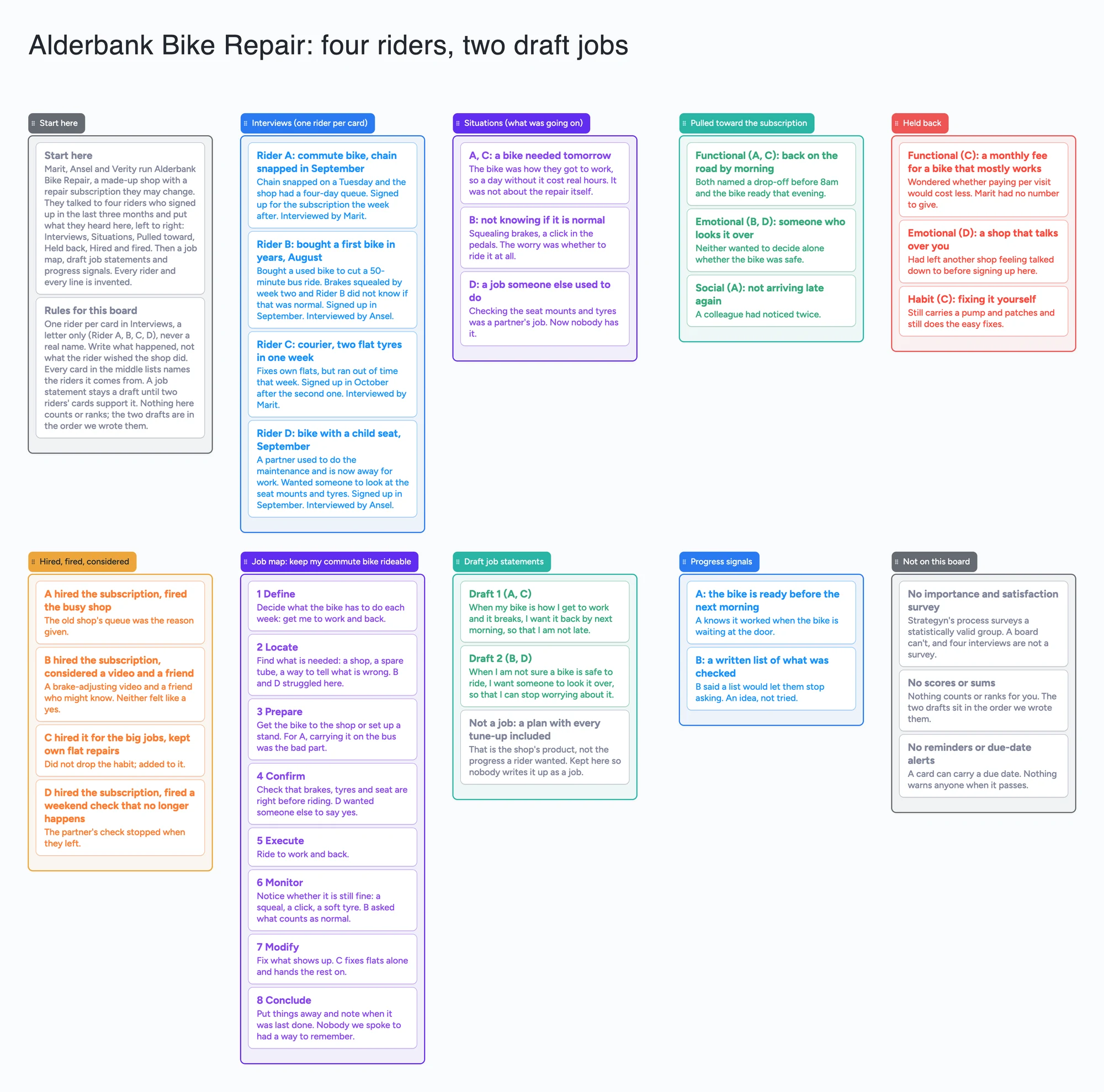
Interview notes end up in four documents and nobody reads them side by side. This is a jobs to be done board already laid out on Instaboard, our online board, filled in for an invented three-person shop: Marit, Ansel and Verity run Alderbank Bike Repair and talked to four riders who signed up for a repair subscription. The board has ten lists and 35 cards: two cards that explain it, four interviews, then what was going on, what pulled each rider in, what held them back, what they hired and fired, a job map, two draft job statements, two progress signals and three cards on what the board does not do. A board holds the stories. It does not survey anyone, score anything or tell you which job is real. Every rider and every line is invented.
Opens in your browser. Anyone can view; a free sign-in lets you edit.
Updated
The short answer
- What it is: a shared page where a small team writes up each customer interview as one card, sorts what it heard into a few lists, and drafts a job statement once two interviews point the same way. The example uses 46 of your 150 free items.
- What it is not: a research method that does the work. Nothing is surveyed, scored or ranked, there are no reminders or due-date alerts, and four interviews are a few stories, not a market.
- Where other tools win: Strategyn's guide runs a survey of a statistically valid group across 50 to 150 measurable desired outcomes, which a board can't; Miro's templates page offers eleven templates for a live workshop with stickies. Both are in a table below.
- Where this board may help: our view: a team that has already talked to a handful of customers and wants the notes in one place, with a rule that a job waits for two interviews.
- Keep off it: real customer names, recordings and anything a customer told you in confidence. The example uses letters and invented riders. A link board is not private.
Where a board can't follow the method
- No survey and no scores. Strategyn's third phase surveys "a statistically valid population" to measure how important and how well served each outcome is. Four interviews are not that, and the board adds nothing up.
- No ranking. The two draft statements sit in the order we wrote them. Which is bigger is a judgement your team makes by reading the cards.
- No reminders or due-date alerts. A card can carry a due date; nothing warns anyone when it passes.
- No recordings. The board holds typed notes. A card can carry text, and a board takes three pictures on the free plan, so audio and long transcripts belong somewhere else.
- A short job map, not a research map. Strategyn says "A job map is not a process map or a customer journey map" and that the average job has 10 to 20 steps. Alderbank's has one card for each of the eight named steps, so it is a start.
Two schools use the same name
Strategyn's guide, written by Tony Ulwick, says Jobs-to-be-Done "is a theory of innovation that holds that people buy products and services to get a job done". Its history section says Ulwick conceptualized it in 1990, named his process Outcome-Driven Innovation® in 1999 (Strategyn's page shows it as its registered mark), and that Clayton Christensen "popularized" it in his 2003 book The Innovator's Solution. That is Strategyn's own account of its history; we did not check the other side of it. The page prints no date; its footer says Copyright 2025.
The Clayton Christensen Institute describes it differently: "a lens that reveals the circumstances—or forces—that drive people and organizations toward and away from decisions", and says people "hire" products or services when jobs arise in their lives. It adds that "Jobs is not asking why someone made their decision" and that the method is "about uncovering a story". Its page prints no date; the footer says 2016 – 2026.
The two pull a board in different directions. Strategyn's process is quantitative: it says needs are measurable, and its second phase captures "50 to 150 measurable desired outcomes" before a survey ranks them. The Institute's version starts from the story. A board suits the story side: one card per person, then what was going on and what pulled them toward or away. Alderbank's lists borrow the Institute's forces toward and away, and its functional, social and emotional labels; its hired, fired and considered list and its progress signals come from Miro's template page; its job map uses the eight steps in Strategyn's guide.
Alderbank Bike Repair, list by list
- Start here (2 cards). Who the three people are, and the rules: one rider per interview card, a letter and never a name, write what happened and not what the rider wished the shop did, and a job statement stays a draft until two riders' cards support it.
- Interviews (4 cards). Rider A's chain snapped and the shop had a four-day queue; Rider B bought a first bike in years and did not know if squealing brakes were normal; Rider C is a courier who ran out of time after two flat tyres in a week; Rider D has a child seat and a partner who used to do the maintenance and is now away.
- Situations (3 cards). A and C needed the bike the next day because it was how they got to work; B did not know if it was normal; D had inherited a job someone else used to do.
- Pulled toward the subscription (3 cards). Functional (A, C): back on the road by morning. Emotional (B, D): someone who looks it over. Social (A): not arriving late again.
- Held back (3 cards). C wondered if paying per visit would cost less, and Marit had no number to give; D had left another shop feeling talked down to; C still carries a pump and patches.
- Hired, fired, considered (4 cards). A hired the subscription and fired the busy shop; B considered a video and a friend; C hired it for the big jobs and kept the flat repairs; D replaced a weekend check that stopped when the partner left.
- Job map (8 cards). Define, Locate, Prepare, Confirm, Execute, Monitor, Modify, Conclude, each with a line from the interviews where there was one.
- Draft job statements (3 cards). Draft 1 (A, C) is about getting the bike back by next morning; Draft 2 (B, D) is about not being sure a bike is safe. The third card is a plan with every tune-up included, marked as a product and not a job.
- Progress signals (2 cards). A knows it worked when the bike is waiting at the door; B said a written list of what was checked would let them stop asking, which is an idea and not something tried.
- Not on this board (3 cards). No survey scores, no sums, no reminders or due-date alerts.
From four interviews to two drafts
Our telling of the example: Marit and Ansel each wrote up two interviews the day they happened, one card per rider. Then they read across. Two cards in Situations began with a bike that was needed tomorrow (A, C); two began with not knowing if a bike was safe (B, D). Each pair got a draft in the shape Miro's page gives a job story, "When I… I want to… so that I…", and each draft names the riders it rests on, so a reader can go back to the interview.
The Institute's warning that the method is not about asking why someone decided shaped the card wording: cards say what happened. "Chain snapped on a Tuesday and the shop had a four-day queue" is an event; "wanted faster repairs" would be the rider's guess at a cause. The third card in the statements list is there because a plan with every tune-up included describes the shop's product. A statement for a job is about the rider's progress, so the card is kept as a reminder not to write it up.
C is the awkward rider. C hired the subscription for the big jobs and kept fixing flats alone, and the money worry in Held back is C's. The board does not settle it. Marit had no number for whether paying per visit would cost less, so that card stays open until someone finds one; it is not a finding.
Run it with your own interviews
- Open the board and rewrite Start here with your own team and your own product, so it is never half a bike shop.
- Delete Alderbank's cards and keep the ten lists. Rename any list that does not fit what you heard.
- Add one card per person you interviewed, with a letter and never a name, the month, and who interviewed them. Miro's page suggests interviewing recent buyers who have used the product for at least two or three months and made the buying decision; Alderbank's riders signed up in the last three months, which is a little different.
- Write cards in the middle lists the day of each interview, and put the riders' letters in each title so you can go back.
- Fill the job map from what people said, not from what you assume. Strategyn's guide says the best job maps include insights gleaned from interviews.
- Draft a statement only when two interviews support it, and keep a card for the solutions that are not jobs.
- Share it. Set the share setting so anyone who joins can edit ("Anyone who joins can edit"); new boards start view-only, and each person signs in to write.
Strategyn, the Clayton Christensen Institute, Miro and ProductPlan are not affiliated with and do not endorse this page, and none of the four is affiliated with Instaboard.
Four pages on the same method, read November 26, 2026
"Not listed" means not on the page we read, not that the tool lacks it. No ranking: they do different things.
| Page | What it says | Better than a board at | Where a board fits |
|---|---|---|---|
| Strategyn: Jobs-to-be-Done guide by Tony Ulwick (no page date; footer Copyright 2025; vendor of consulting and the ODIpro training platform) | Defines the job map's eight steps, three customer roles and a six-phase process in which the survey is the third phase; offers a free job map template download; says "86% success rate" for its own process | Measuring needs with a survey and finding segments, per the page | The interview stage: notes from a few customers read side by side |
| Clayton Christensen Institute: Jobs to Be Done Theory (no page date; footer 2016 – 2026) | Defines it as forces toward and away from decisions; an infographic of three must-knows; case studies on condominium sales and choosing college | The thinking and the worked cases | A place for your own interview cards beside the idea |
| Miro: Jobs to Be Done templates page (no date printed; 11 templates; plan limits not listed on that page) | Templates for a team to capture interviews as demand creation, desired progress and hiring, with green and red stickies, and a job story in "When I… I want to… so that I…" form | A live workshop on a big canvas with stickies | Notes that carry on between workshops |
| ProductPlan: Jobs-To-Be-Done Framework glossary entry (vendor; no page date) | Names two cons: research "can lead your user research to become too abstract and high-level", and some teams worry it can lead to "lackluster design and user experience"; its site menu lists idea capture and roadmaps | Carrying a finding into a roadmap, per its menu; we did not read its product pages | Keeping the evidence behind a job where the whole team can open it |
Swipe the table sideways to see every column.
From each page as read November 26, 2026. Strategyn, Miro and ProductPlan are vendors. Instaboard isn't affiliated with any of them.
How many interviews fit, and what the free plan limits
Each card and each list is 1 of your 150 free items, across all your boards, and the title text box counts too. Arrows, sections and pen strokes don't. Moving a card from one list to another doesn't add an item.
- As built: 10 lists + 35 cards + the title = 46, which leaves 104.
- What stays fixed: the 2 start cards, 8 job map cards, 3 draft statements and 3 cards on what the board doesn't do are 16, plus 10 lists and the title, so 27.
- What grows with riders: the example has 19 cards for 4 riders, a little under five each. At five cards a rider (our rounding up), 24 riders make 27 + 24 x 5 = 147, and the 25th makes 152.
- Copies: two copies of the example as built are 2 x 46 = 92. A copy takes 1 of your 5 free boards.
Limits of the free plan for this board:
- Boards. 5 on the free plan. "Make a copy" takes 1 of them.
- Pictures. 3 per board. The example has none.
- Writing needs a free sign-in. Anyone who joins can view the board; to change it they sign in, and the board then counts as 1 of their 5.
- No reminders or due-date alerts, no sums, no scores.
- Private details. A link board is not the place for customer names, recordings or anything told in confidence; invite-only boards are a Pro feature.
Start from the ready board
It opens in your browser in a few seconds, with nothing to install. Sign in for free when you want to save it and share it.
Questions
What is a jobs to be done board?
A board a team uses to keep customer interviews in one place and read them side by side. The Clayton Christensen Institute describes the method as a lens on the circumstances, or forces, that push people toward and away from decisions. Ours has one card per person, lists for what was going on and what pulled them in or held them back, a job map and draft statements.
Whose method is it, Christensen's or Ulwick's?
Strategyn's guide says Tony Ulwick conceptualized it in 1990 and that Clayton Christensen popularized it in 2003; the Christensen Institute presents it as a lens on forces toward and away from a decision. We have not checked the history beyond those two pages, so the board borrows from both and names where each part comes from.
Does the board rank the jobs or score the outcomes?
No. It adds nothing up and ranks nothing. Strategyn's process surveys a statistically valid population to measure how important each outcome is and how well served it is; four interviews on a board are not that. The two draft statements sit in the order we wrote them.
How many interviews can one board hold?
Our arithmetic: 27 items stay fixed and the example uses about five cards a rider, so 24 riders make 147 of your 150 free items and the 25th passes 150. Pro removes the item limit, at $5 a month billed yearly ($59.99 a year) or $7.99 monthly.
Should I put customers' names on it?
Our view: no. The example uses a letter for each rider and invented details. A link board is not private: whoever you send the link to can read it. Invite-only boards are a Pro feature.
Who can add to the board?
Anyone you share the link with can read the board. To add a card they sign in for free, and if the share setting is "Anyone who joins can edit" they can edit. A board opened from your link takes 1 of their 5 free boards, and a copy takes 1 of yours.
Sources
- Strategyn: Jobs-to-be-Done (A Comprehensive Guide), Tony Ulwick (no page date; footer Copyright 2025; read in full November 26, 2026; vendor content)
- Clayton Christensen Institute: Jobs to Be Done Theory (no page date; footer 2016 – 2026; read in full November 26, 2026)
- Miro: Jobs to Be Done templates and examples (no date printed; 11 templates; read in full November 26, 2026; vendor content)
- ProductPlan: Jobs-To-Be-Done Framework glossary (no page date; read in full November 26, 2026; vendor content)