For a small shop deciding one thing, with an afternoon to read three rivals' pages
A competitive analysis template for a small shop: three rivals' public offers, each fact dated, side by side on one shared board
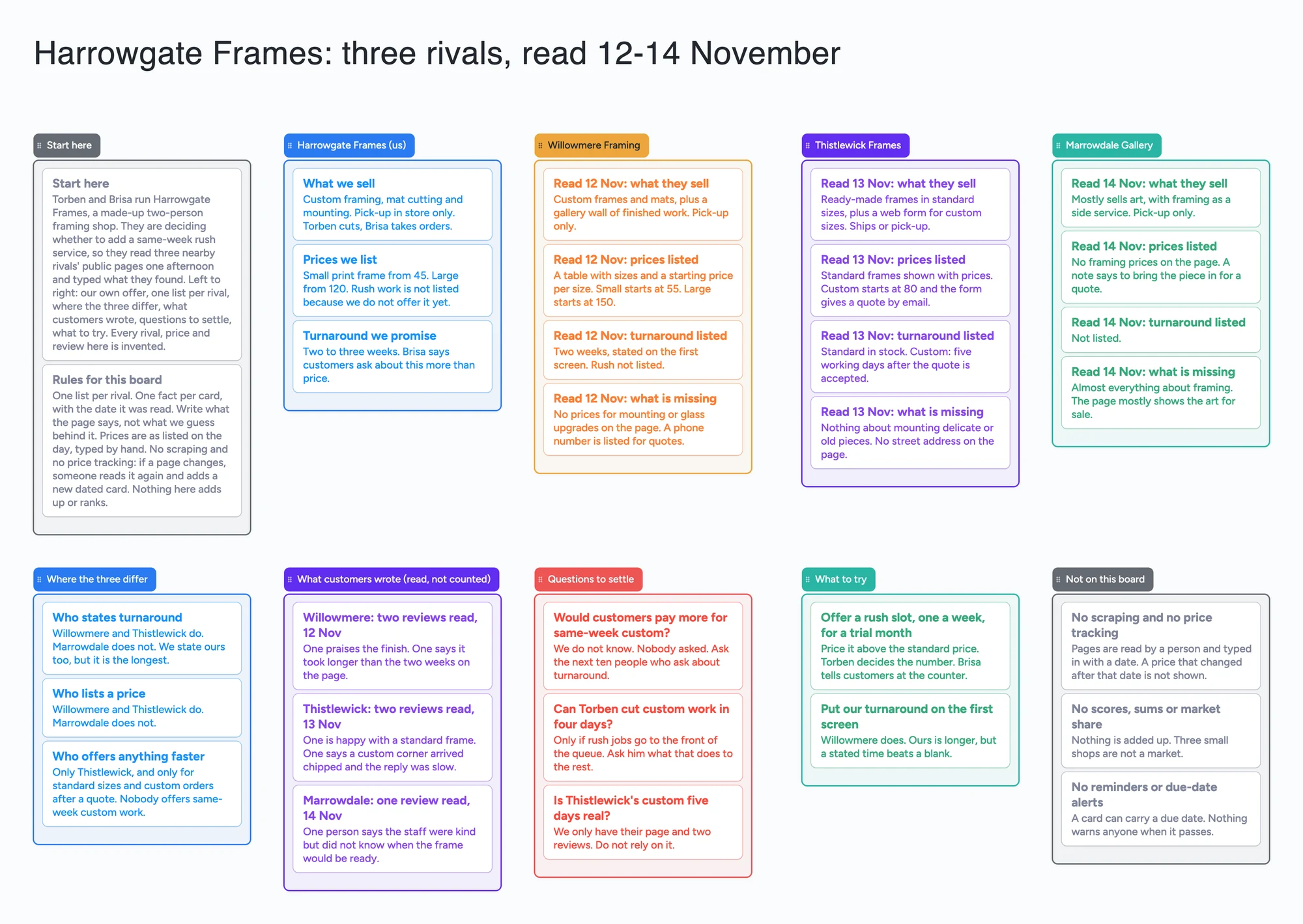
Before you change your prices or add a service, you want to know what the shop down the road already offers. This is a competitor comparison board already laid out on Instaboard, our online board, filled in for an invented two-person framing shop: Torben and Brisa run Harrowgate Frames and are deciding whether to add a same-week rush service, so on three afternoons in November they read three nearby rivals' public pages and typed what each said. The board has ten lists and 31 cards: two cards that explain it, one list for the shop's own offer, one list for each of three rivals, where the three differ, what customers wrote, questions to settle, what to try and three cards on what the board does not do. A board holds what you read, with the date. It does not watch anyone, track a price or tell you who is winning. Every rival, price and review is invented.
Opens in your browser. Anyone can view; a free sign-in lets you edit.
Updated
The short answer
- What it is: a shared page where a small shop writes down what three nearby rivals publicly offer, one list each, one fact per card with the date it was read, and puts its own offer beside them. The example uses 42 of your 150 free items.
- What it is not: a tracker or a market study. Nothing is scraped, no price is followed after the day you typed it, nothing is added up, and there are no reminders or due-date alerts. Three rivals are three rivals, not a market.
- Where other tools win: a spreadsheet gives every rival a row and every factor a column, and software that watches competitor pages or ads does the watching for you; Miro offers 17 competitive analysis templates for a live workshop. The table below has the pages we read.
- Where this board may help: our view: one owner or a pair who need one decision made, such as whether to add a service, and who want the evidence in one place the whole shop can open.
- Keep off it: anything you were not meant to see, such as a rival's private price list, a customer's name, or a screenshot from a login. The example reads public pages only. A link board is not private.
Start from one decision, not from a framework
The US Chamber of Commerce's small business site (CO-, published July 16, 2026) says: "Any competitive analysis you perform should be connected to a specific business goal or decision." It lists six ways to do one: a SWOT, Porter's Five Forces, a growth-share matrix, strategic growth analysis, position mapping and a feature comparison matrix. Harrowgate's decision is narrow, whether to add a same-week rush service, and that picks the lists: what each rival sells, what it lists as a price, what it says about turnaround and what is missing.
Salesforce's small business guide (EMEA, March 11, 2026; a CRM vendor) names five areas to look at: product, cost, place, promotion and brand. Harrowgate's board uses three of those and leaves the rest out on purpose. Place does not matter, because all three rivals are pick-up only. Promotion and brand are not what the decision turns on. Cutting the list to what the decision needs is the first move, and it is yours to make.
The Small Business Administration's page says "Competitive analysis helps you make your business unique" and that the analysis should identify competitors "by product line or service and market segment", including "Indirect or secondary competitors". Marrowdale Gallery is that kind of rival in the example: a gallery that frames on the side. The competitive analysis section is collapsed and opens by click, and the page prints no date for it; we read it November 26, 2026.
Harrowgate Frames and three rivals, list by list
- Start here (2 cards). Who Torben and Brisa are, the decision, and the rules: one list per rival, one fact per card with the date it was read, write what the page says and not what we guess behind it, prices typed by hand as listed that day.
- Harrowgate Frames (us), 3 cards. What we sell, the prices we list and the turnaround we promise, two to three weeks. Rush work is not listed because the shop does not offer it yet.
- Willowmere Framing, 4 cards (read 12 Nov). Custom frames and mats with a gallery of finished work; a size table with starting prices; two weeks stated on the first screen; no mounting or glass prices on the page.
- Thistlewick Frames, 4 cards (read 13 Nov). Ready-made frames in standard sizes and a web form for custom ones; custom starts at 80 by emailed quote; five working days after the quote is accepted; nothing about mounting delicate pieces.
- Marrowdale Gallery, 4 cards (read 14 Nov). Mostly sells art; no framing prices, a note to bring the piece in for a quote; turnaround not listed.
- Where the three differ (3 cards). Who states turnaround, who lists a price, and who offers anything faster. Only Thistlewick Frames does, for standard sizes and for custom orders after a quote.
- What customers wrote (3 cards). Two reviews read for each of the first two rivals and one for the third, typed as events, not scored.
- Questions to settle (3 cards). Would customers pay more for same-week custom, can Torben cut custom work in four days, and is Thistlewick's five days real. The last card says we only have their page and two reviews.
- What to try (2 cards). A rush slot once a week for a trial month, priced above standard, and the shop's own turnaround on its first screen.
- Not on this board (3 cards). No scraping or price tracking, no scores, sums or market share, no reminders or due-date alerts.
What this board skips, and why that is fine for one decision
- No strengths-and-weaknesses lists. Salesforce and the Chamber both describe a SWOT as one framework among several. Harrowgate's lists are by rival, and the weakness a rival has is what its page leaves out.
- No grid of rivals against factors. The US Chamber describes a feature comparison matrix with competitors in the first column and the factors customers weigh across the top. A board can hold that as cards, but a spreadsheet is faster to read once there are more than a handful of factors.
- No watching over time. Salesforce suggests "quarterly or monthly reviews with updated competitor insights". A board can hold a second dated card, but nothing tells you a rival changed.
- No market share. The SBA's list includes market share. Three small shops reading three pages cannot say anything about it.
What goes on a card when you read a rival's page
Our telling of the example: Brisa read each page on a different day, and the card titles start with "Read 12 Nov", "Read 13 Nov" and "Read 14 Nov" so nobody mistakes a card for today's price. A card that says "Not listed" is a finding as much as a card with a price: it says what the page does not tell a customer. The "what is missing" cards are the useful ones for Harrowgate. Nobody offers same-week custom work, and nobody but Willowmere puts turnaround on the first screen.
Customer reviews are cards of events and not scores. "One says a custom corner arrived chipped and the reply was slow" is something that happened. A star average would be a number the board cannot check. Miro's template page lists "Customer Friction Points" as one of five components of a competitor board and suggests reviews or social listening as the source; the example uses reviews only, read by hand, and says how many were read.
The last two lists are the shop's own. Questions to settle holds what the reading could not answer, and one card says plainly that Thistlewick's five-day claim is only a page and two reviews. What to try holds the next step, priced by the owner. Neither is a finding from the rivals.
Set up yours in an afternoon
- Open the board and rewrite Start here with your own shop and the one decision it is for, so it is never half a framing shop.
- Delete Harrowgate's cards and keep the lists. Rename a rival list to the rival's name; add or remove lists for the number you actually have.
- Write your own offer first, with the prices you list and the turnaround you promise, so you are reading rivals against what you actually say.
- Read each rival's public page on its own day, and put the date in every card title. One fact per card.
- Write what is missing, not only what is there.
- Fill Where the three differ last, from the cards, and put your questions in their own list.
- Share it. Set the share setting so anyone who joins can edit ("Anyone who joins can edit"); new boards start view-only, and each person signs in to write.
How many rivals fit, and what the free plan limits
Each card and each list is 1 of your 150 free items, across all your boards, and the title text box counts too. Arrows, sections and pen strokes don't. Moving a card from one list to another doesn't add an item.
- As built: 10 lists + 31 cards + the title = 42, which leaves 108.
- What stays fixed: the 2 start cards, 3 own-offer cards, 3 differ cards, 3 review cards, 3 question cards, 2 try cards and 3 not-on-this-board cards are 19, plus the 7 lists that are not a rival's and the title, so 27. Each rival adds one list and four cards, so 5 items; the example's three rivals are 15.
- More rivals: 27 + 5 per rival, so 10 rivals make 27 + 50 = 77, 24 rivals make 147, and the 25th passes 150.
- A second reading: if every rival gets four new dated cards six weeks later, three rivals add 12 cards, so the example becomes 54.
- Copies: two copies of the example as built are 2 x 42 = 84. A copy takes 1 of your 5 free boards.
Limits of the free plan for this board:
- Boards. 5 on the free plan. "Make a copy" takes 1 of them.
- Pictures. 3 per board. The example has none, so a screenshot of a rival's page is a card of words.
- Writing needs a free sign-in. Anyone who joins can view the board; to change it they sign in, and the board then counts as 1 of their 5.
- No reminders or due-date alerts, no sums, no scores.
- Private details. A link board is not the place for anything a rival or a customer would not want shared; invite-only boards are a Pro feature.
Four pages on the same job, read November 26, 2026
The four pages below are real. The card dates on the board (12 to 14 November), its rivals, prices and reviews are invented. "Not listed" means not on the page we read, not that the tool lacks it. No ranking: they do different things.
| Page | What it says | Better than a board at | Where a board fits |
|---|---|---|---|
| US Chamber of Commerce, CO-: Competitive Analysis Templates to Help Inform Your Business as It Grows (published July 16, 2026; shows a "Brought to you by Walmart" block) | Defines a competitive analysis and lists SWOT, Porter's Five Forces, a growth-share matrix, strategic growth analysis, position mapping and a feature comparison matrix; says to tie it to "a specific business goal or decision" | Explaining the six methods and when to use each | Holding one decision's evidence for the people who have to act on it |
| Salesforce EMEA: The Complete Guide to Competitor Analysis for Small Businesses (March 11, 2026; CRM vendor) | Five areas (product, cost, place, promotion, brand), five steps, a spreadsheet of findings and a CRM to track them; suggests quarterly or monthly reviews | Tracking competitors across email, social and ads in a CRM, per the page; we did not read its product pages | A short read of three pages for one decision, with nothing to buy |
| Small Business Administration: Plan your business (government; the section opens by click; no page date) | Competitive analysis should identify competition by product line or service and market segment, and assess market share, strengths and weaknesses, barriers and indirect competitors | Authority on what a start-up plan should cover | Where the evidence behind a plan lives |
| Miro: Competitive analysis templates (17 templates; no date printed; vendor) | Templates for a perceptual map, SWOT/TOWS, feature comparison matrix and Porter's Five Forces; names competitor tiers, pricing and customer friction points as components | A big canvas and a live workshop with stickies and 2x2 maps | Notes that carry on between workshops |
Swipe the table sideways to see every column.
From each page as read November 26, 2026. Salesforce and Miro are vendors; the Chamber page shows a "Brought to you by Walmart" block; the SBA is a government site. Instaboard isn't affiliated with any of them.
Start from the ready board
It opens in your browser in a few seconds, with nothing to install. Sign in for free when you want to save it and share it.
Questions
What is a competitor comparison board?
A board where a small shop puts what a few rivals publicly offer, one list each, next to its own offer. The US Chamber of Commerce's small business site describes a competitive analysis as a process that reveals how competitors' products, marketing, pricing and other variables compare to yours. Ours is that comparison held as cards for one decision.
Does the board track my rivals' prices?
No. It scrapes nothing and watches nothing. Every price on a card was typed by a person from a public page on the date in the card's title, and a price that changed afterwards is not shown. A second dated card is how the example records a change.
Is it a SWOT?
No. A SWOT sorts what you know into strengths, weaknesses, opportunities and threats. This board is organised by rival and by what each page says, and the weakness it records is what a page leaves out. Both the US Chamber and Salesforce describe a SWOT as one method among several.
How many rivals can one board hold?
Our arithmetic: 27 items stay fixed and each rival adds 5 (one list and four cards), so 24 rivals make 147 and the 25th passes 150. Pro removes the item limit, at $5 a month billed yearly ($59.99 a year) or $7.99 monthly.
Should I put a rival's private information on it?
No. The example reads public pages only. A link board is not private, so anyone you send the link to can read it. Invite-only boards are a Pro feature.
Who can add to the board?
Anyone you share the link with can read the board. To add a card they sign in for free, and if the share setting is "Anyone who joins can edit" they can edit. A board opened from your link takes 1 of their 5 free boards, and a copy takes 1 of yours.
Sources
- US Chamber of Commerce, CO-: Competitive Analysis Templates to Help Inform Your Business as It Grows, by Emily Heaslip (published July 16, 2026; read in full November 26, 2026; shows a "Brought to you by Walmart" block)
- Salesforce EMEA: The Complete Guide to Competitor Analysis for Small Businesses (March 11, 2026; read in full November 26, 2026; vendor content)
- Small Business Administration: Plan your business, market research and competitive analysis (the competitive analysis section is collapsed and opens by click; no page date; read November 26, 2026)
- Miro: Competitive analysis templates (17 templates; no date printed; read in full November 26, 2026; vendor content)