For a small team that has talked to users and wants one picture of them
An empathy map template: what one user says, thinks, does and feels, with the source on every card, on one shared board
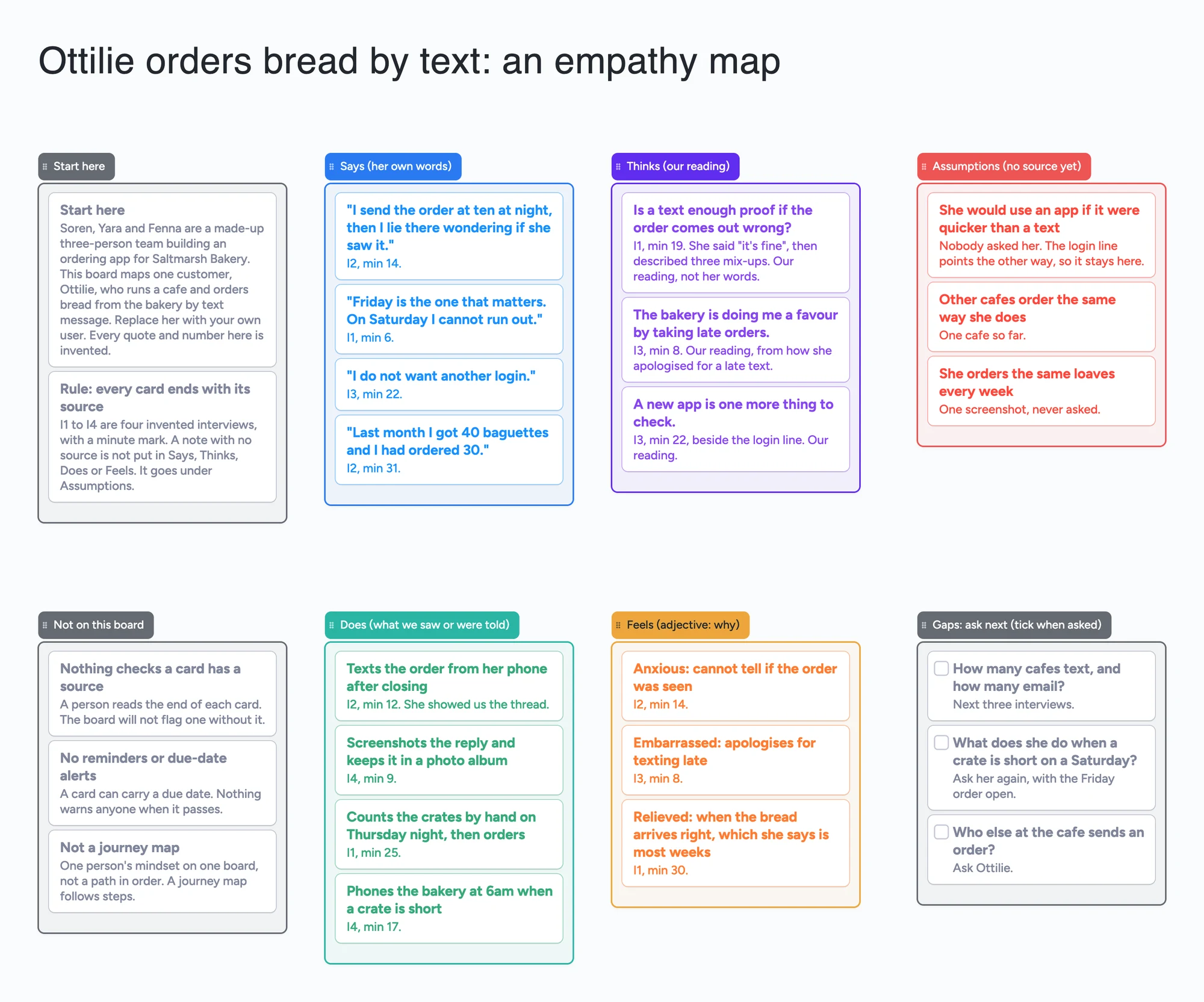
We make Instaboard, an online board. This page gives you an empathy map already laid out on it, filled in for an invented customer: Soren, Yara and Fenna are a three-person team building an ordering app for Saltmarsh Bakery, and the board maps Ottilie, who runs a cafe and orders bread from the bakery by text message. It has eight lists and 25 cards. Four of the lists are the quadrants (Says, Thinks, Does, Feels), and the other four hold the rules, the guesses, the questions still to ask and what the board does not do. The honest picture comes first. The board does not check that a card has a source, it adds nothing up, and it has no step that hides one person's cards from another. Every quote and number on it is invented.
Opens in your browser. Anyone can view; a free sign-in lets you edit.
Updated
The short answer
- What it is: one shared page that holds what a team knows about one user, in four boxes (Says, Thinks, Does, Feels), with a source written at the end of every card and a separate list for what is only a guess. The example uses 34 of your 150 free items.
- What it is not: a check on the evidence. Nothing flags a card with no source, nothing adds up, there are no reminders or due-date alerts, and every card is visible to everyone who has the board open, so a write-alone step has to happen on paper or in a document first.
- Where other tools win: Miro's template page lists 55 empathy map templates, Mural's template has a private mode that hides brainstorming results until everyone has contributed, and Atlassian's Team Playbook gives a 60-minute run order for 3 to 6 people. All three are in a table below.
- Where this board may help: a team of two to six that already has interview notes and keeps losing track of which lines were said by the user and which were the team's own reading.
- Keep off it: a real customer's name, anything a person told you in confidence, and health or money details. The example is invented. A link board is not private.
Four boxes, six boxes or a mix: what three explainers ask for
The three explainers we read (Nielsen Norman Group, Atlassian and IDEO) agree on the idea and differ on the boxes. Atlassian's is also a vendor page, and it appears in the table below as one. Nielsen Norman Group's article (October 2, 2026) calls an empathy map "a collaborative visualization that captures what we know about a particular user or about a user segment". It says traditional maps have four quadrants, Says, Thinks, Does and Feels, with the user or persona in the middle, and that the map is "deliberately not chronological or sequential". It asks for Says to hold, ideally, direct quotes, and for each Feels entry to be an adjective plus a short phrase. It names Goals as a common fifth quadrant. Nielsen Norman Group sells courses, including one on empathy maps, so we read it as a training company's view.
Atlassian's Team Playbook page (no date printed) uses six parts instead: Thinks and feels, Hears, Sees, Says and does, Pain and Gain. Its run order is 15 minutes of prep, 60 minutes to run and 3 to 6 people, and it tells the group not to guess. Atlassian sells software, and the page links its own empathy map template.
IDEO's piece by Tom Kelley (published November 6, 2018) draws the four quadrants as say, do, think and feel, and puts what people say and do on the left. Its steps fill the left side with observations first. Only then does it fill the right, "inferring what people think" and what they feel. It calls the tool "inspired by IDEO and further developed at the Stanford d.school".
Ottilie's board takes the four-quadrant form and IDEO's order of trust: the Says and Does lists are what Ottilie said or what we were told she does, while the Thinks list is headed "our reading" and each of its cards says so. That choice is ours. None of the three pages asks for a separate Assumptions list; we added it because Nielsen Norman Group says a note you can't point to a source for "is an assumption, and it should be labeled as one".
Ottilie, list by list
- Start here (2 cards). Who the three team members are and who Ottilie is, and the one rule: every card ends with an interview number (I1 to I4, four invented interviews) and a minute mark, and a note with no source goes under Assumptions.
- Says, her own words (4 cards). "I send the order at ten at night, then I lie there wondering if she saw it" (I2, minute 14); "Friday is the one that matters. On Saturday I cannot run out" (I1, minute 6); "I do not want another login" (I3, minute 22); "Last month I got 40 baguettes and I had ordered 30" (I2, minute 31).
- Thinks, our reading (3 cards). Whether a text is enough proof if the order comes out wrong (I1, minute 19, where she said it was fine and then described three mix-ups); a sense that the bakery is doing her a favour by taking late orders (I3, minute 8, read from how she apologised for a late text); and a worry that a new app is one more thing to check (I3, minute 22). Each card says it is our reading.
- Does, what we saw or were told (4 cards). She texts the order from her phone after closing (I2, minute 12, she showed the thread); screenshots the reply and keeps it in a photo album (I4, minute 9); counts the crates by hand on Thursday night, then orders (I1, minute 25); and phones the bakery at 6am when a crate is short (I4, minute 17).
- Feels, adjective and why (3 cards). Anxious because she can't tell if the order was seen (I2, minute 14); embarrassed, because she apologises for texting late (I3, minute 8); relieved when the bread arrives right, which she says is most weeks (I1, minute 30).
- Assumptions, no source yet (3 cards). That she would use an app if it were quicker than a text; that other cafes order the way she does; that she orders the same loaves every week. Each card says why it is here.
- Gaps, ask next (3 tick-box cards). How many cafes text and how many email; what she does when a crate is short on a Saturday; who else at the cafe sends an order. The box is ticked when someone has asked.
- Not on this board (3 cards). Nothing checks that a card has a source, no reminders or due-date alerts, and it is not a journey map.
One line followed across the board: "I do not want another login"
Our telling of the example. In interview 3, at minute 22, Ottilie says she does not want another login, so that line sits in Says with its source. Beside it in Thinks the team wrote that a new app is one more thing for her to check; the card says it is our reading, and it gives the same minute mark. The team's hope that she would use an app if it were quicker than a text did not come from anyone, so it sits in Assumptions with the line "Nobody asked her", and the login line is named as the reason it stays there. The next step is on the Gaps list: how many cafes text and how many email.
Nielsen Norman Group says contradictions between quadrants "are worth investigating", because they often point to something users did not say. Ottilie's board has one. In Feels she is anxious about whether the order was seen, and in Does she screenshots the reply to keep it, yet she also says most weeks the bread comes out right. The board does not mark that as a contradiction; a person has to see it.
Can the user fill the map in themselves?
Nielsen Norman Group says yes, as an extra: at the end of an interview or usability session, hand the participant a blank template and ask them to fill in the four quadrants, which gives "a supplementary data source". It adds a caution about Does: what people report doing is not always what you observed them do.
A Reddit thread asked a version of the same question. We read it in an archived copy: r/ProductManagement, posted October 21, 2022 (UTC), "Can users themselves fill out empathy maps, problem statements, personas, etc?", which Reddit shows with 16 comments; we read all 16 in an archived copy and quote seven accounts below, including the ones against the idea. Per account:
- u/nunee1 answered "No, this is lazy", saying customers do not categorize their answers the way the team would.
- u/ballastremix called empathy maps "a questionable tool at the best of times due to bias and misinterpretation", and said that if an experienced expert isn't synthesising the data first, you take on "a lot of risk of making poor decisions off the back of them". The same account recommended two books on interviewing and mental models.
- u/StartupPMF wrote that the value of the exercise is not only the output but the understanding the team gets: "it's to get an understanding of the user, their needs and motivations as you and your team understand it. It's in the learning."
- u/Emergency-Baby-707 said you would not get 80% of the value, but that it was not a terrible idea for someone "new to the industry / product", as a view into how users see themselves.
- u/Artistic_Syrup7117 wrote "I don't think it's lazy, but I still don't think it's a good idea", adding that tools like that take training and experience to use well, so a novice's response should be treated with suspicion.
- u/Obnoxiously_23 wrote "Not without paying them and you don't want data from the people who want to be paid to do it."
- u/Bob-Dolemite called the idea "effectively farming out research to your customers" and, at best, "laziness". The original poster (u/SlicedAdvice) argued back that it would sit beside interviews, not replace them, and the poster ended the exchange with the one word "Blocked."
These are seven accounts out of 16 comments, not a count of what most people think, and most of the ones we quote were against the idea. Our view: Ottilie's board suits the version where the team writes the map from its own notes, and a participant's own fill-in goes in as one more source with its own interview number. The board has no form for a participant to fill in.
Do working teams use them? A poster doubts it, and replies describe how they use them
A second thread, r/UXDesign, posted February 25, 2022 (UTC), "Be honest, do you really work with personas, storyboards, empathy maps and stuff like that?". Reddit shows 65 comments; we read 69 with text in an archived copy. The original poster wrote that they had not really come across anyone who uses these tools in their work, and asked who does. We quote four accounts; others in the thread also mention them. Per account: u/wesleyxx wrote "Personas, Empathy Maps and (most importantly) Customer Journey Mapping every single time. Storyboarding not so much." u/thollywoo said they always do a persona and add an empathy map when the persona alone leaves them struggling to empathise with the user, and a journey map when they can't work out the user flow. u/uxuie wrote that a persona is more "macro" and that "Empathy maps are more 'micro'. You can use them as a snapshot of a user's mindset in a particular flow or user problem they're having in a specific situation." u/Luigiapollo wrote "Yes I use them in every work I realize."
Four quoted accounts is not a survey, and the poster started the thread doubting the tools. We cite them because they name the job the map does, which the board is built for: it holds what a team knows about one person in one place, beside the persona or journey map rather than in place of them.
Three vendor pages to run one on, read November 25, 2026
"Not listed" means not on the page we read, not that the tool lacks it. No ranking: they suit different teams.
| Page | What it says | Better than a board at | Where a board fits |
|---|---|---|---|
| Miro: empathy map templates (no date printed) | Lists 55 templates; the first, "Empathy Map Template" by Miro, shows 25 likes and 3.5K uses and describes four squares for what customers Say, Think, Do and Feel; plan limits not listed on that page | A choice of 55 layouts and a facilitated workshop on a big canvas | One user's notes in lists, one link for the team |
| Mural: empathy map template (no date printed) | Four steps: pick the persona, invite stakeholders, brainstorm, group ideas into themes; suggests private mode to hide results until everyone has contributed, plus a timer tool; plan limits not listed on that page | Writing alone first, then revealing together | Notes that stay put between workshops, with the source on each |
| Atlassian Team Playbook: Empathy Mapping (no date printed; vendor of software) | 15 minutes prep, 60 to run, 3 to 6 people; six parts; asks the team to draw on interviews with actual customers beforehand | A timed run order for a session | The map that carries on after the session |
Swipe the table sideways to see every column.
From each page as read November 25, 2026. Miro, Mural and Atlassian are vendor pages. Instaboard isn't affiliated with any of them, or with Nielsen Norman Group or IDEO.
How much of the 150 items does a map use?
Each card and each list is 1 of your 150 free items, across all your boards, and the title text box counts too. Arrows, sections and pen strokes don't. Moving a card from one list to another adds nothing. Our arithmetic:
- As built: 8 lists + 25 cards + the title = 34, which leaves 116.
- One map per user, each on its own board: Nielsen Norman Group says to start with one user or persona per map, so three maps built like this one are 3 x 34 = 102 and four are 136. A fifth, 170, passes 150.
- Six new cards from every interview: 34 + 6 x 19 = 148 after 19 more interviews, and the 20th passes 150 (154).
- Copies: a copy of the example takes 1 of your 5 free boards, and its 34 items count towards your 150.
Pro removes the item limit: $5 a month billed yearly ($59.99 a year), or $7.99 monthly.
Start yours in five steps
- Open the board and rewrite Start here with your own team and your own user. Keep the rule about sources, or write your own.
- Empty Says, Thinks, Does and Feels and put in only what you can trace to an interview, a session or a ticket. Put the interview number and the minute at the end of every card.
- Put every guess in Assumptions, with the reason it has no source yet.
- Turn each guess into a question on the Gaps list and tick it when someone has asked.
- Share it. Set the share setting so anyone who joins can edit ("Anyone who joins can edit"); new boards start view-only, and each person signs in to write.
What to know on the free plan:
- Boards. 5 on the free plan. "Make a copy" takes 1 of them.
- Pictures. 3 per board. The example has none; a picture of a sketch would take one of the 3.
- Writing needs a free sign-in. Anyone who joins can view the board; to change it they sign in, and the board then counts as 1 of their 5.
- No reminders or due-date alerts, no source check and no hidden-notes step.
- Private details. A link board is not the place for a real person's name or something said in confidence; invite-only boards are a Pro feature.
Start from the ready board
It opens in your browser in a few seconds, with nothing to install. Sign in for free when you want to save it and share it.
Questions
What is an empathy map?
Nielsen Norman Group defines it as a collaborative visualization that captures what we know about a particular user or about a user segment. The common form has four quadrants, Says, Thinks, Does and Feels, around the user. IDEO's and Atlassian's pages use the same idea with their own boxes.
Is an empathy map the same as a persona?
No. Nielsen Norman Group says empathy maps are not a replacement for personas, but one way to visualize what you know about a persona in an organized form. A map can also be built for a single actual person, as Ottilie's is.
Can I put guesses on the map?
Nielsen Norman Group says a map can be sketched even if research is lacking, as long as the team is honest and clearly separates evidence from assumptions. Ottilie's board keeps guesses in their own list, each with the reason it has no source yet.
Does the board warn me about a card with no source?
No. A person reads the end of each card. Our example puts the interview number and the minute at the end of every card, and the board does not flag one without it. There are also no reminders or due-date alerts; a card can carry a due date, but nothing warns anyone when it passes.
Should two users share one map?
Nielsen Norman Group says to start with one user or persona per empathy map. Our view: build one board per user, which also keeps each board well under the 150-item limit; four boards like the example come to 136 items.
Who can edit the board?
Anyone you share the link with can read it. To add a card they sign in for free, and if the share setting is "Anyone who joins can edit" they can edit. A board opened from your link counts as 1 of their 5 free boards.
Sources
- Nielsen Norman Group: Empathy Mapping: The First Step in Design Thinking (Rachel Krause and Sarah Gibbons, October 2, 2026; read in full November 25, 2026; training company)
- Atlassian Team Playbook: Empathy Mapping (no date printed; read in full November 25, 2026; vendor content)
- IDEO: Build Your Creative Confidence: Empathy Maps (Tom Kelley, published November 6, 2018; read in full November 25, 2026)
- Miro: Empathy Map templates (no date printed; read November 25, 2026; vendor content)
- Mural: Empathy map template (no date printed; read November 25, 2026; vendor content)
- Reddit r/ProductManagement: Can users themselves fill out empathy maps, problem statements, personas, etc? (posted October 21, 2022 UTC; read 16 comments in an archived copy, November 25, 2026)
- Reddit r/UXDesign: Be honest, do you really work with personas, storyboards, empathy maps and stuff like that? (posted February 25, 2022 UTC; Reddit shows 65 comments; read 69 with text in an archived copy, November 25, 2026)