For a game master and a co-planner running a long tabletop campaign
A DnD campaign planner for the long game, not one session
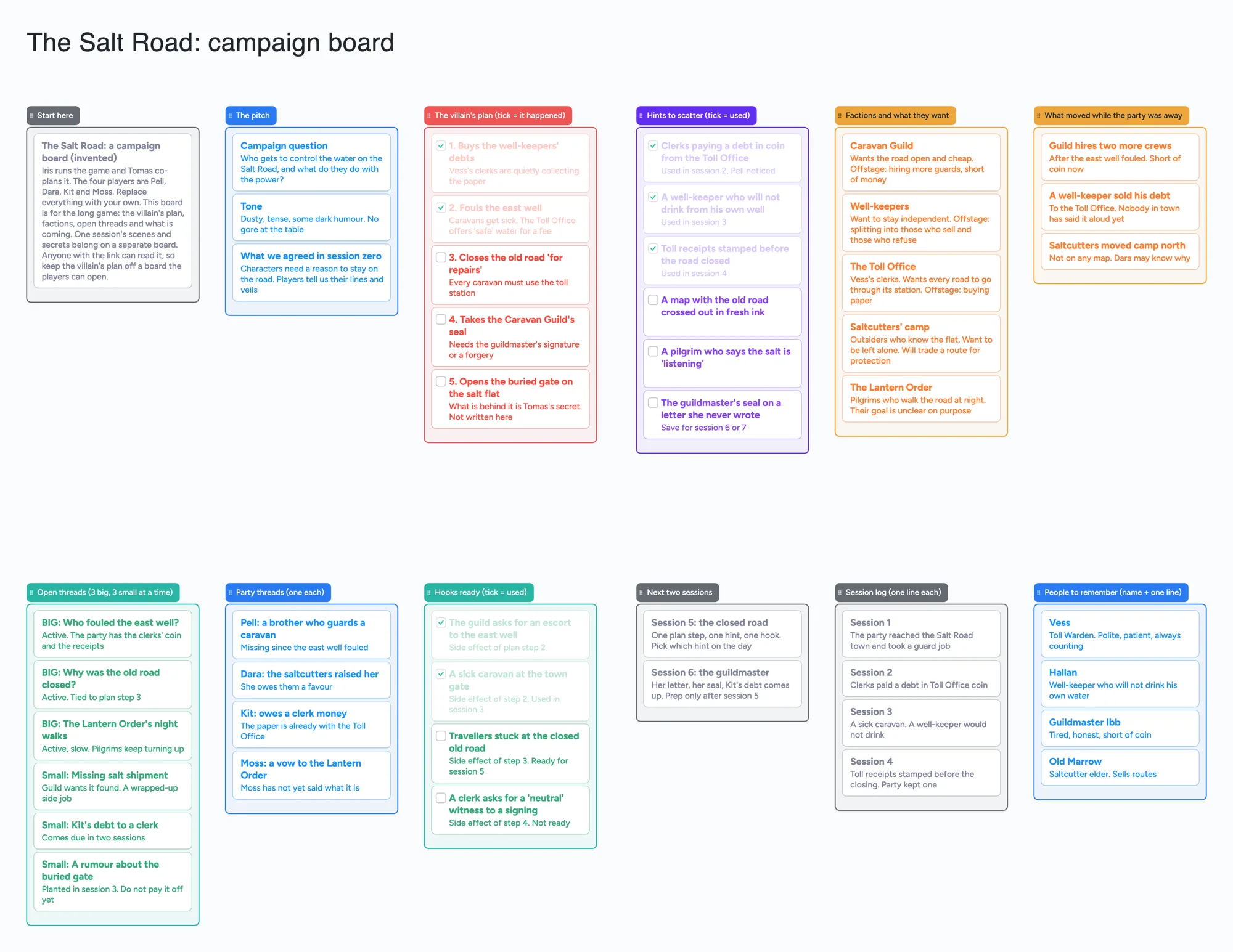
We make Instaboard, an online board. This one is for the whole arc of a tabletop campaign: the villain's plan as steps you tick when they happen, hints to scatter, factions and what they do while the party is away, open plot threads, one thread per player, hooks that are ready, the next two sessions and a one-line log. It is filled in for an invented campaign, The Salt Road, planned by Iris with her co-planner Tomas. It is not a wiki, holds no maps or rules, and anyone with the link can read it, so the villain's plan is the first thing to think about before you share it. A notes app does more of the filing; what a board adds is one picture of what is planned, what has happened and what is waiting, which two planners can edit together.
Opens in your browser. Anyone can view; a free sign-in lets you edit.
Updated
What this board does and doesn't do
- It plans the arc, not a session. The villain's plan, factions, threads and hooks live here. One session's scenes, secrets and handouts belong on a separate board, and a cast of people to track by place is a third job. Our DnD session planner and NPC tracker pages cover those two.
- Anyone with the link can read it. If your players can open the board, they can read the villain's plan. Keep a players' copy with the plan removed, or keep the secret steps off a shared board.
- It holds no rules, no stat blocks and no maps. Cards are short lines of your own notes. Free boards take 3 pictures each.
- It does not remind or schedule. "Session 6" is words on a card. There are no reminders or due-date alerts and no poll for who can come.
- Free plan limits: 5 boards, 150 items across your account and 3 pictures per board. A copy of this board takes 1 of your 5. Pro removes the 3-picture limit and the item limit.
- Everyone with edit access can tick or untick any card. Agree who ticks which.
Before you share it: the villain's plan is on the board
New boards start view-only for anyone with the link, and a board that someone can write on is still readable by everyone who has it. That matters more here than on most boards, because the middle of this one is the part players should not see: the steps of the plan, the hints still to come and what the factions are secretly doing. Three ways round it, none of them built into the board:
- Two planners only. Share the link with your co-planner and nobody else. Iris and Tomas do this.
- Two boards. Copy the board, delete the plan, hints and offstage lists from the copy, and share that one with the table. Each copy takes 1 of your 5 free boards.
- Keep the secrets off. The example leaves the thing behind the buried gate unwritten: the card says it is Tomas's secret and not written here.
Pro has invite-only boards, which keep a board off the open link. Nothing on this page makes a link private on the free plan.
The Salt Road, list by list
The campaign is invented: a dusty road across a salt flat, a Toll Office that wants every caravan to pass through its station, and four players, Pell, Dara, Kit and Moss. Iris runs the game; Tomas co-plans. The lists are our layout, not a rule.
| List | What goes in it | In The Salt Road |
|---|---|---|
| Start here (grey) | What the board is and isn't | One card |
| The pitch (blue) | The campaign question, the tone, what was agreed in session zero | 3 cards |
| The villain's plan (red) | The steps, in order, each a tick box | 5 tick-box cards, steps 1 and 2 ticked |
| Hints to scatter (purple) | Clues the party can find about the plan, each a tick box | 6 tick-box cards, 3 ticked |
| Factions and what they want (orange) | One card per group, with its goal and what it does offstage | 5 cards |
| What moved while the party was away (orange) | Changes you made to the world between sessions | 3 cards |
| Open threads (green) | The plot threads the party can pull on now, big and small | 6 cards: 3 big, 3 small |
| Party threads (blue) | One thread per player character | 4 cards |
| Hooks ready (green) | Ready-made reasons to send the party somewhere, each tied to a plan step | 4 tick-box cards, 2 ticked |
| Next two sessions (grey) | What the next two sessions need, no more | 2 cards |
| Session log (grey) | One line per session played | 4 cards |
| People to remember (blue) | Names with one line each, for the ones who recur | 4 cards |
Swipe the table sideways to see every column.
The board's own wording. Session numbers are typed text; the board has no clock, calendar or reminder.
Planning the plan backwards: villain, hints, hooks
The three red, purple and green lists come from one method that a commenter laid out in r/DMAcademy. In "How do you plan your campaigns?" (posted by u/Vallyria, June 28, 2022), u/HBallzagna answered the question about structuring notes with: "You generally work backwards: First, figure out the villains plan. How many steps are there." They go on to say to write "10-20 hints about what the BBEG is doing" and sprinkle them "2 or 3 per session", and to work out the bad side effect of each step, because local mayors, kings or patrons will hire the party to fix those. That is one person's method, not a rule; other commenters in the same thread use a wiki, OneNote or Google Docs, and u/Eupatorus wrote simply "I don't. I just plan for my next session or two."
- Steps. Write the villain's plan as numbered steps. Tick one when the party's session has made it happen or when you decide it has.
- Hints. Each hint is a clue about a step. Tick it when the table has seen it. In the example, three of six are used and the best, the guildmaster's seal on a letter she never wrote, is saved for later.
- Hooks. Each hook is the side effect of a step: the guild asks for an escort because the east well was fouled (step 2). Each card names its step.
- One of each per session. The same commenter ends with "make sure each session addresses one of the steps of the BBEG's plan, as well as a hint and an adventure hook." The "Next two sessions" list is where you write which ones.
The board can't tell you a hint belongs to a step, or that a step has no hooks. The card text names the step, and the check is yours.
Factions that keep moving while the party is somewhere else
The orange lists follow another commenter's idea. In "What are some methods you use to keep track of plot progression?" (a January 2019 thread, nearly eight years old, posted by u/SensualMuffins), one commenter wrote "I use the faction method": a series of factions tied to plot threads, with the ones the party isn't near "just sit aside", and when the party gets there, "I'll do catch up and figure out what the related factions to those plot threads were up to while the players were away." u/DnD_Delver, in the same thread, writes out traits, bonds, flaws and "most importantly, goals" for each faction and treats them "like I would an individual NPC".
- One card per faction on "Factions and what they want": the goal, and in one phrase what it is doing offstage.
- A second list, "What moved while the party was away," for the changes you decide at the end of a session. In the example, the Guild hired two more crews and a well-keeper sold his debt, and nobody in town has said so aloud yet.
- The board doesn't run the factions. It holds the line you wrote. Whether the Guild has coin is yours to decide.
How many open threads: what people in r/DMAcademy say
In "How many plot threads is too many?" (u/Midnight-Joker-918, August 5, 2024), the comments we read gave different answers, and none is a rule:
- u/TheOriginalDog: tries not to have more than three major long-term and three minor short-term plot threads active, with more held as ideas or planted seeds. Active, for them, means "presented clearly to the players as a current issue." The example board's list title, "3 big, 3 small at a time," borrows this and is our setting, not a standard.
- u/Frog_Thor: one major thread for the end-game villain, one for each character's backstory and one minor thread to tie things together, and "threats can dangle for a long time until they become necessary or interesting." The "Party threads" list is built this way.
- u/Thuesthorn: "No such thing as too many. Let the players choose which their characters pick up."
- u/RandoBoomer: gives the players "a couple large-scale plot hooks" and follows the thread they choose.
A board doesn't settle this. It shows how many cards are sitting in "Open threads" at once, and if there are more than your table can hold, you move some to a list called "Later" or delete them. The example has six.
From session 4 to session 5, on the board
How Iris and Tomas might move the cards after session 4. The order is our example.
- Add a line to "Session log": "Session 4: Toll receipts stamped before the closing. Party kept one." The matching hint, "Toll receipts stamped before the road closed," is ticked.
- Tick step 3 only if it happened, and here it hasn't: the old road is still open on paper. The "Travellers stuck at the closed old road" hook is ready, and it is the side effect of step 3.
- Move something on "What moved while the party was away" to say what the Toll Office did between sessions.
- Fill in "Next two sessions": session 5 gets one plan step, one hint and one hook, picked on the day; session 6 is prepared only after session 5 is played. u/nat1charisma wrote "Now I never plan more than the next 2 sessions," and u/Consistent-Tie-4394 advised to "only prep one or two actual sessions in advance".
- Check the open threads. If a small one has been resolved, delete it so there are still three.
Where other tools do this better
Read November 24, 2026. Prices and features change, so check each page. No ranking: they suit different people. Every row is what a page says; nothing is from using the tool, and Instaboard isn't affiliated with any of them.
| Tool | What its page says | Better than a board at | Where a board fits |
|---|---|---|---|
| Notion template "DnD Campaign Planner" (Notion Marketplace) | Listed at 0 in the page's structured data and rated 4.9 from 20 ratings; its "last updated" line shows no usable date, and the reviews on it are dated February 2025 to February 2026. We did not open the template | A database you can search and link, in one workspace | A single picture of plan, factions and threads with no setup; no search or links |
| Sly Flourish, "Using Notion.so for Lazy RPG Campaign Planning" (by Mike, 6 July 2020) | Describes a free-to-copy Notion template with character and campaign databases, a session template and session zero notes, and says Notion "require[s] that you are online to view your notes" | Linked pages for NPCs, villains, items and locations; a written session template | A visual layout of the arc; no linked databases or session template |
| A wiki, OneNote or Google Docs | Named by several commenters in r/DMAcademy threads we read; we did not read the tools' own pages | Long notes, linked pages, search, a printed copy | A short list per job that two planners both see |
| A spreadsheet | Named by commenters; not read as a tool | Dates, sums, many rows | No columns to maintain |
| Your own paper notes | Not read for this page | Fast, private, no sign-in | Sharing with a co-planner |
Swipe the table sideways to see every column.
From the Notion Marketplace page, the Sly Flourish article and the threads named in Sources, as read November 24, 2026.
Does it fit in 150 items?
Each card and each list is 1 of your 150 free items, across all your boards. The title text box counts too. Arrows, sections and pen strokes don't. Our arithmetic:
- As built: 12 lists + 47 cards + the title = 60.
- It grows by about three cards a session if you add a log line, a hint and a hook and delete nothing: 60 + 3 × 30 = 150 after thirty more sessions, and the next card passes the limit.
- Pruning keeps it flat. Delete a ticked hint or hook once it has been played, and the log is the only list that grows, by one card a session.
- More than one campaign: a second campaign on its own board is another 60, so 120; a third is 180, which passes the limit.
- Other boards share the 150. A co-planner who adds cards counts them toward their own 150.
Pro ($5 a month billed yearly, $59.99 a year, or $7.99 monthly) removes the item limit.
What a board can't do for a campaign
- Keep a secret on a shared link. Anyone with the link can read the whole board.
- Search or link. No searching across cards and no links between a faction and the thread it belongs to; the card text names it.
- Run the world. It doesn't move factions, roll anything or hold rules, stat blocks or maps.
- Remind or schedule. No reminders or due-date alerts and no poll for who can come.
- Record who ticked a box, or when. Anyone with edit access can untick any card.
- Reset for a new arc. There is no reset-all; untick by hand or copy the board first.
Set up your own, in order
- Write the campaign question and the tone on "The pitch", and what the table agreed in session zero.
- Write the villain's plan as steps, then a bad side effect for each, then the hints.
- Add one card per faction with its goal, and one party thread per character.
- Decide who sees it. Share with your co-planner only, or make a players' copy without the secret lists.
- Share the link. New boards start view-only; to let your co-planner write, tick "Anyone who joins can edit" in Share, and each person signs in free to write.
- After each session, add a log line, tick what happened and move one thing on "What moved while the party was away".
- Keep first names only, and no real-world personal details on a link board.
Limits of the free plan for this board
- Items. Each card and each list is 1 of 150 free items across your account; the example is 60. Arrows, sections and pen strokes don't count.
- Boards. 5 on the free plan. "Make a copy" takes 1 of them, so a players' copy costs another.
- Pictures. 3 per board. The example has none.
- Writing needs a sign-in. Anyone with the link can read the board; to change it they sign in free, and the board then counts as 1 of their 5.
- Private details. A link board isn't the place for anything you would not want a player to read.
About the name
Instaboard is not affiliated with or endorsed by Wizards of the Coast. "D&D" and "DnD" are used on this page only to name the game this board is meant for. The campaign, people, places and factions on the ready board are invented, and the board holds no rules content from any game.
Start from the ready board
It opens in your browser in a few seconds, with nothing to install. Sign in for free when you want to save it and share it.
Questions
Can my players read the villain's plan on this board?
Yes, if they have the link. Anyone with the link can read the whole board. Share it only with your co-planner, or copy it and delete the plan, hints and offstage lists from the copy before giving the table that one. Pro has invite-only boards.
How is this different from a session planner?
It covers the whole arc: the villain's plan, factions, open threads, hooks and a log. A session planner covers one night's scenes, secrets and handouts. Use a separate board for each and let the hooks list point from one to the other.
Does the board track what the factions do when the party is away?
Only what you write down. It has a list for the changes you decide between sessions, and a card per faction for its goal. It doesn't run anything for you.
How many plot threads should be open at once?
There is no rule. In the r/DMAcademy thread we read, one commenter keeps three major and three minor active and another says there is no such thing as too many. The example board shows six; change the number to fit your table.
How many sessions fit on the free plan?
150 items across your account, where each card and each list is one item. The example is 60, and adding three cards a session reaches 150 after thirty more sessions. Deleting played hints and hooks keeps it much lower.
Can I put maps or stat blocks on it?
Not much. The free plan holds 3 pictures per board and the board has no rules content or search. Keep maps and stat blocks in a notes app or a shared folder and write the name on the card.
Sources
- r/DMAcademy: "How do you plan your campaigns?" by u/Vallyria (posted 2022-06-28; post and comments read November 24, 2026)
- r/DMAcademy: "What are some methods you use to keep track of plot progression?" by u/SensualMuffins (posted 2019-01-16; post and the comments the page showed read November 24, 2026)
- r/DMAcademy: "How many plot threads is too many?" by u/Midnight-Joker-918 (posted 2024-08-05; post and the comments the page showed read November 24, 2026)
- Sly Flourish: Using Notion.so for Lazy RPG Campaign Planning (by Mike, 6 July 2020; read November 24, 2026)
- Notion Marketplace: DnD Campaign Planner (the page's last-updated line shows no usable date; read November 24, 2026)
Related
DnD session planner online: a filled board for one session, shared with your table
A filled D&D session plan to copy: last session's recap, scenes, secrets with arrows to where players learn them, NPCs, handouts and a next-session list. Free plan limits stated.
DnD NPC tracker online: a filled board you can share with your table
A filled NPC tracker to copy: people by place, factions, a next-session list and arrows for who leans on whom. Share one link with your table. Free plan limits stated.
Character relationship map: a filled template two people can edit
A character relationship chart you fill in by hand: a card per character, captioned arrows, shared with a co-writer. No auto-layout or line styles.