For AP Biology students organizing Unit 5 in their own notes
AP Biology Unit 5 heredity: a concept map you can edit, from meiosis to dihybrid crosses
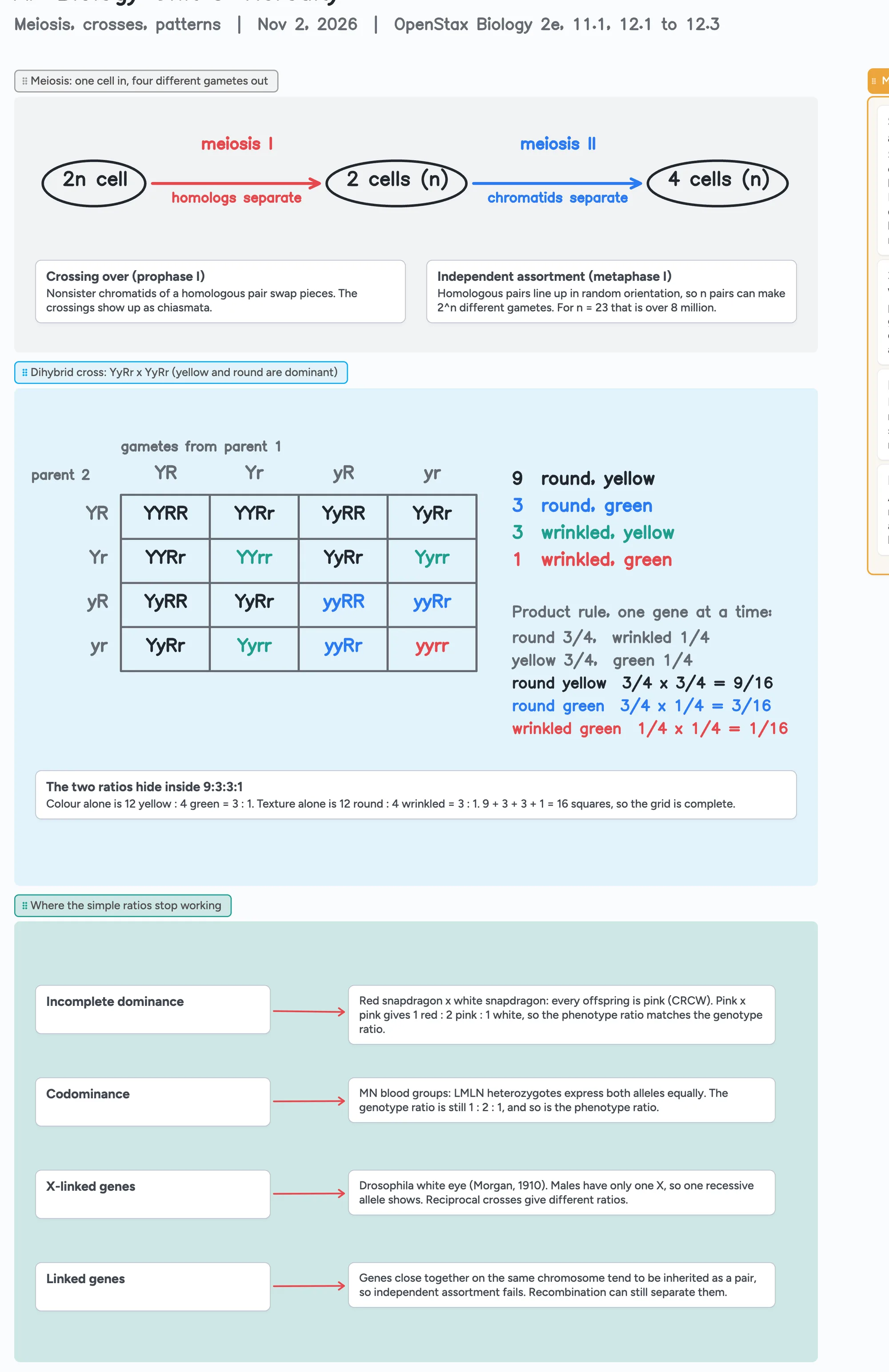
Unit 5 asks you to connect three things that are usually taught on separate days: what meiosis does to chromosomes, what that means for the ratios in a cross, and why some traits don't follow those ratios. This page shows one way to keep them on one board: a meiosis row, a dihybrid cross colour-coded to 9:3:3:1 with the product rule beside it, and one card per non-Mendelian pattern. Open it, swap in your own notes and keep it as your unit map. It is a student-made study aid, not an official AP resource.
Updated
The short answer
- Start from meiosis, not from the Punnett square. Meiosis I separates homologous chromosomes and meiosis II separates sister chromatids. The ratios in a cross follow from that, which is why segregation and independent assortment are the first two cards on the board.
- Colour the squares so 9:3:3:1 is something you can see. In the board's YyRr x YyRr grid, 9 squares are round and yellow, 3 round and green, 3 wrinkled and yellow, 1 wrinkled and green. The same ratio is two 3:1 ratios multiplied: 3/4 x 3/4 = 9/16, 3/4 x 1/4 = 3/16, 1/4 x 1/4 = 1/16.
- Keep the exceptions next to the rule. Incomplete dominance, codominance, X-linked genes and linked genes each get a card joined to the pattern they break.
- Treat the board as notes, not as the course. AP Central lists Unit 5 as 8%–11% of the multiple-choice section; your teacher and the official course materials decide what is tested.
Where Unit 5 sits in the course
AP Central's AP Biology course page (read November 2, 2026) lists eight units and gives Unit 5, Heredity, 8%–11% of the multiple-choice section, the lowest range in its table, level with Unit 1. That page gives the weighting only, and we could not read the full course and exam description in a usable form, so we don't list the unit's official topics here. The board follows the heredity chapters of OpenStax Biology 2e instead (meiosis, Mendel's crosses, non-Mendelian patterns), and the board's Ask in class list is where you add whatever else your teacher covers. Nothing here claims what a particular exam question will look like.
Meiosis: one cell in, four different gametes out
The top section of the board is a three-oval drawing: a 2n cell, then two n cells after meiosis I, then four n cells after meiosis II. Following OpenStax Biology 2e section 11.1 (read November 2, 2026), meiosis is one round of DNA replication followed by two divisions. Meiosis I is the reductional division: homologous chromosomes separate and the cells go from diploid to haploid. Meiosis II is like mitosis: sister chromatids separate.
Two cards under the drawing hold the two sources of variation from meiosis I. Crossing over happens in prophase I, when nonsister chromatids of a homologous pair swap pieces; the crossings are visible as chiasmata. Independent assortment happens at metaphase I, when the homologous pairs line up in random orientation, so n pairs can make 2^n different gametes. For humans, n = 23, which OpenStax puts at over 8 million.
The dihybrid cross: 16 squares you can read
The middle section is the cross OpenStax uses in section 12.3: seed colour (yellow Y is dominant to green y) and seed texture (round R is dominant to wrinkled r), with both parents YyRr. Each parent makes four equally likely gametes, YR, Yr, yR and yr, so the grid has 16 squares. We coloured each square by phenotype: black for round and yellow, blue for round and green, teal for wrinkled and yellow, red for wrinkled and green.
| Phenotype | Squares out of 16 | Product rule | Fraction |
|---|---|---|---|
| Round, yellow | 9 | 3/4 x 3/4 | 9/16 |
| Round, green | 3 | 3/4 x 1/4 | 3/16 |
| Wrinkled, yellow | 3 | 1/4 x 3/4 | 3/16 |
| Wrinkled, green | 1 | 1/4 x 1/4 | 1/16 |
Swipe the table sideways to see every column.
Counts checked by building the 4 x 4 grid in code and counting each phenotype; ratios follow OpenStax Biology 2e section 12.3 (CC BY-NC-SA 4.0), read November 2, 2026.
The card under the grid makes the link to the product rule: colour alone is 12 yellow to 4 green, which is 3:1, and texture alone is 12 round to 4 wrinkled, which is also 3:1. Because the two genes sort independently, the two ratios multiply. OpenStax adds that for more than two genes the Punnett square gets unwieldy and the forked-line or probability method is preferred. With four heterozygous genes, for example, the share that is homozygous recessive at all four is (1/4)^4 = 1/256, and the share that shows the dominant phenotype at all four is (3/4)^4 = 81/256. The board's self-quiz asks for the first of those.
Where the simple ratios stop working
The bottom section has four cue cards, each joined by an arrow to its note, so they stay together when you move them. The notes paraphrase OpenStax Biology 2e sections 12.2 and 12.3 (read November 2, 2026).
- Incomplete dominance. A red snapdragon crossed with a white one gives pink offspring, and pink crossed with pink gives 1 red : 2 pink : 1 white, so the phenotype ratio matches the genotype ratio instead of 3:1.
- Codominance. In the MN blood groups, heterozygotes express both alleles equally. The genotype ratio from a heterozygote cross is still 1:2:1, and the phenotype ratio matches it.
- X-linked genes. Thomas Hunt Morgan mapped the white-eye trait in fruit flies to the X chromosome in 1910. Males have only one X, so one recessive allele shows, and reciprocal crosses give different ratios.
- Linked genes. Genes close together on the same chromosome tend to be inherited as a pair, which breaks independent assortment; recombination can still separate them.
Beside the map, a Mix-ups list collects the pairs that get confused: segregation versus independent assortment, 3:1 versus 1:2:1, meiosis I versus meiosis II, and why dominant and recessive don't describe an X-linked male the way they do a female.
Build your own, step by step
- Draw meiosis first, from memory, with the number of chromosome sets under each stage. Then open the cards and check it against your textbook.
- Pick one cross from your notes and write out the gametes before filling the grid. Colour or tick squares by phenotype and count them before you write the ratio.
- Check the ratio a second way, with the product rule, one gene at a time. If the two methods disagree, one has a mistake.
- Add one card per pattern your teacher has covered, and join it to the rule it breaks.
- Add a Mix-ups list every time a quiz question catches you, and an Ask in class list for what the book can't settle.
- To study, cover the cards, redo the meiosis row, list the gametes for YyRr and explain 9:3:3:1 as 3:1 times 3:1. Tick what you can do and redo the rest tomorrow.
Cards, lists and sections can be dragged, so you can regroup the same cards by chapter or by exam topic. The grid on the board is hand-drawn ink, so for your own crosses you will draw a new grid, or write the squares as a list of cards.
Where something else is better
- Instructor-made maps are better when your teacher grades from one. If your course supplies a map, use it as your checklist and build yours beside it.
- Flashcard decks are better for memorising vocabulary such as the stages of meiosis. A map shows how ideas connect; it doesn't quiz you.
- Practice problems and past free-response questions are better for the exam itself. The board holds what you have learned and doesn't test you.
- A paper notebook is better if your class expects hand-drawn Punnett squares on paper and you work faster that way.
- Your textbook and teacher are the authority. This is a student-made summary of OpenStax, not College Board material, and the board has no answer key.
A study aid, not an official AP resource
Instaboard has no affiliation with the College Board. The map is a short paraphrase of a free textbook, checked November 2, 2026. Check the AP Central course page and your teacher for what is tested.
What Instaboard doesn't do
- No Punnett square tool, no cross calculator, no practice questions and no answer key. Squares are text or hand-drawn ink that the board doesn't understand.
- No AI and no auto-layout. The ready board is a layout to copy, and you move the cards yourself.
- No handwriting search and no conversion of handwriting to text. The eraser removes a whole stroke at a time.
- Editing needs a free sign-in. Viewing a board by link doesn't. If you are under 18, check with a parent or your school before you sign up for anything.
- The free plan is 5 boards and 150 items (cards, lists, images, text boxes; pen strokes, sections and arrows don't count), with 3 images and 1 file per board. This example uses about 30 items, so one board per unit works better than one per topic.
- No import from other note apps. Full-board PDF export works only on drawing boards and trip planners; for a card board, selected cards and lists can be saved as an image.
- Changes made offline are kept and sync when you're back online, but it isn't an offline-first app.
Start from the ready board
It opens in your browser in a few seconds, with nothing to install. Sign in for free when you want to save it and share it.
Questions
What is in AP Biology Unit 5?
AP Central lists Unit 5 as Heredity, 8%–11% of the multiple-choice section. We don't list its official topics because we couldn't read the course and exam description. The board covers meiosis, Mendel's crosses and four non-Mendelian patterns from OpenStax Biology 2e; ask your teacher what else your class covers.
How do I get from a Punnett square to the 9:3:3:1 ratio?
Make the four gametes from each YyRr parent (YR, Yr, yR, yr), fill the 16 squares, and count each phenotype. You get 9 round and yellow, 3 round and green, 3 wrinkled and yellow, 1 wrinkled and green. You can check it with the product rule: 3/4 x 3/4 = 9/16, 3/4 x 1/4 = 3/16, 1/4 x 1/4 = 1/16.
Why do some crosses not give 3:1 or 9:3:3:1?
Several patterns change the ratios: incomplete dominance and codominance give 1:2:1 phenotype ratios from a heterozygote cross, X-linked genes give different ratios in males and females, and linked genes break independent assortment. Each has a card on the board.
What makes the gametes from meiosis different from each other?
Two things in meiosis I: crossing over in prophase I, where nonsister chromatids swap pieces, and the random orientation of homologous pairs at metaphase I, which gives 2^n possible combinations for n pairs.
Is this an official AP Biology resource?
No. It is a student-made study aid based on the free OpenStax Biology 2e textbook. For what is tested, use the College Board's AP Central course page and your teacher.
Can I share the map with a study group?
Yes. Copy the board link and send it. Anyone can look at it without an account, and anyone who wants to write on it signs in for free.
Is Instaboard free?
Yes. The free plan includes 5 boards, 150 cards and items across your account (pen strokes, arrows and sections don't count), 3 images and 1 file per board, unlimited collaborators and video calls up to an hour. Pro is $5 a month billed yearly ($59.99 a year), or $7.99 monthly, and the people you invite join free.
Sources
Related
Make a biology concept map from your own notes
Turn your lecture notes into a biology concept map: concepts on cards, labelled arrows, feedback loops and a recall check. Worked example on the HPA axis, a ready board to copy, and a nursing version.
Build an endocrine system concept map from your own notes
Build an endocrine system concept map from your notes: glands, hormones, target tissues and feedback loops. A sourced example board to edit. No answer key, no AI.
Cornell notes, digital: cue cards that stay linked to your notes
How to take Cornell notes on a screen: a filled example (glycolysis) with cue cards joined to note cards by arrows, a self-quiz checklist and a summary. What a board does that a printable can't, and where a printable is better.
How to organize organic chemistry notes: a reaction map on cards you can move
How to organize organic chemistry notes so reactions connect: a filled reaction map you can open and edit, with one card per reaction, arrows between functional groups and a synthesis worked backwards. Where a printed reaction map or a notebook is better.
A pharmacology concept map you can edit: one list per drug class
A filled pharmacology concept map you can open and edit: five blood pressure drug classes with the prototype drug, how it works, side effects, what to watch for and what to teach. How to build your own, and where a printable template is better.