For co-writers and writing partners
Outline a story with a co-writer, on one board you both edit
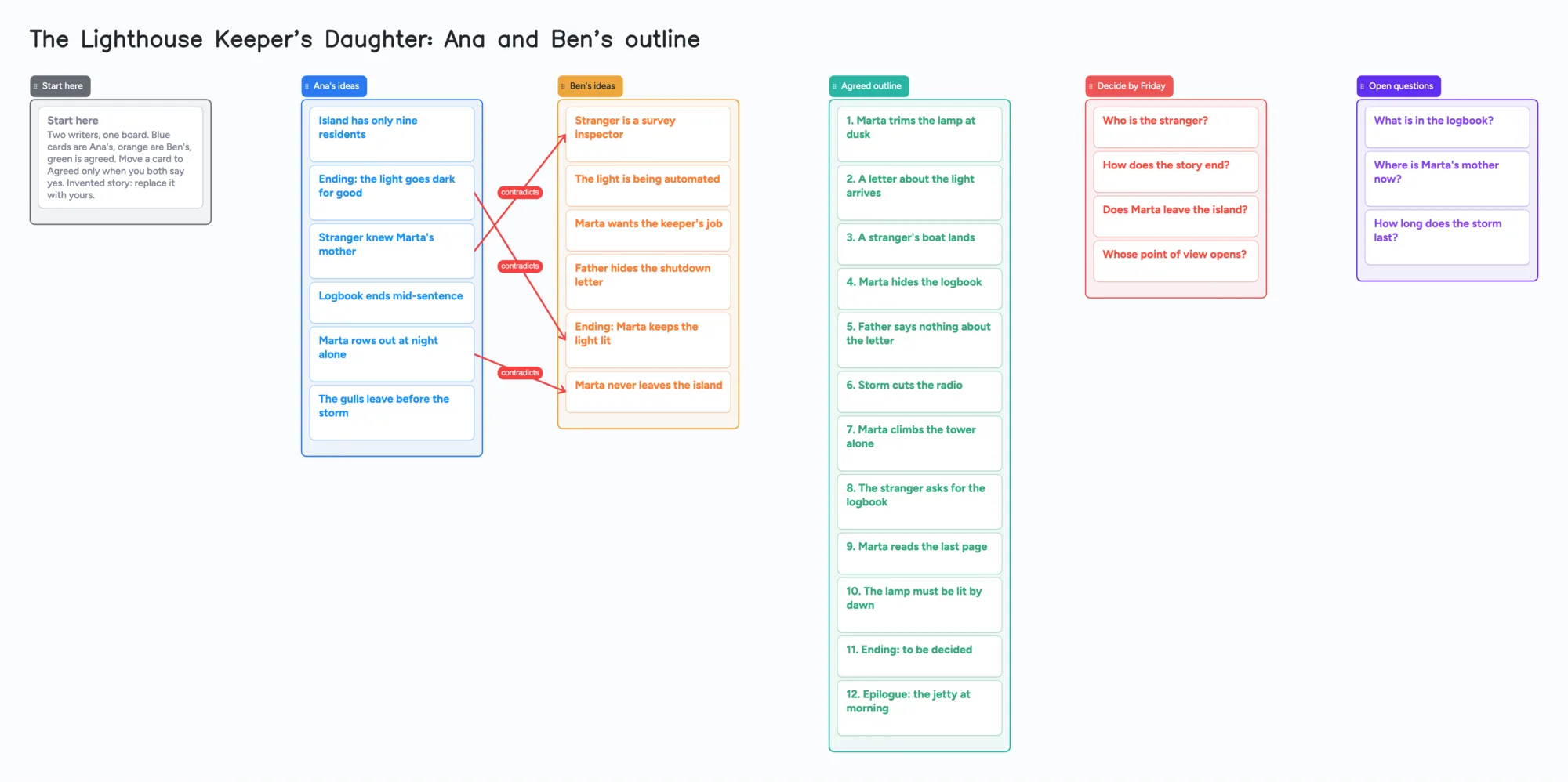
Two people outlining one story usually end up with two documents, a chat thread and a list of things nobody remembers agreeing to. This page shows a different shape: one board with a list of ideas for each of you, a list for what you've both agreed, a list of what you still have to decide and a list of open questions, with a red arrow wherever two ideas contradict. It is for the outline only. It doesn't draft, format a script, count words or export to a writing app, so you write the pages somewhere else (Reedsy Studio, Ellipsus, WriterDuet, Arc Studio or Google Docs, below). The example is an invented story, "The Lighthouse Keeper's Daughter", outlined by two invented writers, Ana and Ben.
Updated
The short answer
- What it is: one board with a list of ideas per writer, a numbered list for what you've agreed, a decide-by list and an open-questions list. A card moves into the agreed list only when you both say yes.
- What it isn't: no drafting, no script formatting, no word count and no export to a writing app. Selected cards and lists can be copied as an image.
- The example board uses 38 of your 150 free items: 32 cards and 6 lists (our arithmetic). Each card and each list counts; pen strokes, sections and arrows don't. Cards your co-writer adds count toward their own 150, not yours.
- Your co-writer needs a free sign-in to write. They can open the link and read the board without one.
What this board can't do for two writers
- It holds the outline, not the draft. There is no script format, no chapters, no word count and no manuscript editor. You write the pages in a drafting tool.
- No export to a writing app and no import from one. Selected cards and lists can be copied as an image.
- Cards are short. The example board's cards are eight words or fewer. A card can hold more, but a board of paragraphs is a document, and Google Docs or a drafting tool is better for that.
- 150 items on the free plan, across your account. Each card and each list is 1 of the 150. The example board is 32 cards and 6 lists, so 38. If each of you parks 30 ideas and you agree 40 beats, that is 100 cards and 6 lists (our arithmetic). Pro is $5 a month billed yearly ($59.99 a year) and removes the item limit.
- 5 boards and 3 images per board on the free plan. Keep one board per story. The example board has no images.
- You set the rules yourselves. Nothing on the board stops either of you moving a card into the agreed list. "Only when we both say yes" is a habit, not a setting.
How two writers outline on one board
Co-writers describe two shapes of the job. In r/Screenwriting (July 2017), one person who co-writes with several writers said they outline together first, passing the outline back and forth, and only then split the work: in parallel (each writes separate acts or scenes and then combine them) or in series (one writes for a period, then hands over). That is one person's view. A shared board covers the first step, the outline you have to agree before either method starts.
- Give each writer a list. On the example board Ana's ideas are blue and Ben's are orange. A card's colour is its border and text; the list keeps its own colour. Each of you drops ideas in your own list without arguing about them yet.
- Keep an agreed list. The green list is numbered, one beat per card. Move a card there only when you both say yes. Twelve numbered beats in the example are the story so far.
- Mark contradictions with an arrow. An arrow can join a card in one list to a card in another, and carries a caption and its own colour. On the example board three red arrows labelled "contradicts" join Ana's ideas to Ben's: his survey inspector against her stranger who knew Marta's mother, and so on. The arrows stay attached when you reorder cards or move a list.
- Park what you can't settle. The red list, "Decide by Friday", holds the four questions that block the outline (who the stranger is, how it ends, whether Marta leaves, whose point of view opens). The purple list holds questions that can wait.
- Hand off to your drafting tool. When the agreed list is full, write the pages in the tool you draft in. The numbered cards are your scene list.
Writers also disagree about whether to brainstorm together or apart. In the same thread, one reply asked whether brainstorming separately and then discussing is more productive. The example board lets you do either: write in your own list at the same time, or take turns in one.
Set up the board with your co-writer
- In the share menu, set "Anyone with the link can edit". New boards start view-only.
- Send the link, or the 4-digit join code. The code expires after 2 hours of inactivity, so send the link to someone you'll need later.
- Your co-writer signs in free (Google, Apple or email) to write. Someone who isn't signed in can open the link and read everything, but can't change anything. Once they're signed in, what they add shows up on your board within a few seconds, and you see what they add in the same way.
- The board counts as one of their 5 free boards, and the cards they add count toward their own 150. If they're already at 5 boards, they can still open the link and write; the board just isn't added to their boards.
Free calls on the board run up to 60 minutes per call, with a warning 10 minutes before the end; everyone signs in free, calls aren't recorded, and Pro has no limit. So the two of you can talk through the red list on the board itself.
Where to write the pages
Each row is from the maker's own pages, read on November 10, 2026. Prices change, so check the page before you choose.
| Tool | Built for | What its page says | Where it fits your co-writing |
|---|---|---|---|
| Instaboard | Visual outlines, with a pen | Free: 5 boards, 150 items; Pro $5 a month billed yearly | A board both of you edit by link; the outline, not the draft |
| Reedsy Studio | Writing and planning a book | Core writing and formatting free; free Boards are card view only; linking notes with attributes and relationships needs the Outlining add-on | Its Studio page offers inviting a co-author, track changes and comments, and live revision on the draft. Its Boards FAQ says sharing a Board with a collaborator is "Not yet" |
| Ellipsus | Collaborative creative writing | "Join for free" on its home page; we did not read a price | Drafts, edits and discussions in one place, with comments and drafts |
| WriterDuet | Screenwriting | Free: 3 projects; Plus $9.99 a month (monthly billing) adds unlimited projects and real-time collaboration; free users can co-write on an upgraded user's script | Writing a script together, live; real-time collaboration is on Plus and above |
| Arc Studio | Screenwriting | Free, Essentials $69 a year, Pro $99 a year | Inviting collaborators and outlining tools are on Pro only; Free lists neither |
| Google Docs | Documents | Its help page says it lets you work with other people | A shared outline as text, with no cards or arrows |
Swipe the table sideways to see every column.
Sources are listed at the bottom of the page, all read on November 10, 2026.
When another tool is the better choice
- You want to write the pages together, live. Reedsy Studio, Ellipsus, WriterDuet, Arc Studio and Google Docs are made for the draft. Instaboard holds no manuscript text.
- You write a screenplay and want the outline in the script. Arc Studio's Pro plan lists outlining tools and inviting collaborators, and its Free plan lists neither.
- Your outline is mostly paragraphs. A shared document is better for long notes than cards.
- You need to plot a whole series with a bible. Instaboard has no timeline, character database or series bible; see a free way to plot with a partner for what the plotting tools do.
- You have a lot of images. Instaboard allows 3 images per board on the free plan.
For the index-card method on its own, with four act lists and a subplot arrow, see outlining with index cards. If you came from Milanote and used up its 100 free items, see the Milanote section for writers.
Start from the ready board
It opens in your browser in a few seconds, with nothing to install. Sign in for free when you want to save it and share it.
Questions
Can two people outline a story on the same board?
Yes. Set "Anyone with the link can edit" and send the link. Your co-writer signs in free to write, and the board counts as one of their 5 free boards. Cards each of you adds show up for the other within a few seconds.
Is it free for both of us?
Yes, within the free plan's limits: 5 boards, 150 items across your account, and 3 images per board. Each of you has your own 150, and cards you add count toward your own.
Does the board draft or format my story?
No. It holds the outline only: short cards, lists, arrows and ink. There is no script format, no word count and no export to a writing app. Write the pages in a drafting tool.
Can my co-writer read the board without signing in?
Yes. Someone who isn't signed in can open the link and read everything, but can't change anything. Writing needs a free sign-in with Google, Apple or email.
How do we mark ideas we disagree on?
Draw an arrow between the two cards, add a caption such as "contradicts" and give it a colour. Arrows between cards in different lists stay attached when you move cards or lists, and they don't count toward your 150 items.
Is there a free co-writing tool that does the drafting too?
Reedsy Studio's core writing is free, and its Studio page offers inviting a co-author to the draft. Ellipsus's home page says "Join for free". Check each page for what the free plan includes.
Sources
- r/Screenwriting: how do you write a script with another person (Jul 2017, one person's view)
- r/writers: best collaborative writing tools (Aug 2024, one person's account)
- Reedsy Studio: planning Boards (all users create as many Boards as they like; FAQ: sharing a Board with a collaborator "Not yet"; read Nov 10, 2026)
- Reedsy Studio: pricing (core writing free, Boards limited to card view, Outlining add-on; read Nov 10, 2026)
- Reedsy Studio: home page (invite a co-author, track changes and comments, revise live; read Nov 10, 2026)
- Ellipsus: home page (collaborative writing tool, drafts, edits and discussions, "Join for free"; read Nov 10, 2026)
- WriterDuet: pricing (Free 3 projects; Plus $9.99 a month with real-time collaboration, monthly billing shown; FAQ: free users co-write on an upgraded user's script; read Nov 10, 2026)
- Arc Studio: pricing (Free, Essentials $69 a year, Pro $99 a year; inviting collaborators and outlining tools on Pro; read Nov 10, 2026)
- Google Docs Help: how to use Google Docs (work with other people; read Nov 10, 2026)
Related
Outline a novel or screenplay with index cards, on a board you can share
Outline a novel or screenplay on digital index cards: one list per act, 40 short cards, subplot arrows, a co-writer on the same board. Free to start; TV pilot too.
A free Milanote alternative for student projects, and where Milanote is better
Milanote's free plan stops at 100 notes, images or links. What Instaboard's free plan gives a student project, where Milanote is better, and a ready project board.
A free Plottr alternative for plotting with a partner, and where Plottr is better
Plottr's live collaboration needs Pro for each person. A free shared plotting board for two writers, and where Plottr, Scyn and Kindling do better.
Character relationship map: a filled template two people can edit
A filled character relationship map to copy: factions, a card per character and captioned arrows for who wants what. Edit it together with a co-writer. Free plan limits stated.
Sketch a rough storyboard by hand, with a co-writer or director on the same board
Sketch a rough storyboard by hand on one shared board: a frame is a section, the pen sketch sits inside it, a caption card goes under it. A filled example to copy.