For a team of three to ten that wants its quarter's goals in one place
Plan a quarter of OKRs on a shared board
This page opens a quarter of goals already laid out on a shared Instaboard board. Read the limits first. Every number on it, the start, the target, where it is now and the score, is text a person types. The board doesn't add scores, doesn't roll key results up into an objective, and sends no reminders or due-date alerts. The example is an invented three-person print shop, Harrowby Letterpress, one month into its first quarter. If you want scores that calculate or goals that link across levels, a section below reads four pages that describe tools for that.
Opens in your browser. Anyone can view; a free sign-in lets you edit.
Updated
What is typed, and what this board will not do
- Typed by hand: a key result card says where it started, where it should end, where it is now and what it scores. A person edits those words at each check-in, and anyone with edit access can change them.
- Nothing rolls up: the board doesn't average key result scores into an objective, draw progress bars or link a team objective to a company one. The example's three objective scores are our arithmetic, in the note under the scoring table below.
- No nudges: no reminders, no due-date alerts, no message when a score goes red. The check-in is a meeting someone has to call.
- Who writes: people you share the link with can read the board. To add or change a card they sign in with a free account. A number is typed text, and anyone with edit access can change it.
- When a tool is better: a goal tool, if you want scores that calculate, progress charts, levels that link, or reminders. A section below reads four pages that describe them.
Four pages, four sets of numbers: read before you write a goal
On November 27, 2026 we read four pages about the method: What Matters (whatmatters.com), Atlassian's Team Playbook, Miro's guide and a monday.com support article. They agree on the shape: a goal with a few measurable results under it. They disagree on how many, how to score and how often to look. We paraphrase them and copy no text.
| Page | How many goals and results | How it scores | How often it looks |
|---|---|---|---|
| What Matters | An objective with 3 to 5 key results under it | Three ways: yes or no, red-yellow-green, or 0.0 to 1.0 per key result, averaged for the objective | Graded at the end of a period, typically a quarter |
| Atlassian's Team Playbook | 1 to 3 objectives, 3 to 5 key results each | A 0 to 1 scale; its examples read 0.3 missed, 0.7 came close, 1 met it | Progress summed up each month; its own teams set goals yearly and refresh them each quarter |
| Miro's guide | One objective with 2 to 5 key results in its intro, 3 to 5 in its steps; ideally no more than five objectives a quarter | Yes or no, or a numbered rating | Regular check-ins; finished objectives replaced from a backlog |
| monday.com's support article | Groups as objectives, items as key results, subitems as tactics | A status column feeds a formula that returns 0, 50, 75 or 100 | Regular syncs to review and grade |
| Harrowby (example) | 3 objectives, 3 key results each | 0.0 to 1.0, typed from the numbers on the card | A monthly check-in, with the quarter's end on Mar 31 |
Swipe the table sideways to see every column.
Our reading: the pages agree on the shape and disagree on every count. Harrowby's three objectives with three key results each sit at the top of Atlassian's objective range and the bottom of the 3 to 5 key results that Atlassian and What Matters both name. Miro's page prints "Last update: August 12, 2025"; monday.com's prints "Last modified on October 20, 2026"; the other two print no article date.
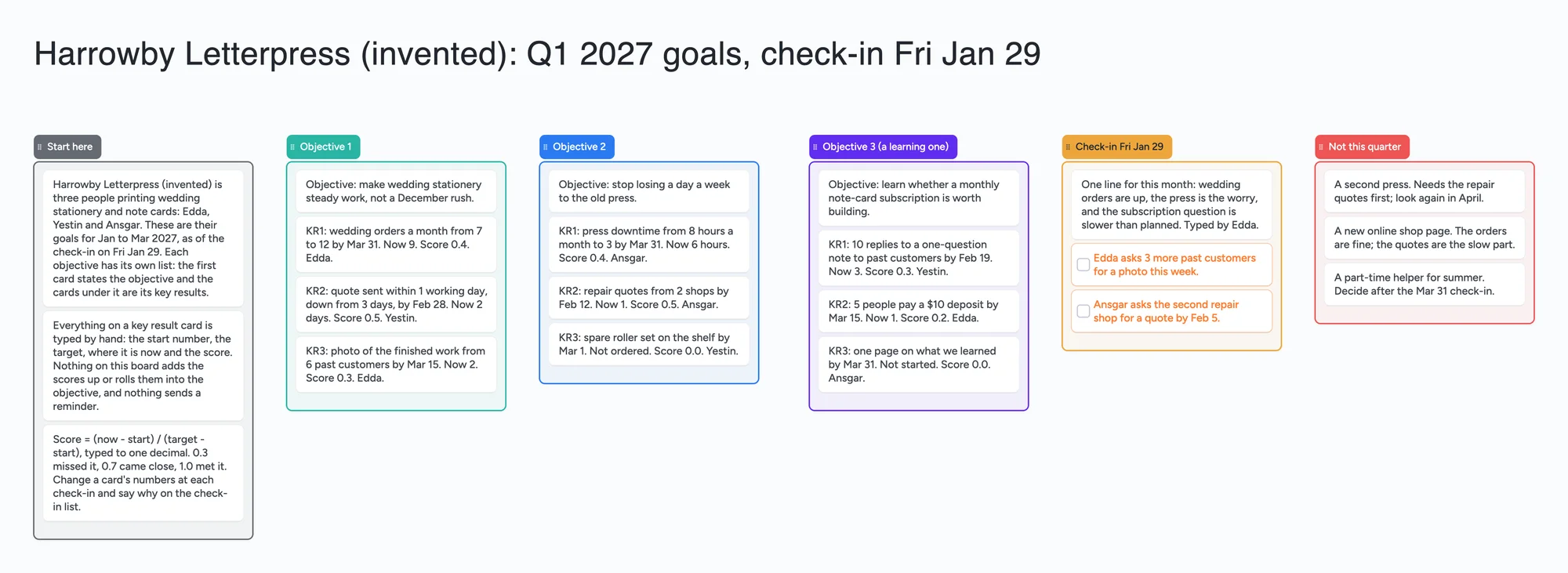
Harrowby's quarter, list by list
The shop, the three people and every figure are invented. The state shown is the check-in on Friday, January 29, 2027, four weeks into a quarter that ends on March 31.
- Start here (3 cards). Who they are, the rule that every number on a key result is typed, and the scoring sum: now minus start, divided by target minus start, typed to one decimal.
- Objective 1 (4 cards). Make wedding stationery steady work, not a December rush. Wedding orders a month from 7 to 12 (now 9, 0.4, Edda), a quote out within one working day instead of three (now 2 days, 0.5, Yestin) and photos from six past customers (now 2, 0.3, Edda).
- Objective 2 (4 cards). Stop losing a day a week to the old press. Downtime from 8 hours a month to 3 (now 6, 0.4, Ansgar), repair quotes from two shops (now 1, 0.5, Ansgar) and a spare roller set on the shelf (not ordered, 0.0, Yestin).
- Objective 3, a learning one (4 cards). Learn whether a monthly note-card subscription is worth building. Ten replies to a one-question note (now 3, 0.3, Yestin), five $10 deposits (now 1, 0.2, Edda) and a one-page write-up (not started, 0.0, Ansgar).
- Check-in Fri Jan 29 (3 cards). One typed line on the month, and two tick-box actions with a name each, one of them with a date, none ticked yet.
- Not this quarter (3 cards). A second press, a new shop page and a summer helper, each with the condition for looking again.
What Matters' page names a learning kind of objective for when the most useful result of a quarter is knowing something, and the third list is one. Its key results measure replies, deposits and a write-up, not sales.
Scoring a board that can't score
Each score on the board comes from the same sum, typed. Here are all nine, with the figures from the cards. This is our arithmetic; the board holds none of it.
| Key result | Start | Target | Now | Score |
|---|---|---|---|---|
| Wedding orders a month | 7 | 12 | 9 | 0.4 |
| Days to send a quote | 3 | 1 | 2 | 0.5 |
| Photos from past customers | 0 | 6 | 2 | 0.3 |
| Hours of press downtime a month | 8 | 3 | 6 | 0.4 |
| Repair quotes in hand | 0 | 2 | 1 | 0.5 |
| Spare roller set on the shelf | 0 | 1 | 0 | 0.0 |
| Replies to the one-question note | 0 | 10 | 3 | 0.3 |
| Deposits paid | 0 | 5 | 1 | 0.2 |
| One-page write-up | 0 | 1 | 0 | 0.0 |
Swipe the table sideways to see every column.
Scores are rounded to one decimal: 2 of 6 is 0.33, 1 of 5 is 0.2. Averaging each objective's three scores gives 0.4, 0.3 and 0.2 (0.17 before rounding). What Matters says Google averages key result scores that way, and Harrowby does it here by hand; it is a choice, not a rule of the board.
A key result that goes down, like days to send a quote, uses the same sum, because the signs cancel. A key result that is done or not done, like the roller set, scores 0 or 1, which is the yes-or-no grading two of the pages describe.
What changes at each monthly check-in
Atlassian's page asks for a short summary of how each key result is doing once a month, scores them with a rubric as a separate step, and says some goals should be off track when a team aims high. On the board that is a small, fixed routine:
- Edit the 'Now' and the score on each key result card, so the card always shows the latest number.
- Type one line on the check-in list: what moved and why. Harrowby's line says orders are up, the press is the worry and the subscription question is slower than planned.
- Add up to two or three actions as tick-box cards with a name. The two on the example are not ticked yet.
- Move anything that isn't going to happen to Not this quarter, with the condition for looking again.
- Next month, start a new check-in list, or rename this one and replace its cards, as you prefer. If you want the history, type it on the check-in card.
Miro's page adds a backlog: objectives that don't fit the period go on a list and are looked at again next quarter. The Not this quarter list is that.
One team on one board, and what levels would take
Several of the pages we read describe goals at more than one level, from the company to teams to people, each tied to the one above. This board holds one team's quarter. It has no arrows in the example and nothing connects an objective to a parent goal.
- Type the parent. Put the company objective's name at the top of the Start here card, so everyone can see what the team's goals serve.
- One board per level. A company board, a team board and, if you want them, boards for people, each with the parent's name typed on its objective card. Nothing keeps those names in step.
- A card can open into its own board, which is one way to hold a person's goals under a team objective.
Four pages that describe goal software
All four pages were read on November 27, 2026. Where a price or limit is marked not listed, the page we read didn't show one. The order is not a ranking, and we have no arrangement with any of these companies.
| Tool page | What the page describes | What you would get beyond typed cards | What stays simpler here |
|---|---|---|---|
| monday.com's support article | A board where groups are objectives and items are key results, with People, Status, Timeline and Formula columns, subitems for tactics, a chart view and a dashboard. Plan prices are not listed on that page (as of November 27, 2026). | A formula that turns a status into a grade, charts, dashboards across boards | No columns or formulas to set up; the whole quarter reads left to right |
| Miro's guide | Writing OKRs in workshop sessions, on a map that links company, team and person objectives; names its own OKR planning template. Plan limits are not listed on that page (as of November 27, 2026). | A map that links levels, workshop templates | A quarter for one team, with nothing to learn first |
| Atlassian's Team Playbook | A play for 3 to 11 people with a rubric, monthly updates and a scoring scale; names its Goals app and a Confluence page as places to keep the work. Prices are not listed on that page (as of November 27, 2026). | A Goals app, with an Updates tab on each goal | A plain board you can copy without a Confluence page |
| What Matters | Training and articles on the method, with grading, types of goal and common mistakes; lists Google Docs, Google Sheets, and pen and paper among the tools to start with. | Teaching material, not a tool | A shared place to type the quarter instead of a doc |
Swipe the table sideways to see every column.
From each page as read November 27, 2026. Three are vendor pages; What Matters is a resource site that sells a book and a course. Its terms say the site's content is protected, so we cite and paraphrase and copy nothing.
Room for the second quarter and the sixth
The free plan allows 150 items across all your boards. Lists, cards and the title text box each count as one; pen strokes, arrows and sections are not counted.
- This example: 6 lists + 21 cards + the title = 28, which leaves 122.
- Copy the board every quarter: five copies come to 140 items, and every copy takes one of the five free boards, so a sixth would need Pro or a deleted board.
- Keep adding to one board: each later quarter adds 5 lists and about 18 cards, 23 items. 28 + 5 x 23 = 143 in the sixth quarter, and the seventh reaches 166 (our arithmetic, if no card is deleted and the Start here list is kept once).
- Pictures: up to three per board; the example has none.
- Private? Not by default. Whoever you give edit rights can change a number, so keep pay, performance reviews and anything about a person off it. Invite-only boards are part of Pro.
Pro removes the item limit and costs $5 a month billed yearly ($59.99) or $7.99 monthly.
Your first quarter, step by step
- Open the board and read the Start here cards, then replace the three with your team, the quarter's end date and the scoring sum you will use.
- Write two or three objectives, one per list, each as a plain sentence. The pages we read keep the count low: Atlassian says 1 to 3, Miro says ideally no more than five.
- Under each, add three key results with a start, a target, where it is now and a name. Each should be a number someone can look up, not a task.
- Type the first scores at the same sitting, even if they are all 0.0, so the card format is settled.
- Set the monthly check-in in your own calendar, and set Share to "Anyone who joins can edit" so every owner can update their own cards.
- At quarter's end, type final scores, move what's left to Not this quarter or a copy, and start the next quarter on a copy or new lists.
Start from the ready board
It opens in your browser in a few seconds, with nothing to install. Sign in for free when you want to save it and share it.
Questions
What is an OKR?
A way of setting goals: an objective says what you want, and a few key results say how you'll know you got there. Every page we read describes it that way and says to review it regularly. They differ on how many of each to write and how to score them.
How many objectives and key results should a team write?
The pages differ. Atlassian's says 1 to 3 objectives with 3 to 5 key results each. What Matters' says 3 to 5 key results under an objective. Miro's gives 2 to 5 in one place and 3 to 5 in another, and ideally no more than five objectives a quarter. The example uses 3 objectives and 9 key results. Decide before you write, and keep to it.
Does the board add up the scores?
No. Each score is typed from the numbers on its card, and so is any average. The sum is on the first card of the example and in the scoring table here. If you want the numbers to calculate, a tool such as the one monday.com's article describes turns a status into a grade.
What is a learning objective?
What Matters' page describes it as one where the most useful result of the quarter is something learned. The example's third objective is one: its key results are replies, deposits and a write-up. The pages we read don't say how to score a learning objective, so Harrowby scores it like the others.
Can we connect company, team and personal goals?
Not on one board. This board holds a single team's quarter and links nothing across levels. You can type the parent's name on each objective, or use one board per level, as the section above describes, but nothing keeps them in step. Miro's guide and Atlassian's page describe tools that link levels.
How many quarters can one board hold?
The example is 28 items. Adding a quarter's lists and cards to the same board adds about 23 items, so it passes 150 in the seventh quarter if nothing is deleted. Copying a board each quarter runs into the five free boards first. Pro removes the item limit.
Sources
- What Matters: What is an OKR? Meaning, definition and examples (whatmatters.com; the page prints no article date and a 2025 copyright line in its footer; read in full in a browser November 27, 2026; its terms say the site's content is protected, so paraphrased only)
- Atlassian: Objectives and Key Results (OKRs), Team Playbook (no page date printed; read in full November 27, 2026; vendor content)
- Miro: What is an OKR and how to write one (Miro Team; prints "Last update: August 12, 2025"; read in full November 27, 2026; vendor content)
- monday.com support: OKR management using monday.com (prints "Last modified on October 20, 2026"; read in full November 27, 2026; vendor content)