For researchers with several papers out at once, and the co-authors who need to see where each one is
A manuscript submission tracker board: a card per paper, a ladder of journals tried in order
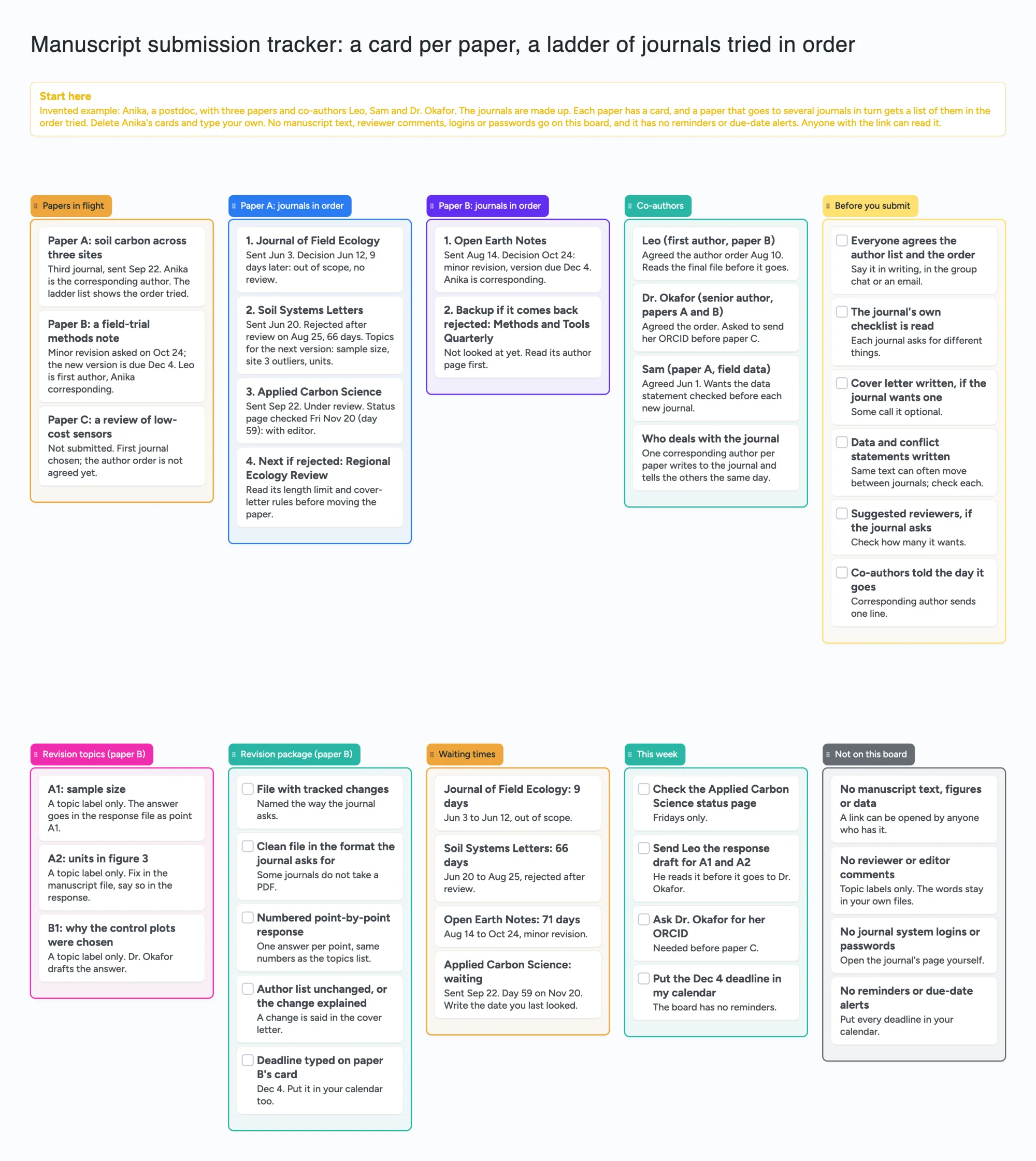
We make Instaboard, an online board. This page gives you a manuscript submission tracker laid out on it and filled in for an invented postdoc, Anika, who has three papers, three co-authors and some made-up journals. Each paper is a card. A paper that goes to one journal after another gets a list of them in the order tried, with the dates sent and decided. Other lists hold the co-authors, a before-you-submit tick list, a revision round by topic and the days each journal took. The board does not check any journal's system, and it holds no manuscript text, figures, reviewer comments, logins or passwords. It has no reminders or due-date alerts. Anika, her co-authors and the journals are made up.
Opens in your browser. Anyone can view; a free sign-in lets you edit.
Updated
Read this first: what the board does and doesn't do
- No manuscript text, figures or data go on it. Anyone with the link can read the board. A card holds where a paper is, who is on it and what the journal asked for.
- No reviewer or editor comments, and no journal logins. Keep the words in your own files and put only a short topic label on the board (for example A1: sample size). Open each journal's system yourself.
- It does not check any journal's system for you. You type the status and the date you last looked.
- It has no reminders or due-date alerts. A revision deadline goes on the paper's card and in your calendar.
- Each journal's own author page decides what to send. The five pages we read are summarised below; Anika's journals are invented.
- What it is: one place where every paper, every journal tried and every co-author sits. The example uses 51 of your 150 free items.
- Free plan: 5 boards, 150 items, 3 pictures per board. Copying the board takes 1 of your 5 boards. Writing on it needs a free sign-in. New boards start with "Anyone who joins can view".
A card per paper, and a ladder per paper
A paper often goes to several journals one after another. In r/AskAcademiaUK ("Keeping track of journal submissions", OP u/secret_tiger101, February 20, 2026), the OP says each paper gets two or three rejections as it works down a list of journals, and that some healthcare journals take six to twelve months to respond. u/mrbiguri answers that one paper cannot go to two journals at once, so there is not much to track. The board's answer is a ladder: one list per paper, one card per journal in the order tried, and the next journal already written on a card at the bottom.
- Papers in flight. One card per paper: where it is now, who is corresponding author, and the next date that matters.
- A ladder list per paper. Anika's paper A has four cards: out of scope after 9 days, rejected after review after 66 days, under review now, and the next journal to read about.
- A card per journal tried. The date sent, the date decided, what the decision was, and one line on why in your own words.
- When a paper is rejected, write the decision on that journal's card and read the next card's author page before moving the paper.
What five journals' author pages ask for
We read these five pages on November 24, 2026. A date is printed only where a page shows one. Our reading: the five pages ask for different things, which is why the board keeps a Before you submit list you edit per journal.
| Author page | What it says | What it means for a card |
|---|---|---|
| Nature, initial submission (no update date found) | Cover letter is optional and not shared with referees; it can carry confidential information such as conflicts and related work in press or submitted elsewhere. The corresponding author manages communication between coauthors | A card for the cover letter, marked optional for this journal; a card naming the corresponding author |
| AGU, submission checklists (no update date found) | A new submission needs an author list with emails and affiliations, ORCID for all authors, three or more suggested reviewers, permissions for reused figures, a data availability statement and a conflict declaration. A revision needs a tracked-changes file, a point-by-point response with the exact text of the comments, and an unmarked Word or LaTeX file, not a PDF | A tick box per item in Before you submit, and a Revision package list for the second round |
| MDPI, editorial process (no update date found) | An Editorial Office technical and ethics pre-check comes before an Academic Editor's pre-check; at least two review reports are collected; authors are generally given five days for a minor revision and ten for a major one; up to two rounds of major revision are usually allowed | A deadline typed on the paper's card the day a revision is requested |
| JMIR Publications support article (page data: updated April 9, 2026) | A numbered point-by-point response is required; responses are numbered by reviewer (A1, A2, A3), each quoting the comment first; send a tracked-changes file and a clean file; the clean file must be .doc or .docx, not PDF, LaTeX or Pages | Revision topics labelled A1, A2, B1 on the board, with the answers kept in the response file |
| CDC Emerging Infectious Diseases, author instructions (page data: last updated January 29, 2026) | Since January 1, 2024 every submission should include a completed copy of the Author Checklist | A tick box for that checklist on the cards of the papers aimed at that journal |
Swipe the table sideways to see every column.
From the pages named, read November 24, 2026. Our wording, not theirs. Pages change, so check each journal's own page the day you submit.
A revision round, by topic
When a journal asks for a revision, the board splits it in two lists. Revision topics holds one card per point, labelled the way the journal's response file will number it, with who drafts the answer. Revision package is a tick list: the tracked-changes file, the clean file in the format asked for, the numbered response, the author list unchanged or the change explained, and the deadline. AGU's revision checklist says a change in authorship, including order, must be explained in the cover letter, which is why that is a tick box.
The board holds the topic label, never the reviewer's words. In r/PhD ("How do you keep track of the papers/abstracts you've submitted?", OP u/Live-Reflection-9205, July 10, 2026), u/workingninja_1 suggests a column for the language reviewers and editors give back, verbatim, because after four or five submissions in one subfield the same objection shows up in different words. That is a good habit, and it belongs in your own file: a reviewer's report is a confidential document, and anyone with the link can read a board. A topic label on the card, with the words in your own folder, keeps the habit without putting them on a page others can open.
Write your own waiting times
The Waiting times list holds one card per journal with the days between sent and decided. Anika's example: 9 days for an out-of-scope decision (June 3 to June 12), 66 days to a rejection after review (June 20 to August 25), 71 days to a minor revision (August 14 to October 24), and a paper still waiting at day 59 on November 20. That is our arithmetic on invented dates. The point is that your own list tells you what to expect from the journals you use, which a journal's own page cannot.
For one number from a journal itself: MDPI's page says reviewers who accept an invitation are generally given 7 to 10 days, and extensions are common. That says nothing about how long a paper waits before a reviewer accepts, so the board does not guess a date for it.
What researchers say they use
In the r/AskAcademiaUK thread, u/kronologically keeps a master Excel spreadsheet of published and pipeline papers, coloured blue for published, green under review, yellow with the editor or a transfer, red rejected and white in the pipeline; u/Mission-Raccoon979 colours rows too and adds a small green number for accepted; u/meglets uses Quire with custom statuses in a Manuscripts project; u/PristineAnt9 suggests Excel or a kanban board; u/prometheus781 keeps it in their head. In the r/PhD thread, five replies name a spreadsheet (u/scifigirl128, u/workingninja_1, u/Most_Advertising3623, u/Advanced_Gold4334 and u/hepiga). u/Most_Advertising3623 answers closest to this page's job: a spreadsheet with "version, corresponding author, venue, submission ID, date, status, next action, deadline, and file location", and a separate tab for target journals, scope, word limits and required files, and says "Consistency matters more than the app." u/Sad-Revolution8406 describes a Notion index page they used a few years ago for conference abstracts, with the title, conference name, conference dates, submission date, costs and keywords, plus a calendar view that filled itself in; u/Old_Mulberry2044 keeps a folder per paper in Obsidian with title, venue, authors and status pulled together on one page; u/RedBeans-n-Ricely keeps a folder per project with a subfolder per journal for feedback, edits and formatting. Replies are single accounts, and these are the comments we read; read November 24, 2026.
Several replies in both threads say the OP may not need a system. In the r/PhD thread u/NeitherCup5010 says to submit one paper per one to two years and not have the problem, and u/JoshuaTheProgrammer cannot imagine working on more than one or two papers at once; in the other thread u/mrbiguri, who says they publish 8 to 10 papers a year with a team, says they do not need a spreadsheet. The OP answers that 1 to 2 of their papers are in their PhD field and the other 3 are in another area they also teach ("Hence the chaos"). Our reading: the replies fit one paper at a time, and the OP's case, several papers in flight, is the one this board is for, along with co-authors who need to see the same page.
How much of the 150 it uses
Our arithmetic: the example is 10 lists, 40 cards and a title, 51 items. Take away Anika's 3 paper cards, her 2 ladder lists and their 6 journal cards, and 40 items stay fixed (the other lists, their cards, the Start here card and the title). Each paper then adds one paper card, one ladder list and about three journal cards, 5 items. At 5 items a paper, 22 papers make 150 and the 23rd goes over. Someone who writes on your board adds the cards they type to their own 150. A copy takes 1 of your 5 free boards. Pro removes the item limit.
What a board can't do
- No status checks. The board never opens a journal's system. You type each status and the date you looked.
- No manuscript text, reviewer comments, logins or passwords. Do not put them on a board that anyone with the link can read.
- No reminders or due-date alerts. A card can carry a due date, but nothing alerts you. Use your calendar.
- No totals across lists. A list can be sorted or filtered on its own; nothing counts how many papers are under review or averages the waiting days.
- No import from a journal's system or a reference manager. Every card is typed by hand.
- No version history of a manuscript. Keep versions in your own files and name the file on the card.
- Ticks don't say who or when. Anyone with edit access can untick a box, and a copy keeps its ticks, so untick the lists before you reuse the board.
- A copy takes 1 of your 5 free boards, and the example uses none of the 3 pictures allowed per board.
Where other tools do this better
Read on November 24, 2026; pages change, so check them.
| Tool | What we read | Better for |
|---|---|---|
| A spreadsheet | u/kronologically keeps papers in a master spreadsheet with colour-coded status, and u/scifigirl128 uses a spreadsheet too | Sorting, filtering and counting many papers, and averaging waiting times |
| Notion or Obsidian | u/Sad-Revolution8406 describes a Notion index page for conference abstracts, and u/Old_Mulberry2044 an Obsidian page that pulls each paper's folder note together | A database per paper with notes and links kept together, if you already work in them |
| A task tool such as Quire | u/meglets uses Quire with custom statuses in a Manuscripts project | Task management with custom statuses, commenting and due dates (the commenter's words); we did not open the tool |
| The journal's own system | Every journal in the table above has its own status page and sends decisions there | The true status and the true deadline; the board only copies what you type |
| A transfer service | In r/AskAcademia (1auigor, OP u/Ok-Toe-1301, February 19, 2024), u/OrbitalPete describes using an automated trickle-down service, Science and then Nature, some years earlier, that passes a rejected paper to the next journal; we did not check whether it still exists | Moving a paper between a publisher's journals without reformatting |
| Instaboard board | Free plan: 5 boards, 150 items, 3 pictures per board. Lists and cards you type, shared by link. No status checks, import, reminders or due-date alerts | Co-authors seeing every paper, every journal tried and what is due on one page |
Swipe the table sideways to see every column.
From the threads and pages named, read November 24, 2026. Our wording, not theirs.
Where these win
Use a spreadsheet when you want to count, sort or average across many papers, and your calendar for dates. Use this board when co-authors need to see where each paper is and which journal is next.
How to use it, in about twenty minutes
- Open the board and sign in free when it asks you to write. Delete Anika's cards and keep the lists.
- Make a card in Papers in flight for each paper with the corresponding author and the next date that matters.
- Make a ladder list per paper and a card per journal tried, with the date sent and decided.
- Read each journal's own author page before you move a paper to it and edit the Before you submit ticks to match.
- Fill the Co-authors list with the date each person agreed the author order.
- When a revision comes, type a topic label per point in Revision topics and tick the package list as you go. Keep the reviewer's words in your own file.
- To share it, set Share to "Anyone who joins can edit" if a co-author should write. Each person who writes signs in for free. Keep manuscript text and comments off it.
- Fill the weekly list and put every deadline in your calendar. Untick it each week.
Start from the ready board
It opens in your browser in a few seconds, with nothing to install. Sign in for free when you want to save it and share it.
Questions
What should a manuscript submission tracker include?
For each paper: the corresponding author, where it is now, and the next date that matters. For each journal tried: the date sent, the date decided and the decision. Shared across papers: who the co-authors are and what each journal asks you to send. On this board each paper is a card and each paper that goes to several journals gets a ladder list.
Does the board check my submission status?
No. It never opens a journal's system. You type each status and the date you looked. It holds no logins.
Can I put reviewer comments on the board?
It is not meant for them. A reviewer's report is confidential, and anyone with the link can read the board. Put a short topic label on a card, such as A1: sample size, and keep the words in your own file.
Do all journals ask for the same files?
No. In the five author pages we read, a cover letter is optional at one, three or more suggested reviewers are asked for at another, a clean revised file must be Word at another and not a PDF, and one journal asks for its own author checklist. Read each journal's own page before you submit.
Can my co-authors write on it?
Yes. New boards start with "Anyone who joins can view", so anyone with the link can read it. Set it to "Anyone who joins can edit" if they should write; each person who writes signs in for free. Keep manuscript text and comments off it.
Is Instaboard free?
Yes. The free plan includes 5 boards, 150 cards and items across your account (pen strokes, arrows and sections don't count), 3 images and 1 file per board, unlimited collaborators and video calls up to an hour. Pro is $5 a month billed yearly ($59.99 a year), or $7.99 monthly, and the people you invite join free.
Sources
- Nature: Initial submission (no update date found; read November 24, 2026)
- AGU Publications: Journals submission checklists (no update date found; read November 24, 2026)
- MDPI: The MDPI editorial process (no update date found; read November 24, 2026)
- JMIR Publications support: As an author, how do I respond to reviewer comments and upload a revised manuscript (page data: updated April 9, 2026; read November 24, 2026)
- CDC Emerging Infectious Diseases: Authors instructions (page data: last updated January 29, 2026; read November 24, 2026)
- r/AskAcademiaUK: Keeping track of journal submissions (OP u/secret_tiger101, February 20, 2026; replies are single accounts; read November 24, 2026)
- r/PhD: How do you keep track of the papers/abstracts you've submitted? (OP u/Live-Reflection-9205, July 10, 2026; replies are single accounts; read November 24, 2026)
- r/AskAcademia: 6 Paper Rejections within 8 months (OP u/Ok-Toe-1301, February 19, 2024; replies are single accounts; read November 24, 2026)