For a volunteer group or small team that needs its program's logic on one page
A logic model template: from situation to impact, with assumptions and outside factors, as lists on a shared board
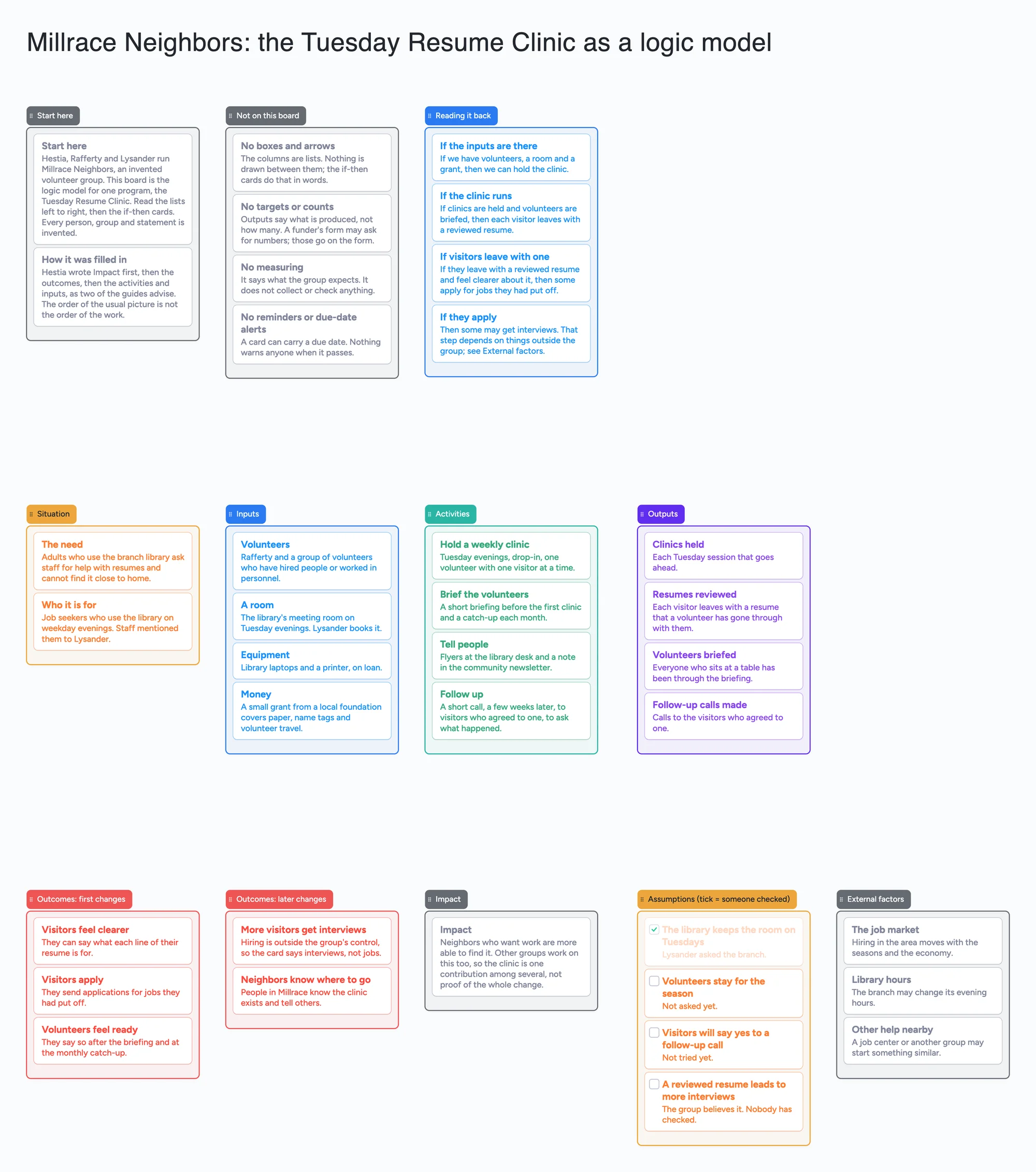
A logic model is a plain account of how a program is supposed to work: what you have, what you do, what that produces and what you hope changes. This logic model board lives on Instaboard and is filled in for a fictional volunteer group: Hestia, Rafferty and Lysander at Millrace Neighbors write down their Tuesday Resume Clinic. It has twelve lists and 37 cards: a start list, a list of what the board leaves out, if-then cards to read it back, then Situation, Inputs, Activities, Outputs, two Outcomes lists, Impact, Assumptions and External factors. It holds the group's statements and nothing else. It draws no boxes, counts nothing and measures nothing, and no card carries a number. None of the people or groups in the example exist.
Opens in your browser. Anyone can view; a free sign-in lets you edit.
Updated
In brief
- Use: a single shared place where a group writes a program as a chain: the need, what it has, what it does, what that produces, what should change and what it takes for granted. It costs 50 of the 150 items a free account allows.
- Not: a drawing, an evaluation or a funder's form. If a funder supplied a template, fill that in and treat the board as scratch space for deciding the wording.
- Likely fit (our view): a volunteer group or small team of two to eight that disagrees about what its program is for and wants the answer written once, in plain sentences, for everyone to see.
- Poor fit: a grant application with a fixed layout and word limit, or a program whose evaluation team already keeps all this in a document.
- Privacy: keep the people you serve out of it, by name or by detail. A board shared by link can be read by anyone who has the link.
When the funder's form, or a plain table, is enough
Oklahoma State's extension fact sheet on logic models for grants says "there is no standard or required format" and tells applicants to follow the funder's own guidance on whether a logic model is required and what layout to use. If your funder gave you a template, fill that in; this board is only a place to settle the statements first. If one person is writing the model alone, a table in a document does the same job and fits a funder's form more easily.
A shared board helps when several people disagree about what the program is for, because the disagreement shows up as a card that someone moves or rewrites, not as an argument in a chat. It does not settle the disagreement.
One tool, several names: logic model, program theory, theory of change
The pages we read use these names differently. Kellogg's guide says the term logic model is "frequently used interchangeably with the term program theory". Prosper Strategies, a consultancy, says organizations often blur a logic model with a theory of change, calls them two different tools, and says the theory of change should be developed first. The informalscience.org blog describes a theory of change as the reasoning behind the steps, and a logic model as a map of the program. The Community Tool Box page (University of Kansas) is titled "Developing a Logic Model or Theory of Change" and treats them together.
We do not pick a side. The board is a logic model in the narrow sense: a list of statements in columns. A group that wants the longer reasoning behind them can add its own list for that; the example does not, and the Assumptions list is the nearest thing it has.
Where the guides disagree about the columns and the order
- Impact as a column. Kellogg's picture has five: resources or inputs, activities, outputs, outcomes and impact. Prosper has the same five. The informalscience.org blog says impacts are "sometimes included". The Oklahoma State sheet lists inputs, activities, outputs and outcomes as the core and offers situation, reach, assumptions and external factors as extras, with no impact section.
- Years for the changes. Kellogg gives 1 to 3 years for short-term outcomes, 4 to 6 for longer-term ones and about 7 to 10 for impact. Prosper gives 1 to 3 and 4 to 6 for short- and long-term outcomes. The informalscience.org blog says long-term can be 7 to 10 years. The Oklahoma State sheet uses short, medium and long term and gives no years. The board puts no years on any card.
- The order of the work. Three of the five pages start from the results. Prosper says it is "best to develop it from right to left", the informalscience.org blog says "Evaluators and resources recommend to start with the outcomes and impacts", and Kellogg's exercises take results first and actions second. The Oklahoma State sheet gives no writing order. That is why the example's Start here card says Hestia wrote Impact first.
The twelve lists, one at a time
- Start here (2 cards). Hestia, Rafferty and Lysander, plus a card saying Impact was written first.
- Not on this board (4 cards). Four things it leaves out: boxes and arrows, targets or counts, measuring, and reminders or due-date alerts.
- Reading it back (4 cards). Four if-then sentences: if the inputs are there, then the clinic can run; if it runs, then each visitor leaves with a reviewed resume; and so on up to interviews.
- Situation (2 cards). Adults at the branch library ask staff for resume help and cannot find it close to home; the job seekers who come on weekday evenings.
- Inputs (4 cards). Volunteers, a room, library laptops and a printer on loan, and a small grant from a local foundation.
- Activities (4 cards). A weekly drop-in clinic, briefing the volunteers, telling people, and a follow-up call.
- Outputs (4 cards). Clinics held, resumes reviewed, volunteers briefed and follow-up calls made, each written as what is produced, without a count.
- Outcomes: first changes (3 cards). Visitors feel clearer, visitors apply for jobs they had put off, volunteers feel ready.
- Outcomes: later changes (2 cards). More visitors get interviews, with a note that hiring is outside the group's control, and neighbors know where to go.
- Impact (1 card). Neighbors who want work are more able to find it, stated as one contribution among several.
- Assumptions (tick = someone checked) (4 cards with tick boxes, one ticked). Only the room card is ticked, because Lysander asked the library; the other three are open.
- External factors (3 cards). The job market, library hours and other help nearby.
Reading it back with if-then cards
Kellogg's guide says to read a logic model by following the chain of "If...then..." statements that connect its parts. A board has no lines between lists, so the example writes the chain out in the Reading it back list. Four cards cover it: inputs to the clinic, the clinic to a reviewed resume, the reviewed resume to applications, and applications to interviews.
The last card says the step to interviews depends on things outside the group and points at External factors. That is the card to argue about. If a group cannot write an if-then card between two lists without a long pause, the lists are probably not yet stated plainly.
What a tick means on the Assumptions list
The Oklahoma State sheet describes assumptions as beliefs about how and why a program will work, and says to prioritize the key ones. In the example every assumption has its own tick-box card, and our convention is that a tick means someone checked it, not that it is true or done. Lysander asked the branch about the room, so that card is ticked. The one that matters most, that a reviewed resume leads to more interviews, says the group believes it and nobody has checked.
A tick box here is only a mark. Nothing reminds anyone to check the rest, and the board cannot tell whether a tick is honest.
Replace the clinic with your own program
- Begin with Start here: put your group and your program in place of Millrace and the clinic.
- Write Impact first, as one sentence, and say if it is a contribution among others.
- Fill the two Outcomes lists, then Outputs, then Activities, then Inputs, then Situation. Move cards between lists when you notice a result sitting among your activities.
- Write the if-then cards between neighboring lists and fix any you cannot say aloud.
- List your assumptions and outside factors, and tick the ones someone has checked.
- Share the link. Pick "Anyone who joins can edit" so colleagues can add cards; until then others can only view it, and each writer signs in for free. Prosper suggests using a logic model at least quarterly, which on a board means opening it and changing cards.
Five pages about logic models, read November 26, 2026
These are the five pages behind the wording on this board. We read each one in full and rank none of them; the first three columns report what the page says, and the last is our view.
| Page | Written for | What it asks you to fill in | What a shared board adds (our view) |
|---|---|---|---|
| Kellogg Foundation: Logic Model Development Guide (updated January 2004; hosted by NACCHO; foundation) | Grantees and program staff, with exercises and checklists | Resources or inputs, activities, outputs, outcomes, impact | A place for the group to keep its statements; the guide's checklists stay on paper |
| Prosper Strategies: Creating a Logic Model (Lindsay Mullen, October 22, 2025; consultancy) | Nonprofit leaders and boards | The same five, in eight steps, with stakeholder input | A shared list for each part, where the page's second step, "Garner Stakeholder Input", would add cards |
| Oklahoma State Extension: Understanding and Building Logic Models for Grants (published April 2025; university) | People writing grant proposals | Inputs, activities, outputs, outcomes, plus situation, reach, assumptions, external factors | Lists for the eight parts; the funder's own form still decides the layout |
| informalscience.org: A Start To Developing a Logic Model (October 4th, 2016; NSF-funded community site) | Informal STEM education teams | Intended results first, then activities and inputs | Somewhere to try the order in one place; the examples it links are other people's documents |
| Miro: Logic Model templates (27 templates, no date printed; vendor) | Teams who plan on a canvas | Inputs, activities, outputs and outcomes laid out visually | Lists in a fixed order; Miro is better when you want to draw the connections |
Swipe the table sideways to see every column.
Rows describe each page as we found it on November 26, 2026. Two of these five are published by a vendor (Miro) or a consultancy (Prosper), and no row is independent research. We have no relationship with any of them. We left the Community Tool Box page out of the table: its text is CC BY-NC-SA, so nothing from it is copied.
What 50 of the 150 leaves for a second program
Free accounts get 150 items in total. A card is one item, a list is one, and the title text box is one; arrows, sections and pen strokes are not counted, and moving a card from list to list is free.
- As filled in: 12 lists, 37 cards and the title come to 50, which leaves 100 of the 150.
- Adding a second program: drop the Start here and Not on this board lists (6 cards) and a program is 10 lists + 31 cards = 41, our arithmetic. Two programs total 91, three total 132 and a fourth would reach 173.
- Copying the example: 2 x 50 = 100 for two copies and 150 for three, which uses the whole allowance.
What else applies to this board:
- Each copy takes one of your five free boards.
- Viewers and writers differ. A link opens the board for reading; to add a card the visitor signs in for free, and the board then becomes 1 of their 5.
- Nothing is private by default. Do not put the people you serve on it; invite-only boards come with Pro.
Start from the ready board
It opens in your browser in a few seconds, with nothing to install. Sign in for free when you want to save it and share it.
Questions
What is a logic model?
A written account of how a program is meant to work: what it has, what it does, what that produces and what should change as a result. Kellogg's guide describes it as a systematic and visual way to present your understanding of those relationships. On the board each part is a list, and a list of if-then cards reads the chain back.
Is a logic model the same as a theory of change?
The pages disagree. Kellogg says logic model is frequently used interchangeably with program theory. Prosper Strategies calls a logic model and a theory of change two tools and says to develop the theory of change first, and informalscience.org calls a theory of change the reasoning behind the steps and a logic model the map. The board is a logic model in the narrow sense; add your own list if you want the longer reasoning written out.
Which order should we fill it in?
Three of the five pages we read start with the results. Prosper says to develop it from right to left and informalscience.org says you need not begin with inputs, while Kellogg's exercises describe results before actions. The example's Start here card says Impact was written first.
Does a logic model use up the free plan?
Not by itself: it takes 50 of the 150 items (our arithmetic), and a third copy would use up the rest. Pro lifts the 150-item cap and costs $5 a month on the yearly plan ($59.99 a year), or $7.99 month to month.
Does the board measure outcomes or draw the connections?
No. The parts are lists, the connections are if-then cards, and no card carries a number. The board records what your group believes; collecting evidence, setting targets and drawing a diagram happen elsewhere, and Miro's page is built for drawing.
Who can write on it?
Anyone you give the link to can look at it. A person who signs in for free can add cards, and everyone who joins can edit if the share option reads "Anyone who joins can edit". Each board someone opens from your link counts toward their 5 free boards.
Sources
- W.K. Kellogg Foundation: Logic Model Development Guide (updated January 2004; hosted by NACCHO; PDF read as text November 26, 2026)
- Prosper Strategies: Creating a Logic Model (Lindsay Mullen, October 22, 2025; we read all of it on November 26, 2026; consultancy)
- Oklahoma State University Extension: Understanding and Building Logic Models for Grants (published April 2025; we read all of it on November 26, 2026)
- informalscience.org: A Start To Developing a Logic Model (October 4th, 2016; we read all of it on November 26, 2026)
- Miro: Logic Model templates (27 templates, undated; looked at November 26, 2026; vendor content)
- Community Tool Box, University of Kansas: Developing a Logic Model or Theory of Change (CC BY-NC-SA 4.0; looked at November 26, 2026; paraphrased, no text copied)