For teams of a few people keeping one design pass together
A Double Diamond template: the brief, four steps and the way back, as lists on a shared board
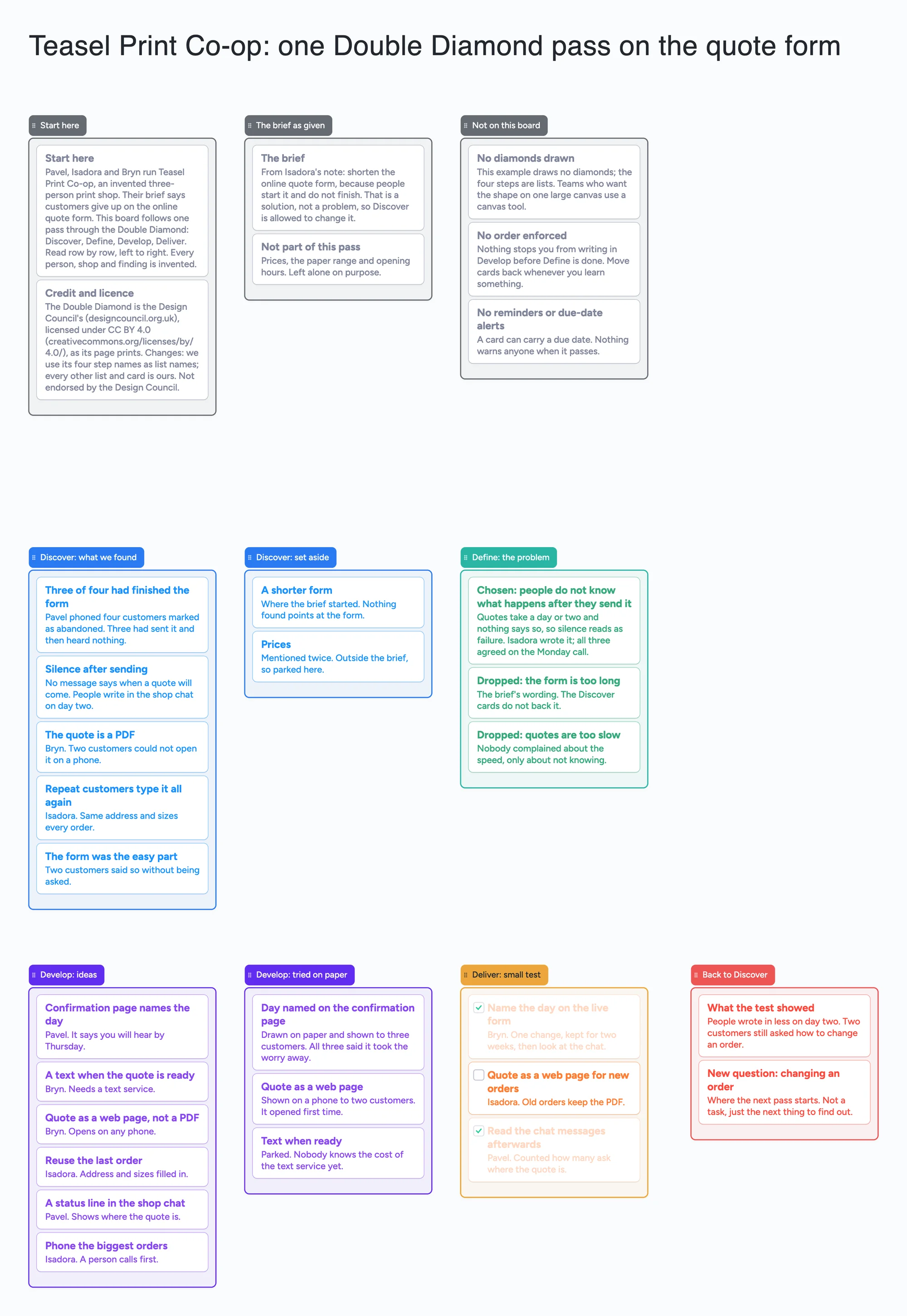
The Double Diamond is the Design Council's picture of a design process: explore a problem widely, settle on what the problem is, explore answers widely, settle on one. Here is a Double Diamond board, ready on Instaboard, filled in for a made-up print shop of three people. Pavel, Isadora and Bryn at Teasel Print Co-op run one pass on a brief that says customers give up on the online quote form. It has ten lists and 31 cards: the brief as given, Discover with what they found and what they set aside, Define with the problem they chose and two they dropped, Develop with six ideas and three tried on paper, Deliver with one small test, and a list that sends them back to Discover. It holds the findings, the choices and the next question. It draws no diamonds and runs no workshop. Nobody and nothing in the example is real.
Opens in your browser. Anyone can view; a free sign-in lets you edit.
Updated
In brief
- Use: one shared place where a team keeps a single pass through a design problem: the brief as given, what it found, the problem it chose, the ideas it tried and the test it will run, plus a list to return to Discover. The example takes 42 of your 150 free items.
- Not: a drawing of the two diamonds, a facilitator or a research tool. Interviews, sketching and testing happen elsewhere; the board keeps what they told you.
- Likely fit (our view): a team of two to six that wants findings, the chosen problem and the next test side by side, and wants everyone to see when the brief changed.
- Poor fit: a workshop where people draw the diamonds on a big canvas, or one designer who keeps notes in a single document.
- Leave off: customer names, contact details and anything confidential. The example shop is invented, and a link board is not private.
What it does not do
- No diamond drawn. The example draws none; the four steps are lists. The pages in the table near the end are built for drawing it on one large canvas.
- No order enforced. Nothing stops a card going into Develop before Define is done. Moving a card back is the point.
- No research and no facilitation. The board does not run the interviews or lead the session. Teasel's findings cards say what the phone calls said; the calls happen off the board.
- No nudges. A due date can sit on a card, but there are no reminders or due-date alerts.
- The method can be the wrong tool. Splunk's guide lists drawbacks: it can take a lot of time and resources, projects don't always start at the first step, and it can feel linear. For a one-afternoon fix, a list of three options may do.
- Pictures are capped. A free board holds 3 pictures; the example holds none, because its lists are all text.
Whose diagram this is, and the credit line
The Double Diamond page on the Design Council's site (no date printed; read in full November 26, 2026) says: "The Double Diamond by the Design Council is licensed under a CC BY 4.0 license," with a link to creativecommons.org/licenses/by/4.0/. Its Framework for Innovation page says the same of that work. We read both pages and the Council's Terms & Conditions page, which has a copyright and no-warranty notice and no trademark or logo clause.
CC BY 4.0, as the Creative Commons summary we read puts it, lets you share and adapt for any purpose as long as you credit the owner, link the licence and note any changes, and never imply the owner backs you. We read only that summary, not the legal code; none of this is legal advice.
What we did: only the four step names come from the Council, used as list names. Every other list and card, and the print shop, are ours. The first list holds a credit card with the licence link and a note of our changes. We left out the Council's downloadable picture and every logo. The Design Council has no tie to Instaboard and has not endorsed this page. If you publish a board made from ours, keep that credit card.
The four steps in one sentence each, and two places the pages disagree
- Discover. Understand, not assume, what the problem is, by talking to and spending time with the people affected (Council's wording, paraphrased).
- Define. Use what you learned to state the challenge in a different way if the insight calls for it (Council's wording, paraphrased).
- Develop. Give different answers to that defined problem, take inspiration from elsewhere and work with a range of people (Council's wording, paraphrased).
- Deliver. Test solutions at small scale, drop the ones that will not work and improve the ones that will (Council's wording, paraphrased).
The pages disagree on two things. The year: the Council's Framework for Innovation page says it launched in 2004, Mural's page says the Council published it in 2004, and Dotwork's guide (Jake Brereton, December 8, 2023, "Updated November 2026") says 2005. We use the Council's year because it is the owner's own date; its Double Diamond page also starts the story in 2003, when the Council was promoting design management and had no standard way to describe the process. The shape: Dotwork says in its FAQ ("Is the double diamond linear?") that the model is "best used as a guide to when to explore and when to narrow, not a strict sequence", and the Council's Framework page says it is not a linear process, since what organisations learn can send them back to the beginning. That is why the example has a Back to Discover list.
Teasel Print Co-op, list by list
- Start here (2 cards). Pavel, Isadora and Bryn, a reading guide, and the credit-and-licence card.
- The brief as given (2 cards). "Shorten the online quote form", noted as a solution rather than a problem, and what is out of this pass.
- Not on this board (3 cards). Three things it does not do: draw the diamonds, enforce the order, or send reminders or due-date alerts.
- Discover: what we found (5 cards). Three of four customers marked as abandoned had finished the form and then heard nothing; no message says when a quote will come; the quote is a PDF two people could not open on a phone; repeat customers retype everything; two said the form was the easy part.
- Discover: set aside (2 cards). A shorter form, where the brief started, and prices, which are outside the brief.
- Define: the problem (3 cards). The chosen problem, that people do not know what happens after they send the form, and the two dropped ones: the form is too long, and quotes are too slow.
- Develop: ideas (6 cards). Name the day on the confirmation page, a text when the quote is ready, a quote as a web page, reuse the last order, a status line in the shop chat, and a phone call on the biggest orders.
- Develop: tried on paper (3 cards). Two ideas shown to customers on paper or a phone, and one parked because nobody knows what the text service costs.
- Deliver: small test (3 cards, all with tick boxes, two ticked). Name the day on the live form (ticked, kept two weeks), a web-page quote for new orders (open), and counting the chat messages that ask where the quote is (ticked).
- Back to Discover (2 cards). What the test showed, and the new question about changing an order.
How a brief about a form became a problem about silence
The brief Teasel was given was a fix: shorten the form. Discover is the step that lets that go. Pavel's four phone calls and the other cards point away from the form, so the Define list keeps the chosen problem at the top and leaves the brief's wording below it, marked as dropped and with the reason. Someone opening the board in a month can see that the brief changed and why, which a list of ideas alone would not show.
In the example nobody voted. The three of them read the Discover cards on the Monday call and Isadora wrote the Define card. The board records the result. It does not collect evidence, weigh it or check that anyone followed up, so a team that wants interview recordings or a survey keeps them somewhere else and writes on the card where they are.
Going back, and what the Back to Discover list is for
After two weeks of the small test, the team put what it showed in Back to Discover: people wrote in less on day two, but two customers still asked how to change an order. That second card is a question, not a task, and it is where the next pass starts. Mural's page lists retrospectives among the uses of its template, which is the same idea in another shape: look again once something has shipped.
A copy of the board for the second pass starts from that list. Delete the cards that are finished, keep the credit card and the lists, and move what you learned into Discover.
Set up your own project
- Begin with the Start here list: replace the print shop with your team and project, and leave the credit card where it is.
- Paste the brief as it was given into The brief as given, even if it reads like a solution.
- Put what you find in Discover, one finding per card, and what you decide to leave alone in Discover: set aside.
- Write the problem you will work on in Define and move the brief's wording below it if you dropped it.
- Put ideas in Develop: ideas, then move the ones you tried into Develop: tried on paper with what happened.
- Pick one small test for Deliver and tick it when it is done. Write what it showed in Back to Discover.
- Invite people. Choose the share option "Anyone who joins can edit" if others should write; a new board starts view-only, and writing needs a free sign-in.
How far 42 items go: more passes, and copies
The free plan allows 150 items across your account. Cards, lists and the title text box count as one each; arrows, sections and pen strokes count for nothing, and dragging a card to another list costs nothing.
- The example: 10 lists, 31 cards and the title make 42 of your 150, leaving 108.
- A second pass on the same board: without the start lists (3 lists and 7 cards), a pass is 7 lists + 24 cards = 31, our arithmetic. Two passes make 73, three make 104, four make 135 and a fifth makes 166.
- Copies: two copies come to 2 x 42 = 84 and three to 126; a fourth would reach 168 and pass the limit.
Limits to know:
- Copying costs a board. You have 5 free boards, and every copy uses 1.
- Reading is open, writing is not. Anyone with your link can look; adding a card needs a free sign-in, and your board then counts as 1 of their 5.
- Leave people out. No customer details on a link board; making a board invite-only is a Pro feature.
Four pages about the Double Diamond, read November 26, 2026
Four vendor pages on the same model, each read to the end. We have not ranked them; the second column is the page's own claim and the last two columns are our opinion.
| Page | What the page says | Choose it when | Choose this board when |
|---|---|---|---|
| Mural: Double Diamond template (no date printed; vendor) | A canvas template; says the Council published the model in 2004; lists four uses: refine the brief, design process, design methods and retrospectives | You want to draw the diamonds and lay out sticky notes on one large canvas | You want the findings, the chosen problem and the next test as cards in lists beside the brief |
| Miro: Double Diamond template (Miroverse community template by Marina Crocci; no date printed; vendor) | A community template with an example about team time management, and a credit line saying the method was created by the British Design Council | Your team already works in Miro and likes a canvas | You want a plain list per step that stays in order |
| Splunk: The Double Diamond Design Process (Jennifer Stanton, June 14, 2024; vendor blog) | A designer's walk through the four steps, with benefits and drawbacks: resource-heavy, not always started at step one, can feel linear | You want one working designer's view of each step | You want somewhere to keep your own findings while you work |
| Dotwork: The Double Diamond Framework (Jake Brereton, December 8, 2023, "Updated November 2026"; vendor blog) | Four phases, benefits, uses in business, design and education, and a note that it is not a strict sequence | You want a general overview with uses by field | You want to keep a real project's pass in one shared place |
Swipe the table sideways to see every column.
Each row is from the page as read on November 26, 2026. All four publishers sell something, and none is an independent study. The Council's own pages are covered under the credit heading. Instaboard has no affiliation with these companies.
Start from the ready board
It opens in your browser in a few seconds, with nothing to install. Sign in for free when you want to save it and share it.
Questions
What is the Double Diamond?
A picture of the design process from the UK Design Council: two diamonds, each opening to explore and then narrowing to a decision, with four steps called Discover, Define, Develop and Deliver. On the board each step is a list, with a list for going back to Discover.
Can I reuse the Design Council's diagram?
The Council's page says the Double Diamond is licensed under CC BY 4.0. Creative Commons' summary says that means credit, a link to the licence and a note of changes, and no suggestion that the Council endorses you. We read that summary and not the full legal text, so check it for your own use. Instaboard isn't affiliated with the Council.
Is it a straight line from Discover to Deliver?
No. The Council's Framework for Innovation page says it is not linear and that what a team learns can send it back to the beginning, and Dotwork calls it a guide, not a strict sequence. The example's Back to Discover list is there for that.
Will one pass fill the free plan?
No. The example uses 42 of 150 free items (our arithmetic), so three copies reach 126 and a fourth would pass the limit. Pro removes the 150-item limit: $5 a month billed yearly, $59.99 a year, or $7.99 monthly.
Does the board draw the diamonds or run the workshop?
No. The four steps are lists, nothing enforces the order and nothing leads the session. For a drawn diagram on a large canvas, Mural and Miro's pages are built for that.
Can my team write on it?
Yes, once they join. Anyone with your link can view; to add a card a person signs in for free, and writing is open to everyone if you choose "Anyone who joins can edit". Opening your link uses 1 of that person's 5 free boards.
Sources
- Design Council: The Double Diamond (no date printed; read in full November 26, 2026; CC BY 4.0)
- Design Council: Framework for Innovation (no date printed; read in full November 26, 2026; CC BY 4.0)
- Design Council: Terms & Conditions (read in full November 26, 2026)
- Creative Commons: Attribution 4.0 International deed (read November 26, 2026; summary, not the legal code)
- Mural: Double Diamond template (no date printed; read November 26, 2026; vendor content)
- Miro: Double Diamond template (Marina Crocci, Miroverse; no date printed; read November 26, 2026; vendor content)
- Splunk: The Double Diamond Design Process (Jennifer Stanton, June 14, 2024; read November 26, 2026; vendor blog)
- Dotwork: The Double Diamond Framework (Jake Brereton, December 8, 2023, "Updated November 2026"; read November 26, 2026; vendor blog)