For a small product team with the vision in one head and the strategy in three documents
A product vision board template: five sections, the biggest risk to test and what changed since version 1, on one shared board
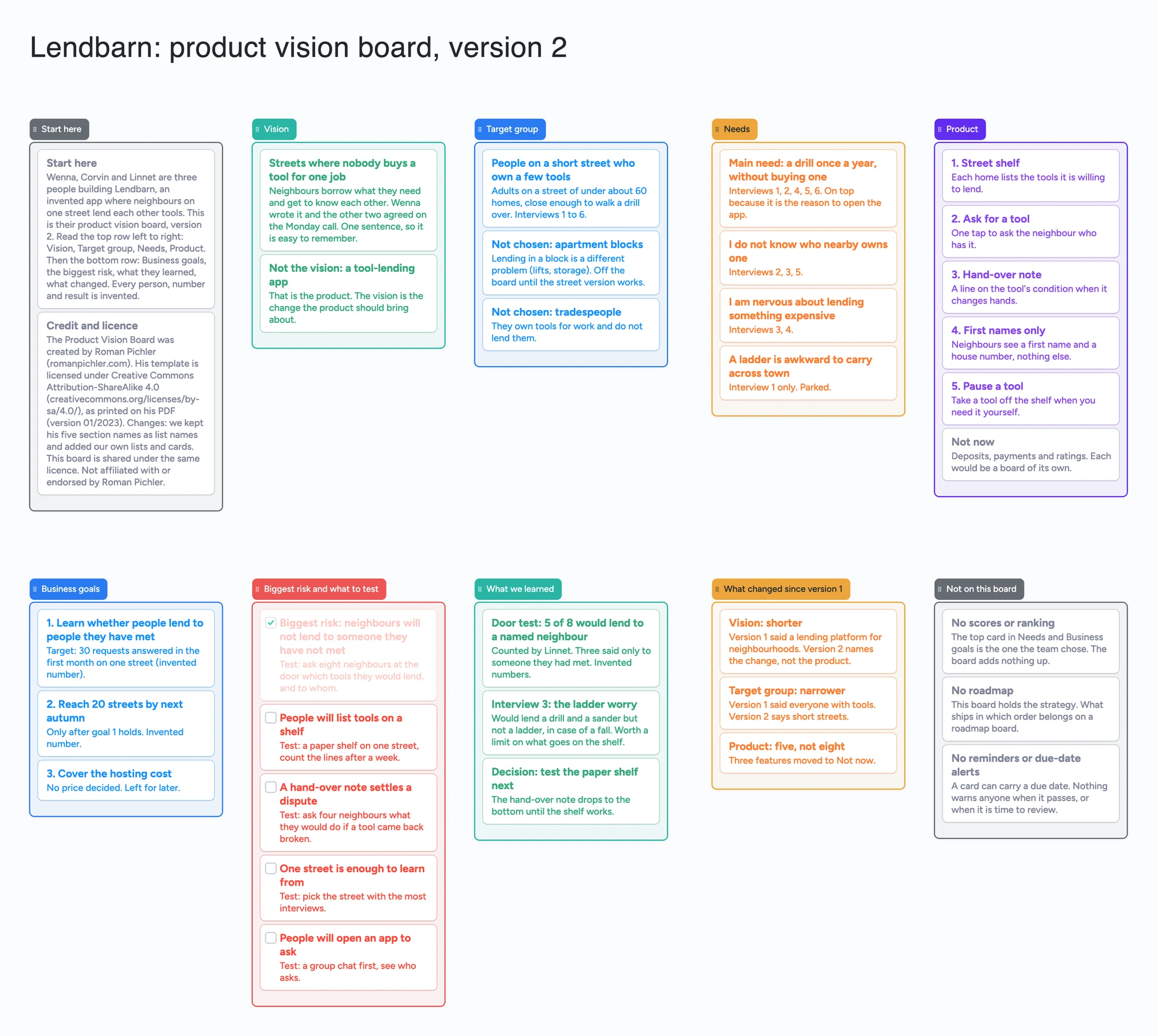
A product vision board only works if everyone on the team reads the same one. This is a product vision board already laid out on Instaboard, our online board, filled in for an invented three-person team: Wenna, Corvin and Linnet are building Lendbarn, an app where neighbours on one street lend each other tools, and this is their version 2. The board has ten lists and 34 cards: two cards that explain it, Roman Pichler's five sections as lists (vision, target group, needs, product and business goals), the biggest risk with the assumptions to test, what they learned, what changed since version 1, and three cards on what the board does not do. A board holds the strategy in one place. It does not test anything, score a need or plan a release. Every person, number and result is invented.
Opens in your browser. Anyone can view; a free sign-in lets you edit.
Updated
The short answer
- What it is: a shared page where a small team writes a product's vision, target group, needs, features and business goals as five lists, picks the one risk to test first and records what the tests said. The example uses 45 of your 150 free items.
- What it is not: a test or a plan. Nothing is scored, ranked or scheduled, there are no reminders or due-date alerts, and a roadmap is a different board. The interviews and experiments happen somewhere else.
- Where other tools win: Roman Pichler's own template and checklist come as a PDF with his workshop and book behind them; Miro's product vision canvas runs a live workshop through nine prompts; Smartsheet offers Excel, Word and PowerPoint files; Confluence has its own template. All four are in a table below.
- Where this board may help: our view: a team that wants version 2 beside the list of what changed and the risk it tested, on one page everyone can open.
- Keep off it: customer names, unreleased pricing and anything confidential. The example uses invented neighbours and numbers. A link board is not private.
What this board can't do, and who does it better
- No testing. The board holds assumptions and what the tests said, as cards. The interviews, the door knocking and the prototypes happen away from it.
- No scores and no ranking. The top card in Needs and in Business goals is the one the team chose. The board adds nothing up.
- No roadmap. This board holds the strategy. What ships in which order belongs on a different board; Pichler's own tool list names a separate GO Product Roadmap for that.
- No reminders or due-date alerts. A card can carry a due date, but nothing warns anyone when it passes, or when it is time to look at the board again.
- Keeping version 1 is up to you. Copy the board or type what changed, as the example does in its own list. A copy of the board takes 1 of your 5 free boards.
- Words, not drawings. The board takes 3 pictures on the free plan and the example has none, so a diagram from a workshop becomes a card of text.
Whose board this is, and the licence line
Roman Pichler's tool page says he first created the Product Vision Board in 2011, and his blog post of the same name (published 10th May 2011, last updated 13 Oct 2025, as shown in a browser) calls it "the simplest thing that could possibly work to capture the vision and strategy of a product". It has five sections: vision, target group, needs, product and business goals.
A public PDF on his site, the template with a checklist (version 01/2023, with © 2024 Roman Pichler on its checklist pages), prints: "This template is licensed under a Creative Commons Attribution-ShareAlike 4.0 Unported license." In a reply dated November 3, 2020 under his blog post he wrote: "Please make sure, though, to show the license agreement on any new product vision board variant you create".
What we did: the example uses his five section names as list names, and everything else is ours, from the lists beside them to every card and the invented app. Its first list carries a credit card with the licence line, which is what his reply asks for, a link to creativecommons.org/licenses/by-sa/4.0/ and a line saying what we changed. We read the licence line on his PDF, not the full licence text, and this is not legal advice. If you publish a board built from ours, keep the line. The example board is shared under the same licence, Creative Commons Attribution-ShareAlike 4.0, which means anyone may copy and adapt it if they credit Pichler, link the licence, say what they changed and keep the same licence. Pichler is not affiliated with Instaboard and does not endorse this page.
Lendbarn, list by list
- Start here (2 cards). Who Wenna, Corvin and Linnet are and how to read the board, and a credit card with the licence line.
- Vision (2 cards). One sentence about the change, "Streets where nobody buys a tool for one job", and a card saying what is not the vision: a tool-lending app is the product.
- Target group (3 cards). People on a short street who own a few tools, and two groups left out on purpose: apartment blocks and tradespeople.
- Needs (4 cards). The main need on top (a drill once a year, without buying one), two smaller ones, and one parked need, carrying a ladder across town (interview 1 only).
- Product (6 cards). Five features (a street shelf, ask for a tool, a hand-over note, first names only, pause a tool) and a Not now card for what was cut.
- Business goals (3 cards). Learn whether people lend to people they have met, reach 20 streets, cover the hosting cost, with invented targets on the first two.
- Biggest risk and what to test (5 cards). The risk on top, neighbours will not lend to someone they have not met, ticked because the door test has run, and four assumptions still open.
- What we learned (3 cards). The door test result, a worry from interview 3 and the decision to test a paper shelf next.
- What changed since version 1 (3 cards). The vision got shorter, the target group narrower, the product five features instead of eight.
- Not on this board (3 cards). No scores or ranking, no roadmap, no reminders or due-date alerts.
Fill it in this order
Pichler's "10 Tips for Creating a Product Strategy with the Product Vision Board" (published 16th July 2014; no update line on the page) says to capture the vision first and then fill in the lower sections from left to right, starting with the target group. It advises a narrow, clear-cut group, because "a large or heterogeneous target group is usually difficult to test". For needs it says to put the main problem or benefit at the top, and for the product to keep to the three to five features that matter, not a backlog.
His checklist describes a good vision as inspiring, shared, ethical, concise, ambitious and enduring, with guidance "for the next five to ten years". Lendbarn's vision card is one sentence about the change, and the card under it says why a tool-lending app is not the vision. Our telling of the example: Wenna wrote the vision, Corvin and Linnet agreed to it on the Monday call, and the board kept that version.
Business goals come last. The PDF says to prioritise them and move the most important one to the top, which is what the board's first card does. Nothing on the board checks that the order was followed; the team does.
After the first version: pick one risk to test, and let the board change
Pichler's blog post says to identify the greatest risk on the board and test it first, and the 10 tips post says that if the board "does not change at all" you should "stop and reflect". His checklist adds that the board is reviewed and adjusted at least once every three months as a rule of thumb. A board can't remind you of that, so the example keeps a What changed since version 1 list that the team fills in when it edits a section.
In the example the biggest risk is that neighbours will not lend to someone they have not met. Linnet knocked on eight doors, five said they would lend to a named neighbour and three only to someone they had met (invented numbers). The result sits in What we learned, the risk card is ticked, and the team decided to test a paper shelf next. The other four assumptions stay as open tick boxes. Interview 3's ladder worry is a result too, but it changed no section, so it sits in What we learned and not in What changed.
The method's author and three other pages, read November 26, 2026
One of these four is by the method's author and three are not. A cell says what the page we read says, not what the tool can do. No ranking: they do different jobs.
| Source | What its page says | Where it wins | What the shared board adds |
|---|---|---|---|
| Roman Pichler: The Product Vision Board (tool page; no page date; the download sits behind an email form) | Says he first created the board in 2011; it captures target group, needs, key features and business goals and comes with a checklist; an extended board adds competitors, revenue sources, cost factors and channels | The original template and checklist, with his workshop and book | Keeping version 2 and what changed where the whole team can open it |
| Atlassian: Product vision board template for Confluence (no date printed) | Three steps: start with a vision; identify target audience, problem space, solution and business goals; align on next steps. Filed under whiteboard templates | Teams that already work in Confluence | A board for a team that is not on Confluence |
| Miro: Product Vision Canvas by Merissa Silk (no date printed; vendor) | A workshop in nine prompts, from problem statement to product vision statement, inspired by the business model canvas, the lean UX canvas and the product canvas, it says | A live workshop on a big canvas with groups and stickies | The result of the workshop, kept as cards after it |
| Smartsheet: Free Product Vision Boards, Templates, and Documents, by Joe Weller (September 7, 2021; vendor) | Downloads in Excel, Word, PowerPoint, PDF and Google formats, including a board, an example, an agile board and a vision statement worksheet | Files to print, present or send as a document | A page the team edits together, with no file to send |
Swipe the table sideways to see every column.
From each page as read November 26, 2026. Pichler is the method's author; Miro and Smartsheet are vendors; Atlassian's page is a vendor template. Instaboard isn't affiliated with any of them.
How many versions and test rounds fit, and what the free plan limits
Each card and each list is 1 of your 150 free items, across all your boards, and the title text box counts too. Arrows, sections and pen strokes don't. Moving a card from one list to another doesn't add an item.
- As built: 10 lists + 34 cards + the title = 45, which leaves 105.
- Test rounds on one board: if each round adds an assumption card and a result card (our estimate) and nothing is deleted, 52 rounds make 45 + 104 = 149, and the 53rd passes 150.
- Versions as copies: three copies of the example as built are 3 x 45 = 135, and a fourth makes 180. A copy takes 1 of your 5 free boards.
Limits of the free plan for this board:
- Boards. 5 on the free plan. "Make a copy" takes 1 of them.
- Pictures. 3 per board. The example has none.
- Writing needs a free sign-in. Anyone who joins can view the board; to change it they sign in, and the board then counts as 1 of their 5.
- No reminders or due-date alerts, no sums, no scores.
- Private details. A link board is not the place for unreleased pricing, customer names or anything confidential; invite-only boards are a Pro feature.
Start yours
- Open the board and rewrite Start here with your product and your team, and keep the credit card with the licence line.
- Delete Lendbarn's cards and keep the lists. Rename any list that does not fit.
- Write the vision first, one or two sentences about the change you want, not the product.
- Fill in target group, needs, product and business goals from left to right, with the most important card on top and no more than five features.
- Pick the biggest risk, give it a card and make each assumption its own tick box.
- Write what each test said as a card, and edit the section above when the answer changes it; one card in What changed for each real change.
- Share it. Set the share setting so anyone who joins can edit ("Anyone who joins can edit"); new boards start view-only, and each person signs in to write.
Start from the ready board
It opens in your browser in a few seconds, with nothing to install. Sign in for free when you want to save it and share it.
Questions
What is a product vision board?
A one-page description of a product's vision and strategy. Roman Pichler's version has five sections: vision, target group, needs, product and business goals. Ours puts each section in its own list, with the biggest risk, what was learned and what changed beside them.
Whose template is it, and can I copy this board?
The Product Vision Board is Roman Pichler's. His PDF says the template is licensed under Creative Commons Attribution-ShareAlike 4.0, and he has asked that any variant show the licence. This board uses his five section names, carries the credit and licence line on its first list, and is not affiliated with or endorsed by him. We read the licence line, not the full licence, and this is not legal advice.
Does the board score or rank the needs?
No. It adds nothing up and ranks nothing. The card on top of Needs and of Business goals is the one the team chose to put there, and the board has no way to check the choice.
How many versions or test rounds can one board hold?
Our arithmetic: as built the example is 45 of your 150 free items. If each test round adds two cards, 52 rounds fit, and three copies of the example make 135. Pro removes the item limit, at $5 a month billed yearly ($59.99 a year) or $7.99 monthly.
Should I put customer names or pricing on it?
Our view: no. The example uses invented neighbours and numbers. A link board is not private: whoever you send the link to can read it. Invite-only boards are a Pro feature.
Who can add to the board?
Anyone you share the link with can read the board. To add a card they sign in for free, and if the share setting is "Anyone who joins can edit" they can edit. A board opened from your link takes 1 of their 5 free boards, and a copy takes 1 of yours.
Sources
- Roman Pichler: The Product Vision Board (blog post; published 10th May 2011, last updated 13 Oct 2025; read in full November 26, 2026)
- Roman Pichler: 10 Tips for Creating a Product Strategy with the Product Vision Board (published 16th July 2014, no update line; read in full November 26, 2026)
- Roman Pichler: Product Vision Board with Checklist (PDF, version 01/2023; checklist pages © 2024; read in full November 26, 2026)
- Roman Pichler: The Product Vision Board (tool page; no page date; read November 26, 2026)
- Atlassian: Product vision board template for Confluence (no date printed; read in full November 26, 2026; vendor content)
- Miro: Product Vision Canvas (no date printed; read in full November 26, 2026; vendor content)
- Smartsheet: Free Product Vision Boards, Templates, and Documents (September 7, 2021; read in full November 26, 2026; vendor content)